
John 2:2
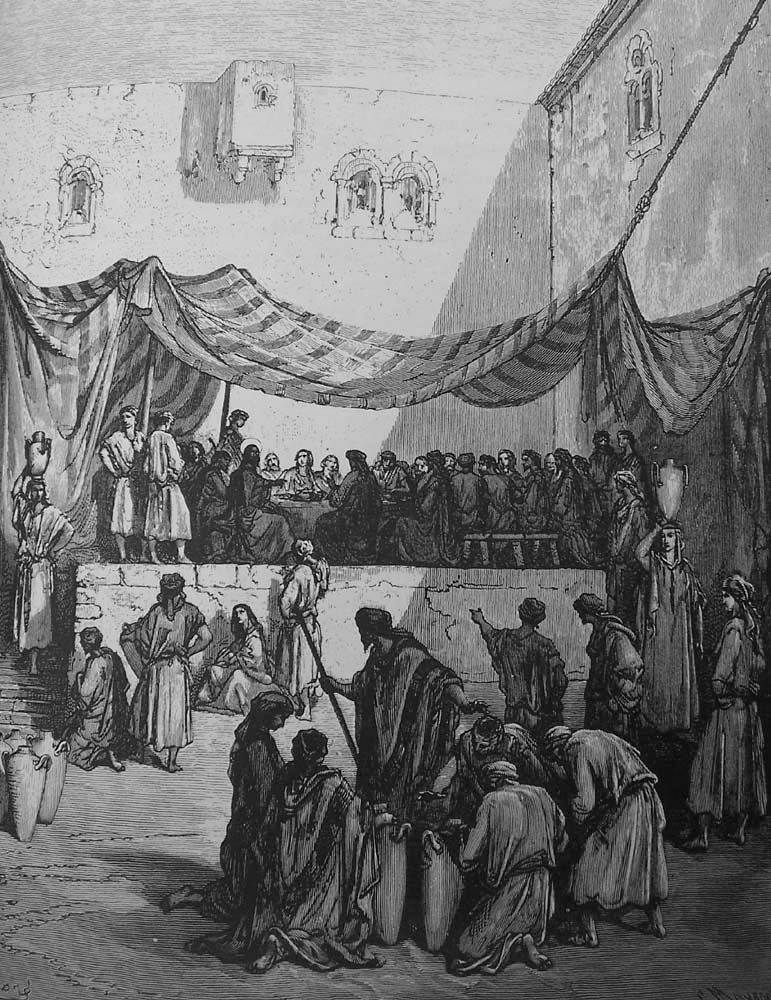
in John 2and Jesus and His disciples had also been invited to the wedding.
BSB
The same verse in ASV and KJV ▾
ASV
and Jesus also was bidden, and his disciples, to the marriage.
KJV
And both Jesus was called, and his disciples, to the marriage.
⋯
This verse in John 2
Commentary
21 notes on this verseFor it was fitting that He, Who was renewing the very nature of man, and refashioning it all for the better, should not only impart His blessing to those already called into being, but also prepare before grace for those soon to be born, and make holy their entrance into being. Receive also yet a third reason. It had been said to the woman by God, In sorrow thou shalt bring forth children. How then was it not needful that we should thrust off this curse too, or how else could we escape a condemned marriage?
This site's exposition
a wedding took place at Cana
on John 2:1-2
Jesus, His disciples and His mother are at a village wedding. A Galilean wedding feast ran several days, with the wine standing as the host's honor before the whole village. The signs of this Gospel begin here.
This site's exposition
had also been invited to the wedding
John Gill thinks Jesus was asked as a relation, with His disciples bidden on His account; Nathanael came from Cana itself. John Wesley says Christ sanctifies human society. Cyril of Alexandria sees Him blessing marriage and the births to come.
The record, by era
The Church Fathers5 voices
The Son of God went to the wedding so that marriage, which had been instituted by his own authority, might be sanctified by his blessed presence. He went to a wedding of the old order when he was about to take a new bride for …
The Lord, in that He came to the marriage to which He was invited, wished, apart from the mystical signification, to assure us that marriage was His own institution. For there were to be those of whom the apostle spoke, "forbidding to marry," and asserting that marriage was an evil, and of the devil's institution: notwithstanding the same Lord declares in the Gospel, on being asked whether it be lawful for a man to put away his wife for any cause, that it is not lawful save for the cause of fornication. In His answer, if you remember, He said, "What God hath joined together let not man put asunder." And they that are well instructed in the catholic faith know that God instituted marriage; and as the union of man and wife is from God, so divorce is from the devil. But in the case of fornication it is lawful for a man to put away his wife, because she first chose to be no longer wife in not preserving conjugal fidelity to her husband. Nor are those women who vow virginity to God, although they hold a higher place of honor and sanctity in the Church, without marriage. For they too, together with the whole Church, attain to a marriage, a marriage in which Christ is the Bridegroom. And for this cause, therefore, did the Lord, on being invited, come to the marriage, to confirm conjugal chastity, and to show forth the sacrament of marriage. For the bridegroom in that marriage, to whom it was said, "Thou hast kept the good wine until now," represented the person of the Lord. For the good wine-namely, the gospel-Christ has kept until now.
The third day was now come from Jesus' baptism, and there was a marriage taking place in Cana of Galilee. Jesus' mother was there when, on the failure of the wine, he made wine out of water.… Jesus being Maker of man and woman does not refuse to be called to a marriage; it was he who after forming Eve brought her to Adam. Therefore in the Gospel he says about this union, "What God has joined together let no man put asunder." Let the heretics therefore be put to shame who reject marriage, since Jesus was called to a marriage and his mother was there.
I said before that He was best known in Galilee; therefore they invite Him to the marriage, and He comes; for He looked not to His own honor, but to our benefit. He who disdained not to "take upon Him the form of a servant" (Phil. ii. 7), would much less disdain to be present at the marriage of servants; He who sat down "with publicans and sinners" (Matt. ix. 13), would much less refuse to sit down with those present at the marriage. Assuredly they who invited Him had not formed a proper judgment of Him, nor did they invite Him as some great one, but merely as an ordinary acquaintance; and this the Evangelist has hinted at, when he says, "The mother of Jesus was there, and His brethren." Just as they invited her and His brethren, they invited Jesus.
In the ancient times there was prophecy, and no times were left without the dispensation of prophecy. But the prophecy, since Christ was not understood therein, was water. For in water wine is in some manner latent. The apostle tells us what we are to understand by this water: "Even unto this day," saith he, "whilst Moses is read, that same veil is upon their heart; that it is not unveiled because it is done away in Christ. And when thou shalt have passed over," saith he, "to the Lord, the veil shall be taken away." By the veil he means the covering over of prophecy, so that it was not understood. When thou hast passed over to the Lord, the veil is taken away; so likewise is tastelessness taken away when thou hast passed over to the Lord; and what was water now becomes wine to thee. Read all the prophetic books; and if Christ be not understood therein, what canst thou find so insipid and silly? Understand Christ in them, and what thou readest not only has a taste, but even inebriates thee; transporting the mind from the body, so that forgetting the things that are past, thou reachest forth to the things that are before. Wherefore, prophecy from ancient times, even from the time when the series of human births began to run onwards, was not silent concerning Christ; but the import of the prophecy was concealed therein, for as yet it was water. When these words of the Gospel are understood, and they are certainly clear, all the mysteries which are latent in this miracle of the Lord will be laid open. Observe what He says, that it behoved the things to be fulfilled in Christ that were written of Him. Where were they written? "In the law," saith He, "and in the prophets, and in the Psalms." He omitted no part of the Old Scriptures. These were water; and hence the disciples were called irrational by the Lord, because as yet they tasted to them as water, not as wine. […]
13 more voices on this verse
The Medieval Church6 voices
And this is what comes next: Jesus was invited. Christ decided to attend this wedding, first of all, to give us an example of humility. For he did not look to his own dignity, but "just as he condescended to accept the form of a …
They invite the Lord to the wedding not because they had seen His miracles, not as a great man, but simply as an acquaintance. Indicating this, the evangelist says: "the Mother of Jesus was there" and His brothers. Just as she and the brothers were …
(Hom. 2d Sund. after Epiph.) His condescension in coming to the marriage, and the miracle He wrought there, are, even considering them in the letter only, a strong confirmation of the faith. Therein too are condemned the errors of Tatian, Marcion, and others who detract from the honour of marriage. For if the undefiled bed, and the marriage celebrated with due chastity, partook at all of sin, our Lord would never have come to one. Whereas now, conjugal chastity being good, the continence of widows better, the perfection of the virgin state best, to sanction all these degrees, but distinguish the merit of each, He deigned to be born of the pure womb of the Virgin; was blessed after birth by the prophetic voice of the widow Anna; and now invited in manhood to attend the celebration of a marriage, honours that also by the presence of His goodness. (in loc.) Nor is it without some mysterious allusion, that the marriage is related as taking-place on the third day. The first age of the world, before the giving of the Law, was enlightened by the example of the Patriarchs; the second, under the Law, by the writings of the Prophets; the third, under grace, by the preaching of the Evangelists, as if by the light of the third day; for our Lord had now appeared in the flesh. The name of the place too where the marriage was held, Cana of Galilee, which means, desire of migrating, has a typical signification, viz. that those are most worthy of Christ, who burn with devotional desires, and have known the passage from vice to virtue, from earthly to eternal things.
And Jesus also was invited, and his disciples, to the marriage. Chrysostom: "He was invited to the marriage, not as someone great, but as a kinsman, and he, being humble, did not refuse the invitation, but went," according to what he teaches in Luke 14: …
A commentator
BonaventureDisputed Questions on Evangelical Perfection, Question 3 · Written in the 13th century.
proposed
That conjugal chastity is to be approved according to the evangelical law is shown by authority, as follows. John 2: Jesus and his disciples were called to the wedding: and consequently he shows that he performed his first miracle there; but if the nuptial act …
Before the incarnation, both penitential compunction and matrimonial generation were necessary: therefore Christ did not institute these two Sacraments anew, but brought to completion and confirmed in the evangelical law what had already been instituted by him and in a certain way impressed upon the …
The Puritans and the Awakening3 voices
And both Jesus was called,.... Or invited, as being a relation, according to the flesh: and his disciples, to the marriage; who were bidden, on his account; and they seem to be these, Andrew, and the other disciple, that followed Jesus, and Simon Peter, and Philip, and Nathanael, who was of this place; and accordingly they all went to it.
Jesus and his disciples were invited to the marriage - Christ does not take away human society, but sanctifies it. Water might have quenched thirst; yet our Lord allows wine; especially at a festival solemnity. Such was his facility in drawing his disciples at first, who were afterward to go through rougher ways.
But the corruption was too plain to be justified; sinners' own consciences are reformers' best friends; yet that was not all, there was a divine power put forth herein, a power over the spirits of men; and in this non-resistance of theirs that scripture was fulfilled ( Mal. iii.
quarantine:debris (2026-07-29) — unbalanced-parens
The Nineteenth Century4 voices
And both Jesus was called, and his disciples - There are several remarkable circumstances here. 1. This was probably the first Christian wedding that was ever in the world. 2. The great Author of the Christian religion, with his disciples, (probably then only four or five in number, see Joh 1:37, etc.), were invited to it. 3. The first miracle Jesus Christ wrought was at it, and in honor of it. 4. The mother of Christ, the most pure of all virgins, the most holy of all wives, and the first Christian mother, was also at it.
A commentator
J.C. Ryle1816–1900
Expository Thoughts on the Gospels: John (lightly modernized text, Grace Gems edition) (1869)
proposed
These verses describe a miracle which should always possess a special interest in the eyes of a true Christian. It is the first, in order of time, of the many mighty works which Jesus did, when He was upon earth. We are distinctly told, "This beginning of miracles did Jesus in Cana of Galilee." Like every other miracle which John was inspired to record, it is related with great minuteness and particularity. And, like every other miracle in John's Gospel, it is rich in spiritual lessons. We learn, firstly, from these verses, how honorable in the sight of Christ is the estate of matrimony . To be present at a "marriage" was almost the first public act of our Lord's earthly ministry. Marriage is not a sacrament, as the Church of Rome asserts. It is simply a state of life ordained by God for man's benefit. But it is a state which ought never to be spoken of with levity, or regarded with disrespect. The Prayerbook service has well described it, as "an honorable estate, instituted of God in the time of man's innocency, and signifying unto us the mystical union that is between Christ and his Church." Society is never in a healthy condition, and true religion never flourishes in that land where the marriage tie is lightly esteemed. They who lightly esteem it have not the mind of Christ. He who "beautified and adorned the estate of matrimony by His presence and first miracle that He wrought in Cana of Galilee," is One who is always of one mind. "Marriage," says the Holy Spirit by Paul, "is honorable in all." (Heb. 13:4.) One thing, however, ought not to be forgotten. Marriage is a step which so seriously affects the temporal happiness and spiritual welfare of two immortal souls, that it ought never to be taken in hand "unadvisedly, lightly, wantonly, and without due consideration."
A commentator
J.C. Ryle1816–1900
Expository Thoughts on the Gospels: John (lightly modernized text, Grace Gems edition) (1869)
proposed
These verses describe a miracle which should always possess a special interest in the eyes of a true Christian. It is the first, in order of time, of the many mighty works which Jesus did, when He was upon earth. We are distinctly told, "This beginning of miracles did Jesus in Cana of Galilee." Like every other miracle which John was inspired to record, it is related with great minuteness and particularity. And, like every other miracle in John's Gospel, it is rich in spiritual lessons.
A commentator
Albert Barnes1798–1870
Notes, Explanatory and Practical, on the Old and New Testaments (1832-1869)
proposed
His disciples - Those that he had made when in Judea. These were Peter, Andrew, Philip, and Nathanael. They were not yet called to be apostles, but they believed that he was the Messiah. The miracle performed here was doubtless to convince them more fully that he was the Christ.
The words behind it
12 Greek wordsEvery Greek word of this verse in the order it stands, with what it means and the door to its own study. The last column counts the times a word stands in the whole Bible: the rarer the word, the more the places it appears belong together.
| Greek | Sound | Meaning | Word study | In the Bible |
|---|---|---|---|---|
| ἐκλήθη | eklethe | Was invited | G2564 → | |
| δὲ | de | then | G1161 → | 2765 times |
| καὶ | kai | also | G2532 → | 9120 times |
| ὁ | ho | <the> | G3588 → | 19766 times |
| Ἰησοῦς | iesous | Jesus | G2424 → | 908 times |
| καὶ | kai | and | G2532 → | 9120 times |
| οἱ | hoi | the | G3588 → | 19766 times |
| μαθηταὶ | mathetai | disciples | G3101 → | 260 times |
| αὐτοῦ | autou | of Him | G846 → | 5565 times |
| εἰς | eis | to | G1519 → | 1755 times |
| τὸν | ton | the | G3588 → | 19766 times |
| γάμον. | gamon | wedding. | G1062 → |
ἐκλήθηWas invited
ekletheG2564 →
δὲthen
deG1161 →2765 times
καὶalso
kaiG2532 →9120 times
ὁ<the>
hoG3588 →19766 times
ἸησοῦςJesus
iesousG2424 →908 times
καὶand
kaiG2532 →9120 times
οἱthe
hoiG3588 →19766 times
μαθηταὶdisciples
mathetaiG3101 →260 times
αὐτοῦof Him
autouG846 →5565 times
εἰςto
eisG1519 →1755 times
τὸνthe
tonG3588 →19766 times
γάμον.wedding.
gamonG1062 →
A shaded row is a word that stands 400 times or fewer in the Bible.
The walk
8 stopsEach card is a verse this one points to, and under it the verses that one points to in turn. Where several paths arrive at the same place, that place is listed first: the text keeps returning to it.
Through
1 Corinthians 10:31So whether you eat or drink or whatever you do, do it all to the glory of God.
it leads to
- Colossians 3:23
Whatever you do, work at it with your whole being, for the Lord and not for men,
Reached by 2 separate paths from here.
- Colossians 3:17
And whatever you do, in word or deed, do it all in the name of the Lord Jesus, giving thanks to God the Father through Him.
- 1 Peter 4:11
If anyone speaks, he should speak as one conveying the words of God. If anyone serves, he should serve with the strength God provides, so that in all things God may be glorified through…
- Colossians 3:23
Through
Colossians 3:17And whatever you do, in word or deed, do it all in the name of the Lord Jesus, giving thanks to God the Father through Him.
it leads to
- 1 Corinthians 10:31
So whether you eat or drink or whatever you do, do it all to the glory of God.
- Proverbs 3:6
in all your ways acknowledge Him, and He will make your paths straight.
- Ephesians 5:20
always giving thanks to God the Father for everything in the name of our Lord Jesus Christ.
- 1 Thessalonians 5:18
Give thanks in every circumstance, for this is God’s will for you in Christ Jesus.
- 1 Corinthians 10:31
Through
Hebrews 13:4Marriage should be honored by all and the marriage bed kept undefiled, for God will judge the sexually immoral and adulterers.
it leads to
- Genesis 2:24
For this reason a man will leave his father and mother and be united to his wife, and they will become one flesh.
- Genesis 2:24
Where this verse is studied
On this page
Studies17
On this verse
On this chapter
About John
This page draws on 18 works. Open the list of works
This page draws on Adam Clarke, Commentary on the Bible; Albert Barnes, Notes, Explanatory and Practical, on the Old and New Testaments (1832-1869); Augustine of Hippo, Tractates on John 9; Bede, Catena Aurea by Aquinas; Bonaventure, Commentary on John, Chapter 2; Bonaventure, Disputed Questions on Evangelical Perfection, Question 3; Bonaventure, Breviloquium, Part 6; Cyril of Alexandria, Commentary on the Gospel of John, Book 2; J. C. Ryle, Expository Thoughts on the Gospels, John; J.C. Ryle, Expository Thoughts on the Gospels: John (lightly modernized text, Grace Gems edition); John Chrysostom, Homily on the Gospel of John 21; John Gill, Exposition of the New Testament (1746-1748); John Wesley, Explanatory Notes upon the New Testament; Matthew Henry, Commentary on the Whole Bible; Maximus of Turin, SERMON 23; Origen of Alexandria, FRAGMENT 28 ON THE GOSPEL OF JOHN; Theophylact of Ohrid, Commentary on John and Thomas Aquinas, Commentary on John.