
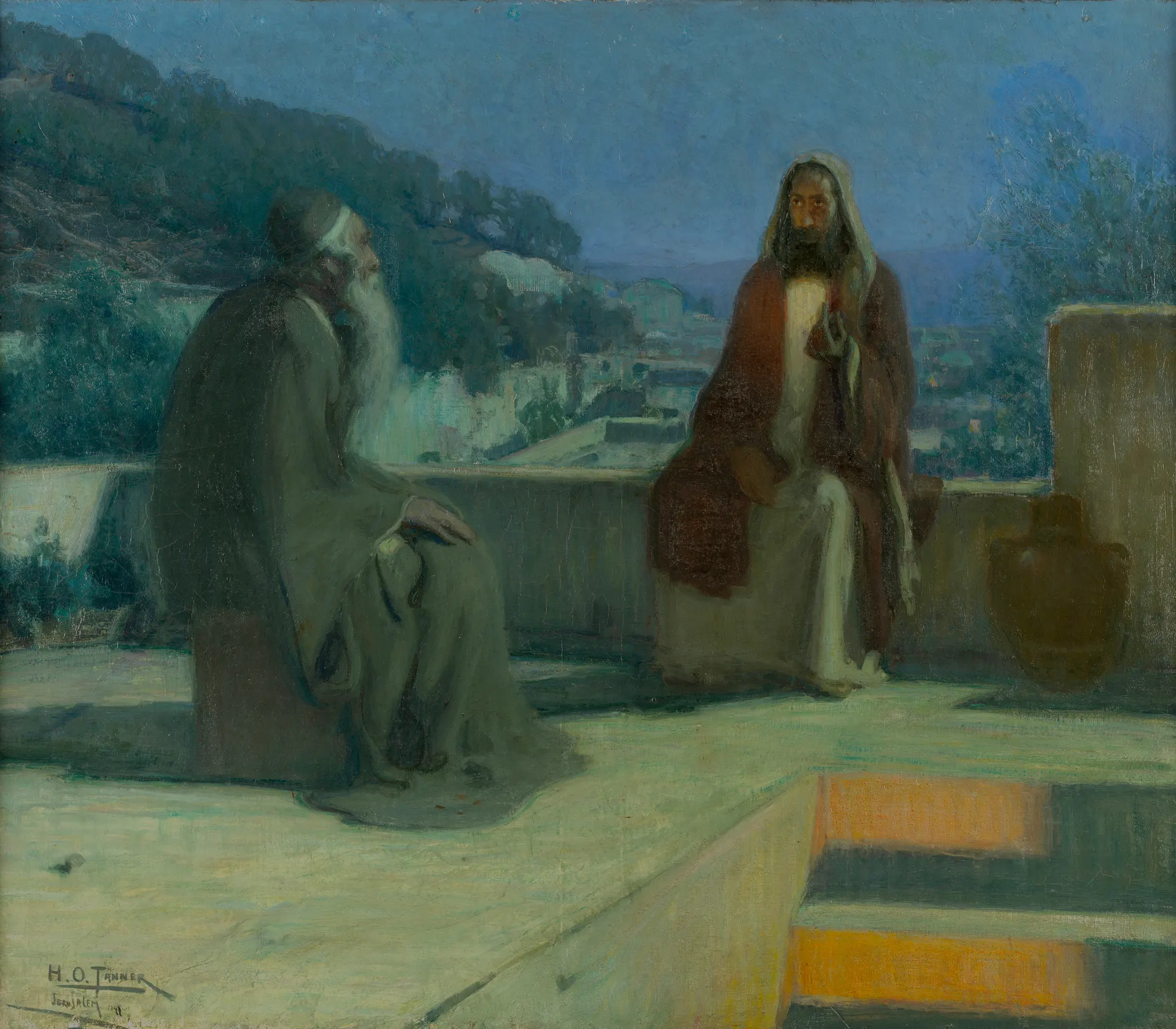
Johnchapter 13
38 verses · John, by tradition · AD 85 to 95 · The Gospels
A new commandment I give you: Love one another. As I have loved you, so you also must love one another.
Introduction
John, by tradition, The Gospels, John Overview.
With this chapter the Gospel turns from the crowds to the twelve, and five chapters pass in one evening. The writer was at that table, and he names himself only as the disciple Jesus loved. He wrote for churches that had leaders and servants, and that had known betrayal and failure inside their own number. The chapter joins an act, a warning and a command, and each one explains the others. Listen for what Jesus knew before He did anything, and for how often the word love returns. Read it as the opening of the farewell that runs to the prayer of chapter 17.
Context
- Who
- Readers whose congregations argued about rank
- What
- The last supper with the twelve, where Jesus washes their feet, names the betrayer, gives the new commandment and foretells Peter's denial.
- Where
- A room in Jerusalem, on the city side of the Kidron valley that Jesus crosses at 18:1.
- When
- The night before the crucifixion, which the chapter dates just before the Passover Feast, about AD 30 or 33.
- Why
- To show the love of Jesus for His own to the end and to set the pattern of service and love for His followers.
Historical context
Foot washing was the lowest task in a household. Roads were dust or mud, people wore open sandals, and a guest's feet were washed on arrival, by a slave, and specifically by a non-Jewish slave where one was available, since Jewish teaching held that a Hebrew slave could not be required to do it. That is the job Jesus took, stripped down and with a towel round his waist, and it is why Peter refuses.
Show the rest of the historical context, 3 more paragraphs
The seating explains how the evening works. Guests reclined on their left sides around a low table, feet outward, so the person to your right had his head near your chest and could speak to you without being overheard. It also explains how someone could reach the feet of every guest without anyone standing up.
Handing a dipped morsel to a guest was a mark of honour, the host singling someone out. That is what makes the exchange with Judas so quiet: to everyone else at the table it looked like a courtesy, which is exactly why nobody understood what was happening when he went out.
John dates the meal in relation to Passover differently from Matthew, Mark, and Luke, who present it as the Passover meal itself, while John says the authorities the next morning avoided defilement so they could eat the Passover. Explanations offered include different calendars in use at the time, different reckonings of when a day began, and a wider use of Passover for the whole festival week. It is a genuine open question, and it is named rather than smoothed over.
Significance
The detail John puts before the washing is the whole point: knowing that the Father had given all things into his hands, and that he had come from God and was going back to God, he rose and took a towel. Security, not insecurity, is what makes a person able to serve.
Show the rest of the significance, 1 more paragraph
And the new commandment given that night set the identifying mark of the church: by this all people will know that you are my disciples, if you have love for one another. For scattered congregations with no buildings and no standing, that was the only badge they had.
The heads below are this chapter's scenes. The numbered points under each are its verses.
The Master Takes the Towel and Washes Feet
He loved them to the very end: The hour held back since John 2:4 comes at the Passover. The Greek eis telos carries two senses at once, the last moment of a life and the full measure of a love. Everything from the towel to the cross runs out of this verse.
John 13:1
“The feast of the passover - See the notes at Mat 26:2, Mat 26:17. His hour was come - The hour appointed in the purpose of God for him to die, Joh 12:27. Having loved his own - Having given to them decisive and constant proofs of his love. This was done by his calling them to follow him; by patiently teaching them; by bearing with their errors and weaknesses; and by making them the heralds of his truth and the heirs of eternal life.”
4 more voices on this verseWhat preachers and commentators have said about this verse, in their own words.
John 13:1
“To remove from this world to the Father. This phrase is worthy of notice; for it refers to the knowledge of Christ, that he knew that his death was a passage to the heavenly kingdom of God. And if, while he was hastening thither, he did not cease to regard his own with his wonted love, there is no reason why we should now think that his affection is changed.”
John Calvin · Commentaries (1554)reformed
John 13:1
“Now before the feast of the passover,.... This feast was instituted as a memorial of the deliverance of the children of Israel out of Egypt, and was an eminent type of Christ; and this passover was what Christ had greatly desired, it being his last, and when he was to express his great love to his people, mentioned here, by dying for them.”
John 13:1
“The passage we have now read begins one of the most interesting portions of John's Gospel. For five consecutive chapters we find the Evangelist recording matters which are not mentioned by Matthew, Mark, and Luke. We can never be thankful enough that the Holy Spirit has caused them to be written for our learning! In every age the contents of these chapters have been justly regarded as one of the most precious parts of the Bible. They have been the food and drink, the strength and comfort of all true-hearted Christians. Let us ever approach them with peculiar reverence.”
John 13:1
“In these verses we have the story of Christ's washing his disciples' feet; it was an action of a singular nature; no miracle, unless we call it a miracle of humility. Mary had just anointed his head; now, lest his acceptance of this should look like taking state, he presently balances it with this act of abasement. But why would Christ do this?”
Matthew Henry · Commentary on the Whole Bible (1707-1721)puritan
John 13:2-3
put into the heart of Judas: The devil had already put the betrayal into the heart of Judas, and Judas remains answerable for it. Verse 3 sets beside it what Jesus knew, the Father's hands holding all things, and His own coming from God. The betrayal and the authority stand in one room.
John 13:2
“The Evangelist says that this was done, while Judas already resolved to betray Christ, not only to show the wonderful patience of Christ, who could endure to wash the feet of such a wicked and detestable traitor; but also that he purposely selected the time when he was near death, for performing what may be regarded as the last act of his life.”
John Calvin · Commentaries (1554)reformed
2 more voices on this verse
John 13:2
“And supper being ended - Rather, δειπνου γενομενου, while supper was preparing. To support this new translation of the words, it may be remarked that, from Joh 13:26, Joh 13:30, it appears that the supper was not then ended: nay, it is probable that it was not then begun; because the washing of feet (Joh 13:5) was usually practised by the Jews before they entered upon their meals, as may be gathered from Luk 7:44, and from the reason of the custom. I think that John wrote, not γενομενου, but γινομενου, as in BL.”
Adam Clarke · Commentary on the Bible (1810-1826)evangelical
John 13:2
“But there are some sins in their own nature so exceedingly sinful, and to which there is so little temptation from the world and the flesh, that it is plain Satan lays the egg of them in a heart disposed to be the nest to hatch them in.”
Matthew Henry · Commentary on the Whole Bible (1707-1721)puritan
the Father had delivered all things: Jesus knew the Father had given Him all things. Chrysostom and Barnes read the verse as placed on purpose before the basin, so the reader sees how great He was who stooped. Augustine adds that all things included the one who would betray Him.
John 13:3
“The things, therefore, that were not formerly in Jesus' hands are given into his hands by the Father. And it is not some things and not others that are given into his hands, but all things.”
Origen of Alexandria · written before 253 · Commentary on the Gospel of John 32.26-27, 34patristic
1 more voice on this verse
John 13:3
“Here is the rightful advancement of the Lord Jesus. Glorious things are here said of Christ as Mediator. (1.) The Father had given all things into his hands; had given him a propriety in all, and a power over all, as possessor of heaven and earth, in pursuance of the great designs of his undertaking; see Matt. xi.”
Matthew Henry · Commentary on the Whole Bible (1707-1721)puritan
John 13:4-5
wrapped a towel around His waist: Every motion here belongs to a household slave: the outer garments off, the towel at the waist, the water poured, the feet washed and dried. Feet were washed on arrival by the lowest servant in the house, and He rises to do it in the middle of the meal.
John 13:4
“He riseth from supper - Not from eating, as Bishop Pearce has well observed, but from his place at table; probably the dishes were not as yet laid down, though the guests were seated. According to the custom of the Jews and other Asiatics, this washing must have taken place before the supper. See on Joh 13:2 (note).”
Adam Clarke · Commentary on the Bible (1810-1826)evangelical
2 more voices on this verse
John 13:4
“In bringing to mind the spiritual meaning of the passage, the Evangelist here seems to me not to have observed the literal sequence of the washing. Normally, it is before supper and before sitting down to supper that those who need to wash their feet wash them. But passing over that time in his account, he says that Jesus, having already sat down for supper, arose from supper so that the Teacher and Lord may begin to wash the feet of the disciples after they had supper. For before the supper, they had been washed and were altogether clean.”
Origen of Alexandria · written before 253 · Commentary on the Gospel of John 32.11-12patristic
John 13:4
“He riseth from supper,.... In the midst of the entertainment, and which no doubt was considerable, his mind being intent on something else; and it being his meat and drink to do his Father's will, he rises and leaves his disciples sitting to finish their meal; and whilst they were murmuring at the waste of the ointment poured on his head, and were filled with indignation at it, as they all of them were, see Mat 26:8; he rises up to wash their feet; amazing patience and humility!”
He poured water into a basin: Washing feet was the work of a servant. Barnes and Clarke cite 1 Samuel 25:41, where Abigail offers to wash the feet of the servants of David. Chrysostom and Theophylact note that Jesus rose to wash the feet of the disciples after all had reclined for the supper.
John 13:5
“Let us come now to the Gospel of God. I find the Lord stripping Himself of His garments, and girding Himself with a towel, pouring water into a basin, and washing the disciples' feet. That heavenly dew was this water, this was foretold, namely, that the Lord Jesus Christ would wash the feet of His disciples in that heavenly dew. And now let the feet of our minds be stretched out.”
Ambrose of Milan · written before 397 · On the Holy Spirit, Book 1, Prologue 12, 16patristic
2 more voices on this verse
John 13:5
“After that be poureth water into a bason,.... This also was a servile work, and what properly belonged to servants to do; see Joh 2:5. The bason to wash the feet in, called by the Jews רגלים עריבת, was fixed by their doctors to hold, "from two logs to nine kabs" (t); not "from two logs to ten", as Dr. Lightfoot has rendered the passage referred to. A "kab" held about a quart of our measure, and a "log" was the fourth part of a "kab". And began to wash the disciples feet.”
John 13:5
“Began to wash ... - It was uniformly the office of a servant to wash the feet of guests, 1Sa 25:41. It became a matter of necessity where they traveled without shoes, and where they reclined on couches at meals. It should be remembered here that the disciples were not sitting at the table, as we do, but were lying with their feet extended from the table, so that Jesus could easily have access to them. See the notes at Mat 23:6.”
John 13:6-8
Peter guards the Master's dignity and refuses the basin, calling Him Lord in the same breath. The answer turns the washing into a necessity: unless Jesus washes him, Peter has no part with Him. Peter receives what he cannot do for himself.
John 13:6
“You ascended from the fountain, what followed? You heard the reading. The high priest, though the presbyters also do it, nevertheless the beginning of the ministry is from the high priest. The high priest, I say, washed your feet. What is this mystery? You surely heard that when the Lord had washed the feet of the other disciples, he came to Peter and Peter said to him: "Do you wash my feet?" (John 13:8). Is this, you the Lord washing the feet of a servant? Do you, the immaculate one, wash my feet?”
Ambrose of Milan · written before 397 · On the Sacraments, Book 3, Chapter 1.4-5patristic
1 more voice on this verse
John 13:6
“Lord, dost thou wash my feet?--Our language cannot bring out the intensely vivid contrast between the "Thou" and the "my," which, by bringing them together, the original expresses, for it is not good English to say, "Lord, Thou my feet dost wash?" But every word of this question is emphatic.”
Jamieson, Fausset & Brown · Commentary Critical and Explanatory on the Whole Bible (1871)reformed
Peter would understand later. Jamieson, Fausset and Brown read later first as verse 12, when Jesus explains what He has done. Aquinas holds the washing is both an example to follow and a mystery, and Wesley says disciples may obey now what they understand later.
John 13:7
“Thou knowest not now - Though he saw the action of Jesus, yet he did not fully understand the design of it. It was a symbolical action, inculcating a lesson of humility, and intended to teach it to them in such a manner that it would be impossible for them ever to forget it. Had he simply commanded them to be humble, it would have been far less forcible and impressive than when they saw him actually performing the office of a servant.”
3 more voices on this verse
John 13:7
Inasmuch therefore as He had come to what manifestly and obviously is the central point of the incident before us, He says: "If thou shouldst refuse to receive this strange and novel lesson of humility, thou wouldst find no part or lot with Me."
Cyril of Alexandria · written before 444 · Commentary on the Gospel of John, Book 9patristic
John 13:7
“What I do thou knowest not now; but thou shalt know hereafter - We do not now know perfectly any of his works, either of creation, providence, or grace. It is enough that we can love and obey now, and that we shall know hereafter.”
John Wesley · Explanatory Notes upon the New Testament (1755)evangelical
John 13:7
“Jesus answered and said . . . What I do thou knowest not now--that is, Such condescension does need explanation; it is fitted to astonish. but thou shall know hereafter--afterwards, meaning presently; though viewed as a general maxim, applicable to all dark sayings in God's Word, and dark doings in God's providence, these words are full of consolation.”
Jamieson, Fausset & Brown · Commentary Critical and Explanatory on the Whole Bible (1871)reformed
Peter says Never, doubling the negative in Greek. Henry reads it as a fixed resolve, and Wesley takes having no part with Jesus as the need to be washed in His blood. Bede reads the washing as the cleansing without which no one has part with Christ.
John 13:8
IN matchless condescension our Lord had girt Himself as a servant, and was washing the feet of the disciples. Peter, struck with such a spectacle, would not allow his Lord to act as a menial, and flatly refused to have his feet washed by his Master. But he changed his mind at once when he was told that a refusal to receive this act of kindness from his Lord would be a virtual rejection of all part in Him, "If I do not wash you, you have no part with Me."
4 more voices on this verse
John 13:8
“Peter saith unto him, thou shall never wash my feet,.... Before he had behaved with modesty, but now with obstinacy and perverseness; and though these expressions might arise from great reverence to Christ, yet they were wrong and rashly spoken. Peter ought to have been satisfied with Christ's reply, and have submitted, since though he then did not know the reason of such surprising conduct, he should hereafter.”
John 13:8
“If I wash thee not - If thou dost not submit to my will, thou hast no part with me - Thou art not my disciple. In a more general sense it may mean, If I do not wash thee in my blood, and purify thee by my Spirit, thou canst have no communion with me, nor any share in the blessings of my kingdom.”
John Wesley · Explanatory Notes upon the New Testament (1755)evangelical
John 13:8
“It is that good part the having of which is the one thing needful. [2.] It is necessary to our having a part in Christ that he wash us. All those whom Christ owns and saves he justifies and sanctifies, and both are included in his washing them. We cannot partake of his glory if we partake not of his merit and righteousness, and of his Spirit and grace.”
Matthew Henry · Commentary on the Whole Bible (1707-1721)puritan
John 13:8
“It is not humility to refuse what the Lord deigns to do for us, or to deny what He has done, but it is self-willed presumption--not rare, however, in those inner circles of lofty religious profession and traditional spirituality, which are found wherever Christian truth has enjoyed long and undisturbed possession.”
Jamieson, Fausset & Brown · Commentary Critical and Explanatory on the Whole Bible (1871)reformed
John 13:9-11
my hands and my head: Peter swings the other way, asking for hands and head. The answer separates two washings, the bath already taken and the feet that pick up the road. Though not all of you stands in verse 10, and verse 11 names the betrayer.
John 13:9
“Not my feet only ... - Peter, with characteristic readiness and ardor, saw now that everything depended on this. His whole salvation, the entire question of his attachment to his Master, was involved. If to refuse to have his feet washed was to be regarded as evidence that he had no part with Jesus, he was not only willing, but desirous that it should be done; not only anxious that his feet should be cleansed, but his hands and his head - that is, that he should be cleansed entirely, thoroughly.”
Clarke holds the disciples had bathed for the Passover. Augustine and Ambrose read the bath as baptism and the feet as the sins a clean man picks up each day. Barnes calls the verse hard and records both views.
John 13:10
“The Lord responded to him, because he said hand and head: The one who has washed does not need to wash again, except to wash only the feet (Ibid., 10). Why is this? Because in baptism all sin is washed away. Therefore, sin is removed: but because Adam was deceived by the devil (Gen. III, 6), and poison was poured upon his feet, you wash the feet; so that in the part where the serpent laid its ambush, a greater assistance of sanctification may be added, so that it cannot deceive you thereafter.”
Ambrose of Milan · written before 397 · On the Sacraments, Book 3, Chapter 1.7patristic
3 more voices on this verse
John 13:10
“He that is washed - That is, he who has been in the bath, as probably all the apostles had lately been, in order to prepare themselves the better for the paschal solemnity; for on that occasion, it was the custom of the Jews to bathe twice. Needeth not save to wash his feet - To cleanse them from any dirt or dust that might have adhered to them, in consequence of walking from the bath to the place of supper.”
Adam Clarke · Commentary on the Bible (1810-1826)evangelical
John 13:10
“He washed them himself, and then said, You are clean; but he excepts Judas: not all; they were all baptized, even Judas, yet not all clean; many have the sign that have not the thing signified. Note, [1.] Even among those who are called disciples of Christ, and profess relation to him, there are some who are not clean, Prov. xxx.”
Matthew Henry · Commentary on the Whole Bible (1707-1721)puritan
John 13:10
“This sentence is singularly instructive. Of the two cleansings, the one points to that which takes place at the commencement of the Christian life, embracing complete absolution from sin as a guilty state, and entire deliverance from it as a polluted life (Re 1:5; 1Co 6:11) --or, in the language of theology, Justification and Regeneration.”
Jamieson, Fausset & Brown · Commentary Critical and Explanatory on the Whole Bible (1871)reformed
For He knew who would betray: Jesus knew who would betray Him. Barnes gives the Greek as the one about to betray, a betrayal already under way. Bonaventure reads the aside as proof Jesus was never deceived, and Ephrem marks that the feet of Judas were among those He washed.
John 13:11
“For he knew who should betray him,.... That is, Jesus, as Beza's ancient copy, and the Syriac and Persic versions read.”
1 more voice on this verse
John 13:11
“For although He well knew that Judas had no kindly feeling or wise consideration for his Master, but that he was full of the poison of devilish bitterness and even then devising the means whereby he might effect the betrayal, He honoured him in the same measure as the rest, and washed even his feet also, continually exhibiting the marks of His own love, and not letting loose His anger till He had tried every kind of remonstrance. For thou mayest perceive how this special characteristic also is peculiar to the Divine Nature.”
Cyril of Alexandria · written before 444 · Commentary on the Gospel of John, Book 9patristic
An Example Given: The Servant Is Not Greater Than His Lord
John 13:12-15
He takes up the two titles they give Him, Teacher and Lord, and draws the duty from them: they wash one another's feet. The scene is Philippians 2 at a supper table, in Augustine's reading.
John 13:12
“Know ye what I have done - Our Lord had told Peter, in the presence of the rest, Joh 13:7, that he should afterwards know what was the intent and meaning of this washing; and now he begins to fulfill his promise; therefore I think it more likely that he gives a command, here, than asks a question, as he knew himself that they did not comprehend his design. On this account γινωσκετε might be translated in the imperative mood, Consider what I have done.”
Adam Clarke · Commentary on the Bible (1810-1826)evangelical
1 more voice on this verse
John 13:12
“Jesus washed the feet of the disciples insofar as he was their teacher, and the feet of the servants insofar as he was their Lord. For the dust from the earth and from worldly things is cleared away by teaching, since it reaches nothing else than the extremities and lower parts of the disciples. But those things that defile the feet are also removed by the lordship of the ruler, since he has authority over those who still receive common defilement because they still have the spirit of bondage.”
Origen of Alexandria · written before 253 · Commentary on the Gospel of John 32.115-16patristic
You call Me Teacher and Lord: The disciples call Jesus Teacher and Lord, and rightly so. Gill and Clarke match the titles to Rabbi and Mar, which the Jews gave their greatest teachers. Jamieson, Fausset and Brown read the pair as learning from Jesus as Teacher and obeying Him as Lord.
John 13:13
“Ye call me Master--Teacher. and Lord--learning of Him in the one capacity, obeying Him in the other. and ye say well, for so I am--The conscious dignity with which this claim is made is remarkable, following immediately on His laying aside the towel of service. Yet what is this whole history but a succession of such astonishing contrast from first to last?”
Jamieson, Fausset & Brown · Commentary Critical and Explanatory on the Whole Bible (1871)reformed
2 more voices on this verse
John 13:13
“For Christ does not hold the title Lord as an empty name of honour, like we do ourselves when, although we remain by nature mere servants, we are decorated by favour of others with titles that surpass our nature and merit: but He is in His nature "Lord," possessing authority over the universe as God; concerning Whom it is said somewhere by the voice of the Psalmist: For all things serve Thee. And He is by nature "Master" [or "Teacher"] also, for all wisdom cometh from the Lord, and by Him cometh all understanding.”
Cyril of Alexandria · written before 444 · Commentary on the Gospel of John, Book 9patristic
John 13:13
“Ye call me Master and Lord,.... רבי, and מר, "Master" and "Lord", were dignified titles among the Jews, which they frequently (y) gave to their doctors and men of learning, and are often to be met with in their writings: hence the disciples called Christ by these names, not out of flattery, but reverence of him, and esteem for him; nor are they blamed, but commended for it: and ye say well, for so I am; though he had acted the part of a servant in such a surprising manner, by washing their feet; yet he had not dropped and…”
Jesus tells the disciples to wash one another's feet. Barnes reads the command as a lesson in humility, while Augustine notes that many washed feet when they received guests. Henry reports the judgment of Calvin that a yearly papal washing copied the act and missed the duty.
John 13:14
“I, then, wish also myself to wash the feet of my brethren, I wish to fulfil the commandment of my Lord, I will not be ashamed in myself, nor disdain what He Himself did first. Good is the mystery of humility, because while washing the pollutions of others I wash away my own. But all were not able to exhaust this mystery. Abraham was, indeed, willing to wash feet, but because of a feeling of hospitality.”
Ambrose of Milan · written before 397 · On the Holy Spirit, Book 1, Prologue 15patristic
2 more voices on this verse
John 13:14
“Ye also ought to wash one another feet - That is, ye should be ready, after my example, to condescend to all the weakness of your brethren; to be willing to do the meanest offices for them, and to prefer the least of them in honor to yourselves.”
Adam Clarke · Commentary on the Bible (1810-1826)evangelical
John 13:14
“What Christ has done Christians should not disdain to do. Calvin saith that the pope, in the annual observance of this ceremony on Thursday in the passion week, is rather Christ's ape than his follower, for the duty enjoined, in conformity to Christ, was mutual: Wash one another's feet.”
Matthew Henry · Commentary on the Whole Bible (1707-1721)puritan
I have set you an example: Jesus has set an example for them. Henry notes He teaches by what He has done as well as by word, and Bede says He taught nothing He had not first done. Chrysostom says it was given so no disciple would count himself greater than another.
John 13:15
“Observe, [1.] What a good teacher Christ is. He teaches by example as well as doctrine, and for this end came into this world, and dwelt among us, that he might set us a copy of all those graces and duties which his holy religion teaches; and it is a copy without one false stroke.”
Matthew Henry · Commentary on the Whole Bible (1707-1721)puritan
John 13:16-17
no servant is greater than his master: The doubled truly marks the weight of the maxim: no servant stands above his master, and no messenger above the one who sent him. The logic runs one way: the Lord has washed feet, so the servant washes feet. The word for messenger here is apostolos, one sent.
John 13:16
“He points out here what an inadmissible offense it would be for servants to refuse to be of the same mind as their own masters. Such a passionate longing for greater and higher things than our merits deserve is really covetousness and nothing else. And he would be perfectly just in bringing the same charge against the apostles, namely, of seeking to be on a higher level than he who commissioned them, if they acted like this. The mind of the One who sent them should be a sufficient yardstick of the glory they seek.”
Cyril of Alexandria · written before 444 · Commentary on the Gospel of John, Book 9patristic
1 more voice on this verse
John 13:16
“The servant is not greater than his lord - Christ has ennobled the acts of humility by practising them himself. The true glory of a Christian consists in being, in his measure, as humble as his Lord. Neither he that is sent - Ουδε αποϚολος Nor an apostle.”
Adam Clarke · Commentary on the Bible (1810-1826)evangelical
If you know these things: Knowing must lead to doing. Bede sets the verse beside James 4:17, where knowing the good and leaving it undone is sin, and Cyril puts the blessing in the doing. Chrysostom hears a warning to Judas, for all knew and not all would do.
John 13:17
“If therefore ye understand these things, He saith----that is, "if ye can clearly perceive the meaning of what I am saying,"----blessed are ye if ye do them. For it is not the knowledge of virtue, but rather the practice of it, that may well be pronounced worthy of both love and zeal.”
Cyril of Alexandria · written before 444 · Commentary on the Gospel of John, Book 9patristic
2 more voices on this verse
John 13:17
“If ye know these things, happy, etc. - True happiness consists in the knowledge of God, and in obedience to him. A man is not happy because he knows much; but because he receives much of the Divine nature, and is, in all his conduct, conformed to the Divine will. “They who have read many books (says Menu) are more exalted than such as have seldom studied; they who retain what they have read, than forgetful readers; they who fully understand, than such as only remember; and they who perform their known duty, than such as barely know it.”
Adam Clarke · Commentary on the Bible (1810-1826)evangelical
John 13:17
The original scope of these words was just this—"If, as you say, you have understood the meaning of this—the washing of your feet by your Master—if you have comprehended My intention in so doing, then it will be to your lasting honor and happiness if you do the same. I have symbolically represented to you, by washing your feet, certain virtues. You shall be a happy people if these virtues are found in you and abound."
Charles Spurgeon · written before 1892 · The Metropolitan Tabernacle Pulpit, Sermon No. 3348: “Knowing and Doing” (lightly modernized text, CCEL edition)Particular Baptist
John 13:18-19
The quotation is Psalm 41:9, the man who shares the bread lifting his heel. The psalm names a close friend who was trusted, and the quotation here keeps the bread and the heel. The words I am He return in the garden at 18:5.
John 13:18
“I speak not of you all - This is a continuation of that discourse which was left off at the tenth verse. The preceding verses may be read in a parenthesis. I know whom I have chosen - I am not deceived in my choice; I perfectly foresaw every thing that has happened, or can happen. I have chosen Judas, not as a wicked man, nor that he should become such; but I plainly foresaw that he would abuse my bounty, give way to iniquity, deliver me into the hands of my enemies, and bring ruin upon himself.”
Adam Clarke · Commentary on the Bible (1810-1826)evangelical
2 more voices on this verse
John 13:18
“The meaning of these words is involved in no slight uncertainty. For while saying that they shall be blessed, who, knowing what is good, are ever zealous to carry it out in action, He straightway adds: I speak not of all. In these words, as I with many others believe, He hints darkly at the traitor; for in no enviable plight is one who is hated of God, and never would one be reckoned among the blessed who had so degraded his soul as to make it capable of such horrible impiety.”
Cyril of Alexandria · written before 444 · Commentary on the Gospel of John, Book 9patristic
John 13:18
“That in the treachery of him that proved false to him the scripture was fulfilled, which takes off very much both the surprise and offence of the thing. Christ took one into his family whom he foresaw to be a traitor, and did not by effectual grace prevent his being so, that the scripture might be fulfilled.”
Matthew Henry · Commentary on the Whole Bible (1707-1721)puritan
Cross references
John 13:18
- QuotingPsalms 41:9“Even my close friend whom I trusted, the one who shared my bread, has lifted up his heel against me.”
'He that eateth bread with me hath lifted up his heel against me' (Judas; 'that the scripture may be fulfilled')
ConnectionsPsalms 41:9
I am telling you now before: Jesus tells them before it happens so they will believe. Augustine reads I am He as the one the Scripture spoke of, and Bonaventure hears the divine name. Origen notes the disciples already believed, so believe here means a faith made stronger.
John 13:19
“Now I tell you before it come ... - They would see by that that he had a knowledge of the heart and the power of foretelling future events, and must therefore have been sent by God. This does not imply that they had no faith before this, but that their faith would be increased and strengthened by it.”
whoever receives the one I send: Between the warning about the betrayer and its announcement, Jesus commissions the men who remain. The chain runs from the Father to the Son to the one He sends, and receiving the last of them receives the first. One man's treachery leaves the sending in place.
John 13:20
“He that receiveth whomsoever I send, receiveth me, &c.--(See on Mt 10:40). The connection here seems to be that despite the dishonor done to Him by Judas, and similar treatment awaiting themselves, they were to be cheered by the assurance that their office, even as His own, was divine.”
Jamieson, Fausset & Brown · Commentary Critical and Explanatory on the Whole Bible (1871)reformed
1 more voice on this verse
John 13:20
“Having previously shown in a manner suitable to the occasion that He is the Christ, and having indicated the means by which the traitor was meditating his grievous outrage against Him, He now devises another very effectual method for overthrowing his evil designs. And now again His discourse seems to be marked by a certain want of distinctness: for He is still trying to conceal the daring deed, and as yet does not openly say who is about to betray Him.”
Cyril of Alexandria · written before 444 · Commentary on the Gospel of John, Book 9patristic
One of You Shall Betray Me: and It Was Night
troubled in spirit: The word for troubled is the one used at Lazarus's tomb in John 11:33 and again in this room at 14:1. Jesus announces that one of them will betray Him, and He says it to the whole table. Every man there is left to ask.
John 13:21
“When Jesus had thus said, he was troubled in spirit, and testified, and said, Verily, verily, I say unto you, One of you shall betray me--The announcement of Joh 13:18 seems not to have been plain enough to be quite apprehended, save by the traitor himself.”
Jamieson, Fausset & Brown · Commentary Critical and Explanatory on the Whole Bible (1871)reformed
1 more voice on this verse
John 13:21
“Troubled in spirit - See Joh 12:27. The reason of his trouble here was that Judas, a professed friend, was about to betray him. He doubtless foresaw the deep and dreadful sorrows of his approaching death, and was also deeply affected with the ingratitude and wickedness of a professed friend. Jesus was man as well as God, and he felt like other men. His human nature shrank from suffering, and his tender sensibilities were affected not less deeply than would be those of other men by baseness and treason.”
John 13:22-25
looked at one another: No one at the table names Judas, and the cover holds to the last hour. They ate reclining, and the disciple Jesus loved lay at His side, the place of a close friend. Peter motions to him, and the question goes through another mouth.
John 13:22
“Terror and dread at once thrill the hearts of the disciples, and they glance one at another, being filled with a twofold alarm at the words uttered. For each one, as was natural, on reviewing the state of his own individual soul, was weighed down with grievous fear; and furthermore, they all felt the agony, no less severe, which was produced by the suspicion that rested on them all in common. For they are well assured that the words spoken will be fully verified.”
Cyril of Alexandria · written before 444 · Commentary on the Gospel of John, Book 9patristic
1 more voice on this verse
John 13:22
“Looked one on another doubting of whom he spake - See the notes on Mat 26:20-25 (note). Every one but Judas, conscious of his own innocence, looked about upon all the rest, wondering who in that company could be such a traitor! Even Judas himself is not suspected. Is not this a proof that his general conduct had been such as to subject him to no suspicion?”
Adam Clarke · Commentary on the Bible (1810-1826)evangelical
the one whom Jesus loved: Augustine identifies him as John, who writes of himself as of another. Clarke and Wesley describe the guests leaning on the left arm on couches. Origen and Bede read the place as a sign of the teaching John would later give.
John 13:23
“Leaning on Jesus’ bosom - This does not mean that he was at that time actually lying on his bosom, but that he occupied a situation next to him at the table, so that his head naturally fell back on his bosom when he spoke to him. See the notes at Mat 23:6. Whom Jesus loved - This was doubtless John himself. The evangelists are not accustomed to mention their own names when any mark of favor or any good deed is recorded. They did not seek publicity or notoriety.”
2 more voices on this verse
John 13:23
“There was lying in the bosom of Jesus -- that is, sitting next to him at table. This phrase only expresses the then customary posture at meals, where the guests all leaned sidewise on couches. And each was said to lie in the bosom of him who was placed next above him.”
John Wesley · Explanatory Notes upon the New Testament (1755)evangelical
John 13:23
“PICTURE the Lord and His Apostles at the holy Supper. A world of interest centers here. Two figures, strangely different, met in this scene—met, shortly afterwards to part and never to meet again. To look upon them, they seemed equally disciples of Jesus and from the position which one of them occupied, as leaning on the Lord's bosom and the other as the treasurer of the Master's little store, they seemed to be equally trusted and honored followers of the great Lord. You might not have known, by mere sight, which was the better man of the two—John or Judas.”
Simon Peter motioned to him: Peter asks through the disciple beside Jesus. Theophylact holds Peter had been rebuked before and feared it again. Chrysostom notes that John calls himself the one Jesus loved to explain why Peter turned to him.
John 13:24
Now, beckoning is taken as slander in proverbs, for the wicked person "beckons with his eyes" … Peter's act, however, was to beckon out of his eagerness for knowledge, and subsequent to such beckoning, to say to his fellow disciple, since he was more intimate with the teacher, "Tell us who it is of whom he speaks."
Origen of Alexandria · written before 253 · Commentary on the Gospel of John 32.275patristic
Leaning back against Jesus, he asked: The disciple leaned back against Jesus. Barnes and Clarke note a different verb from verse 23, as he leans back so that his head rests against the chest of Jesus. Gill reads the question as a whisper, asked close to His ear.
John 13:25
“He then lying on Jesus' breast,.... Being on the couch just before Jesus, with his back to him, he bends backwards, and falling on Jesus' breast, whispers in his ear: and saith unto him, Lord, who is it? using his interest in Christ, and making thus free with him, in compliance with Peter's request; and was no doubt desirous himself of knowing who the person was.”
1 more voice on this verse
John 13:25
“He then lying on Jesus’ breast - This is a different word from the one rendered Joh 13:23 leaning. It means falling back or reclining on the bosom of Jesus. When Peter spake, John laid his head back on the bosom of Jesus, so that he could speak to him privately without being heard by others.”
John 13:26-27
gave it to Judas: The dipped morsel was a mark of honour at an eastern table, the host handing a guest a choice piece. The gesture is a last appeal, and Judas takes it. Satan enters him at the morsel, and do quickly sets the hour of the arrest.
John 13:26
“Jesus answered, he it is,.... Jesus replied, by whispering; for had he spoken out, the rest could not have been so ignorant, as they still continued, after the sign was given: Christ, I say, whispered to John, and told him by what sign he might know the person, and that it was he, to whom, says he, I shall give a sop, when I have dipped it.”
3 more voices on this verse
John 13:26
“And when he had dipped the sop - Dr. Lightfoot observes that it was no unusual thing to dip a sop and give it to any person; and it is probable that the rest of the disciples considered it as given to Judas that he might hurry to do some work on which he wished to employ him, and not wait to finish his supper in a regular manner.”
Adam Clarke · Commentary on the Bible (1810-1826)evangelical
John 13:26
“Jesus answered - In his ear. So careful was he not to offend (if it had been possible) even Judas himself. The sop - Which he took up while he was speaking.”
John Wesley · Explanatory Notes upon the New Testament (1755)evangelical
John 13:26
“It is the character of a widow indeed that she had washed the saints' feet ( 1 Tim. v. 10 ), and there is some comfort in this; but the blessed Jesus here washed the feet of a sinner, the worst of sinners, the worst to him, who was at this time contriving to betray him. Many interpreters consider Christ's washing his disciples' feet as a representation of his whole undertaking.”
Matthew Henry · Commentary on the Whole Bible (1707-1721)puritan
Satan entered into him: Satan entered Judas after the morsel. Origen marks two stages, the betrayal put into his heart at verse 2 and now Satan himself entering. Wesley hears do quickly as asking why Judas delays, and Cyril as words spoken past Judas to Satan.
John 13:27
“After the sop - After he had taken and probably eaten it. By this Judas saw that Jesus knew his design, and that he could not conceal his plan. He saw, also, that the other disciples would be acquainted with it; and, aroused by sudden anger, or with the apprehension that he should lose his reward, or that Jesus might escape, he resolved on executing his plan at once. Satan entered into him - The devil had before this put it into his heart to betray Jesus Joh 13:2, but he now excited him to a more decided purpose.”
3 more voices on this verse
John 13:27
“And after the sop, Satan entered into him,.... After he had taken and eaten the sop, or crust of bread, by which he was pointed out to be the betrayer, "Satan entered into him"; possessed his body, and filled his mind, and stirred him up more eagerly to pursue with rigour his wicked design.”
John 13:27
“But already "Satan has entered into him," and though the Saviour's act might seem enough to recall him even yet, hell is now in his bosom, and he says within himself, "The die is cast; now let me go through with it; fear, begone!" (See on Mt 12:43). Then said Jesus unto him, That thou doest, do quickly--that is, Why linger here?”
Jamieson, Fausset & Brown · Commentary Critical and Explanatory on the Whole Bible (1871)reformed
John 13:27
“What thou doest, do quickly - This is not a permission, much less a command. It is only as if he had said, If thou art determined to do it, why dost thou delay?”
John Wesley · Explanatory Notes upon the New Testament (1755)evangelical
John 13:28-30
no one at the table knew: Judas kept the money bag, so the rest guessed at an errand for the feast or a gift for the poor. The morsel is barely in his hand when he goes out into the night. Everything from here to the garden is spoken to eleven men.
John 13:28
“No man at the table knew - This shows that Jesus had signified to John only who it was that should betray him. The bag - The traveling-bag in which they put their common property. See the notes at Joh 12:6. Have need of against the feast - The feast of the Passover. This feast continued seven days, and they supposed that Jesus had directed him to make preparation for their needs on those days.”
2 more voices on this verse
John 13:28
“Now no man at the table,.... Not one of those who lay upon the couches at the table, excepting John, to whom the signal was given: knew for what intent he spake this unto him; and perhaps he might not know the meaning of his last words, that he spoke concerning the act of betraying him; nor did not imagine that the thing was so near and so speedily to be done, as it was.”
John 13:28
“The disciples however understand not the force of the saying, and this (it seems) in accordance with the Divine dispensation, as Christ did not unfold its meaning to them: since in other places indeed we find Him teaching them that He would be delivered into the hands of sinners, and that He would be crucified, and put to death, and would rise again on the third day; but ever charging them by no means to tell this to any man.”
Cyril of Alexandria · written before 444 · Commentary on the Gospel of John, Book 9patristic
Since Judas kept the money bag: Clarke cites Calmet that nothing was bought on the Passover day, so the disciples thought the feast was still ahead. Henry reports the view of Lightfoot that this supper came before the Passover. Augustine notes the bag served the followers of Jesus and the poor.
John 13:29
“Buy those things that we have need of against the feast - Calmet’s observation here has weight so it. “The disciples who thought that our Lord had said this to Judas, knew well that on the day of the passover there was neither buying nor selling in Jerusalem.”
Adam Clarke · Commentary on the Bible (1810-1826)evangelical
Judas went out into the night: Judas went out, and it was night. Origen reads the night as the darkness in the soul Satan had entered, and Augustine says Judas who went out was himself the night. Chrysostom reads the words plainly, a man so set on his plan he went out at that late hour.
John 13:30
“He then, having received the sop, went immediately out--severing himself for ever from that holy society with which he never had any spiritual sympathy. and it was night--but far blacker night in the soul of Judas than in the sky over his head.”
Jamieson, Fausset & Brown · Commentary Critical and Explanatory on the Whole Bible (1871)reformed
2 more voices on this verse
John 13:30
“He went out - To the chief priests. But he returned afterward, and was with them when they ate the passover, Matt. xxvi, 20, though not at the Lord's Supper.”
John Wesley · Explanatory Notes upon the New Testament (1755)evangelical
John 13:30
“He - went immediately out: and it was night - He set off to Jerusalem from Bethany, which was about two miles distant; and, under the conduct of the prince of darkness, and in the time of darkness, he did this work of darkness.”
Adam Clarke · Commentary on the Bible (1810-1826)evangelical
A New Commandment, and Peter's Denial Foretold
John 13:31-32
With Judas gone the hour has arrived, and the word of John 12:23 now stands in the present tense. Verse 32 closes on at once, with the glorifying set in the immediate future. The cross is hours off.
John 13:31
“But the matters in this passage might be understood even more clearly as follows. Just as the name of God is blasphemed among the Gentiles because of some, so, because of the saints whose good works are seen very distinctly before people, the name of the Father who is in heaven is glorified. In whom, then, was it glorified more than in Jesus, since he committed no sin, nor was deceit found in his mouth, nor did he know sin? And since he is such as this, therefore, the Son is glorified, and God is glorified in him.”
Origen of Alexandria · written before 253 · Commentary on the Gospel of John 32.360-63patristic
3 more voices on this verse
John 13:31
“Now is the Son of man glorified - The last deed is done that was necessary to secure the death of the Son of man, the glory that shall result to him from that death, the wonderful success of the gospel, the exaltation of the Messiah, and the public and striking attestation of God to him in the view of the universe. See the notes at Joh 12:32.”
John 13:31
“Here the scene, as it were, is opened, for the discourse which is continued in the following chapters. Now - While I speak this, the Son of man is glorified - Being fully entered into his glorious work of redemption. This evidently relates to the glory which belongs to his suffering in so holy and victorious a manner.”
John Wesley · Explanatory Notes upon the New Testament (1755)evangelical
John 13:31
“And what is very remarkable, in five brief clauses He repeats this word "glorify" five times, as if to His view a coruscation of glories played at that moment about the Cross. God is glorified in him--the glory of Each reaching its zenith in the Death of the Cross!”
Jamieson, Fausset & Brown · Commentary Critical and Explanatory on the Whole Bible (1871)reformed
God will also glorify the Son: God will glorify the Son at once. Theophylact reads in Himself as God glorifying the Son by His own act. Chrysostom sees it at the cross, where the sun was darkened, and Clarke adds 18:6, where those arresting Jesus fell to the ground.
John 13:32
“The traitor departs to minister to the stratagems of the devil. And now Christ begins His discourse; teaching us thereby, as in a figure, that the things which are fitted only for true disciples are not to be uttered in the hearing of all men. For it is not meet to give that which is holy unto the dogs, as Christ Himself says, nor even to allow pearls to be insulted by the feet of swine.”
Cyril of Alexandria · written before 444 · Commentary on the Gospel of John, Book 9patristic
1 more voice on this verse
John 13:32
“And shall straightway glorify him - Or, glorify him, ευθυς, immediately; “he did, not only in the miracles wrought at his death, but also in that remarkable case mentioned, Joh 18:6, when the whole crowd that came to seize him were driven back with a word of his mouth, and fell to the ground.”
Adam Clarke · Commentary on the Bible (1810-1826)evangelical
I am with you only a little while longer: Little children stands nowhere else on Jesus' lips in this Gospel, a word of affection for men about to lose Him. The hard saying of John 7:34 returns here: where I am going, you cannot come. For the disciples it opens into three chapters of promise.
John 13:33
“The statement "Yet a little while I am with you" is clear in the simple sense, so far as the literal sense is concerned, since he would soon no longer be with the disciples. First, he was arrested by the cohort and the tribune and the servants of the Jews who bound him and led him off to Annas first, and after this he was delivered to Pilate. Next, he was condemned to the cross, and then he spent three days and three nights in the heart of the earth.”
Origen of Alexandria · written before 253 · Commentary on the Gospel of John 32.376patristic
2 more voices on this verse
John 13:33
“Little children - An expression of great tenderness, denoting his deep interest in their welfare. As he was about to leave them, he endeavors to mitigate their grief by the most tender expressions of attachment, showing that he felt for them the deep interest in their welfare which a parent feels for his children. The word “children” is often given to Christians as implying: 1. That God is their Father, and that they sustain toward him that endearing relation, Rom 8:14-15. 2. As denoting their need of teaching and guidance, as children need the aid and counsel of a father.”
John 13:33
“Little children--From the height of His own glory He now descends, with sweet pity, to His "little children," all now His own. This term of endearment, nowhere else used in the Gospels, and once only employed by Paul (Ga 4:19), is appropriated by the beloved disciple himself, who no fewer than seven times employs it in his first Epistle.”
Jamieson, Fausset & Brown · Commentary Critical and Explanatory on the Whole Bible (1871)reformed
John 13:34-35
A new commandment I give you: Leviticus 19:18 had already commanded love of neighbour. The measure is new, as I have loved you, shown that evening with a basin and a towel. Verse 35 puts the mark where outsiders can read it.
John 13:34
“Christ's love to His people in giving His life a ransom for them was altogether new, and consequently as a Model and Standard for theirs to one another. It is not, however, something transcending the great moral law, which is "the old commandment" (1Jo 2:7, and see on Mr 12:28-33), but that law in a new and peculiar form.”
Jamieson, Fausset & Brown · Commentary Critical and Explanatory on the Whole Bible (1871)reformed
2 more voices on this verse
John 13:34
“He plainly indicates the novelty involved in his command here—and the extent to which the love he enjoins here surpasses the old idea of mutual love—by adding the words "Even as I have loved you, you also should love one another." … The law of Moses mandated the necessity of loving our brothers as ourselves, yet our Lord Jesus the Christ loved us far more than he loved himself.”
Cyril of Alexandria · written before 444 · Commentary on the Gospel of John, Book 9patristic
John 13:34
“A new commandment - Not new in itself; but new in the school of Christ: for he had never before taught it them expressly. Likewise new, as to the degree of it, as I have loved you.”
John Wesley · Explanatory Notes upon the New Testament (1755)evangelical
By this everyone will know: Love marks the disciples of Jesus. Chrysostom notes that He passes over the signs they would perform and makes love the mark by which everyone will know them. Augustine reasons that others may hold every other gift, and love alone marks His own.
John 13:35
“By this shall all men know that ye are my disciples--the disciples of Him who laid down His life for those He loved. if ye have love one to another--for My sake, and as one in Me; for to such love men outside the circle of believers know right well they are entire strangers. Alas, how little of it there is even within this circle!”
Jamieson, Fausset & Brown · Commentary Critical and Explanatory on the Whole Bible (1871)reformed
1 more voice on this verse
John 13:35
“By this shall all men ... - That is, your love for each other shall be so decisive evidence that you are like the Saviour, that all people shall see and know it. It shall be the thing by which you shall be known among all men. You shall not be known by special rites or habits; not by a special form of dress or manner of speech; not by special austerities and unusual customs, like the Pharisees, the Essenes, or the scribes, but by deep, genuine, and tender affection.”
John 13:36-38
The hard word carries a promise inside it: Peter follows later. He answers with a boast about laying down his life, and Jesus names the denial before the rooster crows. The warning is mercy, and John 21 brings Peter back.
John 13:36
“Peter said--seeing plainly in these directions how to behave themselves, that He was indeed going from them. Lord, whither goest thou?--having hardly a glimmer of the real truth. Jesus answered, . . . thou canst not follow me now, but thou shalt follow me afterwards--How different from what He said to the Jews: "Whither I go ye cannot come" (Joh 8:21).”
Jamieson, Fausset & Brown · Commentary Critical and Explanatory on the Whole Bible (1871)reformed
2 more voices on this verse
John 13:36
“Peter saith, Lord, whither goest thou? - St. Peter seems to have thought, that Christ, being rejected by the Jews, would go to some other part of the earth to erect his throne, where he might reign without disturbance, according to the gross notions he had of Christ's kingdom.”
John Wesley · Explanatory Notes upon the New Testament (1755)evangelical
John 13:36
“Thou canst not follow me now - Thou hast not faith strong enough to die for me, nor is thy work yet done; but hereafter thou shalt suffer for my sake, and die in defense of my truth. See Joh 21:18.”
Adam Clarke · Commentary on the Bible (1810-1826)evangelical
Clarke holds that Peter pictured a long and hard road. Jamieson, Fausset and Brown hold he saw that Jesus spoke of death and would still lay down his life. Augustine says Peter knew his will and misjudged his strength.
John 13:37
“Why cannot I follow thee now? - Peter probably thought that our Lord intended to go some long journey, which would necessarily subject him to many inconveniences and fatigue; and he felt quite disposed to follow him in this supposed journey, at all hazards. He saw no reason, because he did not see our Lord’s meaning, why he could not follow him now. I will lay down my life for thy sake - Poor Peter! thou wast sincere, but thou didst not know thy own strength.”
Adam Clarke · Commentary on the Bible (1810-1826)evangelical
2 more voices on this verse
John 13:37
“What is there, he means, that prevents or that can keep him back from following His Master, now that his deliberate aim is to die for Christ's sake, reckoning this as his proudest boast?”
Cyril of Alexandria · written before 444 · Commentary on the Gospel of John, Book 9patristic
John 13:37
“I will lay down my life for thy sake--He seems now to see that it was death Christ referred to as what would sever Him from them, but is not staggered at following Him thither.”
Jamieson, Fausset & Brown · Commentary Critical and Explanatory on the Whole Bible (1871)reformed
before the rooster crows, you will: Jesus gives the words of Peter back as a question. Jamieson, Fausset and Brown hear affectionate irony in it. Mark 14:30 has the rooster crow twice, and Theodore reconciles the two, for the rooster crowed once after the first denial.
John 13:38
“Wilt thou lay down thy life for my sake?--In this repetition of Peter's words there is deep though affectionate irony, and this Peter himself would feel for many a day after his recovery, as he retraced the painful particulars.”
Jamieson, Fausset & Brown · Commentary Critical and Explanatory on the Whole Bible (1871)reformed
2 more voices on this verse
John 13:38
“The cock shall not have crowed - That is, cock crowing shall not be over, till thou hast denied me thrice - His three-fold denial was thrice foretold; first, at the time mentioned here; secondly, at that mentioned by St. Luke; lastly, at that recorded by St. Matthew and Mark.”
John Wesley · Explanatory Notes upon the New Testament (1755)evangelical
John 13:38
“The cock shall not crow, etc. - See on Mat 26:34 (note). Dr. Lightfoot has very properly remarked that we must not understand these words, as if the cock should not crow at all before Peter had thrice denied his Master; but we must understand them thus: “The cock shall not have finished his crowing before thou wilt thrice deny me.”
Adam Clarke · Commentary on the Bible (1810-1826)evangelical
Keep studying
Studies15
Sources for this chapter
The summary
Jamieson, Fausset & Brown, Commentary Critical and Explanatory; John Calvin, Commentaries; John Wesley, Explanatory Notes Upon the New Testament and Matthew Henry, Complete Commentary.
The exposition
Adam Clarke, Commentary on the Bible; Albert Barnes, Notes, Explanatory and Practical, on the Gospels; Alexander Maclaren, Expositions of Holy Scripture, John; Ambrose of Milan, On the Sacraments, Book 3, Chapter 1.7; Augustine, Tractates on the Gospel of John; Augustine of Hippo; Bede; Bonaventure, Commentary on John, Chapter 13; Brooke Foss Westcott, The Gospel according to St. John; Cyril of Alexandria, Commentary on the Gospel of John, Book 9; Ephrem the Syrian, COMMENTARY ON TATIAN'S DIATESSARON 18.22; J. C. Ryle, Expository Thoughts on the Gospels, John; Jamieson, Fausset & Brown, Commentary Critical and Explanatory on the Whole Bible; John Calvin, Commentary on the Gospel according to John; John Chrysostom; John Gill, Exposition of the New Testament; John Wesley, Explanatory Notes upon the New Testament; Matthew Henry, Commentary on the Whole Bible; Origen of Alexandria; Theodore of Mopsuestia, COMMENTARY ON THE GOSPEL OF JOHN, FRAGMENT 119.13.38; Theophylact of Ohrid, Commentary on John and Thomas Aquinas, Commentary on John.