
John 13:37
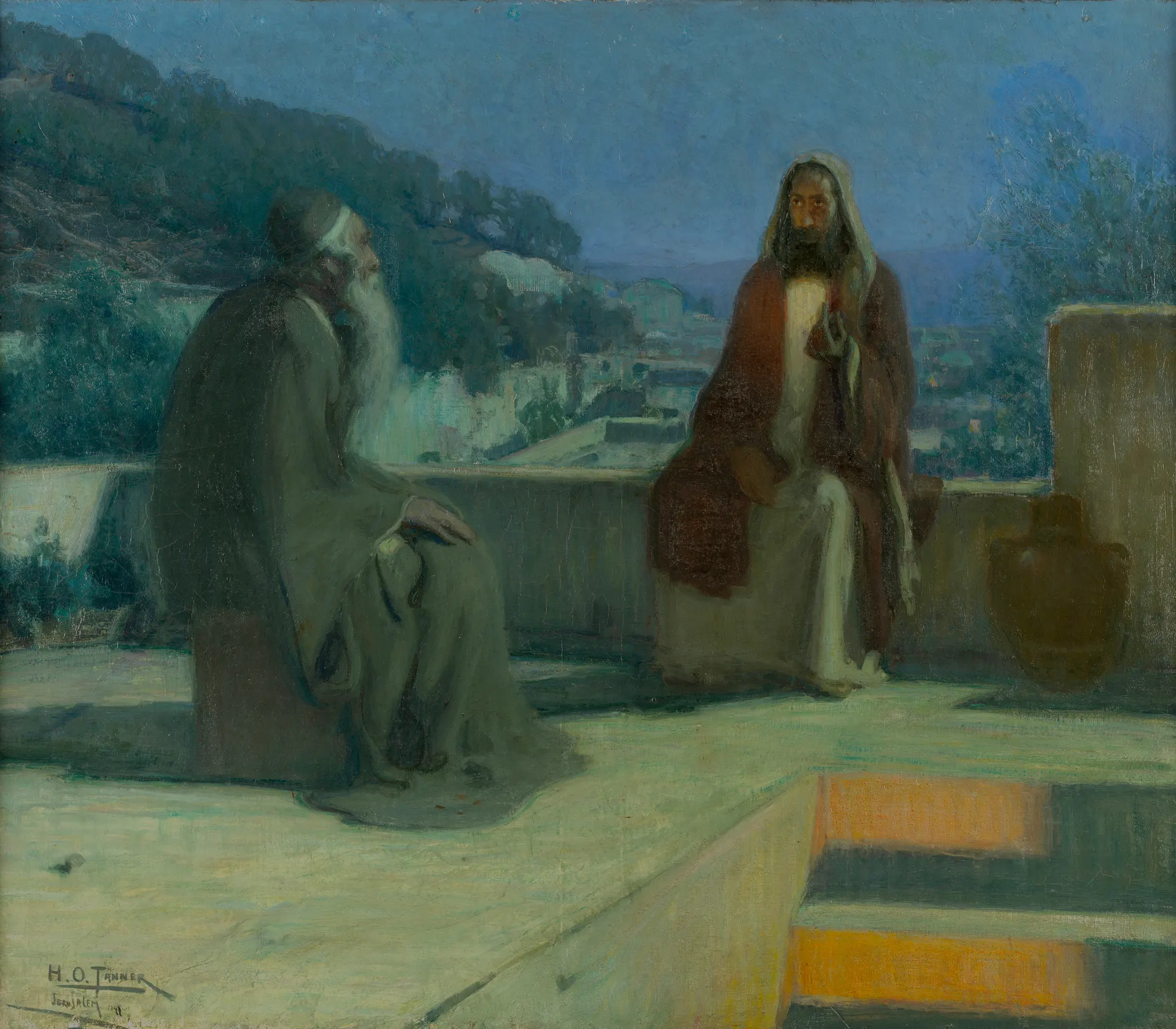
in John 13“Lord,” said Peter, “why can’t I follow You now? I will lay down my life for You.”
BSB
The same verse in ASV and KJV ▾
ASV
Peter saith unto him, Lord, why cannot I follow thee even now? I will lay down my life for thee.
KJV
Peter said unto him, Lord, why cannot I follow thee now? I will lay down my life for thy sake.
⋯
This verse in John 13
Commentary
19 notes on this verseWhat is there, he means, that prevents or that can keep him back from following His Master, now that his deliberate aim is to die for Christ's sake, reckoning this as his proudest boast?
This site's exposition
Lord, where are You going
on John 13:36-38
The hard word carries a promise inside it: Peter follows later. He answers with a boast about laying down his life, and Jesus names the denial before the rooster crows. The warning is mercy, and John 21 brings Peter back.
This site's exposition
why can’t I follow You now
Clarke holds that Peter pictured a long and hard road. Jamieson, Fausset and Brown hold he saw that Jesus spoke of death and would still lay down his life. Augustine says Peter knew his will and misjudged his strength.
The record, by era
The Church Fathers5 voices
Peter had earlier answered the Lord out of a kind of proud self-assurance when he had told him, "I will lay down my life for you." He had not yet received the strength to carry out that promise. Now, in order to be able to do so, he is already filled with charity. That is why he is asked, "Do you love me?" And he answers "I do," because it is only charity that can carry it out. So how do things stand, Peter? Dying is what you were afraid of. He is alive and talking to you, the one you saw dead. Do not be afraid of death anymore. It has been conquered in him whose death you dreaded. He hung on the cross, he was fixed there with nails, he gave up the spirit, he was struck with a lance, laid in the tomb. That is what you were afraid of when you denied him, afraid you would suffer this. And by fearing death you denied life. Understand the truth now: when you were afraid of dying, that is when you died.
Peter promised he would die for him, and he was not even able to die with him. He had staked more, you see, than his credit could stand. He had promised more than he could fulfill, because it was in fact unfitting that he should do what he had promised. "I will lay down my life," he said, "for you." But that is what the Lord was going to do for the servant, not the servant for the Lord. So as he had staked more than he was worth, he was then loving in an inverted sort of way; that is why he was afraid and denied Christ. Later on, though, the Lord, after he has risen, teaches Peter how to love. While he was loving in the wrong way, he collapsed under the weight of Christ's passion. But when he was loving in the right way, Christ promises him a passion of his own.
The blessed Peter, as we have just heard, is ordered to follow. And yet he had originally been thinking of going ahead when he said to the Lord, "I will lay down my life for you." He was so sure of himself that he was unaware of his fear. He wanted to go ahead of the one he should be following. It was a good thing he was eager to do, but he did not keep to the right order.
But what does he say to this? "Why cannot I follow Thee now? I will lay down my life for Thy sake." He saw what was the kind of desire in his mind; but what the measure of his strength, he saw not. The weak man boasted of his willingness, but the Physician had an eye on the state of his health; the one promised, the Other foreknew: the ignorant was bold; He that foreknew all, condescended to teach. How much had Peter taken upon himself, by looking only at what he wished, and having no knowledge of what he was able! How much had he taken upon himself, that, when the Lord had come to lay down His life for His friends, and so for him also, he should have the assurance to offer to do the same for the Lord; and while as yet Christ's life was not laid down for himself, he should promise to lay down his own life for Christ!
When he had shaken off the dread of being the traitor, and was shown to be one of His own, he afterwards asked boldly himself, while the others held their peace. "What sayest thou, Peter? He said, 'thou canst not,' and thou sayest, 'I can'? Therefore thou shalt know from this temptation that thy love is nothing without the presence of the impulse from above." Whence it is clear that in care for him He allowed even that fall. He desired indeed to teach him even by the first words, but when he continued in his vehemence, He did not indeed throw or force him into the denial, but left him alone, that he might learn his own weakness.
11 more voices on this verse
The Church Fathers1 voice
A great thing is love, and stronger than fire itself, and it goeth up to the very heaven; there is no hindrance which can restrain its tearing force. And so the most fervent Peter, when he hears, "Whither I go ye cannot come," what saith he? "Lord, whither goest thou?" and this he said, not so much from wish to learn, as from desire to follow. To say openly, "I go," he dared not yet, but, "Whither goest thou?" Christ answered, not to his words, but to his thoughts. For that this was his wish, is clear from what Christ said, "Whither I go thou canst not follow Me now." Seest thou that he longed for the following Him, and therefore asked the question? And when he heard, "thou shalt follow Me afterwards" not even so did he restrain his longing, and, though he had gained good hopes, he is so eager as to say, "Why cannot I follow Thee now? I will lay down my life for Thee."
The Medieval Church3 voices
Peter answered him: Why cannot I follow? I will lay down my life for thee: and this is to follow perfectly: below, in the fifteenth chapter: "Greater love hath no man than this, that a man lay down his life for his friends." If therefore …
But Peter is so irrepressible in his eagerness that he even contradicts Christ. He is not satisfied with having received the good hope of following Christ later, but insists on his own way and self-confidently says: "Why can I not follow You now? I will …
When John says, Peter said to him, he indicates Peter's confidence. Peter had understood what our Lord had just said as expressing some doubt about the perfection of Peter's love. Love is perfect when one exposes oneself to death for a friend: "Greater love has …
The Puritans and the Awakening2 voices
Jesus answered him, If I wash thee not, thou hast no part with me. 9 Simon Peter saith unto him, Lord, not my feet only, but also my hands and my head. 10 Jesus saith to him, He that is washed needeth not save to wash his feet, but is clean every whit: and ye are clean, but not all.
quarantine:scripture (2026-07-29) — verbatim-scripture
Peter said unto him,.... Not understanding Christ's answer, and being dissatisfied with it, inquires: Lord, why cannot I follow thee now? is the place inaccessible? are the difficulties in the way to it insuperable? the roughness of the road, or the dangers of it, will not discourage me; I am ready to go through the greatest dangers and difficulties, to follow thee: yea, I will lay down my life for thy sake; whatever enemies I should meet with in, following thee, would not dismay me; I would readily hazard my life, and cheerfully lay it down in defence of thee.
The Nineteenth Century5 voices
Why cannot I follow thee now? - Peter probably thought that our Lord intended to go some long journey, which would necessarily subject him to many inconveniences and fatigue; and he felt quite disposed to follow him in this supposed journey, at all hazards. He saw no reason, because he did not see our Lord’s meaning, why he could not follow him now. I will lay down my life for thy sake - Poor Peter! thou wast sincere, but thou didst not know thy own strength.
A commentator
Jamieson, Fausset & Brown1802–1910
Commentary Critical and Explanatory on the Whole Bible (1871)
Peter said--seeing plainly in these directions how to behave themselves, that He was indeed going from them. Lord, whither goest thou?--having hardly a glimmer of the real truth. Jesus answered, . . . thou canst not follow me now, but thou shalt follow me afterwards--How different from what He said to the Jews: "Whither I go ye cannot come" (Joh 8:21).
A commentator
Jamieson, Fausset & Brown1802–1910
Commentary Critical and Explanatory on the Whole Bible (1871)
I will lay down my life for thy sake--He seems now to see that it was death Christ referred to as what would sever Him from them, but is not staggered at following Him thither.
A commentator
J.C. Ryle1816–1900
Expository Thoughts on the Gospels: John (lightly modernized text, Grace Gems edition) (1869)
proposed
Children, I am still with you for a little while. You will look for me, and just as I said to the Jewish authorities, ‘Where I am going you cannot come,’ now I tell you the same. "I give you a new commandment—to love one another. Just as I have loved you, you also are to love one another. Everyone will know by this that you are my disciples—if you have love for one another." Simon Peter said to him, "Lord, where are you going?"
A commentator
J.C. Ryle1816–1900
Expository Thoughts on the Gospels: John (lightly modernized text, Grace Gems edition) (1869)
proposed
Children, I am still with you for a little while. You will look for me, and just as I said to the Jewish authorities, ‘Where I am going you cannot come,’ now I tell you the same. "I give you a new commandment—to love one another. Just as I have loved you, you also are to love one another. Everyone will know by this that you are my disciples—if you have love for one another." Simon Peter said to him, "Lord, where are you going?" Jesus replied, "Where I am going, you cannot follow me now, but you will follow later." Peter said to him, "Lord, why can’t I follow you now? I will lay down my life for you!" Jesus answered, "Will you lay down your life for me? I tell you the solemn truth, the rooster will not crow until you have denied me three times! In this passage we find the Lord Jesus at last alone with His eleven faithful disciples. The traitor, Judas Iscariot, had left the room, and gone out to do his wicked deed of darkness. Freed from his painful company, our Lord opens His heart to His little flock more fully than He had ever done before. Speaking to them for the last time before His passion, He begins a discourse which for touching interest surpasses any portion of Scripture. These verses show us what glory the crucifixion brought both to God the Father and to God the Son. It seems impossible to avoid the conclusion that this was what our Lord had in His mind when He said, "Now is the Son of man glorified, and God is glorified in Him." It is as though He said, "The time of my crucifixion is at hand. My work on earth is finished. An event is about to take place tomorrow, which, however painful to you who love Me, is in reality most glorifying both to Me and My Father." This was a dark and mysterious saying, and we may well believe that the eleven did not understand it. And no wonder!
The words behind it
18 Greek wordsEvery Greek word of this verse in the order it stands, with what it means and the door to its own study. The last column counts the times a word stands in the whole Bible: the rarer the word, the more the places it appears belong together.
| Greek | Sound | Meaning | Word study | In the Bible |
|---|---|---|---|---|
| λέγει | legei | Says | G3004 → | 1325 times |
| αὐτῷ | auto | to Him | G846 → | 5565 times |
| ὁ | ho | <the> | G3588 → | 19766 times |
| Πέτρος· | petros | Peter; | G4074 → | 155 times |
| κύριε, | kurie | Lord, | G2962 → | 711 times |
| διὰ | dia | because of | G1223 → | 664 times |
| τί | ti | why | G5101 → | 563 times |
| οὐ | ou | not | G3756 → | 1664 times |
| δύναμαί | dunamai | am I able | G1410 → | 207 times |
| σοι | soi | You | G4771 → | 2973 times |
| ἀκολουθῆσαι | akolouthesai | to follow | G190 → | 90 times |
| ἄρτι; | arti | presently? | G737 → | 36 times |
| τὴν | ten | The | G3588 → | 19766 times |
| ψυχήν | psuchen | life | G5590 → | 103 times |
| μου | mou | of mine | G3165 → | 1936 times |
| ὑπὲρ | huper | for | G5228 → | 155 times |
| σοῦ | sou | You | G4771 → | 2973 times |
| θήσω. | theso | I will lay down. | G5087 → | 100 times |
λέγειSays
legeiG3004 →1325 times
αὐτῷto Him
autoG846 →5565 times
ὁ<the>
hoG3588 →19766 times
Πέτρος·Peter;
petrosG4074 →155 times
κύριε,Lord,
kurieG2962 →711 times
διὰbecause of
diaG1223 →664 times
τίwhy
tiG5101 →563 times
οὐnot
ouG3756 →1664 times
δύναμαίam I able
dunamaiG1410 →207 times
σοιYou
soiG4771 →2973 times
ἀκολουθῆσαιto follow
akolouthesaiG190 →90 times
ἄρτι;presently?
artiG737 →36 times
τὴνThe
tenG3588 →19766 times
ψυχήνlife
psuchenG5590 →103 times
μουof mine
mouG3165 →1936 times
ὑπὲρfor
huperG5228 →155 times
σοῦYou
souG4771 →2973 times
θήσω.I will lay down.
thesoG5087 →100 times
A shaded row is a word that stands 400 times or fewer in the Bible.
The walk
8 stopsEach card is a verse this one points to, and under it the verses that one points to in turn. Where several paths arrive at the same place, that place is listed first: the text keeps returning to it.
Through
Acts 20:24But I consider my life of no value to me, if only I may finish my course and complete the ministry I have received from the Lord Jesus—the ministry of testifying to the good…
it leads to
- 2 Timothy 4:6–8
For I am already being poured out like a drink offering, and the time of my departure is at hand.
- 2 Corinthians 12:10
That is why, for the sake of Christ, I delight in weaknesses, in insults, in hardships, in persecutions, in difficulties. For when I am weak, then I am strong.
- 2 Corinthians 4:1
Therefore, since God in His mercy has given us this ministry, we do not lose heart.
- 1 Corinthians 15:58
Therefore, my beloved brothers, be steadfast and immovable. Always excel in the work of the Lord, because you know that your labor in the Lord is not in vain.
- Acts 21:13
Then Paul answered, “Why are you weeping and breaking my heart? I am ready not only to be bound, but also to die in Jerusalem for the name of the Lord Jesus.”
- 2 Timothy 4:6–8
Through
John 21:15When they had finished eating, Jesus asked Simon Peter, “Simon son of John, do you love Me more than these?” “Yes, Lord,” he answered, “You know I love You.” Jesus replied, “Feed My lambs.”
it leads to
- 1 John 4:19
We love because He first loved us.
- Isaiah 40:11
He tends His flock like a shepherd; He gathers the lambs in His arms and carries them close to His heart. He gently leads the nursing ewes.
- Romans 15:1
We who are strong ought to bear with the shortcomings of the weak and not to please ourselves.
- 1 John 4:19
Where this verse is studied
On this page
Studies9
About John
This page draws on 15 works. Open the list of works
This page draws on Adam Clarke, Commentary on the Bible; Augustine of Hippo, Tractates on John 66; Augustine of Hippo, SERMON 253.3; Augustine of Hippo, SERMON 296.1; Augustine of Hippo, SERMON 297.1; Bonaventure, Commentary on John, Chapter 13; Cyril of Alexandria, Commentary on the Gospel of John, Book 9; J. C. Ryle, Expository Thoughts on the Gospels, John; J.C. Ryle, Expository Thoughts on the Gospels: John (lightly modernized text, Grace Gems edition); Jamieson, Fausset & Brown, Commentary Critical and Explanatory on the Whole Bible; John Chrysostom, Homily on the Gospel of John 73; John Gill, Exposition of the New Testament (1746-1748); Matthew Henry, Commentary on the Whole Bible; Theophylact of Ohrid, Commentary on John and Thomas Aquinas, Commentary on John.