
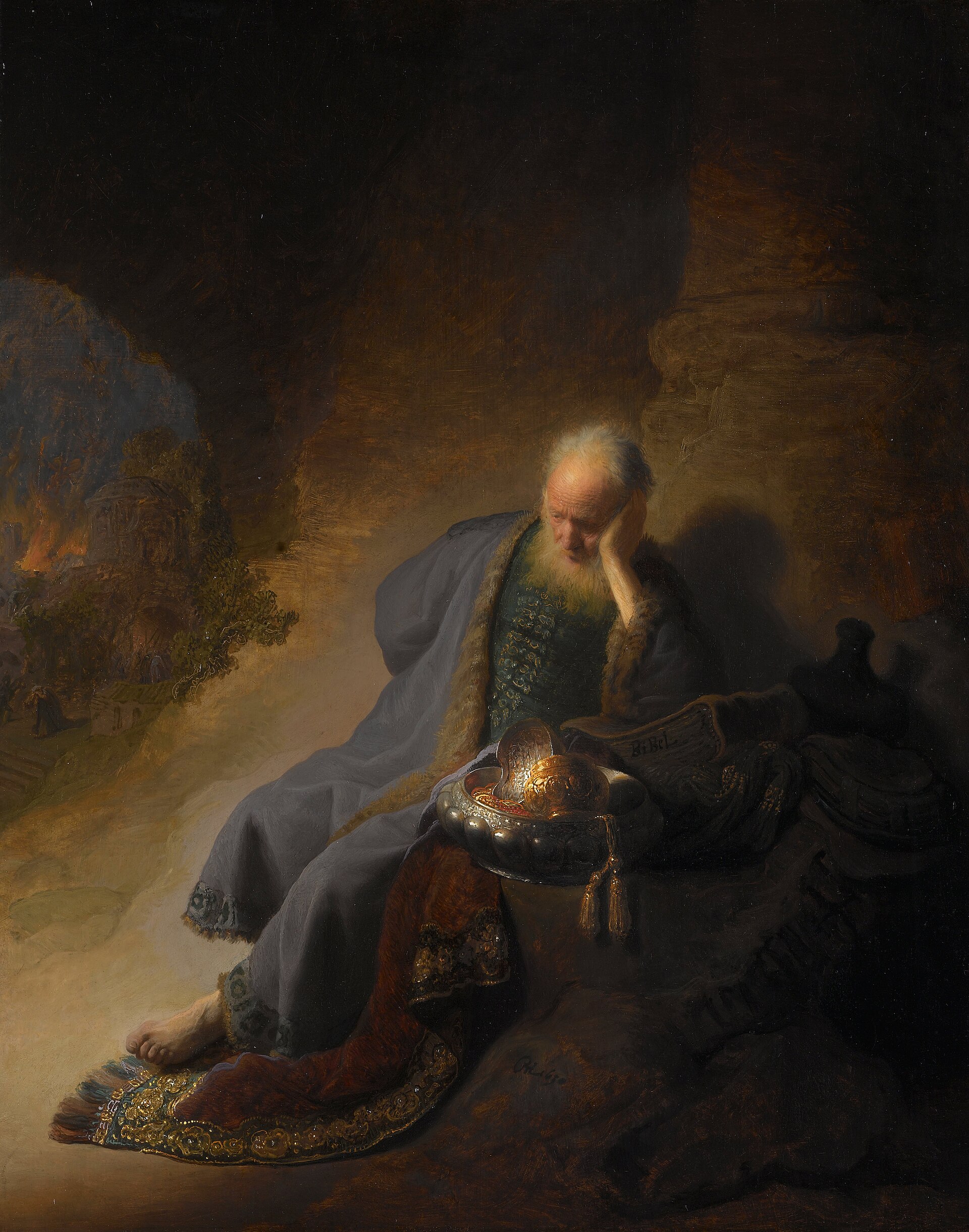
Jeremiahchapter 7
34 verses · Jeremiah, written by Baruch · 7th to 6th century BC · The Prophets
They have built the high places of Topheth in the Valley of Hinnom so they could burn their sons and daughters in the fire—something I never commanded, nor did it even enter My mind.
Introduction
Jeremiah, written by Baruch, The Prophets, Jeremiah Overview.
Jeremiah preached this sermon standing in the gate of the temple as worshippers came in, at the start of the reign of King Jehoiakim. Chapter 26 tells what it nearly cost him. The worshippers believed the building itself made Jerusalem safe, because the city had survived an Assyrian siege a century before. The chapter tests that belief against a ruin any of them could walk to. Listen for the words repeated three times at the start and for the list of commandments that follows. Listen too for what God tells the prophet himself to stop doing. Read it beside chapter 26.
Context
- Who
- Pilgrims arriving to worship, sure that the building itself guaranteed the city
- What
- A sermon at the temple gate warning that the temple will not protect a people who break God's law, with the charges of idolatry and child sacrifice.
- Where
- The gate of the temple in Jerusalem, with the valley of Hinnom and Topheth outside the south-west wall.
- When
- The beginning of the reign of Jehoiakim, about 609 to 608 BC, the date chapter 26 gives for the same sermon.
- Why
- To overturn the belief that the temple guaranteed Jerusalem's safety, and to call the people back to obedience.
Historical context
This is a sermon preached at the door. A speaker in the temple gate faced everyone entering the courts, and the crowd could not get past him without hearing it. Chapter 26 tells the story of what it cost him; this chapter gives the sermon itself.
Show the rest of the historical context, 3 more paragraphs
The chant he mocks, the temple of the LORD, the temple of the LORD, the temple of the LORD, was a real conviction, not a joke. A century earlier Assyria had besieged Jerusalem and gone home without taking it. From that survival, many concluded that God's house in the city made the city untouchable.
His counter-argument is a ruined site anyone could visit. Shiloh, up in the hill country of Ephraim, had housed the tabernacle for generations before the ark was captured in Samuel's day. Excavation at the site shows a violent destruction and burning in that era. The lesson was on the ground, twenty miles north: God had let his own sanctuary be flattened before.
Two practices are named. Cakes were being baked for the queen of heaven, a goddess of love and war worshipped across the region, and a household devotion in which whole families took part. And in the valley of Hinnom, just outside the south-west wall, at a place called Topheth, children were being burned in sacrifice. The Law had forbidden it in the plainest words available.
Significance
The first hearers were being handed a test they could run themselves: go and look at Shiloh. A sanctuary is not a charm. It is a place where God agreed to meet a people who kept covenant, and it can be abandoned.
Show the rest of the significance, 1 more paragraph
The hardest word in the chapter is spoken to the preacher, not the crowd, do not pray for this people. For a nation that had always relied on someone standing in the gap, that was the sound of the door closing.
This chapter in Jewish lifeWhat this chapter is in Jewish life and reading.
What is done
The end of this chapter is read aloud in the synagogue. The site's table in src/lib/hebraic/readings.ts records Jeremiah 7:21 to 8:3 and 9:22 to 9:23 as the Haftarah of Tzav (Leviticus 6:1 to 8:36), in both rites. The Torah portion sets out the burnt offering and the peace offering, and the Haftarah opens on the prophet's word about those same offerings.
Rashi's note on the twenty-first verse reads that word as a rebuke of offerings brought without obedience. It is given under the next heading.
How it is read
Rashi is the one commentator on this chapter whose English the corpus carries, quoted here from The Judaica Press complete Tanach with Rashi, translated by A. J. Rosenberg, which Sefaria reports as CC-BY.
On the threefold cry of the Temple of the Lord, Rashi reads the three as the three pilgrim feasts: "Three times a year you appear before Me" (Rashi on Jeremiah 7:4:1). He reads the questions of the ninth and eleventh verses as questions, and Shiloh as the house destroyed in the days of Eli (Rashi on Jeremiah 7:9:1, 7:11:1 and 7:14:1). The cakes for the queen of heaven were made "the shape of a star" (Rashi on Jeremiah 7:18:1).
On the twenty-first verse Rashi reads the word about burnt offerings as scorn for gifts God will not accept. Since the burnt offering is not accepted, the people might as well eat it as a peace offering, "Why, then, should you lose them?" (Rashi on Jeremiah 7:21:1). On the next verse he names the first condition God set at the Exodus, the covenant of Exodus 19:5, and puts obedience before sacrifice (Rashi on Jeremiah 7:22:1).
The corpus carries thirteen further notes on this chapter without an English text, each marked linked because Sefaria holds no English version of the ref. They stand cited and unquoted at Radak on Jeremiah 7:1:1, 7:2:1, 7:3:1, 7:6:1, 7:7:1, 7:8:1, 7:10:1, 7:12:1, 7:16:1 and 7:17:1. Radak also stands cited at 7:19:1 and 7:23:1. The same holds for Metzudat David on Jeremiah 7:13:1.
What the rabbis say
The corpus carries 40 rabbinic locators on the verses of this chapter, 5 in the Talmud and 35 in the Midrash. It carries the text of none, so each is cited by ref here and never quoted or paraphrased. The verse numbers are the Hebrew ones the corpus prints.
On verse 1 it holds Otzar Midrashim, Midrashim on Megilat Esther, Midrash on the Megillah (of Esther) 3 and Sifrei Devarim 1:3. On verse 4 it holds Ein Yaakov, Nazir 5:1, Nazir 32b:5 and Otzar Midrashim, Baraita of The 32 Midot of Aggadah 1:14. On verse 9 it holds Bereshit Rabbati, Parashat Vayishlach 26, Mekhilta DeRabbi Yishmael, Tractate Bachodesh 8:19 and Midrash Tanchuma Buber, Vayikra 15:1. On verse 12 it holds Sotah 38a:11. On verse 15 it holds Sifrei Devarim 26:7.
On verse 16 it holds Aggadat Bereshit 46:3, Bamidbar Rabbah 2:1 and Berakhot 26b:7. On verse 17 it holds Ein Yaakov (Glick Edition), Taanit 1:30, Midrash Tannaim on Deuteronomy 32:1:1 and Sifrei Devarim 306:1. On verse 18 it holds Devarim Rabbah 10:4, Eikhah Rabbah 1:57 and Pesikta DeRav Kahana 16:11. On verse 20 it holds Midrash Sekhel Tov, Shemot 9:33:7. On verse 21 it holds Megillah 23b:2 and Tanna DeBei Eliyahu Rabbah 6:1. On verse 22 it holds Aggadat Bereshit 31:1.
On verse 24 it holds Midrash Lekach Tov on Lamentations 1:13:1, Midrash Lekach Tov on Lamentations 1:8:1 and Midrash Lekach Tov, Deuteronomy 29:18:1. On verse 25 it holds Avot DeRabbi Natan 1:3, Eikhah Rabbah 2:17 and Eikhah Rabbah, Petichta 31. On verse 26 it holds Aggadat Bereshit 74:3, Midrash Aggadah, Numbers 33:1:1 and Pesikta DeRav Kahana 14:2. On verse 29 it holds Ein Yaakov (Glick Edition), Sotah 9:2, Ein Yaakov, Niddah 3:6 and Ein Yaakov, Sotah 9:1.
On verse 31 it holds Midrash Tanchuma Buber, Appendix to Vaetchanan 2:2 and Midrash Tannaim on Deuteronomy 18:9:6. On verse 34 it holds Midrash Lekach Tov on Lamentations 5:14:1, Midrash Tanchuma Buber, Devarim 1:1 and Midrash Tanchuma, Ki Tavo 4:1.
Sources: Rashi, Rashi on Jeremiah 7:4:1 to 7:25:1, The Judaica Press complete Tanach with Rashi, translated by A. J. Rosenberg, reported CC-BY; Metzudat David, Metzudat David on Jeremiah 7:13:1, cited by ref because the corpus carries no English text; Radak, Radak on Jeremiah 7:1:1, 7:2:1, 7:3:1, 7:6:1, 7:7:1, 7:8:1, 7:10:1, 7:12:1, 7:16:1, 7:17:1, 7:19:1 and 7:23:1, cited by ref because the corpus carries no English text; The Sefaria corpus, scripts/data/sources/sefaria/jeremiah/7.json, the 40 Talmud and Midrash locators on the verses of this chapter; The site's own files, src/lib/hebraic/readings.ts, probed for Jeremiah 7: a Haftarah use, and no festival reading for the book.
The heads below are this chapter's scenes. The numbered points under each are its verses.
Stand in the Gate: The Temple of the LORD, the Temple of the LORD
Jeremiah 7:1-3
the word that came to Jeremiah from the LORD: Jeremiah is told to “Stand in the gate of the house of the LORD” and preach to the worshippers. So the temple court becomes a courtroom on the way to sacrifice. The message is conditional, “Correct your ways and deeds, and I will let you live in this place”.
Jeremiah 7:1
“The word that came to Jeremiah,.... The Word of prophecy, as the Targum: from the Lord, saying; this begins a new prophecy. This verse, and the beginning of the next, are wanting in the Septuagint version.”
Wesley places Jeremiah at the east gate, the public way in and out of the courts where the people gathered. Barnes dates the sermon to the start of Jehoiakim's reign and links it to Jeremiah 26, where preaching it nearly cost the prophet his life. Ahikam protected him.
Jeremiah 7:2
“Stand in the gate of the Lord’s house - There was a show of public worship kept up. The temple was considered God’s residence; the usual ceremonies of religion restored by Josiah were still observed; and the people were led to consider the temple and its services as sacred things, which would be preservatives to them in case of the threatened invasion.”
Adam Clarke · Commentary on the Bible (1810-1826)evangelical
1 more voice on this verse
Jeremiah 7:2
“The gate - The east gate, which was the publick place of going out and coming in, and where the people were then wont to assemble. Proclaim - Proclaiming signifies both the authority by which he spake, and the divulging of what he spake plainly and boldly; possibly, it might be at some publick time, when all the males were to meet.”
John Wesley · Explanatory Notes upon the Old Testament (1765)evangelical
Correct your ways and deeds: Jerome compares the LORD here to a physician who names the wound so that he can heal it. The command to correct assumes the ways are crooked, and Matthew Henry notes that it also shows the people where and how to mend. Mercy speaks first.
Jeremiah 7:3
“But it is a great instance of the favour of God to them that he gives them liberty to amend, shows them where and how they must amend, and promises to accept them upon their amendment: " I will cause you to dwell quietly and peaceably in this place, and a stop shall be put to that which threatens your expulsion." Reformation is the only way, and a sure way to ruin.”
Matthew Henry · Commentary on the Whole Bible (1707-1721)puritan
1 more voice on this verse
Jeremiah 7:3
“If the people repented, instead of being led into captivity, God would maintain their national existence. It is a promise of the continuance of an old blessing.”
Jeremiah 7:4-7
Do not trust in deceptive words: The temple slogan is quoted three times running, “the temple of the LORD, the temple of the LORD, the temple of the LORD”. Confidence in the building stands in for the obedience the building was built to house. The conditions that follow restate the terms Israel accepted at Sinai.
Jeremiah 7:4
“The temple of the Lord - In the Chaldee the passage stands thus: - “Do not trust in the words of lying prophets, which say, Before the temple of the Lord ye shall worship; Before the temple of the Lord ye shall sacrifice; Before the temple of the Lord ye shall adore; thrice in the year ye shall appear before it.” This the Targumist supposes to have been the reason why the words are here thrice repeated.”
Adam Clarke · Commentary on the Bible (1810-1826)evangelical
3 more voices on this verse
Jeremiah 7:4
If heaven and earth must pass away, obviously all things that are earthly must also pass away. Therefore the spots that witnessed the crucifixion and the resurrection profit those only who bear their several crosses, who day by day rise again with Christ and who thus show themselves worthy of an abode so holy. Those who say, "the temple of the Lord, the temple of the Lord," should give ear to the words of the apostle: "you are the temple of the Lord," and the Holy Spirit "dwells in you."
Jerome · written before 420 · LETTER 58.3patristic
Jeremiah 7:4
“Saying - Because this was God's house, they flattered themselves that he would not suffer the Chaldeans to destroy it, therefore the prophet cautions them not to deceive themselves, trusting to the temple and its buildings, as the two courts and house, and holy of holies implied in the word these, which he doth as it were point to with his finger.”
John Wesley · Explanatory Notes upon the Old Testament (1765)evangelical
Jeremiah 7:4
“Now the object of his sermon was, to exhort them seriously to repent, if they wished God to be reconciled to them. So the Prophet shews, that God did not regard their sacrifices and external rites, and that this was not the way, as they thought, of appeasing him.”
John Calvin · Commentaries (1554)reformed
if you act justly toward one another: Verses 5 and 6 set out the terms, and verse 7 gives the promise of the land that hangs on them. To act justly toward one another comes first, before the temple and its offerings. Barnes calls these the conditions the people must keep.
Jeremiah 7:5
“A summary of the conditions indispensable on man’s part, before he can plead the terms of the covenant in his favor. Jer 7:6 In this place - i. e., in Jerusalem. The prophet refers to innocent blood shed there judicially. Of one such judicial murder Jehoiakim had already been guilty Jer 26:23. Jer 7:7 Why then do not the Jews still possess a land thus eternally given them? Because God never bestows anything unconditionally.”
the foreigner and the fatherless: Wesley counts three sins here: oppression, bloodshed and idolatry. He adds that the foreigner, the fatherless and the widow are the people the LORD has taken under his own protection. Barnes ties the innocent blood to a killing Jehoiakim had already ordered in Jerusalem, recorded at Jeremiah 26:23.
Jeremiah 7:6
“Oppress not - Here they are cautioned against three sins, that this people were generally addicted to, oppression, blood, and idolatry; and instances in the worst of oppressions, of such as God hath more especially taken into his immediate protection.”
John Wesley · Explanatory Notes upon the Old Testament (1765)evangelical
the land that I gave to your fathers forever and ever: Forever and ever describes the grant as it was first given to the fathers. Matthew Henry reads the tenure as a covenant promise held by virtue of that grant, and adds that only sin could throw the people out. The conditions of verses 5 and 6 guard it.
Jeremiah 7:7
“They shall enjoy it by covenant, by virtue of the grant made of it to their fathers, not by providence, but by promise. They shall continue in the enjoyment of it without eviction or molestation; they shall not be disturbed, much less dispossessed, for ever and ever; nothing but sin could throw them out.”
Matthew Henry · Commentary on the Whole Bible (1707-1721)puritan
Jeremiah 7:8-11
trusting in deceptive words to no avail: Verse 8 states the charge plainly, “you keep trusting in deceptive words to no avail”. Jesus repeats the words “a den of robbers” at the temple cleansing in Matthew 21:13, Mark 11:17 and Luke 19:46. A den of robbers is where robbers go to feel safe after the crime.
burn incense to Baal: The verse runs through the commandments of Sinai one by one: theft, murder, adultery, false oaths and other gods. Barnes hears the charge as a people who break the Ten Commandments and then walk into the temple. Clarke asks how such worshippers could expect to escape.
Jeremiah 7:9
“Will ye steal, murder - Will you continue to commit such abominations, and pretend to worship me; and thus defile the place that is called by my name; and so make my house a den of robbers? I have seen this, - and can you expect to escape condign punishment? Ye shall not escape.”
Adam Clarke · Commentary on the Bible (1810-1826)evangelical
1 more voice on this verse
Jeremiah 7:9
“Those that think to excuse themselves in unchristian practices with the Christian name, and sin the more boldly and securely because there is a sin-offering provided, do, in effect, make God's house of prayer a den of thieves, as the priests in Christ's time, Matt. xxi.”
Matthew Henry · Commentary on the Whole Bible (1707-1721)puritan
We are delivered is the worshippers' own verdict on themselves as they leave the service. Barnes paraphrases it as a clean slate, the past atoned for and the old wickedness free to begin again. The temple had become a place to reset sin.
Jeremiah 7:10
We are delivered - Jeremiah accuses them of trusting in the ceremonial of the temple instead of leading holy lives. “You break,” he says, “the Ten Commandments, and then you go to the Temple; and when the service is over you say, We are delivered. We have atoned for our past actions, and may start afresh with easy minds upon a new course of wickedness.”
a den of robbers: Barnes notes that the Hebrew word for robbers means men who tear, those who rob by violence. The temple sheltered them. The LORD answers the people's blindness with his own sight, for he has seen it.
Jeremiah 7:11
"Has not this house, in which my name is invoked, been made a den of thieves before your eyes? I who am, I have seen it, says the Lord." I believe that it was from here that the Gospel took: "It is written, 'My father's house will be called a house of prayer,' but you have made it a den of thieves," or, according to another Gospel, "a house of trade." The church of God is turned into a den of thieves when robbery, murder, adultery, perjury, sacrilege, heretical inventions and other evils are practiced within it.
Jerome · written before 420 · Six Books on Jeremiah 2:34.1-3patristic
1 more voice on this verse
Jeremiah 7:11
“Robbers - literally, tearers, those who rob with violence. The temple was the place which sheltered them. It had been consecrated to God. Now that it harbors miscreants, must it not as inevitably be destroyed as a den of robbers would be by any righteous ruler?”
Cross references
Jeremiah 7:11
Jeremiah 7:12-15
go now to the place in Shiloh: The command to “go now to the place in Shiloh” points to the tabernacle's first home, destroyed after Eli's sons and remembered in Psalm 78:60-64. The LORD draws the lesson, “what I did to Shiloh I will now do to the house that bears My Name”.
Jeremiah 7:12
“But go ye now unto my place which was in Shiloh - See what I did to my tabernacle and ark formerly: after a long residence at Shiloh, for the iniquity of the priests and the people, I suffered it to fall into the hands of the Philistines, and to be carried captive into their land, and to be set up in the house of their idols.”
Adam Clarke · Commentary on the Bible (1810-1826)evangelical
1 more voice on this verse
Jeremiah 7:12
“Shiloh was situated between Beth-el and Shechem in Ephraim. at the first--implying that Shiloh exceeded the Jewish temple in antiquity. But God's favor is not tied down to localities (Ac 7:44). my people Israel--Israel was God's people, yet He spared it not when rebellious: neither will He spare Judah, now that it rebels, though heretofore it has been His people.”
Jamieson, Fausset & Brown · Commentary Critical and Explanatory on the Whole Bible (1871)reformed
I have spoken to you again and again: Again and again renders a Hebrew phrase, rising early and speaking. Barnes calls it an expression for earnest speech used only by Jeremiah. Matthew Henry adds that every word God had spoken makes what the people had done heavier.
Jeremiah 7:13
“Rising up early and speaking - A proverbial expression for “speaking zealously and earnestly.” It is used only by Jeremiah.”
the house in which you trust: The phrase the house in which you trust makes the temple itself the object of Judah's confidence. Jamieson, Fausset and Brown note that the land remained the LORD's after he gave it, citing Leviticus 25:23, so the Giver could revoke the gift. Shiloh had already shown it.
Jeremiah 7:14
“I gave--and I therefore can revoke the gift for it is still Mine (Le 25:23), now that ye fail in the only object for which it was given, the promotion of My glory.”
Jamieson, Fausset & Brown · Commentary Critical and Explanatory on the Whole Bible (1871)reformed
all the descendants of Ephraim: Ephraim names the whole northern kingdom. Jerome explains the usage: Jeroboam son of Nebat, the first king of the ten tribes, came from the tribe of Ephraim. Barnes draws the lesson that holding the signs of God's presence gave Israel no safety once it was unworthy of them.
Jeremiah 7:15
“The whole seed of Ephraim - i. e., the whole of the nine northern tribes. Their casting out was a plain proof that the possession of the symbols of God’s presence does not secure a Church or nation from rejection, if unworthy of its privileges.”
Cakes for the Queen of Heaven: Pray Not for This People
Jeremiah 7:16-20
do not pray for these people: The command “do not pray for these people” comes again at 11:14 and 14:11, three times in the book. At verse 18 the whole household serves the Queen of Heaven, idolatry built into the family's daily labor. The exiles keep the same devotion at 44:17-25, likely to Ishtar or Astarte.
Jeremiah 7:16
“Therefore pray not thou for this people - They have filled up the measure of their iniquity, and they must become examples of my justice. How terrible must the state of that place be, where God refuses to pour out the spirit of supplication on his ministers and people in its behalf!”
Adam Clarke · Commentary on the Bible (1810-1826)evangelical
1 more voice on this verse
Jeremiah 7:16
“But there was another thing which might stand them in some stead, and which yet they had no value for, and that was the prophet's intercession for them; his prayers would do them more good than their own pleas: now here that support is taken from them; and their case is said indeed who have lost their interest in the prayers of God's ministers and people.”
Matthew Henry · Commentary on the Whole Bible (1707-1721)puritan
in the cities of Judah and in the streets of Jerusalem?: The LORD tells the prophet to look. Barnes notes the two settings, idolatry in the country towns and idolatry in the open streets of the capital. Matthew Henry adds that the people did it under the prophet's own eyes and defied his office.
Jeremiah 7:17
“The proof of the hopeless immorality of the people is this, that they worship pagan deities (1) generally in the cities of Judah, and not in the capital only; and (2) publicly in the streets of Jerusalem. Such public idolatry could have been practiced only in the reign of a king like Jehoiakim.”
1 more voice on this verse
Jeremiah 7:17
“This intimates both that the sin was evident and could not be denied and that the sinners were impudent and would not be reclaimed; they committed their wickedness even in the prophet's presence and under his eye; he saw what they did, and yet they did it, which was an affront to his office, and to him whose officer he was, and bade defiance to both.”
Matthew Henry · Commentary on the Whole Bible (1707-1721)puritan
cakes for the Queen of Heaven: Wesley and Clarke identify the Queen of Heaven with the moon, set beside the sun as the king of the sky. Clarke adds that the sun and planets, the host of heaven, may be included in the worship with her. Other gods received the drink offerings.
Jeremiah 7:18
“The children gather wood - Here is a description of a whole family gathered together, and acting unitedly in idolatrous worship. 1. The children go and collect wood, and bring it to the place of sacrifice. 2. The fathers lay it in order, and kindle a fire. 3. The mother and her maids knead dough, make their batch, and out of it form cakes, and bake them for the honor of the queen of heaven; most probably the moon, though perhaps not exclusive of the sun and planets, generally called the host of heaven.”
Adam Clarke · Commentary on the Bible (1810-1826)evangelical
1 more voice on this verse
Jeremiah 7:18
“The children - Here God shews how busily they are employed from the youngest to the oldest for their idolatry. The queen - As the sun was looked upon as king, so the moon as the queen of heaven.”
John Wesley · Explanatory Notes upon the Old Testament (1765)evangelical
Is it not themselves they spite: The question turns the provocation back on the people who made it. Jerome answers that anger cannot harm God, so the wrong lands on those who do it and brings confusion on their own faces. Shame is their only gain.
Jeremiah 7:19
“Do they not provoke ... - literally, Is it not themselves (“that they provoke”) to the shame of their faces?”
it will burn and not be extinguished: The wrath reaches the whole land: man, beast, trees and harvest. Matthew Henry notes that once this fire is kindled, prayers and tears will no longer put it out. Verse 16 had already stopped the prophet's prayers.
Jeremiah 7:20
“Upon man, and upon beast - All creation in some mysterious way shares in man’s fall and restoration Rom 8:19-22.”
I Spake Not of Burnt Offerings, but of Obedience
Jeremiah 7:21-23
Add your burnt offerings to your other sacrifices: Verse 22 says the LORD “did not merely command them about burnt offerings and sacrifices”, for the sacrificial law was not the first word. That first word stands in verse 23, “Obey Me, and I will be your God”.
Jeremiah 7:21
“The meaning is, Increase your sacrifices as you will. Acid burnt-offering to peace-offerings. All is in vain as long as you neglect the indispensable requirements of obedience and moral purity. Eat flesh is equivalent to sacrifice. The flesh of animals offered in sacrifice was usually eaten by the offerers, and this meal was regarded as a symbol of reconciliation. God and man partook of the same victim, and so were made friends. This passage Jer 7:21-28 is the Haphtarah (lesson) from the prophets, after the Parashah, Lev. 6–8, or Lesson from the Law.”
about burnt offerings and sacrifices: The word merely in the Berean reading follows the view Jamieson, Fausset and Brown take: sacrifice was a means, and love for God the end. They point to 1 Samuel 15:22. Matthew Henry reads the verse as an appeal to the covenant made when Israel came out of Egypt.
Jeremiah 7:22
“He appeals to the original contract, by which they were first formed into a people, when they were brought out of Egypt. God made them a kingdom of priests to himself, not that he might be regaled with their sacrifices, as the devils, whom the heathen worshipped, which are represented as eating with pleasure the fat of their sacrifices and drinking the wine of their drink-offerings, Deut. xxxii.”
Matthew Henry · Commentary on the Whole Bible (1707-1721)puritan
1 more voice on this verse
Jeremiah 7:22
"I will have mercy, and not sacrifice" (1Sa 15:22). Love to God is the supreme end, external observances only means towards that end. "The mere sacrifice was not so much what I commanded, as the sincere submission to My will gives to the sacrifice all its virtue" [MAGEE, Atonement, Note 57].
Jamieson, Fausset & Brown · Commentary Critical and Explanatory on the Whole Bible (1871)reformed
Obey Me, and I will be your God: Barnes reads the words as a summary of what God commanded the fathers when he brought them out of Egypt, pointing to Exodus 19:5-6. To obey and walk in his ways is the covenant's goal. Tertullian hears God's invitation here, and the people's refusal in verse 24.
Jeremiah 7:23
In a manner most germane to this parable, He said by Jeremiah: "Obey my voice, and I will be your God, and ye shall be my people; and ye shall walk in all my ways, which I have commanded you." This is the invitation of God. "But," says He, "they hearkened not, nor inclined their ear." This is the refusal of the people. "They departed, and walked every one in the imagination of their evil heart." "I have bought a field-and I have bought some oxen-and I have married a wife."
Tertullian · written before 220 · The Five Books Against Marcion, Book 4patristic
Jeremiah 7:24-28
They went backward and not forward: The record runs from the exodus generation to this one, a people who “followed the stubborn inclinations of their own evil hearts”. Prophets were sent “again and again”, yet they “did more evil than their fathers”. Jeremiah must preach though told “they will not listen to you”.
Jeremiah 7:24
“When I said, "Hear my voice and I will be your God," "they did not listen or incline their ears" but followed the desires of their own hearts and, contrary to the principle of the apostle, who forgot what was in the past and strived for what lay before him, they did the opposite, pining for the past and despising the future.”
Jerome · written before 420 · Six Books on Jeremiah 2:41.2-3patristic
1 more voice on this verse
Jeremiah 7:24
“Imagination - Better, as in the margin. And went backward - literally, as in the margin; i. e., they turned their back upon Me to follow their own devices.”
I have sent you all My servants the prophets: The prophets were sent from the day the fathers came out of Egypt until Jeremiah's own day. The Hebrew idiom behind again and again is the one Barnes explains at verse 13, rising early to send. Jerome saw in this record the people's need of grace.
Jeremiah 7:25
“He also reports that they acted offensively against the Lord "from the day on which their ancestors left the land of Egypt until the present time." Hence, the grace of the gospel was necessary to save them, not due to their own merits but to the Lord's mercy.”
Jerome · written before 420 · Six Books on Jeremiah 2:41.2-3patristic
they stiffened their necks: A stiffened neck is the ox that refuses the yoke. Matthew Henry calls it the settled temper, passed from fathers to sons until it ruined them at last, each generation worse than the one before.
Jeremiah 7:26
“This had been their way and manner all along; they were of the same stubborn refractory disposition with those that went before them; it had all along been the genius of the nation, and an evil genius it was, that continually haunted them till it ruined them at last. Their practice and character were still the same. They are worse, and not better, than their fathers.”
Matthew Henry · Commentary on the Whole Bible (1707-1721)puritan
they will not listen to you: The LORD tells Jeremiah the outcome before he speaks. Jamieson, Fausset and Brown call this a trial of the prophet's faith: he was to deliver the warning in obedience, knowing it would be refused. Ezekiel received the same charge at Ezekiel 2:7.
Jeremiah 7:27
"Have no doubt," he says, "that they are stiff-necked and that their works are worse than those of their ancestors. Behold, I give them a place of penance. I do not speak that they may repent, but I only predict what is coming. In any event, you will now speak my word to them and they will not listen to you, and you will call them and they will not answer you, for they are so prideful that when you ask them for a hearing, no one will even bother to respond."
Jerome · written before 420 · Six Books on Jeremiah 2:43.1-3patristic
1 more voice on this verse
Jeremiah 7:27
“Therefore--rather, "Though thou speak . . . yet they will not hearken" [MAURER], (Eze 2:7), a trial to the prophet's faith; though he knew his warnings would be unheeded, still he was to give them in obedience to God.”
Jamieson, Fausset & Brown · Commentary Critical and Explanatory on the Whole Bible (1871)reformed
would not receive correction: Jerome reads correction as discipline, the training the LORD gave his people through judgment and mercy alike. Clarke notes that blessings and chastenings had both been lost on the nation. Jeremiah is to say it to their faces.
Jeremiah 7:28
"And you should then say to them: This is the generation who did not listen to the voice of the Lord their God or accepted his discipline." It is beautiful, as I said before, not that he calls his own people, but that he calls the human race. For, although at the time of the prophets, it was done in part and as a foreshadowing, it was only fulfilled in Christ, when they refused to accept discipline and despised the voice of their Lord.
Jerome · written before 420 · Six Books on Jeremiah 2:43.1-3patristic
1 more voice on this verse
Jeremiah 7:28
“Nor receiveth correction - They have profited neither by mercies nor by judgments: blessings and corrections have been equally lost upon them.”
Adam Clarke · Commentary on the Bible (1810-1826)evangelical
Topheth and the Valley of Slaughter
Jeremiah 7:29-31
Cut off your hair and throw it away: The order “Cut off your hair and throw it away” turns a mourning rite into a command, Jerusalem grieving for herself as for the dead. The high places of Topheth, where children were burned, are named as “something I never commanded, nor did it even enter My mind”.
Jeremiah 7:29
“Cut off thine hair - This was an usual token of sorrow among the Jews. On high places - Upon the high places where thou wentest a whoring from me. The generation - A generation destined to the wrath of God.”
John Wesley · Explanatory Notes upon the Old Testament (1765)evangelical
1 more voice on this verse
Jeremiah 7:29
“Jeremiah summons the people to lament over the miserable consequences of their rejection of God. In the valley of Hinnom, where lately they offered their innocents, they shall themselves fall before the enemy in such multitudes that burial shall be impossible, and the beasts of the field unmolested shall prey upon their remains.”
set up their abominations in the house: The abominations are idols placed inside the temple itself. Jerome points to Ezekiel's vision of an image of Baal set up in the house of God. The courts that bore the LORD's name held his rivals.
the high places of Topheth: Gill reports the Jewish commentator Jarchi, who derived the name Topheth from the drums beaten to cover the cries of the sons and daughters burned. Clarke calls Topheth the place where the fire was kept burning. The Valley of Hinnom lay south of Jerusalem.
Jeremiah 7:31
“And they have built the high places of Tophet,.... Where was the idol Moloch; and which place had its name, as Jarchi thinks, from the beating of drums, that the parents of the children that were burnt might not hear the cry of them: which is in the valley of the son of Hinnom; a valley near Jerusalem, and lay to the south of it, Jos 15:8, to burn their sons and their daughters in the fire: which was done, as Jarchi says, by putting them into the arms of the brasen image Moloch, heated hot.”
2 more voices on this verse
Jeremiah 7:31
“Tophet - in the valley of the son of Hinnom - Tophet was the place in that valley where the continual fires were kept up, in and through which they consecrated their children to Moloch.”
Adam Clarke · Commentary on the Bible (1810-1826)evangelical
Jeremiah 7:31
“Surely it was in a way of righteous judgment, because they had changed the glory of God into the similitude of a beast, that God gave them up to such vile affections that changed them into worse than beasts.”
Matthew Henry · Commentary on the Whole Bible (1707-1721)puritan
Jeremiah 7:32-34
but the Valley of Slaughter: The valley is renamed “the Valley of Slaughter”. The sounds of joy and gladness and the voices of bride and bridegroom fall silent, echoed over Babylon in Revelation 18:23. The sermon that opened at the temple gate closes with the land “a wasteland”.
Jeremiah 7:32
“The valley of slaughter - The place where the slaughtered thousands of this rebellious people shall be cast, in order to their being burnt, or becoming food for the beasts of the field and the fowls of the air, Jer 7:33. These words are repeated, and their meaning more particularly explained, Jer 19:6-15.”
Adam Clarke · Commentary on the Bible (1810-1826)evangelical
1 more voice on this verse
Jeremiah 7:32
“Nay, it is a piece of divinity, in expectation of what the dead body shall be at the resurrection. The want of it has sometimes been an instance of the rage of men against God's witnesses, Rev. xi. Here it is threatened as an instance of the wrath of God against his enemies, and is an intimation that evil pursues sinners even after death.”
Matthew Henry · Commentary on the Whole Bible (1707-1721)puritan
there will be no one to scare them away: Gill notes that to lie unburied was counted a great judgment in Israel. The verse leaves the dead with no one even to drive the birds and beasts away from them. Topheth has run out of room.
Jeremiah 7:33
“And the carcasses of this people shall be meat for the fowls of the heaven, and for the beasts of the earth,.... That is, those which remain unburied, for which there will be found no place to bury them in; all places, particularly Tophet, being so full of dead bodies; not to have a burial, which is here threatened, was accounted a great judgment: and none shall fray them away; or frighten them away; that is, drive away the fowls and the beasts from the carcasses.”
the voices of the bride and bridegroom: The wedding song stands for ordinary life going on. Clarke reads the verse as the end of marriage in Jerusalem, with no cause of joy left and the land made desolate. Such sins, he adds, drew a judgment of the same weight.
Jeremiah 7:34
“Then will I cause to cease - the voice of mirth - There shall no longer be in Jerusalem any cause of joy; they shall neither marry nor be given in marriage, for the land shall be totally desolated. Such horrible sins required such a horrible punishment. And they must be horrible, when they move God to destroy the work of his own hands.”
Adam Clarke · Commentary on the Bible (1810-1826)evangelical
Keep studying
Studies11
Sources for this chapter
The summary
Jamieson, Fausset & Brown, Commentary Critical and Explanatory; John Calvin, Commentaries; John Wesley, Notes on the Old Testament and Matthew Henry, Complete Commentary.
The exposition
Adam Clarke, Commentary on the Bible; Albert Barnes, Notes, Explanatory and Practical, on the Old and New Testaments (1832-1869); Carl Friedrich Keil, The Prophecies of Jeremiah; Jamieson, Fausset & Brown, Commentary Critical and Explanatory on the Whole Bible; Jerome; John Calvin, Commentary on Jeremiah and Lamentations; John Gill; John Wesley, Explanatory Notes upon the Old Testament; Matthew Henry, Commentary on the Whole Bible and Tertullian, The Five Books Against Marcion, Book 4.