
2 Chronicleschapter 20
37 verses · KJV2 Chronicles book hub →
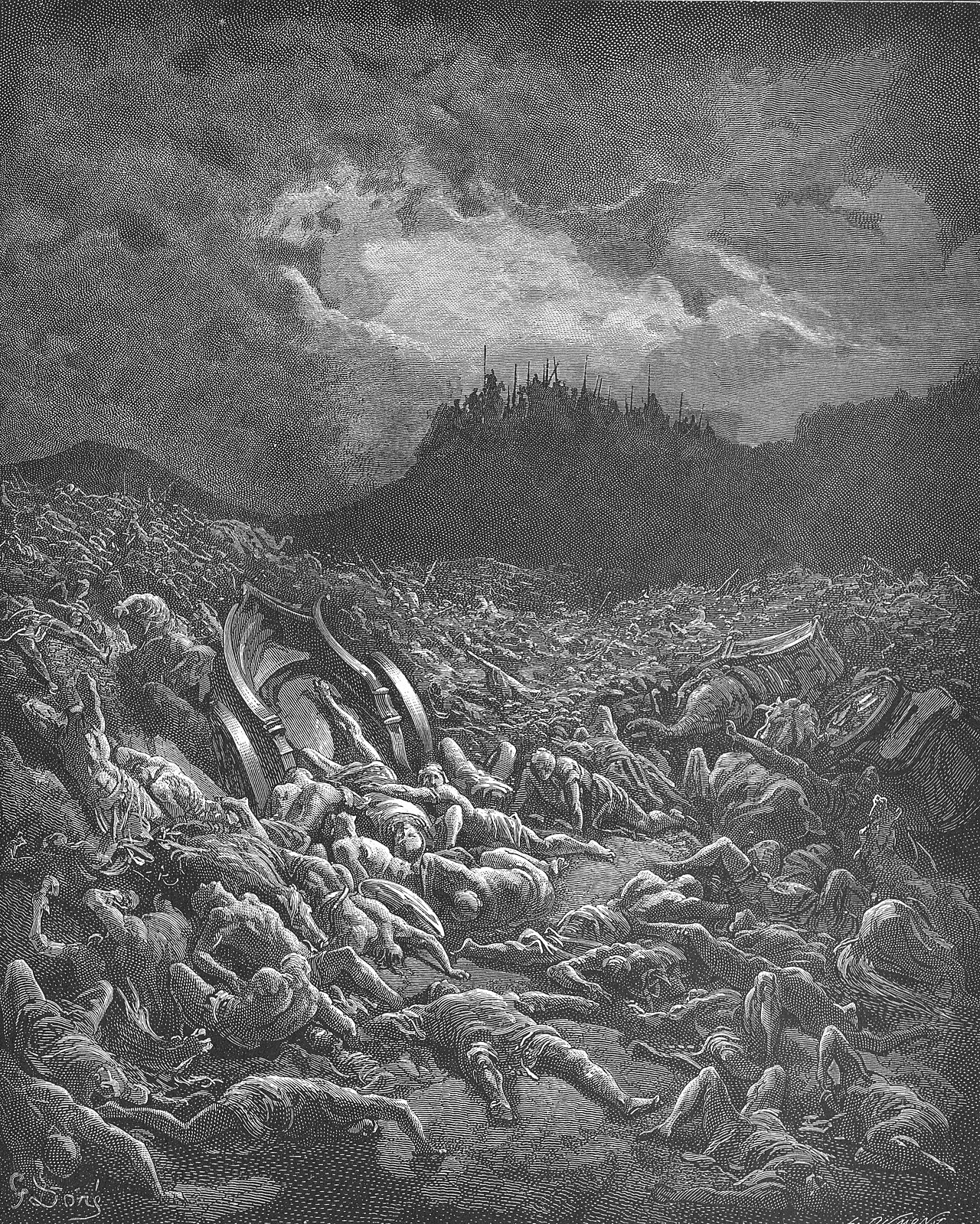
Gustave Doré, 1866The Ammonite and Moabite Armies Are Destroyed, Gustave Doré, Doré's English Bible (1866), public domain
Key verse
And when he had consulted with the people, he appointed singers unto the Lord, and that should praise the beauty of holiness, as they went out before the army, and to say, Praise the Lord; for his mercy endureth for ever.
It stands in Singers march in front, and three days are spent gathering spoil, verses 20 to 30.
The chapter
Chapter summary
Moab, Ammon, and the Meunim come against Judah, and Jehoshaphat, afraid, sets himself to seek Jehovah and proclaims a fast. His prayer ends: 'we have no might against this great company that cometh against us; neither know we what to do: but our eyes are upon thee.' Jahaziel, a Levite of the sons of Asaph, answers by the Spirit: 'the battle is not yours, but God's… stand ye still, and see the salvation of Jehovah with you.' At dawn toward Tekoa the king says, 'Believe in Jehovah your God, so shall ye be established; believe his prophets, so shall ye prosper'. And sends the singers out before the army. The enemy destroys itself; the valley is named Beracah, blessing.
Context
History · Ezra · 2 Chronicles overview
The world behind this chapter
2 Chronicles 20The history
The chapter belongs to Jehoshaphat in the years of his strength and to Jahaziel, a Levite singer, and the site's dossier for this book anchors the deliverance at about 853 BC.
The places are the new court of the temple in Jerusalem, the shore road by the Dead Sea, and the wilderness of Tekoa above it.
The occasion is an invasion already close, come around the southern end of the Dead Sea and up the shore to En-gedi, then up the Ascent of Ziz onto the Judean ridge. That hard road brought them out about a day's march from Jerusalem, past every fortress in the south.
The rest of the history, and what it meant to them
A first hearer knew what a proclaimed fast was. It was the recognised public act of a community in emergency, and people came in from all the cities of Judah to stand with their wives and children while the king prayed aloud.
A first hearer also knew who carried the answer. Jahaziel is a Levite of the sons of Asaph, one of the temple singers speaking as a prophet, which is the ministry the earlier chapters described.
A first hearer knew, last, that three allied armies moving through confined hill country on unfamiliar ground are open to panic and to each other. The phrase about ships going to Tarshish in the closing verses names a class of large seagoing vessel rather than a destination.
What it meant to them
This was the first hearers' own playbook. Ezra proclaimed a fast at the river Ahava because he was ashamed to ask the king for soldiers to guard the road home.
Fast, assemble, pray in the temple court, hear the word through a Levite, and put the singers in front. A community with no army had one strategy, and this chapter is its clearest example.
Sources cited
- John H. Walton, Victor H. Matthews, and Mark W. Chavalas, The IVP Bible Background Commentary: Old Testament
- Keil and Delitzsch, Biblical Commentary on the Old Testament: Chronicles
- The 2 Chronicles dossier's timeline, `src/components/book/dossier-content/2-chronicles.ts`
- The 2 Chronicles rows of `scripts/data/historical-context/ch3-chronicles.mjs`
Where the chapter sits
2 Chronicles 20 falls in Kings of Judah: Rehoboam to Ahaz (chapters 10–28). The divided kingdom narrated from Judah's side only; reform kings (Asa, Jehoshaphat, Joash, Uzziah, Jotham) and evil kings; prophetic interventions unique to Chronicles (Azariah, Hanani, Zechariah son of Jehoiada).
Jehoshaphat's deliverance. ‘The battle is not yours, but God's’; the singers go before the army.
Before it: Solomon's reign, chapters 1–9. After it: Hezekiah to the exile, chapters 29–36.
The whole shape of 2 Chronicles→The structure of this chapter
The heads below are this chapter's scenes. The numbered points under each are its verses.
A. A great multitude comes, and all Judah stands and looks to God
1. (vv. 1-2)
2 Chronicles 20:1
“The present Hebrew (and English) text mentions the Ammonites twice over. Hence, some adopt a different reading and translate “the children of Ammon, and with them certain of the Maonites,” etc. Compare 2Ch 20:10, note; Jdg 10:12, note; 1Ch 4:41, note.”
2 Chronicles 20:2
“On this side Syria - Instead of מארם mearam, from Syria, I would read with one of Kennicott’s MSS. (89) מאדם meedom, from Edom, which alteration brings it to truth and does not require the change of half a letter, as it consists in the almost imperceptible difference between ר resh and ד daleth. We do not read of any Syrians in this invasion, but we know there were Edomites, or inhabitants of Mount Seir. Hazazon-tamar - “In the wood of palm trees, that is, in Engedi.” - Targum.”
Adam Clarke· Commentary on the Bible (1810-1826)evangelical
the children of Moab, and the children of Ammon: The coalition is family: Moab and Ammon are Lot's sons, and mount Seir joins from Esau, kindred nations Israel was forbidden to dispossess on the way up from Egypt. They come by the Dead Sea's western shore and are already at En-gedi when the report lands, a day's march from Jerusalem. The threat arrives at the door before the king hears of it.
2. (vv. 3-4)
2 Chronicles 20:3
“General fasts had been previously observed by the Israelites (e. g. Jdg 20:26; 1Sa 7:6); but we do not hear of any fast having been “proclaimed” by authority before this.”
1 more voice on this verse
2 Chronicles 20:3
“Fasting from bodily refreshments, upon such extraordinary occasions, is a token of self-judging for the sins we have committed (we own ourselves unworthy of the bread we eat, and that God might justly withhold it from us), and of self-denial for the future; fasting for sin implies a resolution to fast from it, though it has been to us as a sweet morsel.”
Matthew Henry· Commentary on the Whole Bible (1707-1721)puritan
2 Chronicles 20:4
“The place they met in was the house of the Lord, before the new court, which was perhaps lately added to the former courts (that, as some think, which was called the court of the women ); thus they came within reach of that gracious promise which God had made, in answer to Solomon's prayer, ch. vii. My ears shall be attentive to the prayer that is made in this place.”
Matthew Henry· Commentary on the Whole Bible (1707-1721)puritan
proclaimed a fast: Jehoshaphat feared, and the fear is set down without embarrassment; what he does with it is the chapter. He set himself to seek the LORD, the verb Chronicles measures every king by, and turns the panic into a national fast, so that Judah gathers out of all the cities to ask help of the LORD. The crisis becomes a congregation before it becomes a campaign.
3. (vv. 5-9)
2 Chronicles 20:5
The new court - In Solomon’s Temple there were two courts. One of these had probably been renovated by Jehoshaphat or by his father, Asa 2Ch 15:8, and was known as “the new court.”
2 Chronicles 20:6
“Jehoshaphat stood - What an instructive sight was this! The king who proclaimed the fast was foremost to observe it, and was on this occasion the priest of the people; offering in the congregation, without form or any premeditation, one of the most sensible, pious, correct, and as to its composition one of the most elegant prayers ever offered under the Old Testament dispensation.”
Adam Clarke· Commentary on the Bible (1810-1826)evangelical
2 Chronicles 20:7
“Abraham - To whom thou hast engaged thyself by covenant to be his friend, and the friend of his seed forever. The sword - Or rather, the sword of judgement or of vengeance, that is, war, whereby thou punisheth thy people for their sins.”
John Wesley· Explanatory Notes upon the Old Testament (1765)evangelical
2 Chronicles 20:8
“And they dwelt therein,.... From ages past, hitherto, since it was first given them, and they were put into the possession of it: and have built thee a sanctuary therein for thy name; a temple for his worship, honour, and glory, and for him to dwell in; and is a reason why it might be hoped he would protect them, especially when they prayed to him: saying; and he promised to hear and help them, as follows.”
2 more voices on this verse
2 Chronicles 20:8
“Therein for thy name - “For the name of thy Word.” - Targum.”
Adam Clarke· Commentary on the Bible (1810-1826)evangelical
2 Chronicles 20:8
“Here thy name is; here we are. Lord, help us, for the glory of thy name." (5.) He pleads the ingratitude and injustice of his enemies: "We are such as it will be thy glory to appear for; they are such as it will be thy glory to appear against; for, [1.] They ill requite our ancient kindnesses.”
Matthew Henry· Commentary on the Whole Bible (1707-1721)puritan
2 Chronicles 20:9
“For thy name is in this house - “Thy Majesty is in this house.” Several of Kennicott’s and De Rossi’s MSS., with the Vulgate, Syriac, and Arabic, add נקרא nikra, “is invoked;” Thy name is invoked in this house - here thou dwellest, and here thou art worshipped.”
Adam Clarke· Commentary on the Bible (1810-1826)evangelical
before the new court: The prayer stands on Solomon's dedication and quotes it back to God: verse 9's formula, if the sword, judgment, pestilence or famine come and we stand before this house and cry, then thou wilt hear and help, is the petition of 2 Chr 6:28-30 invoked as a filed covenant document, for thy name is in this house. Abraham is called thy friend, a title Isa 41:8 repeats and Jas 2:23 seals, and the land is argued as the gift given to that friend's seed for ever. Jehoshaphat prays precedent before he prays need.
4. (vv. 10-12)
2 Chronicles 20:10
“And now, behold, the children of Ammon, and Moab, and Mount Seir, whom thou wouldest not let Israel invade, when they came out of the land of Egypt,.... Charging them not to meddle with them, nor take any of their lands from them, Deu 2:5, but they turned from them, and destroyed them not; in obedience to the divine command, when it was in their power to have done it.”
1 more voice on this verse
2 Chronicles 20:10
“The Maonites of 2Ch 20:1 are here, and in 2Ch 20:22-23, called the “children” or inhabitants “of mount Seir.” Hence, we may gather that they were a tribe of Edomites, the inhabitants, probably of a city Maon (now Ma’an) on the eastern side of the Wady el-Arabah.”
2 Chronicles 20:11
“They reward us - Six of Kennicott’s and De Rossi’s MSS. add רעה evil: “Behold, they reward us Evil.” This is also the reading of the Targum.”
Adam Clarke· Commentary on the Bible (1810-1826)evangelical
2 Chronicles 20:12
“Wilt thou not judge - Wilt thou not give sentence against them, and execute it upon them? The justice of God is the refuge of those that are wronged. No might - Though he had great armies, yet he seems to have been surprized by these men, before his forces were in readiness to oppose them.”
John Wesley· Explanatory Notes upon the Old Testament (1765)evangelical
whom thou wouldest not let Israel invade: The legal argument sharpens: these are the nations Israel spared at God's own command in Deut 2, and this is how they reward the restraint, coming to cast Judah out of the inheritance. Then the prayer ends with the sentence the whole book keeps as its model: we have no might against this great company, neither know we what to do, but our eyes are upon thee. Confessed helplessness aimed at God is the posture Chronicles calls strength.
5. (v. 13)
2 Chronicles 20:13
“Little ones - Whom they used to present before the Lord in times of great distress, to stir up themselves to more fervent prayers, their eyes being upon their harmless and tender children, and to move God to compassion, because God hath declared, that he will be prevailed with, by such methods as these.”
John Wesley· Explanatory Notes upon the Old Testament (1765)evangelical
with their little ones: All Judah stands before the LORD with their little ones, their wives, and their children, one verse the narrator did not owe the record. The nation waits for its answer as households, and the children hear the prayer whose deliverance they will inherit.
B. Jahaziel: the battle is not yours, but God's
1. (vv. 14-17)
2 Chronicles 20:14
“Mattaniah” is thought to be a corrupt reading for “Nethaniah,” who is mentioned among the sons of Asaph in 1Ch 25:2, 1Ch 25:12.
1 more voice on this verse
2 Chronicles 20:14
“He was of the sons of Asaph, and therefore one of the singers; on that office God would put an honour. Whether he was a prophet before this or no is uncertain, most probably he was, which would make him the more regarded. There needed no sign, the thing itself was to be performed the very next day, and that would be confirmation enough to his prophecy.”
Matthew Henry· Commentary on the Whole Bible (1707-1721)puritan
2 Chronicles 20:15
“The prophet uses words familiar to the people, and connected with several great deliverances (see the marginal references). 2Ch 20:16 By the “cliff (or, rather - as in the margin - ascent) of Ziz,” we must understand the mountain path which leads up from Engedi across the elevated tract still known as El-Husasah, in the direction of Tekoa 2Ch 20:20. At the end of the brook - Rather, “at the end of the gulley,” or dry torrent-course. No name like Jeruel has been as yet found in this district.”
2 Chronicles 20:16
“Tomorrow go ye down against them,....”
1 more voice on this verse
2 Chronicles 20:16
“It is fit that he who commands the deliverance should command those for whom the deliverance is to be wrought, and give the necessary orders, both for time and place.”
Matthew Henry· Commentary on the Whole Bible (1707-1721)puritan
2 Chronicles 20:17
“For the Lord will be with you - “The Word of the Lord shall be your Helper.” - Targum.”
Adam Clarke· Commentary on the Bible (1810-1826)evangelical
a Levite of the sons of Asaph: The answer comes through a singer: Jahaziel is of the sons of Asaph, the choir David founded in 1 Chr 25, and the Spirit of the LORD comes on him in the midst of the congregation. The oracle carries the sentence that occurs nowhere else in Scripture, the battle is not yours, but God's, and its instruction repeats Moses at the sea: set yourselves, stand ye still, and see the salvation of the LORD, the shape of Ex 14:13, a correspondence the bench draws and the words invite. Tomorrow they must still march out; standing still is a posture of trust, not of absence.
2. (vv. 18-19)
2 Chronicles 20:18
“And Jehoshaphat bowed his head with his face to the ground,.... Not only in reverence of God, and his prophet, but as a token of his belief of what was said, and his thankfulness for it: and all Judah, and the inhabitants of Jerusalem, fell before the Lord, worshipping him; adoring his goodness to them, in imitation of their king.”
1 more voice on this verse
2 Chronicles 20:18
“Jehoshaphat bowed his head . . . and all Judah, &c.--This attitude was expressive of reverence to God and His Word, of confidence in His promise, and thankfulness for so extraordinary a favor.”
Jamieson, Fausset & Brown· Commentary Critical and Explanatory on the Whole Bible (1871)reformed
2 Chronicles 20:19
“And the Levites, of the children of the Kohathites, and of the children of the Korhites,.... Who were of the posterity of Kohath, in the line of Korah: stood up to praise the Lord God of Israel with a loud voice on high; in high notes; they being the course in turn at this time for this service.”
bowed his head with his face: Worship answers the oracle before any deliverance is seen: the king on his face, all Judah falling before the LORD, and the Levites standing to praise with a loud voice on high. The narrator names the Kohathites and the Korhites, and the second name carries a history: Korah's rebellion died in Num 16, but the children of Korah died not, and his line became a house of singers whose psalms the Psalter keeps. The rebel's descendants lead the praise on the eve of a battle God will fight.
C. Singers march in front, and three days are spent gathering spoil
1. (v. 20)
2 Chronicles 20:20
“Believe in the Lord your God - “Believe in the Word of the Lord your God, and believe in his law, and believe in his prophets; and ye shall prosper.” Here the Word and the revelation are most pointedly distinguished; the Word being used personally.”
Adam Clarke· Commentary on the Bible (1810-1826)evangelical
1 more voice on this verse
2 Chronicles 20:20
“That is true courage which faith inspires a man with; nor will any thing contribute more to the establishing of the heart in shaking times than a firm belief of the power, and mercy, and promise of God. The heart is fixed that thus trusteth in the Lord, and is kept in perfect peace. In our spiritual conflicts, this is the victory, this is the prosperity, even our faith.”
Matthew Henry· Commentary on the Whole Bible (1707-1721)puritan
believe his prophets: At the going forth Jehoshaphat preaches one sentence: believe in the LORD your God, so shall ye be established; believe his prophets, so shall ye prosper. The scholars note that the first clause runs on the same Hebrew wordplay as Isa 7:9, if ye will not believe, surely ye shall not be established, belief and being-established sharing one root, and the correspondence is stated as their account. Trust in the LORD and trust in his sent word stand in one breath as one thing.
2. (v. 21)
2 Chronicles 20:21
“Praise the beauty of holiness - Some render, “in the beauty of holiness” - i. e. in rich apparel and ornaments suitable to a holy occasion. Compare Psa 29:2.”
1 more voice on this verse
2 Chronicles 20:21
“By this strange advance towards the field of battle, Jehoshaphat intended to express his firm reliance upon the word of God (which enabled him to triumph before the battle), to animate his own soldiers, to confound the enemy, and to engage God on their side; for praise pleases God better than all burnt offering and sacrifice.”
Matthew Henry· Commentary on the Whole Bible (1707-1721)puritan
as they went out before the army: The order of march is the chapter's theology made visible: singers first, army behind, praising the beauty of holiness, the phrase that entered Scripture at 1 Chr 16:29 and occurs four times ever. Their one line is the refrain David planted at 1 Chr 16:34, Praise the LORD; for his mercy endureth for ever, the sentence that will outlive the temple itself. Judah's vanguard is a liturgy.
3. (vv. 22-23)
2 Chronicles 20:22
“The Lord set ambushments - “The Word of the Lord placed snares among the children of Ammon and Moab; and the inhabitants of the mountain of Gibla, who came to fight with Judah; and they were broken to pieces:” so the Targum.”
Adam Clarke· Commentary on the Bible (1810-1826)evangelical
1 more voice on this verse
2 Chronicles 20:22
“The consequence was, that as the mutual strife commenced when the Hebrew procession set out from Jerusalem, the work of destruction was completed before Jehoshaphat and his people arrived at the battlefield.”
Jamieson, Fausset & Brown· Commentary Critical and Explanatory on the Whole Bible (1871)reformed
2 Chronicles 20:23
“For the children of Ammon and Moab stood up against the inhabitants of Mount Seir,.... Supposing that they had acted a treacherous part by them, and took on the side of their enemies: utterly to slay and destroy them; as they did: and when they had made an end of the inhabitants of Seir; so that there were none left of them: everyone helped to destroy one another; in their confusion mistook one another, either for Edomites or Jews, like the Midianites in the times of Gideon.”
when they began to sing: The timing clause carries the doctrine: when they BEGAN to sing and to praise, the LORD set ambushments, and the coalition turned on itself, Ammon and Moab against mount Seir and then every one against another. Who the ambushments were, angelic agents or panicking allies, the text does not say, and the commentators divide without needing to settle it since the sentence's subject is the LORD either way. Judah's only weapon discharged that morning was the refrain of verse 21.
4. (vv. 24-25)
2 Chronicles 20:24
“When Judah came towards the watch tower in the wilderness,.... Which might stand upon the hill or cliff of Ziz, for the sake of the direction of travellers, and the preservation of them from thieves and robbers: they looked unto the multitude; which they could take a view of from the top of the hill: and behold, they were dead bodies fallen to the earth, and none escaped; all to a man slain, there was not one to be seen standing on his feet.”
1 more voice on this verse
2 Chronicles 20:24
“The march of Judah from Jerusalem would take five or six hours. By the time they reached the watch-towers in the wilderness of Jeruel all was over.”
2 Chronicles 20:25
“Both riches with the dead bodies - For פגרים peparim, dead bodies, בגדים begadim, garments, is the reading of eight MSS. in the collections of Kennicott and De Rossi, and in several ancient editions. None of the versions have dead bodies except the Chaldee. The words might be easily mistaken for each other, as the פ pe, if a little faint in the under dot might easily pass for a ב beth; and we know that the ר resh and ד daleth, are frequently interchanged and mistaken for each other, both in Hebrew and Syriac.”
Adam Clarke· Commentary on the Bible (1810-1826)evangelical
1 more voice on this verse
2 Chronicles 20:25
“Now it appeared what was God's end in bringing this great army against Judah; it was to humble them and prove them, that he might do them good in their latter end. It seemed at first a disturbance to their reformation, but it proved a recompence of it. Never was victory celebrated with more solemn and enlarged thanksgivings.”
Matthew Henry· Commentary on the Whole Bible (1707-1721)puritan
toward the watch tower: From the watch tower Judah sees only dead bodies fallen to the earth, and none escaped: the battle was over before the army arrived, exactly as the oracle said. The spoil takes three days to gather and is more than they could carry away, the plunderers plundered and the treasure of three nations handed to the people who sang. The narrator counts the days because abundance is part of the testimony.
5. (v. 26)
2 Chronicles 20:26
“On the fourth they set out on their return to Jerusalem in the same order and joyful mood as they came. The place where they mustered previous to departure was, from their public thanksgiving service, called, "The Valley of Berachah" ("benediction"), now Wady Bereikut.”
Jamieson, Fausset & Brown· Commentary Critical and Explanatory on the Whole Bible (1871)reformed
the valley of Berachah: On the fourth day they assemble to bless the LORD, and the place takes the name Berachah, blessing, unto this day. The map itself keeps the receipt: a valley near Tekoa named not for the victory but for the thanksgiving after it.
6. (vv. 27-30)
2 Chronicles 20:27
“Then they returned, every man of Judah and of Jerusalem, and Jehoshaphat at the forefront of them, to go again to Jerusalem with joy,.... There to praise the Lord in the temple, as they had done in the valley: for the Lord had made them to rejoice over their enemies; by giving them a complete victory, and making them masters of so much wealth and riches.”
2 more voices on this verse
2 Chronicles 20:27
“Jehoshaphat in the forefront of them - He was their leader in all these spiritual, holy, fatiguing, and self-denying exercises. What a noble and persuasive pattern!”
Adam Clarke· Commentary on the Bible (1810-1826)evangelical
2 Chronicles 20:27
“Praising God must not be the work of a day only; but our praises, when we have received mercy, must be often repeated, as our prayers were when we were in the pursuit of it.”
Matthew Henry· Commentary on the Whole Bible (1707-1721)puritan
2 Chronicles 20:28
“And they came to Jerusalem with psalteries, and harps, and trumpets,.... The three principal instruments of music used in singing the praises of God; these they played upon as they came to the city, and entered it, and passed through it: unto the house of the Lord; the temple, there to offer praise and thanksgiving again.”
1 more voice on this verse
2 Chronicles 20:28
“To the house - To renew their praises in the court of the temple, the proper and usual place for it. Praising God must not be the work of a day only, but our praises when we have received mercy, must be often repeated, as our prayers were, when we where in pursuit of it.”
John Wesley· Explanatory Notes upon the Old Testament (1765)evangelical
2 Chronicles 20:29
“And the fear of God was on all the kingdoms of these countries,.... Whose armies were slain, and all other neighbouring ones; for the word these is supplied: when they had heard that the Lord fought against the enemies of Israel; and they were afraid to invade their land, or make war with them; nor did the Edomites dare to revolt in the times of Jehoshaphat.”
2 Chronicles 20:30
“So the realm of Jehoshaphat was quiet,.... Both within and without; they were at peace among themselves, and none from abroad dared to molest them: for his God gave him rest round about; from all his enemies; the Targum has it, the Word of his God; and so, in the preceding verse, the Word of the Lord fought; and in 2Ch 20:28 the Word of the Lord made them rejoice.”
Jehoshaphat in the forefront of them: The return is a procession, psalteries, harps and trumpets to the house of the LORD, the war ending where it began, in the sanctuary. The fear of God falls on all the kingdoms round about when they hear that the LORD fought against the enemies of Israel, and the reign closes into quiet: his God gave him rest round about. Rest as the fruit of a battle fought by singing is the Chronicler's whole argument in one reign.
D. A good reign, high places left, and ships broken at Ezion-geber
1. (vv. 31-34)
2 Chronicles 20:31
“5 And Jehoshaphat stood in the congregation of Judah and Jerusalem, in the house of the L ORD , before the new court, 6 And said, O L ORD God of our fathers, art not thou God in heaven? and rulest not thou over all the kingdoms of the heathen? and in thine hand is there not power and might, so that none is able to withstand thee?”
Matthew Henry· Commentary on the Whole Bible (1707-1721)puritan
1 more voice on this verse
2 Chronicles 20:31
“And Jehoshaphat reigned over Judah,.... Of these two verses; see Gill on 1Ki 22:42. 1Ki 22:43.”
2 Chronicles 20:33
“Those that were erected to the honour of strange gods were taken away ( ch. xvii. 6 ); but those where the true God was worshipped, being less culpable, were thought allowable, and Jehoshaphat was loth to disoblige the people so far as to take them away, for as yet they had not prepared their hearts to serve the God of their fathers.”
Matthew Henry· Commentary on the Whole Bible (1707-1721)puritan
1 more voice on this verse
2 Chronicles 20:33
“The latter clause of this verse helps to reconcile the first clause with the statement that Jehoshaphat “took away the high places” (see 2Ch 15:17 note).”
2 Chronicles 20:34
“In the book of Jehu - This is totally lost, though it is evident that it was in being when the books of Chronicles were written.”
Adam Clarke· Commentary on the Bible (1810-1826)evangelical
Azubah the daughter of Shilhi: The regnal summary: twenty-five years, walking in the way of Asa, doing right in the sight of the LORD. The Howbeit at verse 33, the high places were not taken away, stands beside 17:6, which says he took them away, and the readings hold both: the royal reform removed them and popular use rebuilt them, for as yet the people had not prepared their hearts, the verse's own explanation. The rest of the acts are in the book of Jehu the son of Hanani, one of the named sources the Chronicler worked from and openly cites.
2. (vv. 35-37)
2 Chronicles 20:35
“And yet God reproves and punisheth him for it, ver. 37, to shew his great dislike of all familiar conversation of his servants and people with professed enemies of God and of religion, as Ahaziah was. Very wickedly - Or who did industriously, and maliciously, and constantly work wickedness, as the Hebrew phrase implies, giving himself up to idolatry and all wickedness.”
John Wesley· Explanatory Notes upon the Old Testament (1765)evangelical
2 more voices on this verse
2 Chronicles 20:35
“After this - Jehoshaphat’s history had been formally completed 2Ch 20:34. Consequently we can lay no stress on the note of time contained in the words “after this,” which are detached from the context to which they originally referred. On the history 2Ch 20:35-37, see marginal references and notes.”
2 Chronicles 20:35
“There is an emphasis laid upon the time-- after this, after God had done such great things for him, without any such scandalous and pernicious confederacies, given him not only victory, but wealth, yet after this to go and join himself with a wicked king was very ungrateful.”
Matthew Henry· Commentary on the Whole Bible (1707-1721)puritan
2 Chronicles 20:36
“And he joined himself with him to make ships to go to Tarshish,.... Of which; see Gill on 1Ki 22:48, and though it is there said, 1Ki 22:49, that Jehoshaphat refused letting the servants of Ahaziah go with his, that was after he had been reproved for joining with him, and after the ships were broken: and they made the ships in Eziongeber; of which see Gill on 1Ki 9:26.”
2 Chronicles 20:37
“The Lord hath broken, etc. - “The Word of the Lord hath broken.” - Targum. Concerning Tarshish, Ezion-geber, and Ophir, and the voyage thither, see the notes on 1Ki 10:22, and at 1Ki 10:29 (note), and on 2Ch 9:26-28 (note). The Tarshish here is called by the Chaldee Torsos in the great sea, some place in the Mediterranean. On this subject the reader has, no doubt, already seen a great variety of opinions.”
Adam Clarke· Commentary on the Bible (1810-1826)evangelical
join himself with Ahaziah king of Israel: The chapter that opened with the book's model prayer closes with the king's recurring flaw: another alliance with the house of Ahab, this time a merchant fleet with Ahaziah, who did very wickedly. Eliezer of Mareshah prophesies the verdict, because thou hast joined thyself with Ahaziah, the LORD hath broken thy works, and the ships are wrecked at Ezion-geber before they sail. Chronicles lets the deliverance and the failure stand in one chapter, which is how it writes every good king it has.
This page carries no textual note on 2 Chronicles 20. Where this site has examined a place the manuscripts differ, the examination is in the manuscripts room. Every place this site examines →
Sources for this chapter
The summary
Jamieson, Fausset & Brown, Commentary Critical and Explanatory; John Wesley, Notes on the Old Testament and Matthew Henry, Complete Commentary.
The exposition
Alfred Edersheim, The Temple: Its Ministry and Services; Jamieson Fausset and Brown, Commentary Critical and Explanatory on the Whole Bible; John Gill, Exposition of the Old Testament; John Wesley, Explanatory Notes upon the Old Testament; Keil, The Books of the Chronicles; Matthew Henry, Commentary on the Whole Bible and W. H. Bennett, The Books of Chronicles (Expositor's Bible).
Keep studying
On this page