
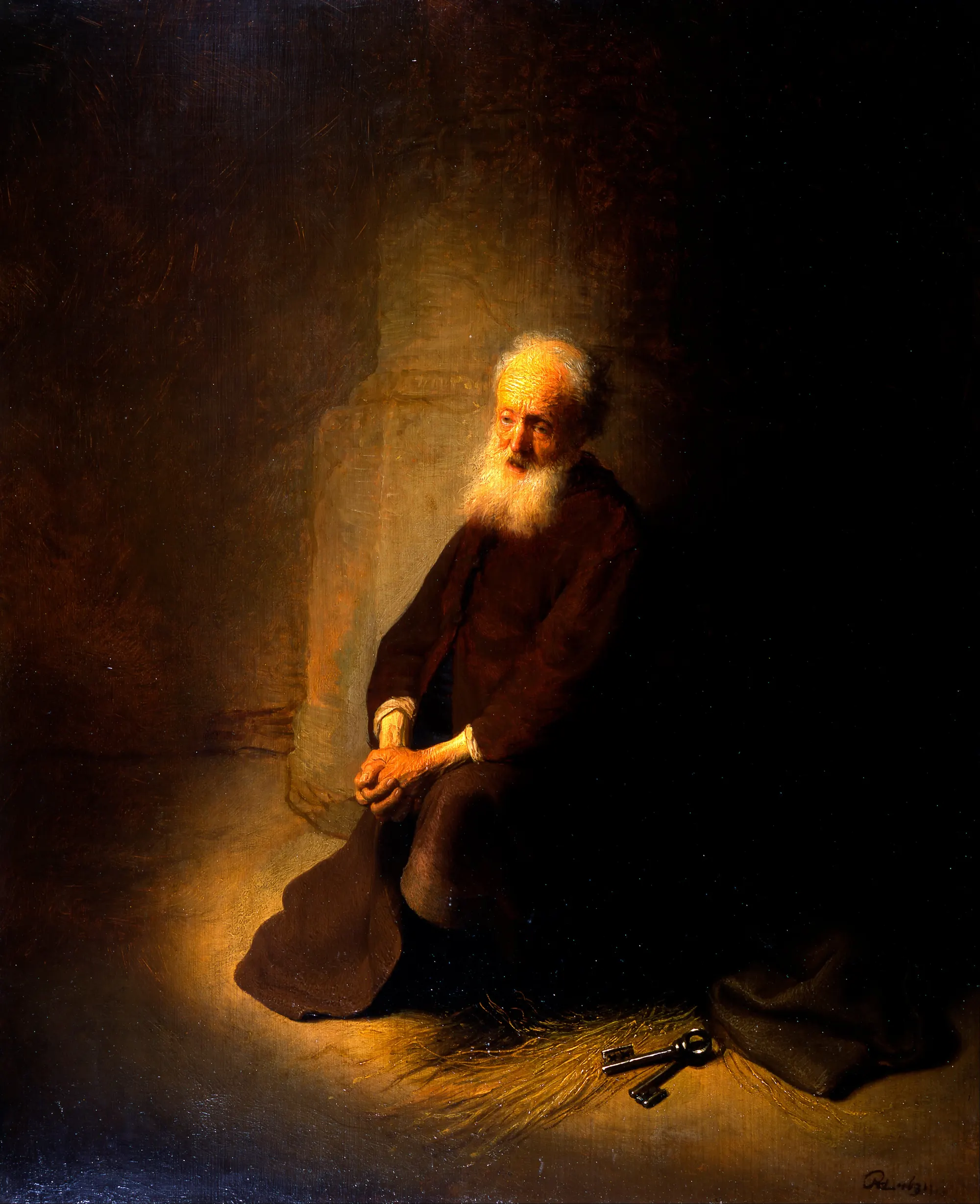
1 Peterchapter 1
25 verses · Peter · AD 62 to 64 · The general letters
For you know that it was not with perishable things such as silver or gold that you were redeemed from the empty way of life you inherited from your forefathers,
Introduction
Peter, The general letters, 1 Peter Overview.
This chapter opens a letter from Peter, the fisherman who once denied Jesus and was restored by Him. He wrote near the end of his life, most likely from Rome, to small churches spread across five provinces of Asia Minor. Many of the believers there were Gentiles who had left the gods of their towns and lost their standing for it. Listen for the words of family and inheritance given to people who had lost both. Listen also for how often the writer looks back to the prophets and forward to the day Christ appears. Hear it as a letter to people far from home.
Context
- Who
- Mixed congregations of Jewish and Gentile background living as outsiders in their own towns
- What
- The greeting and opening of Peter's first letter, which praises God for the new birth and then calls the readers to a holy life.
- Where
- Written from Babylon, most likely Rome, to churches in Pontus, Galatia, Cappadocia, Asia and Bithynia, in what is now Turkey.
- When
- About AD 62 to 64, in the years just before Nero turned on the church in Rome.
- Why
- To steady believers under slander and loss by showing them what they already hold in Christ and how they should now live.
Historical context
The five provinces named at the start, Pontus, Galatia, Cappadocia, Asia, Bithynia, trace a circuit. A letter carrier landing on the Black Sea coast could work his way around through the interior and back, reading the letter in each town. The order is a route, not a list.
Show the rest of the historical context, 3 more paragraphs
The words for the readers are legal words. A resident alien lived in a town legally but permanently belonged elsewhere: he paid taxes, had limited rights, could not hold office, and was always the outsider. Peter takes the status his readers actually held in their towns and makes it their identity before God.
Refining gold was familiar work. Ore was heated until the metal ran and the impurities rose to be skimmed off, and the fire was judged by the purity that came out. Peter's readers were being told what the heat in their lives was for.
The inheritance language plays against Roman inheritance law, which everyone knew was fragile. An estate could be confiscated by the state, eaten by debt, or seized in a family lawsuit. An inheritance that cannot perish, spoil, or fade is a deliberate contrast, and it is kept somewhere no magistrate can reach.
Significance
These readers had lost standing at home. The letter opens by telling them the standing they lost is not the one that counts, they are chosen, and the loss is temporary and purposeful.
Show the rest of the significance, 1 more paragraph
The reminder that prophets and even angels strained to see what these ordinary provincials now knew put small, harassed house churches at the center of something very old and very large.
The heads below are this chapter's scenes. The numbered points under each are its verses.
A Living Hope and an Inheritance That Cannot Fade
Pontus, Galatia, Cappadocia, Asia, and Bithynia: Peter names himself only an apostle of Jesus Christ and addresses believers across five provinces of Asia Minor. The word rendered strangers, parepidemos, names resident aliens, and the letter builds its vocabulary of pilgrimage on that status. Silvanus likely carried the letter along a route touching each province in turn.
1 Peter 1:1
“Peter, an apostle of Jesus Christ - On the word apostle, see the Rom 1:1 note; 1Co 9:1 ff notes. To the strangers - In the Greek, the word “elect” (see 1Pe 1:2) occurs here: ἐκλεκτοῖς παρεπιδήμοις eklektois parepidēmois, “to the elect strangers.” He here addresses them as elect; in the following verse he shows them in what way they were elected. See the notes there: The word rendered “strangers” occurs only in three places in the New Testament; Heb 11:13, and 1Pe 2:11, where it is rendered pilgrims, and in the place before us.”
3 more voices on this verseWhat preachers and commentators have said about this verse, in their own words.
1 Peter 1:1
“Through Pontus, Galatia, Cappadocia, Asia, and Bithynia - He names these five provinces in the order wherein they occurred to him, writing from the east. All these countries lie in the Lesser Asia. The Asia here distinguished from the other provinces is that which was usually called the Proconsular Asia being a Roman province.”
John Wesley · Explanatory Notes upon the New Testament (1755)evangelical
1 Peter 1:1
“The author of it, described, 1. His first name was Simon, and Jesus Christ gave him the surname of Peter, which signifies a rock, as a commendation of his faith, and to denote that he should be an eminent pillar in the church of God, Gal. ii. By his office-- an apostle of Jesus Christ.”
Matthew Henry · Commentary on the Whole Bible (1707-1721)puritan
1 Peter 1:1
“Christians, if they rightly consider their calling, must never settle themselves here, but feel themselves travellers. As the Jews in their dispersion diffused through the nations the knowledge of the one God, preparatory to Christ's first advent, so Christians, by their dispersion among the unconverted, diffuse the knowledge of Christ, preparatory to His second advent.”
Jamieson, Fausset & Brown · Commentary Critical and Explanatory on the Whole Bible (1871)reformed
the foreknowledge of God the Father: One sentence names the Father, the Spirit and Jesus Christ: the foreknowledge of God the Father, sanctified by the Spirit, and sprinkling by His blood. The sprinkling recalls the covenant blood thrown at Sinai in Exodus 24.
1 Peter 1:2
“Elect according to the foreknowledge of God - If the apostle had directed his letter to persons elected to eternal life, no one, as Drs. Lardner and Macknight properly argue, could have received such a letter, because no one could have been sure of his election in this way till he had arrived in heaven.”
Adam Clarke · Commentary on the Bible (1810-1826)evangelical
4 more voices on this verse
1 Peter 1:2
“The grace of God is a generous, not a selfish principle. (2.) The best blessings we can desire for ourselves, or one for another, are grace and peace, with the multiplication of them; therefore the apostles so often make this their prayer in the beginning and end of their epistles. (3.) Solid peace cannot be enjoyed where there is no true grace; first grace, then peace.”
Matthew Henry · Commentary on the Whole Bible (1707-1721)puritan
1 Peter 1:2
“The divine three are introduced in their respective functions in redemption. through--Greek, "in"; the element in which we are elected. The "election" of God realized and manifested itself "IN" their sanctification. Believers are "sanctified through the offering of Christ once for all" (Heb 10:10).”
Jamieson, Fausset & Brown · Commentary Critical and Explanatory on the Whole Bible (1871)reformed
1 Peter 1:2
“My Brethren, I beg you to notice and carefully consider the value which God sets upon real holiness, since the Three Persons are represented as co-working to produce a Church without "spot, or wrinkle, or any such thing." Those men who despise holiness of heart are in direct conflict with God. Holiness is the architectural plan upon which God builds up His living temple. We read in Scripture of the "beauties of holiness." Nothing is beautiful before God but that which is holy.”
1 Peter 1:2
“Election, in the scripture sense, is God's doing anything that our merit or power have no part in. The true predestination, or fore-appointment of God is, 1. He that believeth shall be saved from the guilt and power of sin.”
John Wesley · Explanatory Notes upon the New Testament (1755)evangelical
1 Peter 1:3-5
new birth into a living hope: The letter opens on a living hope through the resurrection of Jesus Christ from the dead, a hope resting on an event. The inheritance is imperishable, undefiled, and unfading, and the heirs are shielded by God’s power, so both are kept.
1 Peter 1:3
"Blessed be the God and Father of our Lord Jesus Christ, who by His great mercy has regenerated us." For if God generated us of matter, He afterwards, by progress in life, regenerated us. "The Father of our Lord, by the resurrection of Jesus Christ:" who, according to your faith, rises again in us; as, on the other hand, He dies in us, through the operation of our unbelief.
Clement of Alexandria · written before 215 · From the Latin Translation of Cassiodoruspatristic
2 more voices on this verse
1 Peter 1:3
“Christ's resurrection is the cause of ours, (1) as an efficient cause (1Co 15:22); (2) as an exemplary cause, all the saints being about to rise after the similitude of His resurrection. Our "hope" is, Christ rising from the dead hath ordained the power, and is become the pattern of the believer's resurrection.”
Jamieson, Fausset & Brown · Commentary Critical and Explanatory on the Whole Bible (1871)reformed
1 Peter 1:3
“They who receive the precious gift of faith, thereby become the sons of God; and, being sons, they shall receive the Spirit of holiness to walk as Christ also walked. Throughout every part of this appointment of God, promise and duty go hand in hand. All is free gift; and yet such is the gift, that the final issue depends on our future obedience to the heavenly call.”
John Wesley · Explanatory Notes upon the New Testament (1755)evangelical
imperishable, undefiled, and unfading: Those born again to a living hope are heirs, and their inheritance is kept in heaven for them. Adam Clarke reads the three words as an inheritance free of decay, impurity and fading. No persecution on earth can touch it.
1 Peter 1:4
“To an inheritance - Called an inheritance because it belongs to the children of God. Eternal life cannot be a gift to any but these; for, even in heaven, the lot is dealt out according to law: if children, then heirs; if not children, then not heirs. Incorruptible - Αφθαρτον· It has no principles of dissolution or decay in it; and, therefore, must be totally different from this earth. Undefiled - Αμιαντον· Nothing impure can enter it; it not only has no principles or seeds of dissolution in itself, but it can never admit any; therefore its deterioration is impossible.”
Adam Clarke · Commentary on the Bible (1810-1826)evangelical
2 more voices on this verse
1 Peter 1:4
“For God foresaw that the faith and behavior of people would be put right by the teaching of the gospel, and so he chose them in Christ before the foundation of the world, predestinating them to be his children by partaking of the Spirit of sonship. For foreknowledge means no more than seeing what is inside a person. It is now no longer foreknowledge in effect but knowledge of something real which has been foreseen.”
Origen of Alexandria · written before 253 · CATENApatristic
1 Peter 1:4
“Being "begotten again" as a "son," he is an "heir," as earthly fathers beget children who shall inherit their goods. The inheritance is "salvation" (1Pe 1:5, 9); "the grace to be brought at the revelation of Christ" (1Pe 1:13); "a crown of glory that fadeth not away." incorruptible--not having within the germs of death.”
Jamieson, Fausset & Brown · Commentary Critical and Explanatory on the Whole Bible (1871)reformed
God's power keeps the inheritance and guards the heirs. Albert Barnes notes that the verb means kept as by a garrison. The guard holds through faith until the salvation already ready is revealed in the last time.
1 Peter 1:5
“Through faith - Through which alone salvation is both received and retained. Ready to be revealed - That Rev. is made in the last day. It was more and more ready to be revealed, ever since Christ came.”
John Wesley · Explanatory Notes upon the New Testament (1755)evangelical
2 more voices on this verse
1 Peter 1:5
“Who are kept by the power of God - That is, “kept” or preserved in the faith and hope of the gospel; who are preserved from apostacy, or so kept that you will finally obtain salvation. The word which is used here, and rendered “kept,” (φρουρέω phroureō,) is rendered in 2Co 11:32, kept with a garrison; in Gal 3:23, and here, kept; in Php 4:7, shall keep. It does not elsewhere occur in the New Testament.”
1 Peter 1:5
“The preparations for it are being made now, and began when Christ came: "All things are now ready"; the salvation is already accomplished, and only waits the Lord's time to be manifested: He "is ready to judge." last time--the last day, closing the day of grace; the day of judgment, of redemption, of the restitution of all things, and of perdition of the ungodly.”
Jamieson, Fausset & Brown · Commentary Critical and Explanatory on the Whole Bible (1871)reformed
1 Peter 1:6-7
In this you greatly rejoice: Joy and grief stand together because the trial has a purpose. Faith proven by trial ends in praise, glory, and honor at the revelation of Jesus Christ, the letter's first pairing of suffering and glory.
1 Peter 1:6
“Read "grieve" in this verse in the sense of "suffer," as in "in grief you shall bring forth children." For a woman experiences grief not in bearing children but rather in suffering before birth.”
Origen of Alexandria · written before 253 · Exhortation to Martyrdom 39patristic
3 more voices on this verse
1 Peter 1:6
“THIS VERSE TO A WORLDLY MAN looks amazingly like a contradiction; and even to a Christian man, when he understands it best, it will still be a paradox. “Ye greatly rejoice,” and yet “ye are in heaviness.” Is that possible? Can there be in the same heart great rejoicing, and yet a temporary heaviness? Most assuredly. This paradox has been known and felt by many of the Lord’s children, and it is far from being the greatest paradox of the Christian life.”
1 Peter 1:6
“If need be - For it is not always needful. If God sees it to be the best means for your spiritual profit. Ye are in heaviness - Or sorrow; but not in darkness; for they still retained both faith, 1 Pe i, 5, hope, and love; yea, at this very time were rejoicing with joy unspeakable, 1 Pe i, 8.”
John Wesley · Explanatory Notes upon the New Testament (1755)evangelical
1 Peter 1:6
“2Ti 3:12 is not to be pressed too far. Not every believer, nor every sinner, is tried with afflictions [THEOPHYLACT]. Some falsely think that notwithstanding our forgiveness in Christ, a kind of atonement, or expiation by suffering, is needed. ye are in heaviness--Greek, "ye were grieved." The "grieved" is regarded as past, the "exulting joy" present.”
Jamieson, Fausset & Brown · Commentary Critical and Explanatory on the Whole Bible (1871)reformed
Albert Barnes reads the proving of faith as the test that shows whether it is genuine, a process worth more than the assaying of gold. Athanasius writes that the saints shone like gold from the fire. Gold perishes, while tested faith ends in praise when Christ is revealed.
1 Peter 1:7
“That the trial of your faith - The putting of your religion to the test, and showing what is its real nature. Compare Jas 1:3, Jas 1:12. Being much more precious than of gold - This does not mean that their faith was much more precious than gold, but that the testing of it, (δοκίμιον dokimion,) the process of showing whether it was or was not genuine, was a much more important and valuable process than that of testing gold in the fire.”
1 more voice on this verse
1 Peter 1:7
“Because the saints saw that the divine fire would cleanse them and benefit them, they did not shrink back from or get discouraged by the trials which they faced. Rather than being hurt by what they went through, they grew and were made better, shining like gold that has been refined in a fire.”
Athanasius of Alexandria · written before 373 · Festal Letters 10patristic
1 Peter 1:8-9
you have not seen Him: Within a generation of the resurrection these readers love a Christ they have never seen, and their joy is inexpressible and glorious. Verse 9 names where faith ends: the goal of your faith, the salvation of your souls.
1 Peter 1:8
"For now," he says, "we know in part, and we prophesy in part, but then face to face." And this it is which has been said also by Peter: "Whom having not seen, ye love; in whom now also, not seeing, ye believe; and believing, ye shall rejoice with joy unspeakable." For our face shall see the face of the Lord and shall rejoice with joy unspeakable,-that is to say, when it shall behold its own Delight.
Irenaeus · written before 202 · Against Heresies Book Vpatristic
2 more voices on this verse
1 Peter 1:8
“Whom having not seen, ye love - Those to whom the apostle wrote had never seen Christ in the flesh; and yet, such is the realizing nature of faith, they loved him as strongly as any of his disciples could, to whom he was personally known. For faith in the Lord Jesus brings him into the heart; and by his indwelling all his virtues are proved, and an excellence discovered beyond even that which his disciples beheld, when conversant with him upon earth.”
Adam Clarke · Commentary on the Bible (1810-1826)evangelical
1 Peter 1:8
“The "glory" is partly in present possession, through the presence of Christ, "the Lord of glory," in the soul; partly in assured anticipation. "The Christian's joy is bound up with love to Jesus: its ground is faith; it is not therefore either self-seeking or self-sufficient" [STEIGER].”
Jamieson, Fausset & Brown · Commentary Critical and Explanatory on the Whole Bible (1871)reformed
the goal of your faith: Faith has a goal, and the believer is already receiving it. Albert Barnes reads their joy and love for Christ, whom they have not seen, as the evidence that the salvation of their souls was theirs.
1 Peter 1:9
“If it is the mind which prays and sings in the spirit and the mind which receives perfection and salvation, how is it that Peter says: "As the outcome of your faith you obtain the salvation of your souls"? If the soul neither prays nor sings with the spirit, how shall it hope for salvation?”
Origen of Alexandria · written before 253 · On First Principles 2.8.3patristic
2 more voices on this verse
1 Peter 1:9
“Receiving the end of your faith, even the salvation of your souls - The result or object of your faith; that is, what your faith is designed and adapted to secure. Compare the notes at Rom 10:4. The word rendered receiving is used here as indicating that they would surely obtain that. They even now had such peace and joy in believing, that it furnished undoubted evidence that they would be saved; and such that it might be said that even now they were saved.”
1 Peter 1:9
“Receiving--in sure anticipation; "the end of your faith," that is, its crowning consummation, finally completed "salvation" (Peter here confirms Paul's teaching as to justification by faith): also receiving now the title to it and the first-fruits of it. In 1Pe 1:10 the "salvation" is represented as already present, whereas "the prophets" had it not as yet present.”
Jamieson, Fausset & Brown · Commentary Critical and Explanatory on the Whole Bible (1871)reformed
1 Peter 1:10-12
Concerning this salvation, the prophets: The prophets searched for the time to which the Spirit was pointing when He foretold the sufferings of Christ and the glories to follow. They were serving later readers, and even angels long to look into these things.
1 Peter 1:10
“Of which salvation the prophets have inquired - The incarnation and suffering of Jesus Christ, and the redemption procured by him for mankind, were made known, in a general way, by the prophets; but they themselves did not know the time when these things were to take place, nor the people among and by whom he was to suffer, etc.; they therefore inquired accurately or earnestly, εξεζητησαν, and searched diligently, εξηρευνησαν, inquiring of others who were then under the same inspiration, and carefully searching the writings of those who had, before their time, spoken of these things.”
Adam Clarke · Commentary on the Bible (1810-1826)evangelical
2 more voices on this verse
1 Peter 1:10
"Of which salvation," he says, [1 Peter 1:10] "the prophets have inquired and searched diligently," and what follows. It is declared by this that the prophets spoke with wisdom, and that the Spirit of Christ was in them, according to the possession of Christ, and in subjection to Christ. For God works through archangels and kindred angels, who are called spirits of Christ.
Clement of Alexandria · written before 215 · From the Latin Translation of Cassiodoruspatristic
1 Peter 1:10
“Even from the beginning of the world this salvation has been testified to by the Holy Spirit. prophets--Though there is no Greek article, yet English Version is right, "the prophets" generally (including all the Old Testament inspired authors), as "the angels" similarly refer to them in general. inquired--perseveringly: so the Greek.”
Jamieson, Fausset & Brown · Commentary Critical and Explanatory on the Whole Bible (1871)reformed
the sufferings of Christ and the glories to follow: The prophets searched their own words to learn the time they were pointing to. The Spirit of Christ spoke of His sufferings and then of glories, plural, as John Wesley reads them: the resurrection, the ascension and the kingdom. Suffering then glory runs through the letter.
1 Peter 1:11
“And what manner of time - By what marks to be distinguished. The glories that were to follow - His sufferings; namely, the glory of his resurrection, ascension, exaltation, and the effusion of his Spirit; the glory of the last judgment, and of his eternal kingdom; and also the glories of his grace in the hearts and lives of Christians.”
John Wesley · Explanatory Notes upon the New Testament (1755)evangelical
2 more voices on this verse
1 Peter 1:11
“Searching what - That is, examining their own predictions with care, to ascertain what they meant. They studied them as we do the predictions which others have made; and though the prophets were the medium through which the truth was made known, yet their own predictions became a subject of careful investigation to themselves. The expression used here in the original, rendered “what,” (εἰς τίνα eis tina,) literally, “unto what,” may mean, so far as the Greek is concerned, either “what time,” or “what people,” or “what person;” that is, with reference to what person the prophecies were really uttered.”
1 Peter 1:11
“His humiliation and death, and the glorious consequences of it: The sufferings of Christ, and the glories that should follow. This enquiry would lead them into a view of the whole gospel, the sum whereof is this, that Christ Jesus was delivered for our offences and raised again for our justification. The time, and the manner of the times, wherein the Messiah was to appear.”
Matthew Henry · Commentary on the Whole Bible (1707-1721)puritan
angels long to look into these things: The prophets served a later people. John Wesley sees a rising order here: prophets and kings longed to see Christ, and the angels long to know more. Jamieson, Fausset and Brown take the Spirit sent from heaven as the gift of Pentecost.
1 Peter 1:12
“Which things angels desire to look into - A beautiful gradation; prophets, righteous men, kings, desired to see and hear what Christ did and taught. What the Holy Ghost taught concerning Christ the very angels long to know.”
John Wesley · Explanatory Notes upon the New Testament (1755)evangelical
3 more voices on this verse
1 Peter 1:12
“This verse implies that we, Christians, may understand the prophecies by the Spirit's aid in their most important part, namely, so far as they have been already fulfilled. with the Holy Ghost sent down--on Pentecost. The oldest manuscripts omit Greek preposition en, that is, "in"; then translate, "by." The Evangelists speaking by the Holy Spirit were infallible witnesses.”
Jamieson, Fausset & Brown · Commentary Critical and Explanatory on the Whole Bible (1871)reformed
1 Peter 1:12
“Unto whom it was revealed,.... The salvation they searched and inquired into, and the grace of it; the time of its being wrought out, and what sort of times they would be when Christ should come, both to the church, and to the world, among Jews and Gentiles; as also what cruel sufferings the Messiah should undergo, and what great glory should be put upon him afterwards: that not unto themselves, but unto us they did minister. The Vulgate Latin, Arabic, and Ethiopic versions, read "unto you"; and so do some copies.”
1 Peter 1:12
“Unto whom it was revealed - We may presume that, in a great variety of cases, the prophets did not understand the meaning of their own predictions. They had a general view of God’s designs; but of particular circumstances, connected with those great events, they seem to have known nothing, God reserving the explanation of all particulars to the time of the issue of such prophecies.”
Adam Clarke · Commentary on the Bible (1810-1826)evangelical
Gird Up Your Minds: Be Holy, You Were Bought With Blood
Therefore prepare your minds for action: The Greek behind prepare your minds for action pictures a traveler belting his robe to move freely, as Israel ate the Passover in Exodus 12:11. The call to Set your hope fully on the grace turns the whole posture forward.
1 Peter 1:13
“Still, there may be an allusion to the "end" mentioned in 1Pe 1:9. Hope so perfectly (Greek, "teleios") as to reach unto the end (telos) of your faith and hope, namely, "the grace that is being brought unto you in (so the Greek) the revelation of Christ." As grace shall then be perfected, so you ought to hope perfectly. "Hope" is repeated from 1Pe 1:3.”
Jamieson, Fausset & Brown · Commentary Critical and Explanatory on the Whole Bible (1871)reformed
2 more voices on this verse
1 Peter 1:13
"Wherefore, girding up your loins," "serve the Lord in fear" and truth, as those who have forsaken the vain, empty talk and error of the multitude, and "believed in Him who raised up our Lord Jesus Christ from the dead, and gave Him glory," and a throne at His right hand. To Him all things in heaven and on earth are subject. Him every spirit serves. He comes as the Judge of the living and the dead. His blood will God require of those who do not believe in Him.
Polycarp of Smyrna · written before 155 · Epistle to the Philippians 2patristic
1 Peter 1:13
“WE noticed, in reading the chapter from which our text is taken, that the Apostle Peter first mentioned the glorious Doctrines of Grace and the marvelous benefits bestowed by God upon Believers and he, afterwards, drew from them a practical inference. "Therefore," he said, "gird up the loins of your mind." A Doctrine of God may become dangerous if it is not reduced to practice—and all the Doctrines of God's Word may readily be turned to good and practical account if we are willing to so employ them.”
Charles Spurgeon · written before 1892 · The Metropolitan Tabernacle Pulpit, Sermon No. 2649: “Girded for the Work” (lightly modernized text, CCEL edition)Particular Baptist
1 Peter 1:14-16
As obedient children, do not conform: Obedient children no longer shape life by the passions of your former ignorance. Holiness reaches everything, so be holy in all you do, because God is holy, and verse 16 quotes Leviticus 11:44 to ground the command.
1 Peter 1:14
And Peter in his epistle says the same: "So that your faith and hope may be in God, because you have purified your souls in obedience to the truth," "as obedient children, not behaving after the fashion of the lusts in which in your ignorance you formerly indulged; but as he who has called you is holy, so also must you be holy in all your conduct; as it is written, Be ye holy for I am holy."
Clement of Alexandria · written before 215 · The Stromata Book 3patristic
2 more voices on this verse
1 Peter 1:14
“Not fashioning yourselves - As the offices of certain persons are known by the garb or livery they wear, so are transgressors: where we see the world’s livery we see the world’s servants; they fashion or habit themselves according to their lusts, and we may guess that they have a worldly mind by their conformity to worldly fashions.”
Adam Clarke · Commentary on the Bible (1810-1826)evangelical
1 Peter 1:14
"Lusts" flow from the original birth-sin (inherited from our first parents, who by self-willed desire brought sin into the world), the lust which, ever since man has been alienated from God, seeks to fill up with earthly things the emptiness of his being; the manifold forms which the mother-lust assumes are called in the plural lusts.
Jamieson, Fausset & Brown · Commentary Critical and Explanatory on the Whole Bible (1871)reformed
so be holy in all you do: The God who called them is holy, so the called must be holy in all they do. Albert Barnes takes the character of God as the pattern for the whole of life. Didymus the Blind adds that God supplies the holiness He asks.
1 Peter 1:15
“Literally, "But (rather) after the pattern of Him who hath called you (whose characteristic is that He is) holy, be (Greek, 'become') ye yourselves also holy." God is our grand model.”
Jamieson, Fausset & Brown · Commentary Critical and Explanatory on the Whole Bible (1871)reformed
1 more voice on this verse
1 Peter 1:15
“And yet it is required in strong terms, and enforced by three reasons, taken from the grace of God in calling us,--from his command, it is written, --and from his example. Be you holy, for I am holy. Learn, (1.) The grace of God in calling a sinner is a powerful engagement to holiness.”
Matthew Henry · Commentary on the Whole Bible (1707-1721)puritan
Peter quotes the law given to Israel in Leviticus 11:44. Albert Barnes notes that the command to be holy, first written for Israel, fits all who call God their Father. Holy people take after their holy God.
1 Peter 1:16
“Because it is written, Be ye holy; for I am holy - Lev 11:44. This command was addressed at first to the Israelites, but it is with equal propriety addressed to Christians, as the professed people of God. The foundation of the command is, that they professed to be his people, and that as his people they ought to be like their God. Compare Mic 4:5. It is a great truth, that people everywhere will imitate the God whom they worship. They will form their character in accordance with his. They will regard what he does as right.”
2 more voices on this verse
1 Peter 1:16
“The will of God is our sanctification, for He wishes His "image "-us-to become likewise His "likeness; " that we may be "holy" just as Himself is "holy." That good-sanctification, I mean-I distribute into several species, that in some one of those species we may be found.”
Tertullian · written before 220 · On Exhortation to Chastitypatristic
1 Peter 1:16
“As I am the fountain of holiness, being holy in My essence, be ye therefore zealous to be partakers of holiness, that ye may be as I also am [DIDYMUS]. God is essentially holy: the creature is holy in so far as it is sanctified by God. God, in giving the command, is willing to give also the power to obey it, namely, through the sanctifying of the Spirit (1Pe 1:2).”
Jamieson, Fausset & Brown · Commentary Critical and Explanatory on the Whole Bible (1871)reformed
Cross references
1 Peter 1:16
- QuotingLeviticus 19:2“Speak to the whole congregation of Israel and tell them: Be holy because I, the LORD your God, am holy.
'Be ye holy; for I am holy' ('it is written')
judges each one’s work impartially: The Father the readers call on also judges each one’s work impartially, so the fear commanded is the reverence of children toward a holy Judge. Their stay as foreigners takes up the exile language of 1:1, the whole of earthly life lived as guests.
1 Peter 1:17
“And if ye call on the Father - That is, if you are true Christians, or truly pious - piety being represented in the Scriptures as calling on God, or as the worship of God. Compare Act 9:11; Gen 4:26; 1Ki 18:24; Psa 116:17; 2Ki 5:11; 1Ch 16:8; Joe 2:32; Rom 10:13; Zep 3:9; 1Co 1:2; Act 2:21. The word “Father” here is used evidently not to denote the Father in contradistinction to the Son, but as referring to God as the Father of the universe.”
1 more voice on this verse
1 Peter 1:17
“And therefore says he: "Spend the time of your sojourning here," not in luxury, or fastidiousness, nor haughtiness of heart, but in fear. On this earth you have time not eternity, do you use the time as those who must pass hence.”
Ambrose of Milan · written before 397 · Epistle 63patristic
1 Peter 1:18-19
not with perishable things: Redemption is priced against silver or gold: the readers were freed by the precious blood of Christ, a lamb without blemish or spot. Those are the Passover lamb's marks in Exodus 12:5.
1 Peter 1:18
“Ye were not redeemed with corruptible things - To redeem, λυτροω, signifies to procure life for a captive or liberty for a slave by paying a price, and the precious blood of Christ is here stated to be the price at which the souls of both Jews and Gentiles were redeemed; is was a price paid down, and a price which God’s righteousness required. Corruptible things mean here any thing that man usually gives in exchange for another; but the term necessarily includes all created things, as all these are corruptible and perishing.”
Adam Clarke · Commentary on the Bible (1810-1826)evangelical
1 more voice on this verse
1 Peter 1:18
“Man is "sold under sin" as a slave; shut up under condemnation and the curse. The ransom was, therefore, paid to the righteously incensed Judge, and was accepted as a vicarious satisfaction for our sin by God, inasmuch as it was His own love as well as righteousness which appointed it.”
Jamieson, Fausset & Brown · Commentary Critical and Explanatory on the Whole Bible (1871)reformed
a lamb without blemish or spot: At the Passover, Israel was redeemed from Egypt by the blood of a lamb, as Jamieson, Fausset and Brown observe. The lamb had to be without blemish or spot, and Christ was that Lamb. His blood is precious beyond silver or gold.
1 Peter 1:19
“We have come in our theological conversation to use that word, "blood," somewhat lightly. I think it should scarcely ever be pronounced without a shudder. "The blood is the life thereof." When shed, it indicates suffering—suffering more intense than that of chastisement or bruising. Wounds are inflicted which make the lifeblood to flow out. In the case of our Lord, Jesus Christ, the term, "blood," brings before us all His griefs and anguish and where the crown of thorns pierced Him. Behold the Man!”
Charles Spurgeon · written before 1892 · The Metropolitan Tabernacle Pulpit, Sermon No. 3395: “The Savior's Precious Blood” (lightly modernized text, CCEL edition)Particular Baptist
1 more voice on this verse
1 Peter 1:19
“As Israel's redemption from Egypt required the blood of the paschal lamb, so our redemption from sin and the curse required the blood of Christ; "foreordained" (1Pe 1:20) from eternity, as the passover lamb was taken up on the tenth day of the month.”
Jamieson, Fausset & Brown · Commentary Critical and Explanatory on the Whole Bible (1871)reformed
ConnectionsExodus 12:13, Exodus 12:5
1 Peter 1:20-21
before the foundation of the world: Christ was known before the foundation of the world and revealed in the last times, the cross set in a plan older than creation. Faith and hope rest on the God who raised Him from the dead and glorified Him.
1 Peter 1:20
“Who verily was foreordained - Προεγνωσμενου· Foreknown; appointed in the Divine purpose to be sent into the world, because infinitely approved by the Divine justice. Before the foundation of the world - Before the law was given, or any sacrifice prescribed by it. Its whole sacrificial system was appointed in reference to this foreappointed Lamb, and consequently from him derived all its significance and virtue. The phrase καταβολη κοσμου, foundation of the world, occurs often in the New Testament, and is supposed by some learned men and good critics to signify the commencement of the Jewish state.”
Adam Clarke · Commentary on the Bible (1810-1826)evangelical
1 more voice on this verse
1 Peter 1:20
“Peter's language in the history corresponds with this here: an undesigned coincidence and mark of genuineness. Redemption was no afterthought, or remedy of an unforeseen evil, devised at the time of its arising. God's foreordaining of the Redeemer refutes the slander that, on the Christian theory, there is a period of four thousand years of nothing but an incensed God.”
Jamieson, Fausset & Brown · Commentary Critical and Explanatory on the Whole Bible (1871)reformed
who raised Him from the dead and glorified Him: Faith in God comes through Christ. John Wesley writes that without Christ people could only dread God, while through Him they believe, hope and love. Adam Clarke takes the verse to describe Gentiles, who learned of the true God only when the gospel reached them.
1 Peter 1:21
“Who through him believe - For all our faith and hope proceed from the power of his resurrection. In God that raised Jesus, and gave him glory - At his ascension. Without Christ we should only dread God; whereas through him we believe, hope, and love.”
John Wesley · Explanatory Notes upon the New Testament (1755)evangelical
Born Again of Seed That Never Dies
Since you have purified your souls: Souls purified by obedience produce a genuine love for your brothers, and the command then doubles it: love one another deeply, from a pure heart. The word for deeply, ektenos, means stretched out, love as sustained effort.
1 Peter 1:22
“Seeing ye have purified your souls - Having purified your souls, in obeying the truth - by believing in Christ Jesus, through the influence and teaching of the Spirit; and giving full proof of it by unfeigned love to the brethren; ye love one another, or ye will love each other, with a pure heart fervently.”
Adam Clarke · Commentary on the Bible (1810-1826)evangelical
1 Peter 1:23-25
For you have been born again: The new birth of 1:3 comes not of perishable seed, but of imperishable, through the living and enduring word of God. Peter quotes Isaiah 40:6 to 8, where all flesh withers like grass, and names the word that lasts as the word proclaimed to you.
1 Peter 1:23
“Being born again - See the notes at Joh 3:3. Not of corruptible seed - “Not by virtue of any descent from human parents” - Doddridge. The result of such a birth, or of being begotten in this way - for so the word rendered “born again” more properly signifies - is only corruption and decay. We are begotten only to die. There is no permanent, enduring life produced by that. It is in this sense that this is spoken of as, “corruptible seed,” because it results in decay and death.”
2 more voices on this verse
1 Peter 1:23
“PETER HAD earnestly exhorted the scattered saints to love each other “with a pure heart fervently,” and he wised fetches his argument, not from the law, nor from nature, nor from philosophy, but from that high and divine nature which God hath implanted in his people. Love each other with a pure heart fervently, for ye have been born again, not with corruptible seed, but with incorruptible. I might compare Peter to some judicious tutor of the princes of the blood, who labors to beget and foster a kingly spirit in the king’s sons.”
1 Peter 1:23
“The life is in God, yet it is communicated to us through the word. "The Gospel shall never cease, though its ministry shall" [CALOVIUS]. The abiding resurrection glory is always connected with our regeneration by the Spirit.”
Jamieson, Fausset & Brown · Commentary Critical and Explanatory on the Whole Bible (1871)reformed
Peter quotes Isaiah 40, where the prophet sets all flesh beside the word of God. John Wesley reads the flower as human glory at its most brief, his wisdom, strength and wealth. Grass withers and flowers fall.
1 Peter 1:24
“All flesh - Every human creature is transient and withering as grass. And all the glory of it - His wisdom, strength, wealth, righteousness. As the flower - The most short-lived part of it.”
John Wesley · Explanatory Notes upon the New Testament (1755)evangelical
2 more voices on this verse
1 Peter 1:24
“One who reflecting on this holds cheaply all that mankind prizes, whose only love is the divine life, because "all flesh is grass, and all the glory of man as the flower of grass," can never care for this grass which "to-day is and to-morrow is not"; studying the divine ways, he knows not only that human life has no fixity, but that the entire universe will not keep on its quiet course for ever; he neglects his existence here as an alien and a passing thing; for the Saviour said, "Heaven and earth shall pass away," the whole of…”
Gregory of Nyssa · written before 395 · On Virginity 4patristic
1 Peter 1:24
“So also the Greek for "falleth" is "fell away," that is, is fallen away: it no sooner is than it is gone. thereof--omitted in the best manuscripts and versions. "The grass" is the flesh: "the flower" its glory.”
Jamieson, Fausset & Brown · Commentary Critical and Explanatory on the Whole Bible (1871)reformed
Cross references
1 Peter 1:24
- QuotingIsaiah 40:6“A voice says, “Cry out!” And I asked, “What should I cry out?” “All flesh is like grass, and all its glory like the flowers of the field.”
'All flesh is as grass... but the word of the Lord endureth for ever'
The quotation from Isaiah 40:8 ends on the word that lasts. Peter names that word as the gospel these readers heard, so the message that gave them new birth in verse 23 is the lasting word. Albert Barnes notes that its power is never weakened.
1 Peter 1:25
“But the word of the Lord - In Isaiah Isa 40:8 “the word of our God.” The sense is not materially varied. Endureth forever - Is unmoved, fixed, permanent. Amidst all the revolutions on earth, the fading glories of natural objects, and the wasting strength of man, his truth remains unaffected. Its beauty never fades; its power is never enfeebled. The gospel system is as lovely now as it was when it was first revealed to man, and it has as much power to save as it had when first applied to a human heart.”
2 more voices on this verse
1 Peter 1:25
"But the word of the Lord," he says, "endures for ever:" as well prophecy as divine doctrine.
Clement of Alexandria · written before 215 · From the Latin Translation of Cassiodoruspatristic
1 Peter 1:25
“Ye have not far to look for the word; it is among you, even the joyful Gospel message which we preach. Doubt not that the Gospel preached to you by our brother Paul, and which ye have embraced, is the eternal truth.”
Jamieson, Fausset & Brown · Commentary Critical and Explanatory on the Whole Bible (1871)reformed
How this psalm is built
The form: A letter's greeting, then a blessing of God for the new birth, then the first commands of the letter from verse 13, as The Berean text's own markers: the greeting of verses 1 and 2, the blessing that opens at verse 3, and the Therefore of verse 13 classes it.
The patterns in this chapter
| Device | What it does | Where to see it |
|---|---|---|
| Father, Spirit and Son in one greeting | Verse 2 names God the Father, the Spirit and Jesus Christ in one sentence, and gives each His own work: the Father's foreknowledge, the Spirit's sanctifying and the sprinkling of the Son's blood. Jamieson, Fausset and Brown read the verse as the three introduced in their own functions in redemption.Jamieson, Fausset & Brown, Commentary Critical and Explanatory on the Whole Bible, on 1 Peter 1:2. | 1 Peter 1:2 |
| Perishable and imperishable | The word imperishable stands at verse 4, of the inheritance, and at verse 23, of the seed of new birth. Perishable stands at verses 18 and 23, and gold is said to perish at verse 7. Silver, gold and the grass of verse 24 pass away, while the inheritance, the blood of Christ and the word of God last.The Berean Standard Bible text of 1 Peter, counted from the store, The verses table, translation 3, 1 Peter. | 1 Peter 1:4, 1 Peter 1:7, 1 Peter 1:18, 1 Peter 1:23 |
| Two quotations from the law and the prophets | Verse 16 quotes the command to be holy from Leviticus 11:44, and verses 24 and 25 quote Isaiah 40:6 to 8 on the grass that withers and the word that stands. Albert Barnes names both sources in his notes on the two places.Albert Barnes, Notes, Explanatory and Practical, on 1 Peter 1:16 and 1:25. | 1 Peter 1:16, 1 Peter 1:24, 1 Peter 1:25 |
The prophets who searched their own words
6 more paragraphs on the patterns
Verses 10 to 12 picture the prophets studying what they had written. Adam Clarke holds that they knew the salvation in a general way and did not know its time (Commentary on the Bible, on 1 Peter 1:10). Albert Barnes reads them as examining their own predictions as others would (Notes, Explanatory and Practical, on 1 Peter 1:11). The Spirit who spoke through them is called the Spirit of Christ, and the same Spirit sent from heaven carried the gospel to these readers.
The debated reading: foreknowledge
Verse 2 calls the readers chosen according to the foreknowledge of God, and verse 20 says Christ was known before the foundation of the world. John Wesley reads election as God's doing in which human merit has no part, and names its rule as salvation for the one who believes (Explanatory Notes upon the New Testament, on 1 Peter 1:2).
Adam Clarke, following Lardner and Macknight, doubts that such a letter could have been received by people elected to eternal life. None of them could have been sure of it (Commentary on the Bible, on 1 Peter 1:2). Origen of Alexandria reads foreknowledge as God seeing what is in a person (quoted in the Catena, on 1 Peter 1:4).
What the chapter hands forward
The new birth through the word at verse 23 becomes the longing for the pure milk of the word at 2:2. The holiness of verses 15 and 16 becomes the holy priesthood of 2:5 and the holy nation of 2:9. The readers named exiles at verse 1 and foreigners at verse 17 are addressed as foreigners and exiles again at 2:11, where the second part of the letter begins.
Keep studying
Studies34
Show the next 6 titles
- Eternal Security, and the Five Warnings of Hebrews
- Fire
- Holiness and Purity
- Be Holy, Because I Am Holy
- A Living Hope
- Hope in the Cell
Show the next 6 titles
Places1
Words12
Sources for this chapter
The summary
Jamieson, Fausset & Brown, Commentary Critical and Explanatory; John Calvin, Commentaries; John Wesley, Explanatory Notes Upon the New Testament and Matthew Henry, Complete Commentary.
The context
John Wesley, Explanatory Notes upon the New Testament and Matthew Henry, Commentary on the Whole Bible.
The form and classifications
The Berean text's own markers: the greeting of verses 1 and 2, the blessing that opens at verse 3, and the Therefore of verse 13, 1 Peter 1:1 to 3 and 1:13.
The exposition
Adam Clarke, Commentary on the Bible; Albert Barnes; Athanasius of Alexandria, Festal Letters 10; Didymus the Blind, Commentary on 1 Peter; Jamieson, Fausset & Brown, Commentary Critical and Explanatory on the Whole Bible; John Calvin, Commentary on the Catholic Epistles; John Gill, Exposition of the New Testament; John Wesley, Explanatory Notes upon the New Testament and Matthew Henry, Commentary on the Whole Bible.