
Jonah 2:10
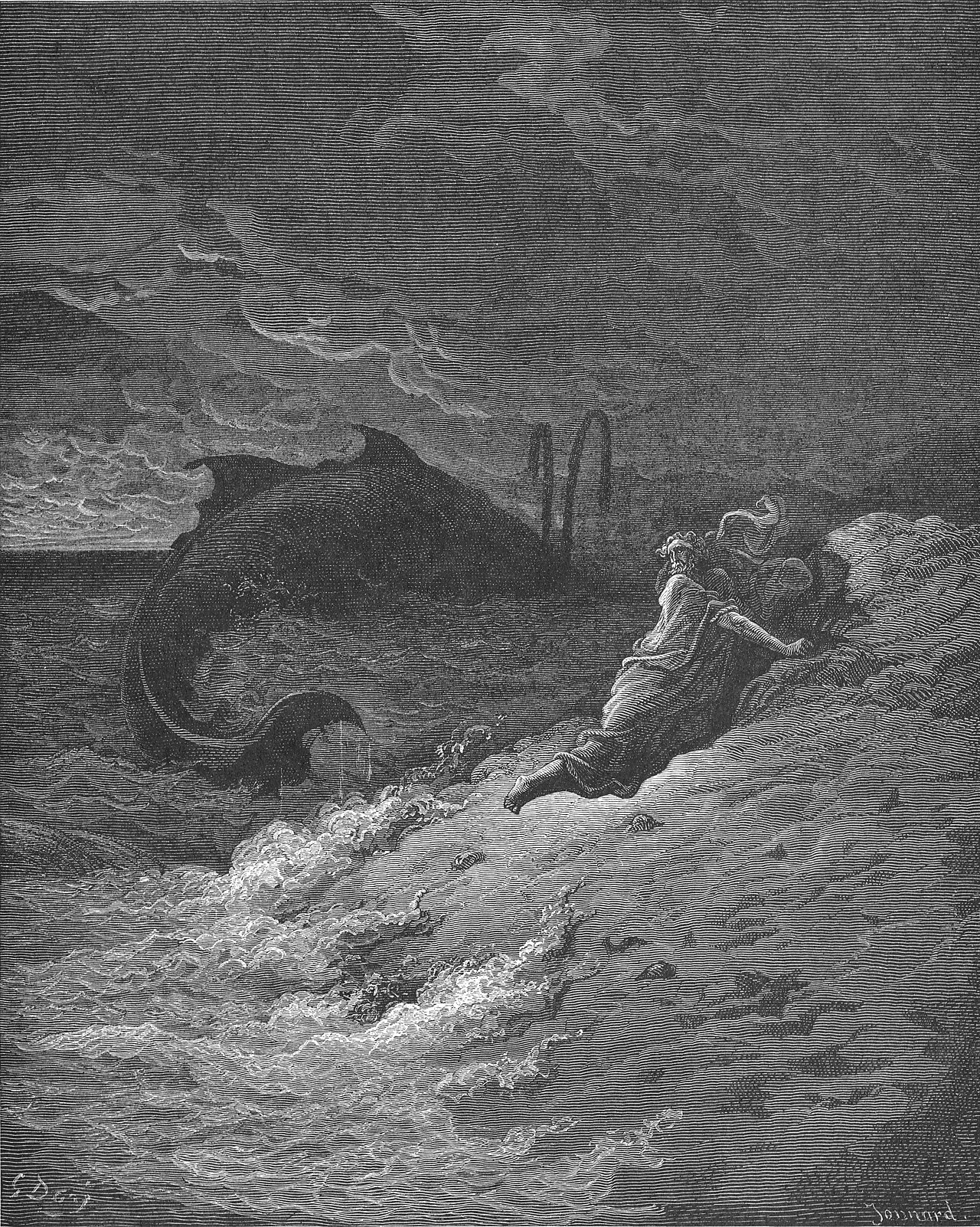
in Jonah 2And the LORD commanded the fish, and it vomited Jonah onto dry land.
BSB
The same verse in ASV and KJV ▾
ASV
And Jehovah spake unto the fish, and it vomited out Jonah upon the dry land.
KJV
And the Lord spake unto the fish, and it vomited out Jonah upon the dry land.
⋯
This verse in Jonah 2
Commentary
10 notes on this verse"And the LORD spoke unto the fish, and it vomited out Jonah upon the dry land." LXX: 'and he ordered the whale to vomit Jonah out onto the dry land'. That which we read above as being about Jonah, the Lord prayed for in the stomach of the whale about which Job speaks in an unclear way: "let he who curses this day curse him, he who will capture the great whale" [Job. 3:8 LXX].
This site's exposition
And the Lord spake unto the fish, and it vomited out Jonah upon the dry land
And the Lord spake unto the fish, and it vomited out Jonah upon the dry land ends the ordeal with the same directness that began it, the Lord who prepared the fish at 1:17 now commanding it to release him, the creature obedient to God's word where the prophet had not been. Dry land closes the chapter's water imagery entirely, Jonah delivered onto solid ground exactly where his voyage from Joppa had begun. Gill and Wesley both note that the text never records Jonah stepping out under his own strength, the deliverance as total and as undeserved as the punishment that came before it.
The record, by era
The Church Fathers4 voices
If, however, any one imagine it impossible that men should survive for such a length of time, and that Elias was not caught up in the flesh, but that his flesh was consumed in the fiery chariot, let him consider that Jonah, when he had been cast into the deep, and swallowed down into the whale's belly, was by the command of God again thrown out safe upon the land.
Jonah was swallowed by the monster of the deep, in whose belly whole ships were devoured, and after three days he was vomited out again safe and sound. Enoch and Elijah, who even now, without experiencing a resurrection (because they have not even encountered death), are learning to the full what it is for the flesh to be exempted from all humiliation, and all loss, and all injury and all disgrace. They have been translated from this world and from this very cause are already candidates for everlasting life. To what faith do these notable events bear witness, if not to that which ought to inspire in us the belief that they are proofs and documents of our own future and our completed resurrection? To borrow the apostle's phrase, these were "figures of ourselves." They are written that we may believe that the Lord is more powerful than all natural laws about the body.
A commentator
Gregory of NazianzusIn Defense of His Flight to Pontus, Oration 2 · Written before 390.
proposed
Jonah then was not ignorant of the mighty hand of God, with which he threatened other men, nor did he imagine that he could utterly escape the Divine power; this we are not to believe: but when he saw the falling away of Israel, and perceived the passing over of the grace of prophecy to the Gentiles-this was the cause of his retirement from preaching and of his delay in fulfilling the command; accordingly he left the watchtower of joy, for this is the meaning of Joppa in Hebrew, I mean his former dignity and reputation, and flung himself into the deep of sorrow: and hence he is tempest-tossed, and falls asleep, and is wrecked, and aroused from sleep, and taken by lot, and confesses his flight, and is cast into sea, and swallowed, but not destroyed, by the whale; but there he calls upon God, and, marvellous as it is, on the third day he, like Christ, is delivered...
A commentator
Ambrose of MilanThe Six Days of Creation, Book 4, Chapter 4 · Written before 397.
proposed
Jonah did not escape the sea by the power of his birth, but by the hidden divine command he was thrown overboard, and a whale received him, vomited him out after three days as a sign of future mystery, and reserved him by the merit of prophetic grace.
The Medieval Church1 voice
The prophet is animated with good hope, and now secure about his liberation, he promises that he will sacrifice thanksgiving and that he will fulfill all vows.
3 more voices on this verse
The Puritans and the Awakening1 voice
And the Lord spake unto the fish,.... Or gave orders to it; he that made it could command it; all creatures are the servants of God, and do his will; what he says is done; he so ordered it by his providence, that this fish should come near the shore, and be so wrought upon by his power, that it could not retain Jonah any longer in its belly.
The Nineteenth Century2 voices
And the Lord spake unto the fish - That is, by his influence the fish swam to shore, and cast Jonah on the dry land.
A commentator
Albert Barnes1798–1870
Notes, Explanatory and Practical, on the Old and New Testaments (1832-1869)
proposed
And the Lord spake unto the fish - Psa 148:8. Wind and storm fulfill His word. The irrational creatures have wills. God had commanded the prophet, and he disobeyed. God, in some way, commanded the fish. He laid His will upon it, and the fish immediately obeyed; a pattern to the prophet when He released him. “God’s will, that anything should be completed, is law and fulfillment and hath the power of law. Not that Almighty God commanded the fish, as He does us or the holy angels, uttering in its mind what is to be done, or inserting into the heart the knowledge of what He chooseth. But if He be said to command irrational animals or elements or any part of the creation, this signifieth the law and command of His will. For all things yield to His will, and the mode of their obedience is to us altogether ineffable, but known to Him.” “Jonah,” says Chrysostom, “fled the land, and fled not the displeasure of God. He fled the land, and brought a tempest on the sea: and not only himself gained no good from flight, but brought into extreme peril those also who took him on board. When he sailed, seated in the vessel, with sailors and pilot and all the tackling, he was in the most extreme peril: when, sunk in the sea, the sin punished and laid aside, he entered that vast vessel, the fish’s belly, he enjoyed great fearlessness; that thou mayest learn that, as no ship availeth to one living in sin, so when freed from sin, neither sea destroyeth, nor beasts consume. […]
How the passage was read
What the Jewish commentators add
And I, in laudation, give thanks; my offerings I will offer before You as I pledged; I will repay my soul’s redemption in the shadow of before the LORD!
This section is reception history: how the passage was read and kept in the Jewish tradition. Where a reading parts from an essential of the Christian faith, the section says so at that point.
Texts and citation data: Sefaria; each excerpt follows its version’s licence. 3 further sources are cited on this chapter that carry no English text this site may quote or only restate the verse.
The words behind it
8 Hebrew wordsEvery Hebrew word of this verse in the order it stands, with what it means and the door to its own study. The last column counts the times a word stands in the whole Bible: the rarer the word, the more the places it appears belong together.
| Hebrew | Sound | Meaning | Word study | In the Bible |
|---|---|---|---|---|
| וַיֹּ֥אמֶר | vaiyomer | and he spoke | H559 → | 5305 times |
| יְהוָ֖ה | yahweh | Yahweh | H3068 → | 6520 times |
| לַדָּ֑ג | ladag | to the fish | H1709 → | 19 times |
| וַיָּקֵ֥א | vaiyake' | and it vomited up | H6958 → | |
| אֶת־ | ʾet- | <obj.> | H853 → | 10935 times |
| יוֹנָ֖ה | yonah | Jonah | H3124 → | 19 times |
| אֶל־ | ʾel- | to | H413 → | 5510 times |
| הַיַּבָּשָֽׁה׃ פ | haiyabashah | the dry land | H3004 → | 14 times |
וַיֹּ֥אמֶרand he spoke
vaiyomerH559 →5305 times
יְהוָ֖הYahweh
yahwehH3068 →6520 times
לַדָּ֑גto the fish
ladagH1709 →19 times
וַיָּקֵ֥אand it vomited up
vaiyake'H6958 →
אֶת־<obj.>
ʾet-H853 →10935 times
יוֹנָ֖הJonah
yonahH3124 →19 times
אֶל־to
ʾel-H413 →5510 times
הַיַּבָּשָֽׁה׃ פthe dry land
haiyabashahH3004 →14 times
A shaded row is a word that stands 400 times or fewer in the Bible.
The walk
8 stopsEach card is a verse this one points to, and under it the verses that one points to in turn. Where several paths arrive at the same place, that place is listed first: the text keeps returning to it.
Through
Genesis 1:3And God said, “Let there be light,” and there was light.
it leads to
- 2 Corinthians 4:6
For God, who said, “Let light shine out of darkness,” made His light shine in our hearts to give us the light of the knowledge of the glory of God in the face of…
- John 1:5
The Light shines in the darkness, and the darkness has not overcome it.
- Isaiah 45:7
I form the light and create the darkness; I bring prosperity and create calamity. I, the LORD, do all these things.
- Isaiah 60:19
No longer will the sun be your light by day, nor the brightness of the moon shine on your night; for the LORD will be your everlasting light, and your God will be your…
- 1 John 1:5
And this is the message we have heard from Him and announce to you: God is light, and in Him there is no darkness at all.
- 2 Corinthians 4:6
Through
Psalms 33:9For He spoke, and it came to be; He commanded, and it stood firm.
it leads to
- Genesis 1:3
And God said, “Let there be light,” and there was light.
- Psalms 33:6
By the word of the LORD the heavens were made, and all the stars by the breath of His mouth.
- Psalms 148:5–6
Let them praise the name of the LORD, for He gave the command and they were created.
- Genesis 1:3
Where this verse is studied
On this page
Studies1
About Jonah
Who and where
1 name in this verse with a page on the site.
This page draws on 11 works. Open the list of works
This page draws on Adam Clarke, Commentary on the Bible; Albert Barnes, Notes, Explanatory and Practical, on the Old and New Testaments (1832-1869); Ambrose of Milan, The Six Days of Creation, Book 4, Chapter 4; Gregory of Nazianzus, In Defense of His Flight to Pontus, Oration 2; Haimo of Auxerre, Commentary (church-history corpus); Irenaeus, Against Heresies Book V; Jerome, Commentary on Jonah, Chapter 2; John Gill, Exposition of the Old Testament; John Gill, Exposition of the Old Testament (1748-1763); John Wesley, Explanatory Notes upon the Old Testament and Tertullian, ON THE RESURRECTION OF THE FLESH 58.