
Jonah 2:1
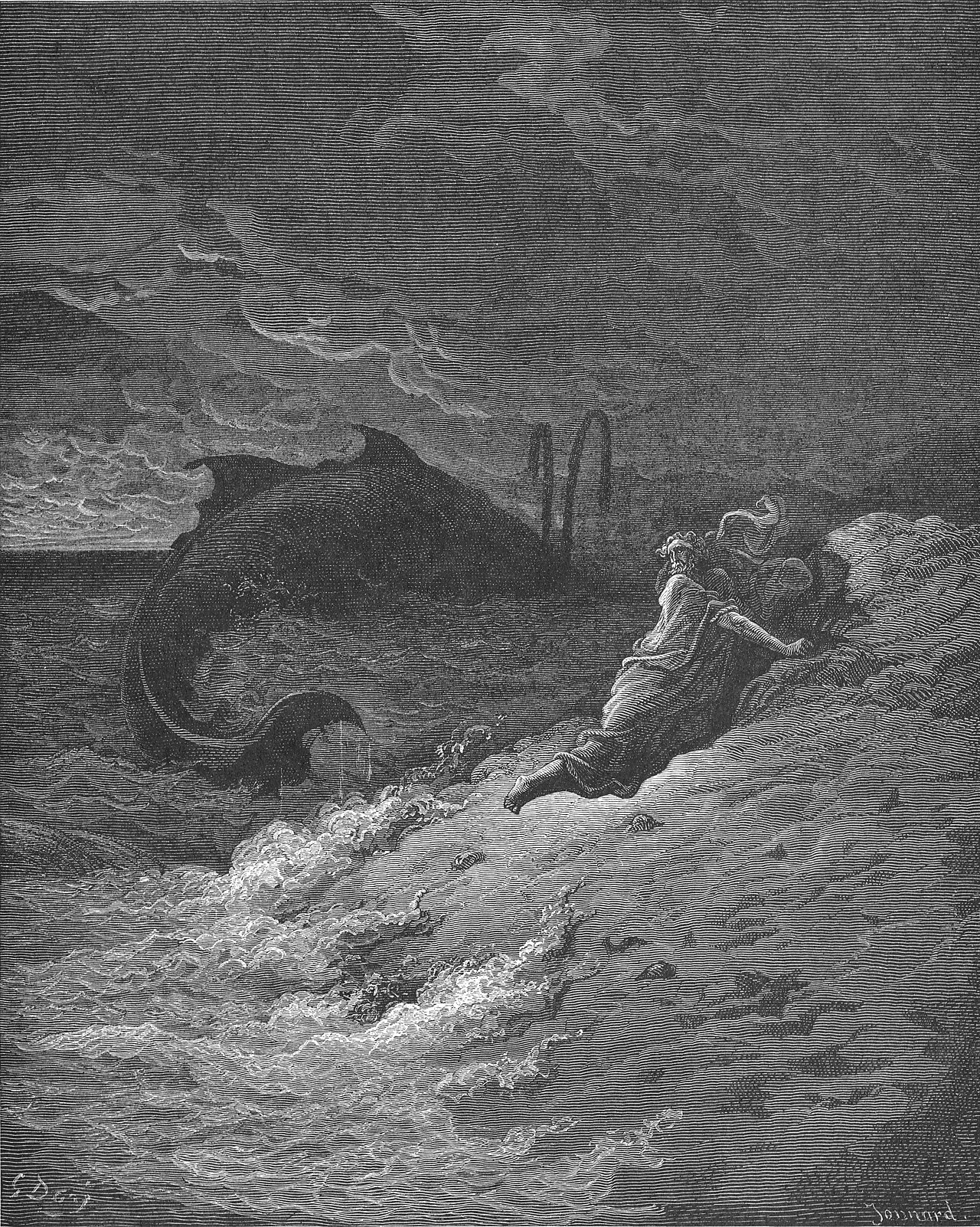
in Jonah 2From inside the fish, Jonah prayed to the LORD his God,
BSB
The same verse in ASV and KJV ▾
ASV
Then Jonah prayed unto Jehovah his God out of the fish’s belly.
KJV
Then Jonah prayed unto the Lord his God out of the fish’s belly,
⋯
This verse in Jonah 2
Commentary
18 notes on this verseA commentator
Albert Barnes1798–1870
Notes, Explanatory and Practical, on the Old and New Testaments (1832-1869)
Then - (“And”) Jonah prayed, i. e., when the three days and nights were passed, he uttered this devotion. The word “prayed” includes thanksgiving, not petition only. It is said of Hannah that she “prayed” 1Sa 2:1; but her canticle is all one thanksgiving without a single petition. In this thanksgiving Jonah says how his prayers had been heard, but prays no more. God had delivered him from the sea, and be thanks God, in the fish’s belly, as undisturbed as in a Church or an oratory, secure that God, who had done so much, would fulfill the rest.
This site's exposition
Jonah prayed unto the Lord his God out of the fish’s belly
on Jonah 2:1-2
Then Jonah prayed unto the Lord his God out of the fish's belly turns the fish from an instrument of judgment into a closet of prayer, the psalm rising from inside the very punishment Jonah had asked for himself. His opening line, I cried by reason of mine affliction unto the Lord, and he heard me, out of the belly of hell cried I, and thou heardest my voice, uses the belly of hell as the natural word for the place of the dead and the deep alike, which the commentators read as poetic intensity rather than a claim about the fish's own nature. Gill and Henry both note that a prayer built almost entirely from the language of the Psalms argues Jonah carried the temple's own worship in memory long before the dark made him need it.
The record, by era
The Church Fathers5 voices
"Then Jonah prayed unto the LORD his God out of the fish's belly." LXX: similar. If Jonah is compared to the Lord, and his time of three days and three nights in the belly of the whale is a sign of the suffering of the Saviour, his prayer also ought to be a kind of prayer of the Saviour. Some people, I don't doubt, will find it difficult to believe that a man can spend three days and three nights in the belly of a whale, especially after a shipwreck. These people can either be religious or not. But if they have faith, they will believe this all the more: how three children thrown into a furnace of hot fire were so well protected that their clothes were not even singed [Dan. 3:94/27]; how the sea drew back on itself into two sides and held itself up like a wall to offer a route for the people who wanted to pass [Ex. 14:22-29]; how with all human moderation the anger of a lion that had been increased by hunger was taken by fear at the sight of his prey, and didn't want to touch it [Dan. 6:23]; and even other such miracles. If they do not have faith, let them read the fifteen books of Ovid's Metamorphoses, and all Greek and Latin history. Therein they will see Daphne changed into a bay-tree, or the sister of Phaeton changed into poplars; how Jupiter the highest god, was transformed into a swan, flowed in gold and became a raging bull, and other adventures where the ugliness of the stories attest the holiness of the divinity. They believe in these stories and say that everything is possible for one god. And while they believe these ugly stories and defend the absolute power of a god, they do not attribute this same power to honest deeds. […]
A commentator
Methodius of OlympusMethodius Fragments: On the History of Jonah · Written before 311.
proposed
As, then, Jonah spent three days and as many nights in the whale's belly, and was delivered up sound again, so shall we all, who have passed through the three stages of our present life on earth -- I mean the beginning, the middle, and the end, of which all this present time consists -- rise again. For there are altogether three intervals of time, the past, the future, and the present. And for this reason the Lord spent so many days in the earth symbolically, thereby teaching clearly that when the fore-mentioned intervals of time have been fulfilled, then shall come our resurrection, which is the beginning of the future age, and the end of this. For in that age there is neither past nor future, but only the present. Moreover, Jonah having spent three days and three nights in the belly of the whale, was not destroyed by his flesh being dissolved, as is the case with that natural decomposition which takes place in the belly, in the case of those meats which enter into it, on account of the greater heat in the liquids, that it might be shown that these bodies of ours may remain undestroyed. For consider that God had images of Himself made as of gold, that is of a purer spiritual substance, as the angels; and others of clay or brass, as ourselves. He united the soul which was made in the image of God to that which was earthy. As, then, we must here honour all the images of a king, on account of the form which is in them, so also it is incredible that we who are the images of God should be altogether destroyed as being without honour. Whence also the Word descended into our world, and was incarnate of our body, in order that, having fashioned it to a more divine image, He might raise it incorrupt, although it had been dissolved by time. […]
A commentator
Cyril of AlexandriaCommentary on the Twelve Minor Prophets, Jonah · Written before 444.
proposed
The event would rightly be taken to be truly remarkable and surpassing rhyme or reason. If God were said to be responsible however; who would still demur? the Divinity is powerful, and easily changes the nature of living things to whatever he chooses, nothing standing in the way of his ineffable wishes.
A commentator
Ambrose of MilanInterrogation of Job and David, Chapter 6 · Written before 397.
proposed
From my mother's womb you are my God; for I have been placed in the womb by you and have never departed from it. Like Jonah, who was placed in the belly of the whale, I was interceding for the people. And he truly was with God in his mother's womb, as it is written: 'Before the boy knows how to refuse the evil and choose the good, the land of the two kings you dread will be laid waste' (Isaiah 7:16).
Now that I have made mention of the great prophet, who typifies the holy mystery, foreshadowed the death which lasted three days and the salvation it restored, I should like to retrace the footsteps of my poem and briefly hasten back to Jonah. Wondrous are …
11 more voices on this verse
The Church Fathers5 voices
Do you praise the fearlessness of Elijah in speaking to tyrants and his translation in fire and the noble heritage of Elisha, the sheepskin mantle, accompanied by the spirit of Elijah? Then praise also the life of Basil passed in the midst of the fire, I mean in the multitude of temptations, and his preservation through fire which burned but did not consume, the miracle of the bush. Praise also the fair garment of skin, which came to him from on high, his fleshlessness. I shall omit other parallels, as the young men bedewed in the flames and the fugitive prophet praying in the belly of the fish and coming forth from the monster as from a chamber. I shall pass over the just man in the den, restraining the ferocity of lions, and the struggle of the seven Maccabees, who with a priest and their mother was perfected by blood and all kinds of tortures. Basil emulated their endurance and achieved their glory.
"I cried out," he says, "to the Lord my God in my affliction, and he heard me. Out of the belly of hell he heard my cry." "I," says Jonah, "who previously thought that God appears to prophets only in Jerusalem, found him present even …
Since the holy God has promised those who hope in him a means of escape from every affliction, we, even if we have been cut off in the midst of the seas of evils and are racked by the mighty waves stirred up against us by the spirits of wickedness, nevertheless endure in Christ who strengthens us. We have not slackened the intensity of our zeal for the churches, nor do we, as in a storm when the waves rise high, expect destruction. We still hold fast to our earnest endeavors as much as is possible, sensible of the fact that he who was swallowed by the whale was considered deserving of safety because he did not despair of his life but cried out to the Lord. So then, we ourselves, having reached the uttermost limit of evils, do not give up our hope in the Lord but watch and see his help on all sides.
To this I reply, that either all the miracles wrought by divine power may be treated as incredible, or there is no reason why the story of this miracle should not be believed. The resurrection of Christ Himself upon the third day would not be believed by us, if the Christian faith was afraid to encounter Pagan ridicule. Since, however, our friend did not on this ground ask whether it is to be believed that Lazarus was raised on the fourth day, or that Christ rose on the third day, I am much surprised that he reckoned what was done with Jonah to be incredible; unless, perchance, he thinks it easier for a dead man to be raised in life from his sepulchre, than for a living man to be kept in life in the spacious belly of a sea monster. For without mentioning the great size of sea monsters which is reported to us by those who have knowledge of them, let me ask how many men could be contained in the belly which was fenced round with those huge ribs which are fixed in a public place in Carthage, and are well known to all men there? Who can be at a loss to conjecture how wide an entrance must have been given by the opening of the mouth which was the gateway of that vast cavern? unless, perchance, as our friend stated it, the clothing of Jonah stood in the way of his being swallowed without injury, as if he had required to squeeze himself through a narrow passage, instead of being, as was the case, thrown headlong through the air, and so caught by the sea monster as to be received into its belly before he was wounded by its teeth. […]
The word for depth (profundum) stands for porro fundum, the far bottom, whose lowest levels are wholly submerged. From here the prophet cried to the Lord so that he could be more easily heard. It was from this depth that Peter poured forth his glorious …
The Medieval Church2 voices
He prepared the fish, that is, He made it come next to the ship, in order that it might take Jonah in its mouth when he was thrown overboard.
The fish which swallowed Jonah in the sea, shows forth the death which Christ suffered in the world. Three days and nights was the one in the whale's belly, the other in the tomb.
The Puritans and the Awakening2 voices
Then Jonah prayed unto the Lord his God out of the fish's belly.
He that has Christ dwelling in his heart by faith, wherever he goes carries the altar along with him, that sanctifies the gift, and is himself a living temple. Jonah was here in confinement; the belly of the fish was his prison, was a close and dark dungeon to him; yet there he had freedom of access to God, and walked at liberty in communion with him.
The Nineteenth Century2 voices
A commentator
Jamieson, Fausset & Brown1802–1910
Commentary Critical and Explanatory on the Whole Bible (1871)
Faith enables Jonah now to feel this; just as the returning prodigal says of the Father, from whom he had wandered, "I will arise and go to my Father" (Lu 15:18). out of the fish's belly--Every place may serve as an oratory. No place is amiss for prayer. Others translate, "when (delivered) out of the fish's belly." English Version is better.
Then Jonah prayed - out of the fish’s belly - This verse makes the first of the second chapter in the Hebrew text. It may be asked, “How could Jonah either pray or breathe in the stomach of the fish?” Very easily, if God so willed it. And let the reader keep this constantly in view; the whole is a miracle, from Jonah’s being swallowed by the fish till he was cast ashore by the same animal. It was God that had prepared the great fish. It was the Lord that spake to the fish, and caused it to vomit Jonah upon the dry land. All is miracle.
How the passage was read
What the Jewish commentators add
a huge fish —It was a male, and he stood there with room, so that he did not think to pray.
1 more on this passage, in their own words ▾
And the LORD invited a great fish to swallow Jonah, and Jonah was in the fish’s guts for three days and three nights.
This section is reception history: how the passage was read and kept in the Jewish tradition. Where a reading parts from an essential of the Christian faith, the section says so at that point.
Texts and citation data: Sefaria; each excerpt follows its version’s licence. 3 further sources are cited on this chapter that carry no English text this site may quote or only restate the verse.
The words behind it
7 Hebrew wordsEvery Hebrew word of this verse in the order it stands, with what it means and the door to its own study. The last column counts the times a word stands in the whole Bible: the rarer the word, the more the places it appears belong together.
| Hebrew | Sound | Meaning | Word study | In the Bible |
|---|---|---|---|---|
| וַיִּתְפַּלֵּ֣ל | vaiyitpalel | and he prayed | H6419 → | |
| יוֹנָ֔ה | yonah | Jonah | H3124 → | 19 times |
| אֶל־ | ʾel- | to | H413 → | 5510 times |
| יְהוָ֖ה | yahweh | Yahweh | H3068 → | 6520 times |
| אֱלֹהָ֑יו | ʾelohav | God his | H430 → | 2601 times |
| מִמְּעֵ֖י | mimeei | from [the] inward parts of | H4578 → | |
| הַדָּגָֽה׃ | hadagah | the fish | H1710 → |
וַיִּתְפַּלֵּ֣לand he prayed
vaiyitpalelH6419 →
יוֹנָ֔הJonah
yonahH3124 →19 times
אֶל־to
ʾel-H413 →5510 times
יְהוָ֖הYahweh
yahwehH3068 →6520 times
אֱלֹהָ֑יוGod his
ʾelohavH430 →2601 times
מִמְּעֵ֖יfrom [the] inward parts of
mimeeiH4578 →
הַדָּגָֽה׃the fish
hadagahH1710 →
A shaded row is a word that stands 400 times or fewer in the Bible.
The walk
8 stopsEach card is a verse this one points to, and under it the verses that one points to in turn. Where several paths arrive at the same place, that place is listed first: the text keeps returning to it.
Through
Psalms 91:15When he calls out to Me, I will answer him; I will be with him in trouble. I will deliver him and honor him.
it leads to
- Psalms 50:15
Call upon Me in the day of trouble; I will deliver you, and you will honor Me.”
Reached by 2 separate paths from here.
- Jeremiah 33:3
Call to Me, and I will answer and show you great and unsearchable things you do not know.
- Isaiah 65:24
Even before they call, I will answer, and while they are still speaking, I will hear.
- Psalms 138:7
If I walk in the midst of trouble, You preserve me from the anger of my foes; You extend Your hand, and Your right hand saves me.
- John 12:26
If anyone serves Me, he must follow Me; and where I am, My servant will be as well. If anyone serves Me, the Father will honor him.
- Psalms 50:15
Through
Job 13:15Though He slay me, I will hope in Him. I will still defend my ways to His face.
it leads to
- Psalms 23:4
Even though I walk through the valley of the shadow of death, I will fear no evil, for You are with me; Your rod and Your staff, they comfort me.
- Job 19:25–28
But I know that my Redeemer lives, and in the end He will stand upon the earth.
- Job 23:10
Yet He knows the way I have taken; when He has tested me, I will come forth as gold.
- Psalms 23:4
Where this verse is studied
About Jonah
Who and where
1 name in this verse with a page on the site.
This page draws on 18 works. Open the list of works
This page draws on Adam Clarke, Commentary on the Bible; Albert Barnes, Notes, Explanatory and Practical, on the Old and New Testaments (1832-1869); Ambrose of Milan, Interrogation of Job and David, Chapter 6; Augustine of Hippo, LETTER 102, TO DEOGRATIAS; Basil of Caesarea, LETTER 242; Cassiodorus, EXPOSITION ON THE PSALMS 129:1; Cyril of Alexandria, Commentary on the Twelve Minor Prophets, Jonah; Gregory of Nazianzus, ON BASIL THE GREAT, ORATION 43:74; Haimo of Auxerre, Commentary (church-history corpus); Jamieson, Fausset & Brown, Commentary Critical and Explanatory on the Whole Bible; Jerome, Commentary on Jonah, Chapter 2; John Gill, Exposition of the Old Testament; John Gill, Exposition of the Old Testament (1748-1763); Matthew Henry, Commentary on the Whole Bible; Methodius of Olympus, Methodius Fragments: On the History of Jonah; Paulinus of Nola, POEM 24:205; Rabanus Maurus, Commentary (church-history corpus) and Theodoret of Cyrus, COMMENTARY ON JONAH 2:3.