
Jonah 3:6
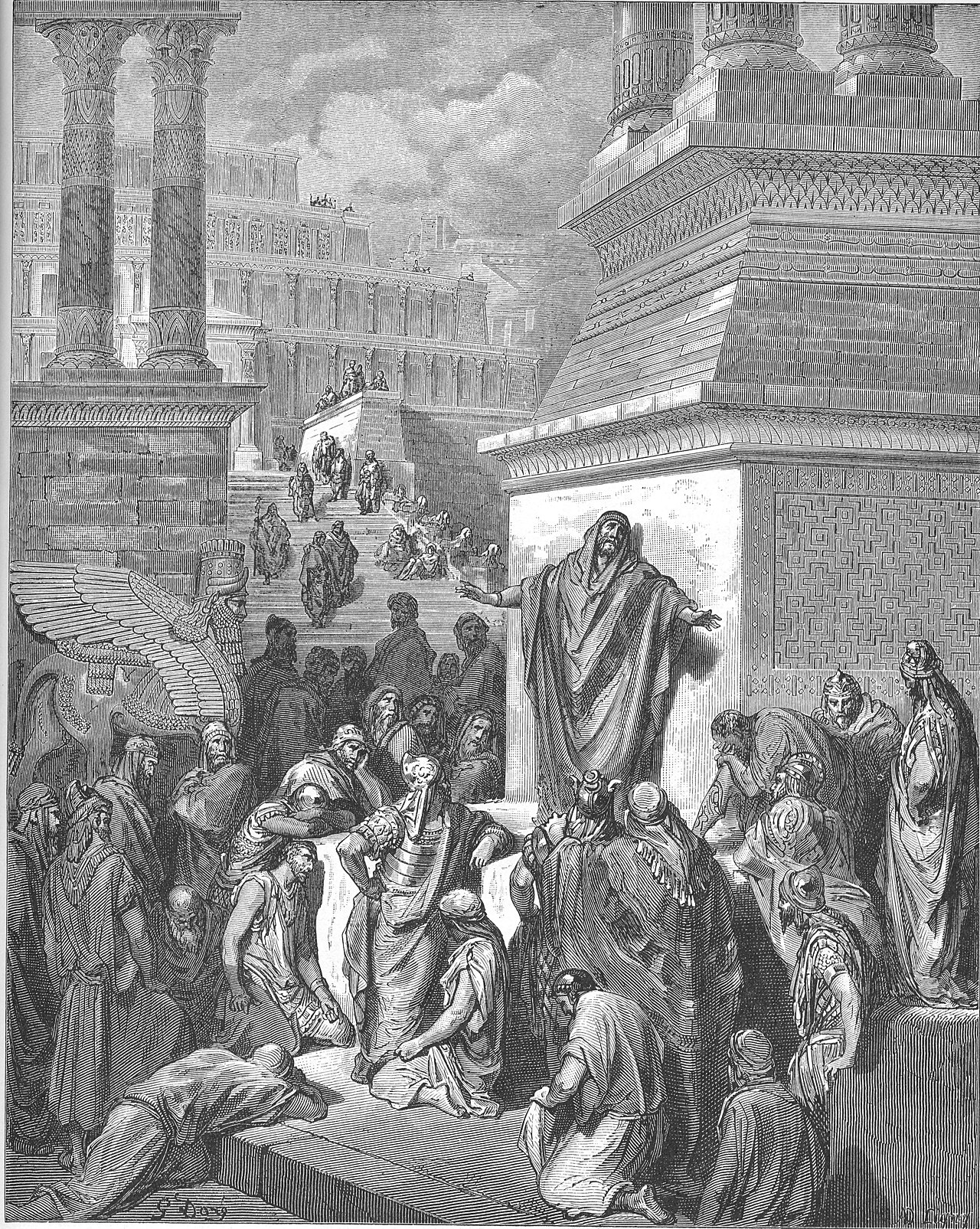
in Jonah 3When word reached the king of Nineveh, he got up from his throne, took off his royal robe, covered himself with sackcloth, and sat in ashes.
BSB
The same verse in ASV and KJV ▾
ASV
And the tidings reached the king of Nineveh, and he arose from his throne, and laid his robe from him, and covered him with sackcloth, and sat in ashes.
KJV
For word came unto the king of Nineveh, and he arose from his throne, and he laid his robe from him, and covered him with sackcloth, and sat in ashes.
⋯
This verse in Jonah 3
Commentary
8 notes on this verseWord came unto the king - This, some think, was Pul; others, Sardanapalus his son, king of Assyria, who flourished in the reign of Jeroboam the Second: but it seems more probable that the monarch here alluded to was a king of Assyria contemporary with Joash, king of Judah. It was by the decree of the king that the fast was instituted, and became general.
This site's exposition
For word came unto the king of Nineveh
For word came unto the king of Nineveh shows the repentance reaching the throne only after it has already spread through the city, the king following his people's example rather than issuing the first order. He arose from his throne, laid his robe from him, and covered himself with sackcloth, sitting in ashes, every mark of royal dignity set aside for the clothing of mourning. Clarke and Jamieson, Fausset & Brown both weigh the identity of this king, whether Adad-nirari the third or another Assyrian ruler of the period, without any Assyrian record naming the episode directly, and note that the text itself is content to call him simply the king of Nineveh.
The record, by era
The Church Fathers3 voices
The king preferred to escape in a hair-shirt, rather than to perish in purple garments. We must understand, dearly beloved, that lowliness avails more than power.
A sovereign serves God one way as a man, another way as a king. He serves him as man by living according to faith. He serves him as king by exerting the necessary strength to sanction laws that command goodness and prohibit its opposite. It was thus that Ezekiel served him by destroying the groves and temples of idols and the high places that had been set up contrary to the commandments of God. Thus Josiah served him by performing similar acts. Thus the king of the Ninevites served him by compelling the whole city to appease the Lord.
"For word came unto the king of Nineveh, and he arose from his throne, and he laid his robe from him, and covered him with sackcloth, and sat in ashes.
The Puritans and the Awakening2 voices
For word came unto the king of Nineveh,....
The king of Nineveh rose from his throne, not only in reverence to a word from God in general, but in fear of a word of wrath in particular, and in sorrow and shame for sin, by which he and his people had become obnoxious to his wrath.
1 more voice on this verse
The Nineteenth Century1 voice
A commentator
Albert Barnes1798–1870
Notes, Explanatory and Practical, on the Old and New Testaments (1832-1869)
proposed
For word came - , rather, “And the matter came,” i. e., the “whole account,” as we say. “The word, word,” throughout Holy Scripture, as in so many languages stands for that which is reported of. “The whole account,” namely, how this stranger, in strange austere attire, had come, what had happened to him before he came, how he preached, how the people had believed him, what they had done, as had just been related, “came to the king.” The form of words implies that what Jonah relates in this verse took place after what had been mentioned before. People are slow to carry to sovereigns matters of distress, in which they cannot help. This was no matter of peril from man, in which the counsel or energy of the king could be of use. Anyhow it came to him last. But when it came to him, he disdained not to follow the example of those below him. He was not jealous of his prerogative, or that his advice had not been had; but, in the common peril, acted as his subjects had, and humbled himself as they did. Yet this king was the king of Nineveh, the king, whose name was dreaded far and wide, whose will none who disputed, prospered . “He who was accounted and was the greatest of the kings of the earth, was not held back by any thought of his own splendor, greatness or dignity, from fleeing as a suppliant to the mercy of God, and inciting others by his example to the same earnesthess.” The kings of Assyria were religious, according to their light. They ascribed all their victories to their god, Asshur . When the king came to hear of One who had a might such as he had not seen, he believed in Him. And he arose from his throne - He lost no time; he heard, “and he arose” . […]
How the passage was read
What the Jewish commentators add
On the verses either side of this one
"And they believed"- because the sailors were in the city and they testified about Yonah that they had cast him into the sea, and the rest of his story as it happened. This is why they believed his prophecy and repented completely.
This section is reception history: how the passage was read and kept in the Jewish tradition. Where a reading parts from an essential of the Christian faith, the section says so at that point.
Texts and citation data: Sefaria; each excerpt follows its version’s licence. 2 further sources are cited on this chapter that carry no English text this site may quote or only restate the verse.
The words behind it
15 Hebrew wordsEvery Hebrew word of this verse in the order it stands, with what it means and the door to its own study. The last column counts the times a word stands in the whole Bible: the rarer the word, the more the places it appears belong together.
| Hebrew | Sound | Meaning | Word study | In the Bible |
|---|---|---|---|---|
| וַיִּגַּ֤ע | vaiyiga' | and it reached | H5060 → | |
| הַדָּבָר֙ | hadavar | the word | H1697 → | 1440 times |
| אֶל־ | ʾel- | to | H413 → | 5510 times |
| מֶ֣לֶך | melekh | [the] king of | H4428 → | |
| נִֽינְוֵ֔ה | ninveh | Nineveh | H5210 → | 17 times |
| וַיָּ֙קָם֙ | vaiyakom | and he arose | H6965 → | 628 times |
| מִכִּסְא֔וֹ | mikiso | from throne his | H3678 → | |
| וַיַּעֲבֵ֥ר | vaiyaaver | and he took off | H5674 → | |
| אַדַּרְתּ֖וֹ | ʾadarto | cloak his | H155 → | |
| מֵֽעָלָ֑יו | mealav | from on <the> him | H5921 → | 5755 times |
| וַיְכַ֣ס | vaykhas | and he covered | H3680 → | |
| שַׂ֔ק | sak | sackcloth | H8242 → | 49 times |
| וַיֵּ֖שֶׁב | vaiyeshev | and he sat | H3427 → | 1079 times |
| עַל־ | ʾal- | on | H5921 → | 5755 times |
| הָאֵֽפֶר׃ | haefer | <the> ash[es] | H665 → |
וַיִּגַּ֤עand it reached
vaiyiga'H5060 →
הַדָּבָר֙the word
hadavarH1697 →1440 times
אֶל־to
ʾel-H413 →5510 times
מֶ֣לֶך[the] king of
melekhH4428 →
נִֽינְוֵ֔הNineveh
ninvehH5210 →17 times
וַיָּ֙קָם֙and he arose
vaiyakomH6965 →628 times
מִכִּסְא֔וֹfrom throne his
mikisoH3678 →
וַיַּעֲבֵ֥רand he took off
vaiyaaverH5674 →
אַדַּרְתּ֖וֹcloak his
ʾadartoH155 →
מֵֽעָלָ֑יוfrom on <the> him
mealavH5921 →5755 times
וַיְכַ֣סand he covered
vaykhasH3680 →
שַׂ֔קsackcloth
sakH8242 →49 times
וַיֵּ֖שֶׁבand he sat
vaiyeshevH3427 →1079 times
עַל־on
ʾal-H5921 →5755 times
הָאֵֽפֶר׃<the> ash[es]
haeferH665 →
A shaded row is a word that stands 400 times or fewer in the Bible.
The walk
8 stopsEach card is a verse this one points to, and under it the verses that one points to in turn. Where several paths arrive at the same place, that place is listed first: the text keeps returning to it.
Through
Daniel 9:3So I turned my attention to the Lord God to seek Him by prayer and petition, with fasting, sackcloth, and ashes.
it leads to
- Jeremiah 29:10–13
For this is what the LORD says: “When Babylon’s seventy years are complete, I will attend to you and confirm My promise to restore you to this place.
- Jeremiah 33:3
Call to Me, and I will answer and show you great and unsearchable things you do not know.
- James 5:16–18
Therefore confess your sins to each other and pray for each other so that you may be healed. The prayer of a righteous man has great power to prevail.
- Nehemiah 1:4–11
When I heard these words, I sat down and wept. I mourned for days, fasting and praying before the God of heaven.
- Esther 4:16
“Go and assemble all the Jews who can be found in Susa, and fast for me. Do not eat or drink for three days, night or day, and I and my maidens will fast…
- Jeremiah 29:10–13
Through
Job 2:8And Job took a piece of broken pottery to scrape himself as he sat among the ashes.
it leads to
- Job 42:6
Therefore I retract my words, and I repent in dust and ashes.”
- Ezekiel 27:30
They will raise their voices for you and cry out bitterly. They will throw dust on their heads and roll in ashes.
- Job 42:6
Through
Luke 10:13Woe to you, Chorazin! Woe to you, Bethsaida! For if the miracles that were performed in you had been performed in Tyre and Sidon, they would have repented long ago, sitting in sackcloth and…
it leads to
- Isaiah 23:1–18
This is the burden against Tyre: Wail, O ships of Tarshish, for Tyre is laid waste, without house or harbor. Word has reached them from the land of Cyprus.
- Isaiah 23:1–18
Where this verse is studied
About Jonah
Who and where
1 name in this verse with a page on the site.
This page draws on Adam Clarke, Commentary on the Bible; Albert Barnes, Notes, Explanatory and Practical, on the Old and New Testaments (1832-1869); Augustine of Hippo, LETTER 185:5.19; Caesarius of Arles, Commentary (church-history corpus); Jamieson, Fausset & Brown, Commentary Critical and Explanatory on the Whole Bible; Jerome, Commentary on Jonah, Chapter 3; John Gill, Exposition of the Old Testament (1748-1763) and Matthew Henry, Commentary on the Whole Bible.