
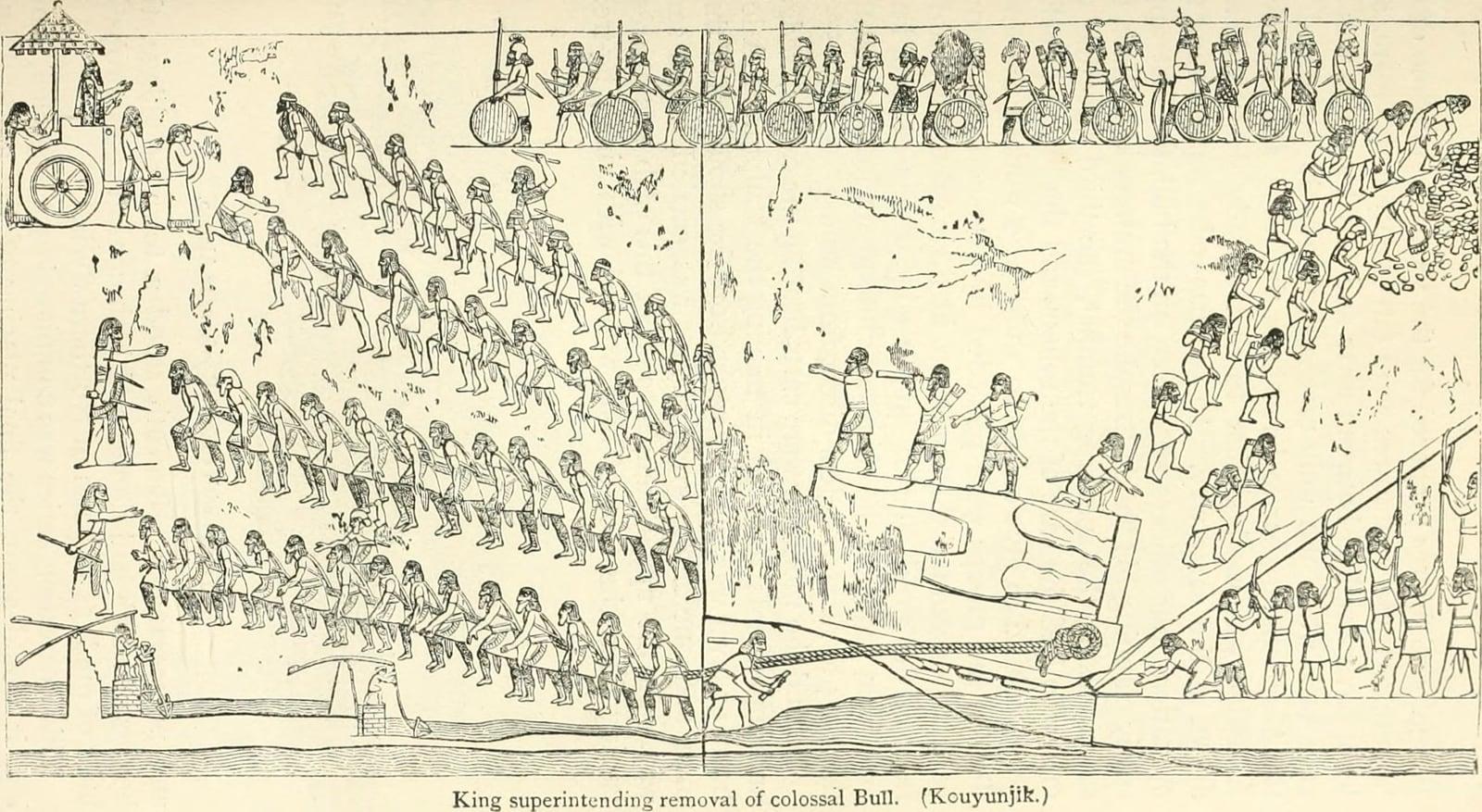
King Superintending Removal of Colossal Bull, in Austen Henry Layard, 1882. Public domain.
2 Kings 19:36 · Place · Featured Study
Nineveh
Nineveh was the capital of Assyria, across the Tigris from modern Mosul.
So Sennacherib king of Assyria broke camp and withdrew. He returned to Nineveh and stayed there.
- Today
- the mounds of Kouyunjik and Nebbi Yunus, opposite Mosul
- Region
- Assyria, on the left bank of the Tigris
- Site
- 36.359, 43.153
- First named
- Genesis 10:11 “…into Assyria, where he built Nineveh, Rehoboth-Ir, Calah,”
- Last named
- Luke 11:32 “The men of Nineveh will stand…”
Layard found the name of Nineveh on the bricks of Kouyunjik.
Summary
Jonah preached in the city, Sennacherib went home to it from Judah, and Nahum and Zephaniah foretold its ruin. Its ruins lie in two mounds on the left bank of the river.
- Genesis names it first among four cities.
- Jesus named its men at the judgment.
- Layard and Sayce differ over how far its ruins reach.
The City Sennacherib Went Home To
Second Kings names Nineveh once, at the end of the Assyrian siege of Jerusalem.
Strong's dictionary glosses the name as Nineveh, the capital of Assyria. In the Hebrew text it stands in 16 verses of six books.
Albert Barnes, in his note on Sennacherib's return, observes that the verse shows Nineveh as the Assyrian capital.
The page Hezekiah and Sennacherib teaches the campaign that ended with this return, and the page Ararat takes up the end of 2 Kings 19.
Nineveh on Layard's Plan
Layard's plan shows the inclosure across the river from Mosul.
Kouyunjik lies north of the smaller mound, with the Tigris to the west.
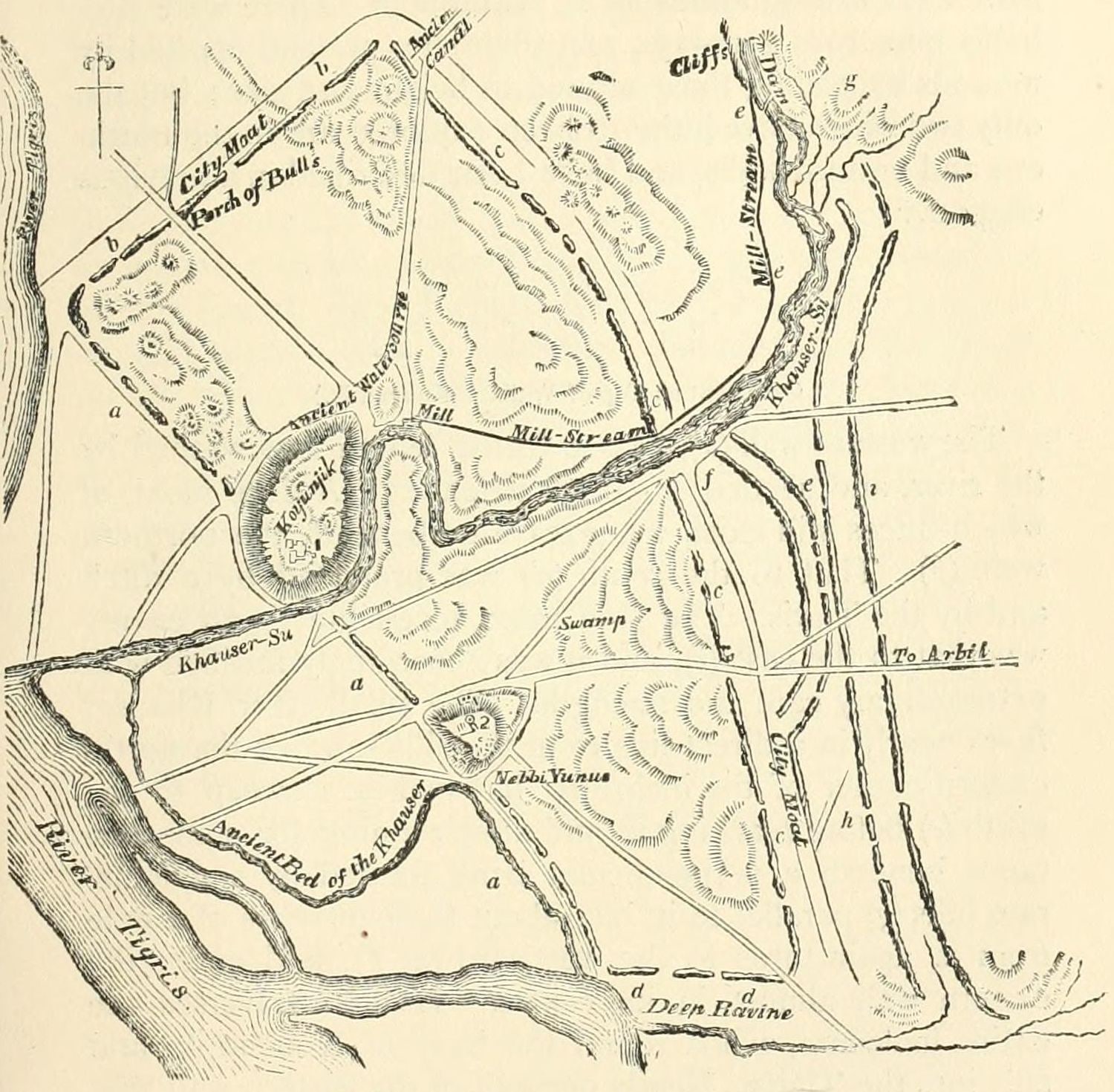
- Porch of BullsA gateway in the northern wall, one of the two walls where Layard explored gateways. The plan prints it on the wall line.Nahum 3:13
- KouyunjikThe larger mound stands by the Khauser stream. The plan draws it inside the western wall.2 Kings 19:36
- Nebbi YunusThe smaller mound, where tradition places the tomb of Jonah, Layard writes. The plan draws it inside the same river wall, south of Kouyunjik.Jonah 3:3
- The eastern moatsThe side most open to attack, guarded by moats and three walls, Layard writes. The plan draws the outer lines on the eastern side, south of the Khauser.Nahum 3:14
Austen Henry Layard, Plan of Mound and Inclosure of Kouyunjik, in Nineveh and Babylon, new edition, London, John Murray, 1882, p. 395. Public domain; File:Nineveh and Babylon - a narrative of a second expedition to Assyria during the years 1849, 1850, and 1851 (1882) (14767038112).jpg.
Four numbered points, each where Layard's plan prints the place, with north at the top. Layard surveyed the walls and mounds as they stood, and he notes that the Tigris has since changed its course.
The page Jonah: History or Parable? sets the size of this walled city beside the book of Jonah.
Nineveh in Scripture, in Order
Each of these verses names Nineveh or its people.
Seven moments from Genesis to Matthew, in the order of the canon.
- The first kingdomsNineveh is built in AssyriaGenesis 10:11
- After Sennacherib's siegeSennacherib returns to Nineveh and stays there2 Kings 19:36
- Jonah's first callJonah is sent to the great cityJonah 1:2
- Jonah's preachingThe Ninevites believe God and proclaim a fastJonah 3:5
- Nahum's oracleThe burden against NinevehNahum 1:1
- Zephaniah's oracleThe LORD will make Nineveh a desolationZephaniah 2:13
- The ministry of JesusThe men of Nineveh will stand at the judgmentMatthew 12:41
Six books of the Hebrew Bible name the city, and Matthew and Luke name its men.
Nineveh Repents teaches Jonah 3, and The Fall of Nineveh, 612 BC teaches the end Nahum and Zephaniah foretold.
The Palace on Kouyunjik
The palace on the larger mound was Sennacherib's.
Austen Henry Layard, in Nineveh and Babylon, writes that short inscriptions on the slabs name the king who oversaw the raising of the mounds and the placing of the colossal bulls. The king is Sennacherib, and the sculptures record his building of a great palace and its temples at Nineveh.
What the Text Leaves Unsaid
Scripture leaves the city's size and plan unmeasured.
Scripture gives no measure of the city's walls and names none of its mounds.
None Besides Me
Zephaniah gave the city a boast that Isaiah also puts in the mouth of Babylon.
This carefree city that dwells securely, that thinks to herself: “I am it, and there is none besides me,” what a ruin she has become, a resting place for beasts. Everyone who passes by her hisses and shakes his fist.So now hear this, O lover of luxury who sits securely, who says to herself, ‘I am, and there is none besides me. I will never be a widow or know the loss of children.’Jamieson, Fausset and Brown hold that Zephaniah took the phrase from this verse.
Voices on Nineveh
Two notes by one commentator read Nahum's charge against the city.
Matthew Henry (1662 to 1714)
“Nineveh had with her cruelties been a terror and destruction to others, and therefore destruction and terror shall be brought upon her. Those that are for overthrowing all that come in their way will, sooner or later, meet with their match.”
Matthew Henry · Commentary on the Whole Bible · on Nahum 3:1Puritan
“It is a city of blood, in which a great deal of innocent blood is shed by unrighteous war, or under colour and pretence of public justice, or by suffering barbarous murders to go unpunished; for this the righteous God will make inquisition.”
Matthew Henry · Commentary on the Whole Bible · on Nahum 3:1Puritan
Which Ruins Are Nineveh?
Readers differ on whether Nineveh was the walled inclosure opposite Mosul or a ring of strongholds reaching to Nimrud and Khorsabad.
One city of many strongholdsAusten Henry Layard and M. G. Easton
Layard, in Nineveh and Its Remains, judged the two mounds opposite Mosul too small a space for so great a city. He set the four great mounds of Nimrud, Kouyunjik, Khorsabad and Karamles at the corners of a square about sixty miles round. In Nineveh and Babylon he called Nineveh a city of many strongholds, the best defended of them at Kouyunjik giving its name to the whole. Easton's Bible Dictionary of 1897 calls those four masses of ruins the whole ruins of Nineveh in the general view.
The objection: Layard himself reports that Henry Rawlinson read the name of Calah on the bricks from Nimrud.
The walled city opposite MosulA. H. Sayce, Fresh Light from the Ancient Monuments
A. H. Sayce places Nineveh opposite Mosul, with its chief palace under the mounds of Kouyunjik. He sets Calah a few miles to the south at Nimrud, and the city Sargon founded at Khorsabad several miles to the north.
The objection: Layard held that Calah, Resen and Nineveh could not have stood so close together, since Genesis 10:12 puts Resen between Nineveh and Calah.
The page Nimrod and the First Kingdoms weighs who built Nineveh and which city Genesis 10:12 calls great.
The Men of Nineveh
The city that said there was none besides her once turned at a prophet's word.
When God saw their actions—that they had turned from their evil ways—He relented from the disaster He had threatened to bring upon them.Jesus set the men of Nineveh against His own generation in Matthew 12:41.
Sources
Scripture is the Berean Standard Bible.
- James Strong, Exhaustive Concordance of the Bible (1890), Hebrew dictionary, entry 5210, and the verses that carry them.
- Austen Henry Layard, Nineveh and Its Remains, vol. 2, New York, George P. Putnam, 1849, pp. 192 and 195.
- Austen Henry Layard, Nineveh and Babylon, new edition, London, John Murray, 1882, pp. 23 to 28, 373 to 374 and 395 to 397.
- A. H. Sayce, Fresh Light from the Ancient Monuments, second edition, London, The Religious Tract Society, 1884, chapter II.
- M. G. Easton, Illustrated Bible Dictionary (1897), entry Nineveh.
- Albert Barnes, Notes, Explanatory and Practical, on the Old and New Testaments (1832 to 1869), on 2 Kings 19:36.
- Matthew Henry, Commentary on the Whole Bible (1710), on Nahum 3:1.
- Jamieson, Fausset and Brown, Commentary Critical and Explanatory on the Whole Bible (1871), on Zephaniah 2:15.
Keep Studying
Read it6
Studies7
People and groups6
Places2
Doctrines2