
Jonah 3:5
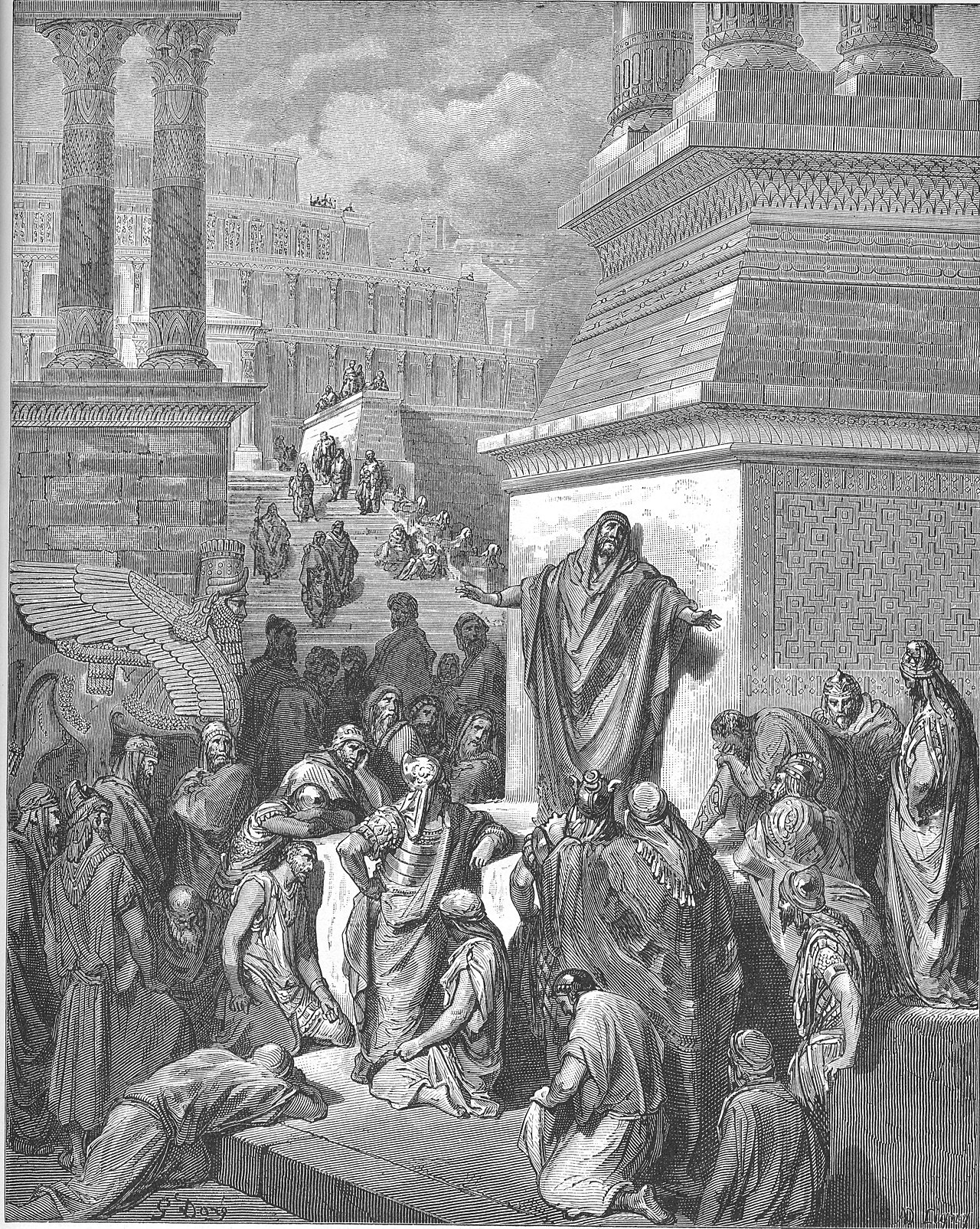
in Jonah 3And the Ninevites believed God. They proclaimed a fast and dressed in sackcloth, from the greatest of them to the least.
BSB
The same verse in ASV and KJV ▾
ASV
And the people of Nineveh believed God; and they proclaimed a fast, and put on sackcloth, from the greatest of them even to the least of them.
KJV
So the people of Nineveh believed God, and proclaimed a fast, and put on sackcloth, from the greatest of them even to the least of them.
⋯
This verse in Jonah 3
Commentary
13 notes on this verseIf what the Apostle has said is not enough, let them hear the Prophet saying, I chastened myself with fasting. He therefore who fasts not is uncovered and naked and exposed to wounds. And if Adam had clothed himself with fasting he would not have been found to be naked. Nineveh delivered itself from death by fasting. And the Lord Himself says, This kind goeth not out but by prayer and fasting.
This site's exposition
And the Ninevites believed God
The Ninevites "believed God". Jesus holds this against His generation at Matthew 12:41, where "they repented at the preaching of Jonah, and now One greater than Jonah is here". Wesley and Barnes note that the Hebrew verb for believed is the word used elsewhere of settled trust.
The record, by era
The Church Fathers5 voices
"So the people of Nineveh believed God, and proclaimed a fast, and put on sackcloth, from the greatest of them even to the least of them." LXX: similar. Nineveh believed but Israel did not believe; the foreskin believed, but circumcision remained without faith. First of all the men of Nineveh believed who had arrived at the age of Christ [Eph. 4:13]: they announced a fast and dressed in sackcloth, from the greatest to the smallest of them. This regime and clothing is very worthy of penitence, so that those who had offended God through their indulgence or lust appeased him by condemning all that they had previously offended with. Sackcloth and fasting are the weapons of penitence, the rescue of sinners. First of all fasting, then sackcloth; first of all what is not seen, then what is visible; the one is always shown to God, the other sometimes to man. And if it were necessary to remove one from the two then I would rather keep fasting without sackcloth than have sackcloth without fasting. Elder men give the example which pertains to youths: for no one is without sin; and if his life only lasted one day, the years of his life would still be counted [Job 14:5. LX]. For if the stars are not pure before God, they are still more so than a worm or putrefaction, and those who are held by the sin of Adam, the great offender. Note here too the order, which is well written: God commands the prophet, the prophet proclaims to the city. First of all the men believe, announce fasting, and then everyone puts on sackcloth. The men do not announce the putting on of sackcloth, but only the fasting. All the same, with reason, those to whom penitence has been proscribed wear sackcloth and fast so that empty stomach and mourning clothes give the Lord more of an opportunity to remit.
But the Chaldaeans and the Medes and Persians, having a somewhat wider knowledge, were instructed by the building of the Tower, and the deluge, and by what happened in the case of Hezekiah and Jonah, and by the Captivity, and by Daniel and the Three …
A commentator
Clement of RomeClement's First Letter to the Corinthians, Chapter 7 · Written before 99.
proposed
Let us turn to every age that has passed, and learn that, from generation to generation, the Lord has granted a place of repentance to all such as would be converted unto Him... Jonah proclaimed destruction to the Ninevites; but they, repenting of their sins, propitiated God by prayer, and obtained salvation, although they were aliens [to the covenant] of God.
Do you see how vexed God is when fasting is treated despitefully? Learn how delighted he is when fasting is honored. When Eve was maltreated, he inflicted death as a penalty upon the insolent individual. He revoked death when she was honored once again. Desiring to show you the power of this thing of importance, he gave her authority over the sentence, after the arrest, to snatch the prisoners from the middle of the journey and change their course toward life. And he did this not only for two or three or twenty people but also for a whole population, in the case of the great and marvelous city of the Ninevites, which had knelt and bowed its head over this pit of perdition and was expecting to suffer the blow from above. Like a heavenly power overseeing Nineveh's charge, fasting snatched the city from these gates of death and returned Nineveh to life.
A commentator
Gregory of NazianzusOn His Father's Silence, ORATION 16:14 · Written before 390.
proposed
Let us sow in tears, so that we may reap in joy. Let us show ourselves people of Nineveh, not of Sodom. Let us amend our wickedness, lest we be consumed with it. Let us listen to the preaching of Jonah, lest we be overwhelmed by fire and brimstone. And if we have departed from Sodom, let us escape to the mountain. Let us flee to Zoar. Let us enter it as the sun rises. Let us not stay in all the plain. Let us not look around us, lest we be frozen into a pillar of salt, a really immoral pillar, to accuse the soul that returns to wickedness.
6 more voices on this verse
The Church Fathers1 voice
They could never have believed in God on the basis of this remark alone, from a completely unknown foreigner threatening them with destruction and adding nothing further, not even letting the listeners know by whom he was sent. Rather, it is obvious he also mentioned …
The Puritans and the Awakening2 voices
So the people of Nineveh believed God,.... Or "in God" (r): in the word of the Lord, as the Targum; they believed there was a God, and that he, in whose name Jonah came, was the true God; they believed the word the prophet spake was not the word of man, but, the word of God; faith came by hearing the word, which is the spring of true repentance, and the root of all good works. Kimchi and R.
The wearing of sackcloth, especially to those who were used to fine linen, was a very uneasy thing, and they would not have done it if they had not had a deep sense of their sin and their danger by reason of sin, which hereby they designed to express.
The Nineteenth Century3 voices
A commentator
Albert Barnes1798–1870
Notes, Explanatory and Practical, on the Old and New Testaments (1832-1869)
And the people of Nineveh believed God; - strictly, “believed in God.” To “believe in God” expresses more heart-belief, than to “believe God” in itself need convey. To believe God is to believe what God says, to be true; “to believe in” or “on God” expresses not belief only, but that belief resting in God, trusting itself and all its concerns with Him. It combines hope and trust with faith, and love too, since, without love, there cannot be trust.
A commentator
Jamieson, Fausset & Brown1802–1910
Commentary Critical and Explanatory on the Whole Bible (1871)
proposed
believed God--gave credit to Jonah's message from God; thus recognizing Jehovah as the true God. fast . . . sackcloth--In the East outward actions are often used as symbolical expressions of inward feelings.
quarantine:debris (2026-07-29) — starts-lowercase
The people of Nineveh believed God - They had no doubt that the threatening would be fulfilled, unless their speedy conversion prevented it; but, though not expressed, they knew that the threatening was conditional. “The promises and threatenings of God, which are merely personal, either to any particular man or number of men, are always conditional, because the wisdom of God hath thought fit to make these depend on the behavior of men.” - Dr. S. Clarke’s Sermons, vol. i. Proclaimed a fast - And never was there one so general, so deep, and so effectual. Men and women, old and young, high and low, and even the cattle themselves, all kept such a fast as the total abstinence from food implies.
How the passage was read
What the Jewish commentators add
"And they believed"- because the sailors were in the city and they testified about Yonah that they had cast him into the sea, and the rest of his story as it happened. This is why they believed his prophecy and repented completely.
1 more on this passage, in their own words ▾
overturned Destroyed. [He did not say, “Destroyed,” because “overturned” has two meanings, bad and good. If they do not repent, it will be destroyed; if they repent, then “overturned” refers to the people of Nineveh, that they will be changed from bad to good, and they will repent.
This section is reception history: how the passage was read and kept in the Jewish tradition. Where a reading parts from an essential of the Christian faith, the section says so at that point.
Texts and citation data: Sefaria; each excerpt follows its version’s licence. 2 further sources are cited on this chapter that carry no English text this site may quote or only restate the verse.
The words behind it
11 Hebrew wordsEvery Hebrew word of this verse in the order it stands, with what it means and the door to its own study. The last column counts the times a word stands in the whole Bible: the rarer the word, the more the places it appears belong together.
| Hebrew | Sound | Meaning | Word study | In the Bible |
|---|---|---|---|---|
| וַֽיַּאֲמִ֛ינוּ | vaiyaaminu | and they believed | H539 → | |
| אַנְשֵׁ֥י | ʾanshei | [the] people of | H582 → | 566 times |
| נִֽינְוֵ֖ה | ninveh | Nineveh | H5210 → | 17 times |
| בֵּֽאלֹהִ֑ים | belohim | in God | H430 → | 2601 times |
| וַיִּקְרְאוּ־ | vaiyikreu- | and they proclaimed | H7121 → | 733 times |
| צוֹם֙ | tzom | a fast | H6685 → | |
| וַיִּלְבְּשׁ֣וּ | vaiyilbeshu | and they wore | H3847 → | |
| שַׂקִּ֔ים | sakim | sackcloth<s> | H8242 → | 49 times |
| מִגְּדוֹלָ֖ם | migedolam | from great their | H1419 → | 526 times |
| וְעַד־ | vead- | and unto | H5704 → | 1261 times |
| קְטַנָּֽם׃ | ketanam | insignificant their | H6996 → |
וַֽיַּאֲמִ֛ינוּand they believed
vaiyaaminuH539 →
אַנְשֵׁ֥י[the] people of
ʾansheiH582 →566 times
נִֽינְוֵ֖הNineveh
ninvehH5210 →17 times
בֵּֽאלֹהִ֑יםin God
belohimH430 →2601 times
וַיִּקְרְאוּ־and they proclaimed
vaiyikreu-H7121 →733 times
צוֹם֙a fast
tzomH6685 →
וַיִּלְבְּשׁ֣וּand they wore
vaiyilbeshuH3847 →
שַׂקִּ֔יםsackcloth<s>
sakimH8242 →49 times
מִגְּדוֹלָ֖םfrom great their
migedolamH1419 →526 times
וְעַד־and unto
vead-H5704 →1261 times
קְטַנָּֽם׃insignificant their
ketanamH6996 →
A shaded row is a word that stands 400 times or fewer in the Bible.
The walk
8 stopsEach card is a verse this one points to, and under it the verses that one points to in turn. Where several paths arrive at the same place, that place is listed first: the text keeps returning to it.
Through
Daniel 9:3So I turned my attention to the Lord God to seek Him by prayer and petition, with fasting, sackcloth, and ashes.
it leads to
- Jeremiah 29:10–13
For this is what the LORD says: “When Babylon’s seventy years are complete, I will attend to you and confirm My promise to restore you to this place.
- Jeremiah 33:3
Call to Me, and I will answer and show you great and unsearchable things you do not know.
- James 5:16–18
Therefore confess your sins to each other and pray for each other so that you may be healed. The prayer of a righteous man has great power to prevail.
- Nehemiah 1:4–11
When I heard these words, I sat down and wept. I mourned for days, fasting and praying before the God of heaven.
- Esther 4:16
“Go and assemble all the Jews who can be found in Susa, and fast for me. Do not eat or drink for three days, night or day, and I and my maidens will fast…
- Jeremiah 29:10–13
Through
Joel 1:14Consecrate a fast; proclaim a solemn assembly! Gather the elders and all the residents of the land to the house of the LORD your God, and cry out to the LORD.
it leads to
- Joel 2:15–16
Blow the ram’s horn in Zion, consecrate a fast, proclaim a sacred assembly.
- Jonah 3:8
Furthermore, let both man and beast be covered with sackcloth, and have everyone call out earnestly to God. Let each one turn from his evil ways and from the violence in his hands.
- Joel 2:15–16
Through
Matthew 12:41The men of Nineveh will stand at the judgment with this generation and condemn it; for they repented at the preaching of Jonah, and now One greater than Jonah is here.
it leads to
- Matthew 12:42
The Queen of the South will rise at the judgment with this generation and condemn it; for she came from the ends of the earth to hear the wisdom of Solomon, and now One…
- Matthew 12:42
Where this verse is studied
On this page
Studies10
On this verse
About Jonah
This page draws on 14 works. Open the list of works
This page draws on Adam Clarke, Commentary on the Bible; Albert Barnes, Notes on the Old Testament; Albert Barnes, Notes, Explanatory and Practical, on the Old and New Testaments (1832-1869); Ambrose of Milan, Letters, Letter 44; Clement of Rome, Clement's First Letter to the Corinthians, Chapter 7; Cosmas Indicopleustes, The Christian Topography, Book 12; Gregory of Nazianzus, On His Father's Silence, ORATION 16:14; Jamieson, Fausset & Brown, Commentary Critical and Explanatory on the Whole Bible; Jerome, Commentary on Jonah, Chapter 3; John Chrysostom, HOMILIES ON REPENTANCE AND ALMSGIVING 5:4; John Gill, Exposition of the Old Testament (1748-1763); John Wesley, Explanatory Notes upon the Old Testament; Matthew Henry, Commentary on the Whole Bible and Theodore of Mopsuestia, COMMENTARY ON JONAH 3:5-9.