
Jonah 3:2
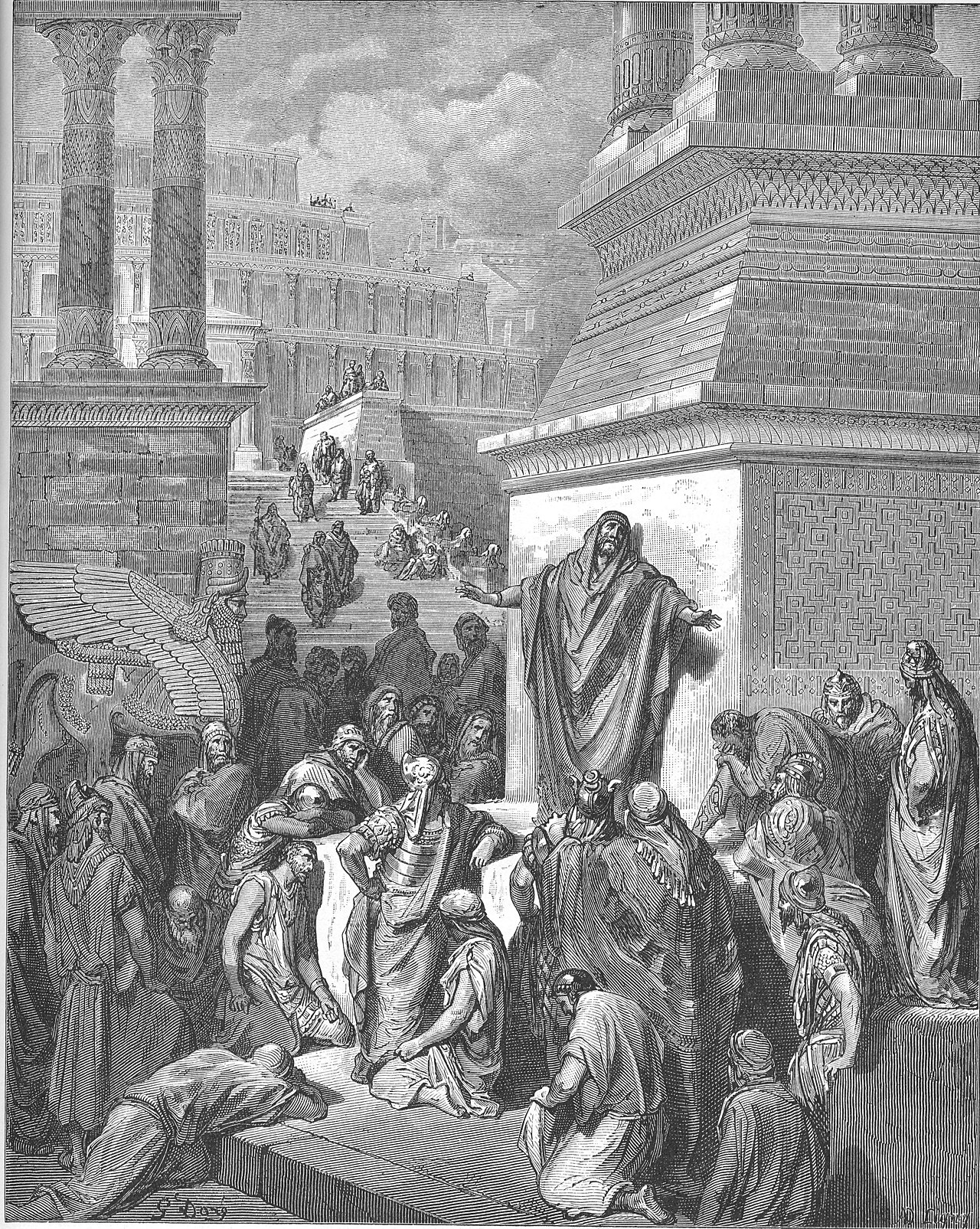
in Jonah 3“Get up! Go to the great city of Nineveh and proclaim to it the message that I give you.”
BSB
The same verse in ASV and KJV ▾
ASV
Arise, go unto Nineveh, that great city, and preach unto it the preaching that I bid thee.
KJV
Arise, go unto Nineveh, that great city, and preach unto it the preaching that I bid thee.
⋯
This verse in Jonah 3
Commentary
9 notes on this verseAnd preach unto it the preaching - וקרא את הקריאה vekera eth hakkeriah, “And cry the cry that I bid thee.” Be my herald, and faithfully deliver my message. The word κηρυξ in Greek answers to the Hebrew קורא kore: both signifying a crier, a herald, a preacher; one that makes proclamation with a loud and earnest cry. Such was John Baptist, Isa 40:3; such was Jesus Christ, John 7:18-37; and such were all his apostles.
This site's exposition
And the word of the Lord came unto Jonah the second time, saying
on Jonah 3:1-3
And the word of the Lord came unto Jonah the second time, saying, repeats the commission of 1:2 almost word for word, the second time marking mercy renewed toward the very prophet who had run from the first calling. This time Jonah arose and went unto Nineveh according to the word of the Lord, the same verb that once carried him toward Tarshish now carrying him where he was sent. Nineveh is described as an exceeding great city of three days across, and Henry and Keil both read the phrase as the time needed to cover the city's full extent or its districts rather than a straight-line crossing, since the site of ancient Nineveh does not stretch that far.
The record, by era
The Church Fathers1 voice
"And the word of the LORD came unto Jonah the second time, saying, arise, go unto Nineveh, that great city, and preach unto it the preaching that I bid you." LXX: 'and the message of God came to Jonah a second time, saying, arise, go to Nineveh, the great city, and preach there this message that I have told you'. He did not say to the prophet, "why have you not done what you were ordered to do?."
The Medieval Church1 voice
Jonah arose, it says; he did not delay, but immediately made himself ready for obeying.
The Reformation1 voice
There is here set before us a remarkable proof of God's grace, -- that he was pleased to bestow on Jonah his former dignity and honor. He was indeed unworthy of the common light, but God not only restored him to life, but favored him again with the office and honor of a prophet. This, as I have said, Jonah obtained through the wonderful and singular favor of God.
The Puritans and the Awakening2 voices
): "Arise, go to Nineveh, that great city," that metropolis, and preach unto it, preach against it, so the Chaldee. What is against us is preached to us, that we may hear it and take warning; and what is preached to us, if we do not give ear to it, and mix faith with it, will prove to be against us.
quarantine:debris (2026-07-29) — leading-punctuation+unbalanced-parens
Arise, go unto Nineveh, that great city,.... So it is called; See Gill on Jon 1:
2 more voices on this verse
The Nineteenth Century2 voices
A commentator
Jamieson, Fausset & Brown1802–1910
Commentary Critical and Explanatory on the Whole Bible (1871)
proposed
preach . . . the preaching--literally, "proclaim the proclamation." On the former occasion the specific object of his commission to Nineveh was declared; here it is indeterminate. This is to show how freely he yields himself, in the spirit of unconditional obedience, to speak whatever God may please.
quarantine:debris (2026-07-29) — starts-lowercase
A commentator
Albert Barnes1798–1870
Notes, Explanatory and Practical, on the Old and New Testaments (1832-1869)
proposed
Arise, go to Nineveh that great city, and preach (or cry) unto it - God says to Jonah the self-same words which He had said before; only perhaps He gives him an intimation of His purpose of mercy, in that he says no more, “cry against her,” but “cry unto her.” He might “cry against” one doomed to destruction; to “cry unto her,” seems to imply that she had some interest in, and so some hope from, this cry. “The preaching that I bid thee.” This is the only notice which Jonah relates that God took of his disobedience, in that He charged him to obey exactly what He commanded . “He does not say to him, why didst thou not what I commanded?” He had rebuked him in deed; He amended him and upbraided him not . “The rebuke of that shipwreck and the swallowing by the fish sufficed, so that he who had not felt the Lord commanding, might understand Him, delivering.” Jonah might have seemed unworthy to be again inspired by God. But “whom the Lord loveth, He chasteneth;” whom He chasteneth, He loveth . “The hard discipline, the severity and length of the scourge, were the earnests of a great trust and a high destination.” He knew him to be changed into another man, and, by one of His most special favors, gives him that same trust which he had before deserted . “As Christ, when risen, commended His sheep to Peter, wiser now and more fervent, so to Jonah risen He commends the conversion of Nineveh. For so did Christ risen bring about the conversion of the pagan, by sending His Apostles, each into large provinces, as Jonah was sent alone to a large city” . “He bids him declare not only the sentence of God, but in the same words; not to consider his own estimation or the ears of his hearers, nor to mingle soothing with severe words, and convey the message ingeniously, but with all freedom and severity to declare openly what was commanded him. […]
How the passage was read
What the Jewish commentators add
"Get up..[call out] that which I speak"- [Meaning,] that I spoke to you already and also that which I am now speaking to you, that you should call out to it [the city] that it will be overturned because of their evil.
2 more on this passage, in their own words ▾
"And he got up..a city great to God."- [When it comes to] anything which one wants to enlarge, [one should] juxtapose it with God in a way that increases its size, like [it says in the following phrases]: "Like the mountains of God," (Tehillim:7) "The cedars of God,"(Tehillim:11) "A flame of God from its darkness."
And this was the word of prophecy from before the LORD with Jonah again, saying:
This section is reception history: how the passage was read and kept in the Jewish tradition. Where a reading parts from an essential of the Christian faith, the section says so at that point.
Texts and citation data: Sefaria; each excerpt follows its version’s licence. 2 further sources are cited on this chapter that carry no English text this site may quote or only restate the verse.
The words behind it
14 Hebrew wordsEvery Hebrew word of this verse in the order it stands, with what it means and the door to its own study. The last column counts the times a word stands in the whole Bible: the rarer the word, the more the places it appears belong together.
| Hebrew | Sound | Meaning | Word study | In the Bible |
|---|---|---|---|---|
| ק֛וּם | kum | arise | H6965 → | 628 times |
| לֵ֥ךְ | lekh | go | H1980 → | 1546 times |
| אֶל־ | ʾel- | to | H413 → | 5510 times |
| נִֽינְוֵ֖ה | ninveh | Nineveh | H5210 → | 17 times |
| הָעִ֣יר | hair | the city | H5892 → | 1090 times |
| הַגְּדוֹלָ֑ה | hagedolah | <the> great | H1419 → | 526 times |
| וִּקְרָ֤א | vikra' | and call out | H7121 → | 733 times |
| אֵלֶ֙יהָ֙ | ʾeleiha | against it | H413 → | 5510 times |
| אֶת־ | ʾet- | <obj.> | H853 → | 10935 times |
| הַקְּרִיאָ֔ה | hakeriah | the proclamation | H7150 → | |
| אֲשֶׁ֥ר | ʾasher | which | H834 → | 5497 times |
| אָנֹכִ֖י | ʾanokhi | I | H595 → | |
| דֹּבֵ֥ר | dover | [am] speaking | H1696 → | |
| אֵלֶֽיךָ׃ | ʾeleikha | to you | H413 → | 5510 times |
ק֛וּםarise
kumH6965 →628 times
לֵ֥ךְgo
lekhH1980 →1546 times
אֶל־to
ʾel-H413 →5510 times
נִֽינְוֵ֖הNineveh
ninvehH5210 →17 times
הָעִ֣ירthe city
hairH5892 →1090 times
הַגְּדוֹלָ֑ה<the> great
hagedolahH1419 →526 times
וִּקְרָ֤אand call out
vikra'H7121 →733 times
אֵלֶ֙יהָ֙against it
ʾeleihaH413 →5510 times
אֶת־<obj.>
ʾet-H853 →10935 times
הַקְּרִיאָ֔הthe proclamation
hakeriahH7150 →
אֲשֶׁ֥רwhich
ʾasherH834 →5497 times
אָנֹכִ֖יI
ʾanokhiH595 →
דֹּבֵ֥ר[am] speaking
doverH1696 →
אֵלֶֽיךָ׃to you
ʾeleikhaH413 →5510 times
A shaded row is a word that stands 400 times or fewer in the Bible.
The walk
8 stopsEach card is a verse this one points to, and under it the verses that one points to in turn. Where several paths arrive at the same place, that place is listed first: the text keeps returning to it.
Through
Matthew 3:8Produce fruit, then, in keeping with repentance.
it leads to
- Luke 3:8
Produce fruit, then, in keeping with repentance. And do not begin to say to yourselves, ‘We have Abraham as our father.’ For I tell you that out of these stones God can raise up…
- Acts 26:20
First to those in Damascus and Jerusalem, then to everyone in the region of Judea, and then to the Gentiles, I declared that they should repent and turn to God, performing deeds worthy of…
- 2 Peter 1:4–8
Through these He has given us His precious and magnificent promises, so that through them you may become partakers of the divine nature, now that you have escaped the corruption in the world caused…
- Galatians 5:22–23
But the fruit of the Spirit is love, joy, peace, patience, kindness, goodness, faithfulness,
- Philippians 1:11
filled with the fruit of righteousness that comes through Jesus Christ, to the glory and praise of God.
- Luke 3:8
Through
Jeremiah 1:17Get yourself ready. Stand up and tell them everything that I command you. Do not be intimidated by them, or I will terrify you before them.
it leads to
- Jeremiah 1:7–8
But the LORD told me: “Do not say, ‘I am only a child.’ For to everyone I send you, you must go, and all that I command you, you must speak.
- 1 Kings 18:46
And the hand of the LORD came upon Elijah, and he tucked his cloak into his belt and ran ahead of Ahab all the way to Jezreel.
- Jeremiah 1:7–8
Through
Jonah 1:2“Get up! Go to the great city of Nineveh and preach against it, because its wickedness has come up before Me.”
it leads to
- Genesis 18:20–21
Then the LORD said, “The outcry against Sodom and Gomorrah is great. Because their sin is so grievous,
- Genesis 18:20–21
Where this verse is studied
About Jonah
Who and where
1 name in this verse with a page on the site.
This page draws on 9 works. Open the list of works
This page draws on Adam Clarke, Commentary on the Bible; Albert Barnes, Notes, Explanatory and Practical, on the Old and New Testaments (1832-1869); Carl Friedrich Keil, The Twelve Minor Prophets; Haimo of Auxerre, Commentary (church-history corpus); Jamieson, Fausset & Brown, Commentary Critical and Explanatory on the Whole Bible; Jerome, Commentary on Jonah, Chapter 3; John Calvin, Commentaries; John Gill, Exposition of the Old Testament (1748-1763) and Matthew Henry, Commentary on the Whole Bible.