
Jonah 1:17
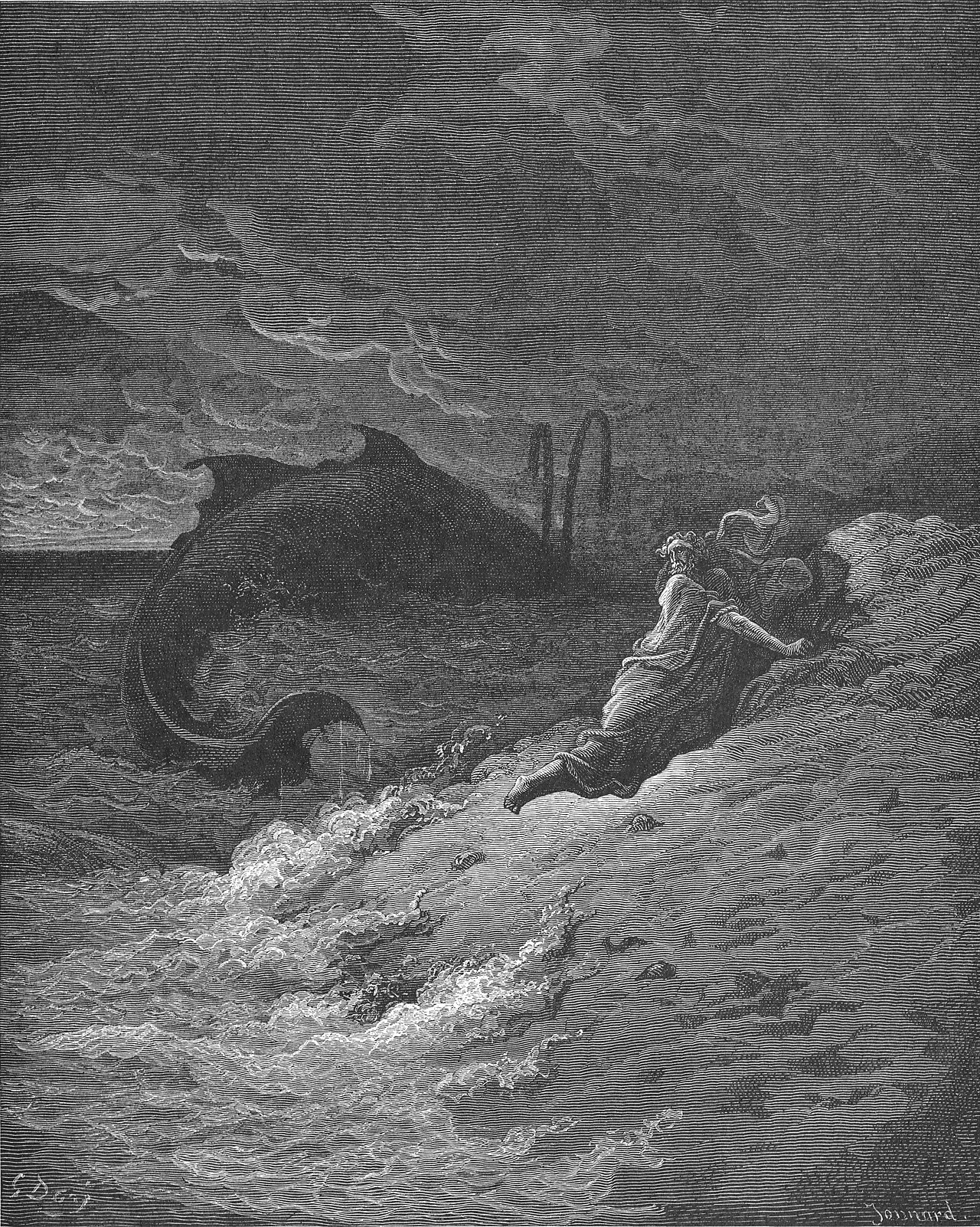
in Jonah 1Now the LORD had appointed a great fish to swallow Jonah, and Jonah spent three days and three nights in the belly of the fish.
BSB
The same verse in ASV and KJV ▾
ASV
And Jehovah prepared a great fish to swallow up Jonah; and Jonah was in the belly of the fish three days and three nights.
KJV
Now the Lord had prepared a great fish to swallow up Jonah. And Jonah was in the belly of the fish three days and three nights.
⋯
This verse in Jonah 1
Commentary
14 notes on this verse"Now the LORD had prepared a great fish to swallow up Jonah." LXX: 'and the Lord ordered a great fish to swallow Jonah'. The Lord commanded death and the underworld to receive the prophet. To the eager jaws of death he seemed a prey: she had such joy in swallowing him, and such sadness in spitting him out. Thus happened what is written in Hosea: "I will be your death, O Death! I will be your bite, Hell!" [Hos. 13:14].
This site's exposition
Now the Lord had prepared a great fish to swallow up Jonah
Now the Lord had prepared a great fish to swallow up Jonah turns the sea that was about to kill him into the means of his rescue, three days and three nights in its belly fixed by the text before any explanation of the mercy is given. The Lord Jesus took the detail as history rather than metaphor when he told the scribes and Pharisees that as Jonas was three days and three nights in the whale's belly, so shall the Son of man be three days and three nights in the heart of the earth, repeating the sign again at Matthew 16:4 and Luke 11:30 as the one sign that generation would be given. Keil and Pusey both read the Lord's own usage as settling how the sign is to be received, its force resting on Jonah's swallowing being a real event rather than a story he invented.
The record, by era
The Church Fathers4 voices
A commentator
Apostolic ConstitutionsCONSTITUTIONS OF THE HOLY APOSTLES 2:3.22 · Written before 380.
proposed
It is also your duty, O bishop, to follow the examples of those that have gone before and to apply their judgments skillfully to the cases of those who want words of severity or of consolation. Besides, it is reasonable that in your administration of justice you should follow the will of God. As God deals with sinners and with those who return, you should act accordingly in your judging. Now did not God by Nathan admonish David for his offense? And yet as soon as he said he repented, God delivered him from death, saying, "Be of good cheer; you shall not die." So also, when God had caused Jonah to be swallowed up by the sea and the whale upon his refusal to preach to the Ninevites, when yet he prayed to God out of the belly of the whale, he retrieved his life from corruption.
They further object: A dead man recently deceased was raised by the living; but show us that it is possible for a man dead and buried for three days to rise again. The testimony we seek is supplied by the Lord Jesus himself in the Gospels, when he says, "For even as Jonah was in the belly of the fish three days and three nights, so will the Son of man be three days and three nights in the heart of the earth." Now when we study the story of Jonah the force of the resemblance becomes striking. Jesus was sent to preach repentance. So was Jonah. Though Jonah fled, not knowing what was to come, Jesus came willingly, to grant repentance for salvation. Jonah slumbered in the ship and was fast asleep amid the stormy sea; while Jesus by God's will was sleeping, the sea was stirred up, for the purpose of manifesting thereafter the power of him who slept. They said to Jonah, "What are you doing asleep? Rise up, call upon your God, that God may save us," but the apostles say, "Lord, save us!" In the first instance they said, Call upon your God, and in the second, save us. In the first Jonah said to them, "Pick me up and throw me into the sea, that it may quiet down for you"; in the other Christ himself "rebuked the wind and the sea, and there came a great calm." Jonah was cast into the belly of a great fish, but Christ of his own will descended to the abode of the invisible fish of death. He went down of his own will to make death disgorge those it had swallowed up, according to the Scripture: "I shall deliver them from the power of the nether world, and I shall redeem them from death."
Did Jonah, then, on this account, think that repentance was unnecessary for the pagan Ninevites, when he tried to avoid his duty of preaching? Or was it not, rather, that he foresaw that the mercy of God would be poured out on the heathen also, and so feared it would prove him a false prophet? Actually it was because of a pagan city, which did not yet know God and which sinned in ignorance, that the prophet was almost lost. And he would have been lost, were it not for the fact that what he endured was a type of the Lord's suffering, by which pagan penitents also would be redeemed.
The last question is about Jonah, and it is not put as if it were taken from Porphyry but as if it were a laughingstock of the pagans. It is expressed thus: "Please tell me what we are to think about Jonah, who is said to have been three days in the belly of a whale. It is improbable and unbelievable that he should have been swallowed up with his clothing and should have been inside the fish. If it is figuratively said, please explain it.… I have noticed that this sort of question is a matter of much jest and much laughter to pagans. The answer to this is that either all the divine miracles are to be disbelieved or there is no reason why they should not be believed. We should not believe in Christ himself and that he rose on the third day, if the faith of the Christians feared the laughter of the pagans.
The Medieval Church1 voice
A commentator
BonaventureCollations on the Hexaemeron, Collation 14 · Written in the 13th century.
proposed
In the mystery of prophetical revelation, Christ is symbolized by occurrence, as with Jonah who was "in the belly of the fish three days," as the Lord was in the tomb three days.
7 more voices on this verse
The Puritans and the Awakening4 voices
A great fish - The Hebrew word is, numbered, has appointed him for Jonah's receiver and deliverer. God has the command of all his creatures, and can make any of them serve his designs of mercy to his people.
An illustrious type of Christ, who was buried and rose again according to the scriptures ( 1 Cor. xv. 4 ), according to this scripture, for, as Jonah was three days and three nights in the whale's belly, so was the Son of man three days and three nights in the heart of the earth, Matt. xii. Jonah's burial was a figure of Christ's.
Now the Lord had prepared a great fish to swallow up Jonah,....
The honour God put upon Jonah, in giving him a commission to go and prophesy against Nineveh. Jonah signifies a dove, a proper name for all God's prophets, all his people, who ought to be harmless as doves, and to mourn as doves for the sins and calamities of the land. His father's name was Amittai--My truth; for God's prophets should be sons of truth.
The Nineteenth Century3 voices
A commentator
Albert Barnes1798–1870
Notes, Explanatory and Practical, on the Old and New Testaments (1832-1869)
Now the Lord had (literally “And the Lord”) prepared - Jonah (as appears from his thanksgiving) was not swallowed at once, but sank to the bottom of the sea, God preserving him in life there by miracle, as he did in the fish’s belly.
A commentator
Jamieson, Fausset & Brown1802–1910
Commentary Critical and Explanatory on the Whole Bible (1871)
proposed
prepared a great fish--not created specially for this purpose, but appointed in His providence, to which all creatures are subservient. The fish, through a mistranslation of Mt 12:40, was formerly supposed to be a whale; there, as here, the original means "a great fish." The whale's neck is too narrow to receive a man.
quarantine:debris (2026-07-29) — starts-lowercase
Now the Lord had prepared a great fish - דג גדול dag gadol. This could not have been a whale, for the throat of that animal can scarcely admit a man’s leg; but it might have been a shark, which abounds in the Mediterranean, and whose mouth and stomach are exceedingly capacious. In several cases they have been known to swallow a man when thrown overboard. See the note on Mat 12:40 (note), where the whole subject of this verse is considered at large. That days and nights do not, among the Hebrews, signify complete days and nights of twenty-four hours, see Est 4:16, compared with Est 5:1; Jdg 14:17, Jdg 14:18. Our Lord lay in the grave one natural day, and part of two others; and it is most likely that this was the precise time that Jonah was in the fish’s belly.
The words behind it
15 Hebrew wordsEvery Hebrew word of this verse in the order it stands, with what it means and the door to its own study. The last column counts the times a word stands in the whole Bible: the rarer the word, the more the places it appears belong together.
| Hebrew | Sound | Meaning | Word study | In the Bible |
|---|---|---|---|---|
| וַיְמַ֤ן | vayman | and he appointed | H4487 → | 28 times |
| יְהוָה֙ | yahweh | Yahweh | H3068 → | 6520 times |
| דָּ֣ג | dag | a fish | H1709 → | 19 times |
| גָּד֔וֹל | gadol | great | H1419 → | 526 times |
| לִבְלֹ֖עַ | livloa' | to swallow | H1104 → | |
| אֶת־ | ʾet- | <obj.> | H853 → | 10935 times |
| יוֹנָ֑ה | yonah | Jonah | H3124 → | 19 times |
| וַיְהִ֤י | vayhi | and he was | H1961 → | 3559 times |
| יוֹנָה֙ | yonah | Jonah | H3124 → | 19 times |
| בִּמְעֵ֣י | bimei | in [the] inward parts of | H4578 → | |
| הַדָּ֔ג | hadag | the fish | H1709 → | 19 times |
| שְׁלֹשָׁ֥ה | sheloshah | three | H7969 → | 432 times |
| יָמִ֖ים | yamim | days | H3117 → | 2304 times |
| וּשְׁלֹשָׁ֥ה | usheloshah | and three | H7969 → | 432 times |
| לֵילֽוֹת׃ | leilot | nights | H3915 → | 233 times |
וַיְמַ֤ןand he appointed
vaymanH4487 →28 times
יְהוָה֙Yahweh
yahwehH3068 →6520 times
דָּ֣גa fish
dagH1709 →19 times
גָּד֔וֹלgreat
gadolH1419 →526 times
לִבְלֹ֖עַto swallow
livloa'H1104 →
אֶת־<obj.>
ʾet-H853 →10935 times
יוֹנָ֑הJonah
yonahH3124 →19 times
וַיְהִ֤יand he was
vayhiH1961 →3559 times
יוֹנָה֙Jonah
yonahH3124 →19 times
בִּמְעֵ֣יin [the] inward parts of
bimeiH4578 →
הַדָּ֔גthe fish
hadagH1709 →19 times
שְׁלֹשָׁ֥הthree
sheloshahH7969 →432 times
יָמִ֖יםdays
yamimH3117 →2304 times
וּשְׁלֹשָׁ֥הand three
usheloshahH7969 →432 times
לֵילֽוֹת׃nights
leilotH3915 →233 times
A shaded row is a word that stands 400 times or fewer in the Bible.
The walk
8 stopsEach card is a verse this one points to, and under it the verses that one points to in turn. Where several paths arrive at the same place, that place is listed first: the text keeps returning to it.
Through
Habakkuk 3:2O LORD, I have heard the report of You; I stand in awe, O LORD, of Your deeds. Revive them in these years; make them known in these years. In Your wrath, remember mercy!
it leads to
- Psalms 85:6
Will You not revive us again, that Your people may rejoice in You?
- Psalms 90:13–17
Return, O LORD! How long will it be? Have compassion on Your servants.
- Hosea 6:2–3
After two days He will revive us; on the third day He will raise us up, that we may live in His presence.
- Isaiah 51:9–11
Awake, awake, put on strength, O arm of the LORD. Wake up as in days past, as in generations of old. Was it not You who cut Rahab to pieces, who pierced through the…
- Lamentations 3:32
Even if He causes grief, He will show compassion according to His abundant loving devotion.
- Psalms 85:6
Through
Matthew 16:4A wicked and adulterous generation demands a sign, but none will be given it except the sign of Jonah.” Then He left them and went away.
it leads to
- Luke 11:29–30
As the crowds were increasing, Jesus said, “This is a wicked generation. It demands a sign, but none will be given it except the sign of Jonah.
- Matthew 12:39–40
Jesus replied, “A wicked and adulterous generation demands a sign, but none will be given it except the sign of the prophet Jonah.
- Luke 11:29–30
Through
Matthew 12:40For as Jonah was three days and three nights in the belly of the great fish, so the Son of Man will be three days and three nights in the heart of the earth.
it leads to
- Matthew 27:63–64
“Sir,” they said, “we remember that while He was alive that deceiver said, ‘After three days I will rise again.’
- Matthew 27:63–64
Where this verse is studied
On this page
About Jonah
Who and where
1 name in this verse with a page on the site.
This page draws on 14 works. Open the list of works
This page draws on Adam Clarke, Commentary on the Bible; Albert Barnes, Notes, Explanatory and Practical, on the Old and New Testaments (1832-1869); Apostolic Constitutions, CONSTITUTIONS OF THE HOLY APOSTLES 2:3.22; Augustine of Hippo, LETTER 170:6; Bonaventure, Collations on the Hexaemeron, Collation 14; Carl Friedrich Keil, The Twelve Minor Prophets; Cyril of Jerusalem, Catechetical Lecture 14:7; Edward Bouverie Pusey, The Minor Prophets: A Commentary; Jamieson, Fausset & Brown, Commentary Critical and Explanatory on the Whole Bible; Jerome, Commentary on Jonah, Chapter 1; John Gill, Exposition of the Old Testament (1748-1763); John Wesley, Explanatory Notes upon the Old Testament; Matthew Henry, Commentary on the Whole Bible and Tertullian, ON PURITY 10.