
Jonah 3:4
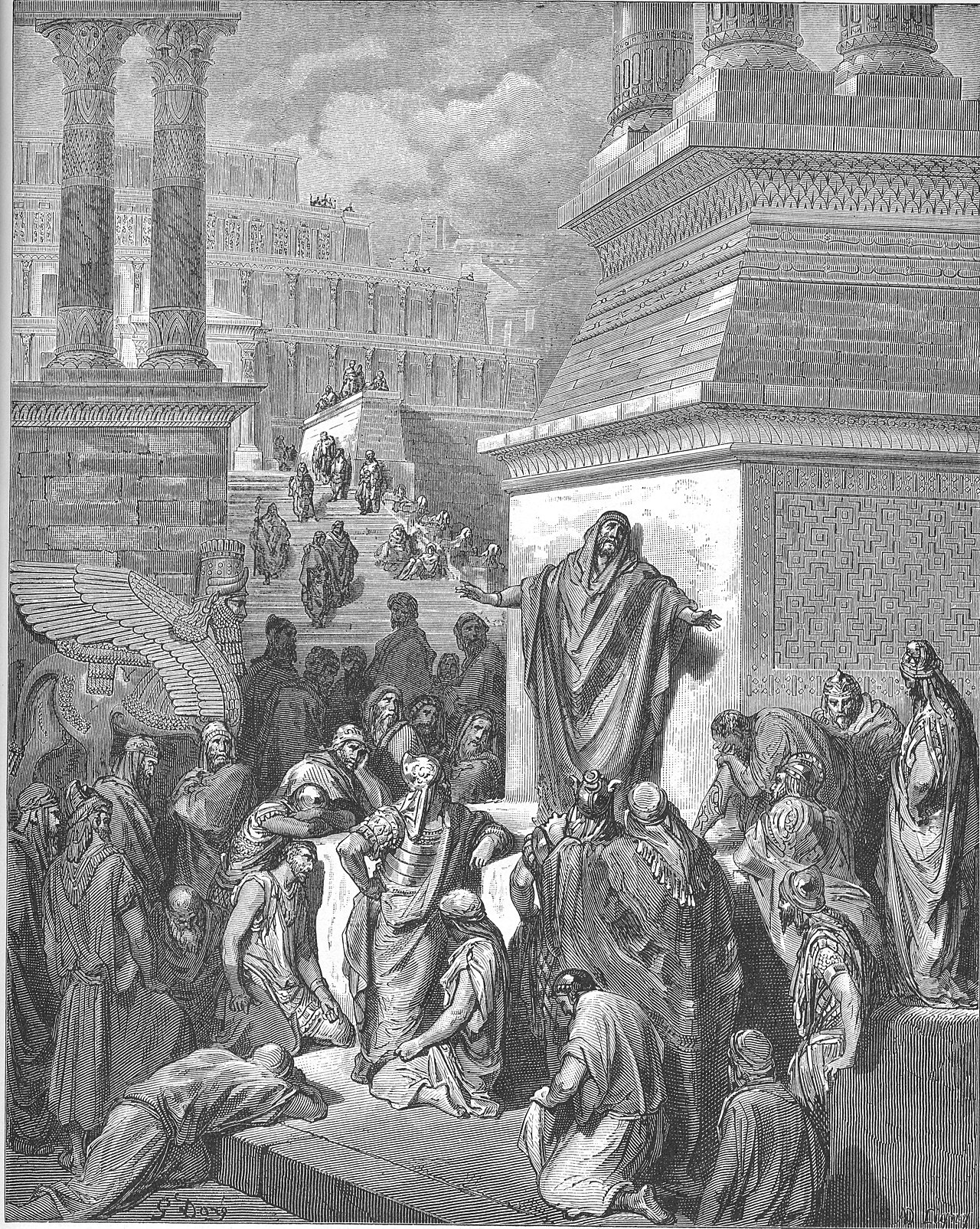
in Jonah 3On the first day of his journey, Jonah set out into the city and proclaimed, “Forty more days and Nineveh will be overturned!”
BSB
The same verse in ASV and KJV ▾
ASV
And Jonah began to enter into the city a day’s journey, and he cried, and said, Yet forty days, and Nineveh shall be overthrown.
KJV
And Jonah began to enter into the city a day’s journey, and he cried, and said, Yet forty days, and Nineveh shall be overthrown.
⋯
This verse in Jonah 3
Commentary
12 notes on this verse"[And Jonah began to enter into the city a day's journey], and he cried, and said, Yet forty days, and Nineveh shall be overthrown." LXX: 'he proclaimed and said, another three days and Nineveh will be destroyed". The umber three written in the Septuagint does not agree with the penitence, and I am quite astonished at this translation, for in Hebrew neither the letters or syllables or accents or the word show any common element. For three is said, salos and forty arbaim.
This site's exposition
Forty more days and Nineveh will be overturned!
The whole of Jonah's recorded preaching is "Forty more days and Nineveh will be overturned!", with no call to repent. Gill and Calvin note that he speaks it on the first day, one day into a city of three. Verse 5 shows the whole city taking it as a warning.
The record, by era
The Church Fathers5 voices
[Daniel 4:27] "'Wherefore, O king, let my counsel meet with thy favor, and make up for thy sins by deeds of charity, and thine iniquities by showing mercy to the poor. Perhaps God will forgive thy transgressions.'" Since he had previously pronounced the sentence of God, which of course cannot be altered, how could he exhort the king to deeds of charity and acts of mercy towards the poor? This difficulty is easily solved by reference to the example of King Hezekiah, who Isaiah had said was going to die (Isaiah 38:1); and again, to the example of the Ninevites, to whom it was said: "Yet forty days, and Nineveh shall be destroyed" (Jonah 3:4). And yet the sentence of God was changed in response to the prayers of Hezekiah and the city of Nineveh, not by any means because of the ineffectualness of the judgment itself but because of the conversion of those who merited pardon. Morever in Jeremiah God states that He threatens evil for the nation (Jeremiah 18:7-8), but if it does that which is good, He will alter His threats to bestow mercy. Again, He affirms that He directs His promises to the man who does good; and if the same man thereafter works evil, He says that He changes His decision, not with regard to the men themselves, but with regard to their works which have thus changed in character. For after all, God is not angered at men but at their sins; and when no sins inhere in a man, God by no means inflicts a punishment which has been commuted. In other words, let us say that Nebuchadnezzar performed deeds of mercy toward the poor in accordance with Daniel's advice, and for that reason the sentence against him was delayed of execution for twelve months. […]
A commentator
Clement of RomeClement's First Letter to the Corinthians, Chapter 7 · Written before 99.
proposed
Let us turn to every age that has passed, and learn that, from generation to generation, the Lord has granted a place of repentance to all such as would be converted unto Him... Jonah proclaimed destruction to the Ninevites; but they, repenting of their sins, propitiated God by prayer, and obtained salvation, although they were aliens [to the covenant] of God.
Does God for our salvation deceive and say certain things so that the sinner ceases doing what he might do if he had not heard certain of these words? Was the one who says, "Yet three days and Nineveh shall be destroyed," speaking as one who speaks truly or not? Or as one who deceives by a deceit that converts? If that kind of conversion did not happen, was what was said no longer a deceit but already truth. There would have been a destruction that followed for Nineveh. It was up to those who hear.
If you want, let us also hear this story: "Now the word of the Lord," it says, "came to Jonah, saying, 'Rise and go to Nineveh, the great city.' " He wanted to put Jonah to shame by sending him to the great city of Nineveh, because he foresaw the prophet's escape. However, let us also listen to the preaching: "Yet three days, and Nineveh shall be overthrown." Why do you, God, foretell the sufferings that you will inflict upon Nineveh? "So that I will not do what I announced." This is why God threatened with hell—so he would not lead anyone away to hell. He says, "Fear that which is spoken to you, and do not be saddened about what has been done." Why does he establish the appointed time to be only a period of three days? So that you may learn even the virtue of the barbarians—I call the Ninevites barbarians, who were able to annul in three days such anger caused by sin. I want you to marvel at the philanthropy of God, who was satisfied with three days of repentance for so many transgressions. I do not want you to sink into despair, even though you have innumerable sins.
A commentator
John ChrysostomHomily on the Paralytic Let Down Through the Roof, 3 · Written before 407.
proposed
For He never makes a public display of our sins, except at any time He sees men insensible to them. For when He says "ye saw me hungry, and fed me not: and thirsty and gave me no drink," He speaks thus at the present time in order that we may not hear these words in time to come. He threatens, He exposes us in this world, that He may not have to expose us in the other: even as He threatened to overthrow the city of the Ninevites for the very reason that He might not overthrow it. For if He wished to publish our sins He would not announce beforehand that He would publish them: but as it is He does make this announcement in order that being sobered by the fear of exposure, if not also by the fear of punishment we may purge ourselves from them all.
5 more voices on this verse
The Church Fathers1 voice
We should not despair of those who are still unwilling to correct their vices and do not even blush to defend them. In a similar way hope was not abandoned for that city of which it is written, "Three days more, and Nineveh shall be …
The Puritans and the Awakening1 voice
And Jonah began to enter into the city a day's journey,....
The Nineteenth Century3 voices
Yet forty days - Both the Septuagint and Arabic read three days. Probably some early copyist of the Septuagint, from whom our modern editions are derived, mistook the Greek numerals μ forty for γ three; or put the three days’ journey in preaching instead of the forty days mentioned in the denunciation.
A commentator
Jamieson, Fausset & Brown1802–1910
Commentary Critical and Explanatory on the Whole Bible (1871)
It is no longer a cry against the sins of Nineveh, but an announcement of its ruin in forty days. This number is in Scripture associated often with humiliation. It was forty days that Moses, Elijah, and Christ fasted.
A commentator
Albert Barnes1798–1870
Notes, Explanatory and Practical, on the Old and New Testaments (1832-1869)
proposed
And Jonah began to enter the city a day’s journey - Perhaps the day’s journey enabled him to traverse the city from end to end, with his one brief, deep cry of woe; “Yet forty days and Nineveh overthrown.” He prophesied an utter overthrow, a turning it upside down. He does not speak of it as to happen at a time beyond those days. The close of the forty days and the destruction were to be one. He does not say strictly, “Yet forty days and Nineveh shall be overthrown,” but, “Yet forty days and Nineveh overthrown.” The last of those forty days was, ere its sun was set, to see Nineveh as a “thing overthrown.” Jonah knew from the first God’s purpose of mercy to Nineveh; he had a further hint of it in the altered commission which he had received. It is perhaps hinted in the word “Yet” . “If God had meant unconditionally to overthrow them, He would have overthrown them without notice. ‘Yet,’ always denotes some long-suffering of God.” But, taught by that severe discipline, he discharges his office strictly. He cries, what God had commanded him to cry out, without reserve or exception. The sentence, as are all God’s threatenings until the last, was conditional. But God does not say this. That sentence was now within forty days of its completion; yet even thus it was remitted. Wonderful encouragement, when one Lent sufficed to save some 600,000 souls from perishing! Yet the first visitation of the cholera was checked in its progress in England, upon one day’s national fast and humiliation; and we have seen how general prayer has often-times at once opened or closed the heavens as we needed. […]
How the passage was read
What the Jewish commentators add
overturned Destroyed. [He did not say, “Destroyed,” because “overturned” has two meanings, bad and good. If they do not repent, it will be destroyed; if they repent, then “overturned” refers to the people of Nineveh, that they will be changed from bad to good, and they will repent.
2 more on this passage, in their own words ▾
"And he got up..a city great to God."- [When it comes to] anything which one wants to enlarge, [one should] juxtapose it with God in a way that increases its size, like [it says in the following phrases]: "Like the mountains of God," (Tehillim:7) "The cedars of God,"(Tehillim:11) "A flame of God from its darkness."
"And they believed"- because the sailors were in the city and they testified about Yonah that they had cast him into the sea, and the rest of his story as it happened. This is why they believed his prophecy and repented completely.
This section is reception history: how the passage was read and kept in the Jewish tradition. Where a reading parts from an essential of the Christian faith, the section says so at that point.
Texts and citation data: Sefaria; each excerpt follows its version’s licence. 2 further sources are cited on this chapter that carry no English text this site may quote or only restate the verse.
The words behind it
14 Hebrew wordsEvery Hebrew word of this verse in the order it stands, with what it means and the door to its own study. The last column counts the times a word stands in the whole Bible: the rarer the word, the more the places it appears belong together.
| Hebrew | Sound | Meaning | Word study | In the Bible |
|---|---|---|---|---|
| וַיָּ֤חֶל | vaiyachel | and he began | H2490 → | |
| יוֹנָה֙ | yonah | Jonah | H3124 → | 19 times |
| לָב֣וֹא | lavo' | to go | H935 → | 2568 times |
| בָעִ֔יר | vair | in the city | H5892 → | 1090 times |
| מַהֲלַ֖ךְ | mahalakh | a journey of | H4109 → | |
| י֣וֹם | yom | a day | H3117 → | 2304 times |
| אֶחָ֑ד | ʾechad | one | H259 → | |
| וַיִּקְרָא֙ | vaiyikra' | and he proclaimed | H7121 → | 733 times |
| וַיֹּאמַ֔ר | vaiyomar | and he said | H559 → | 5305 times |
| ע֚וֹד | od | yet | H5750 → | |
| אַרְבָּעִ֣ים | ʾarbaim | forty | H705 → | |
| י֔וֹם | yom | day[s] | H3117 → | 2304 times |
| וְנִֽינְוֵ֖ה | venineveh | and Nineveh | H5210 → | 17 times |
| נֶהְפָּֽכֶת׃ | nehpakhet | [is] about to be overturned | H2015 → |
וַיָּ֤חֶלand he began
vaiyachelH2490 →
יוֹנָה֙Jonah
yonahH3124 →19 times
לָב֣וֹאto go
lavo'H935 →2568 times
בָעִ֔ירin the city
vairH5892 →1090 times
מַהֲלַ֖ךְa journey of
mahalakhH4109 →
י֣וֹםa day
yomH3117 →2304 times
אֶחָ֑דone
ʾechadH259 →
וַיִּקְרָא֙and he proclaimed
vaiyikra'H7121 →733 times
וַיֹּאמַ֔רand he said
vaiyomarH559 →5305 times
ע֚וֹדyet
odH5750 →
אַרְבָּעִ֣יםforty
ʾarbaimH705 →
י֔וֹםday[s]
yomH3117 →2304 times
וְנִֽינְוֵ֖הand Nineveh
veninevehH5210 →17 times
נֶהְפָּֽכֶת׃[is] about to be overturned
nehpakhetH2015 →
A shaded row is a word that stands 400 times or fewer in the Bible.
The walk
8 stopsEach card is a verse this one points to, and under it the verses that one points to in turn. Where several paths arrive at the same place, that place is listed first: the text keeps returning to it.
Through
Jonah 3:10When God saw their actions—that they had turned from their evil ways—He relented from the disaster He had threatened to bring upon them.
it leads to
- Jeremiah 18:8
But if that nation I warned turns from its evil, then I will relent of the disaster I had planned to bring.
- 1 Kings 21:27–29
When Ahab heard these words, he tore his clothes, put on sackcloth, and fasted. He lay down in sackcloth and walked around meekly.
- Exodus 32:14
So the LORD relented from the calamity He had threatened to bring on His people.
- Amos 7:6
So the LORD relented from this plan. “It will not happen either,” said the Lord GOD.
- Jeremiah 18:8
Through
2 Kings 20:1In those days Hezekiah became mortally ill. The prophet Isaiah son of Amoz came to him and said, “This is what the LORD says: ‘Put your house in order, for you are about to…
it leads to
- Isaiah 38:1–22
In those days Hezekiah became mortally ill. The prophet Isaiah son of Amoz came to him and said, “This is what the LORD says: ‘Put your house in order, for you are about to…
- 2 Chronicles 32:24–26
In those days Hezekiah became mortally ill. So he prayed to the LORD, who spoke to him and gave him a sign.
- Philippians 2:27
He was sick indeed, nearly unto death. But God had mercy on him, and not only on him but also on me, to spare me sorrow upon sorrow.
- Isaiah 38:1–22
Through
Deuteronomy 18:22When a prophet speaks in the name of the LORD and the message does not come to pass or come true, that is a message the LORD has not spoken. The prophet has spoken…
it leads to
- Deuteronomy 18:20
But if any prophet dares to speak a message in My name that I have not commanded him to speak, or to speak in the name of other gods, that prophet must be put…
- Deuteronomy 18:20
Where this verse is studied
On this page
Studies10
On this verse
About Jonah
Who and where
2 names in this verse with a page on the site.
- PersonDivided kingdomJonahThe prophet who fled his commission, prayed from the fish's belly, preached Nineveh's overthrow, and sulked at its mercy — the sig…
- PlaceAssyriaNinevehThe great city of Assyria that repented in sackcloth at Jonah’s preaching, that Sennacherib returned to after Jerusalem was spared…
This page draws on 13 works. Open the list of works
This page draws on Adam Clarke, Commentary on the Bible; Albert Barnes, Notes, Explanatory and Practical, on the Old and New Testaments (1832-1869); Caesarius of Arles, SERMON 133:3; Clement of Rome, Clement's First Letter to the Corinthians, Chapter 7; Jamieson, Fausset & Brown, Commentary Critical and Explanatory on the Whole Bible; Jerome, Commentary on Jonah, Chapter 3; Jerome, St. Jerome, Commentary on Daniel, CHAPTER FOUR; John Calvin, Commentaries on the Twelve Minor Prophets; John Chrysostom, HOMILIES ON REPENTANCE AND ALMSGIVING 5:4; John Chrysostom, Homily on the Paralytic Let Down Through the Roof, 3; John Gill, Exposition of the Old Testament; John Gill, Exposition of the Old Testament (1748-1763) and Origen of Alexandria, HOMILIES ON JEREMIAH 19:7.