
Jonah 2:6
in Jonah 2To the roots of the mountains I descended; the earth beneath me barred me in forever! But You raised my life from the pit, O LORD my God!
BSB
The same verse in ASV and KJV ▾
ASV
I went down to the bottoms of the mountains; The earth with its bars closed upon me for ever: Yet hast thou brought up my life from the pit, O Jehovah my God.
KJV
I went down to the bottoms of the mountains; the earth with her bars was about me for ever: yet hast thou brought up my life from corruption, O Lord my God.
⋯
This verse in Jonah 2
Commentary
5 notes on this verseI went down to the bottoms of the mountains - This also may be literally understood. The fish followed the slanting base of the mountains, till they terminated in a plain at the bottom of the great deep. The earth with her bars - He represents himself as a prisoner in a dungeon, closed in with bars which he could not remove, and which at first appeared to be for ever, i.e., the place where his life must terminate.
This site's exposition
The waters compassed me about, even to the soul
on Jonah 2:5-6
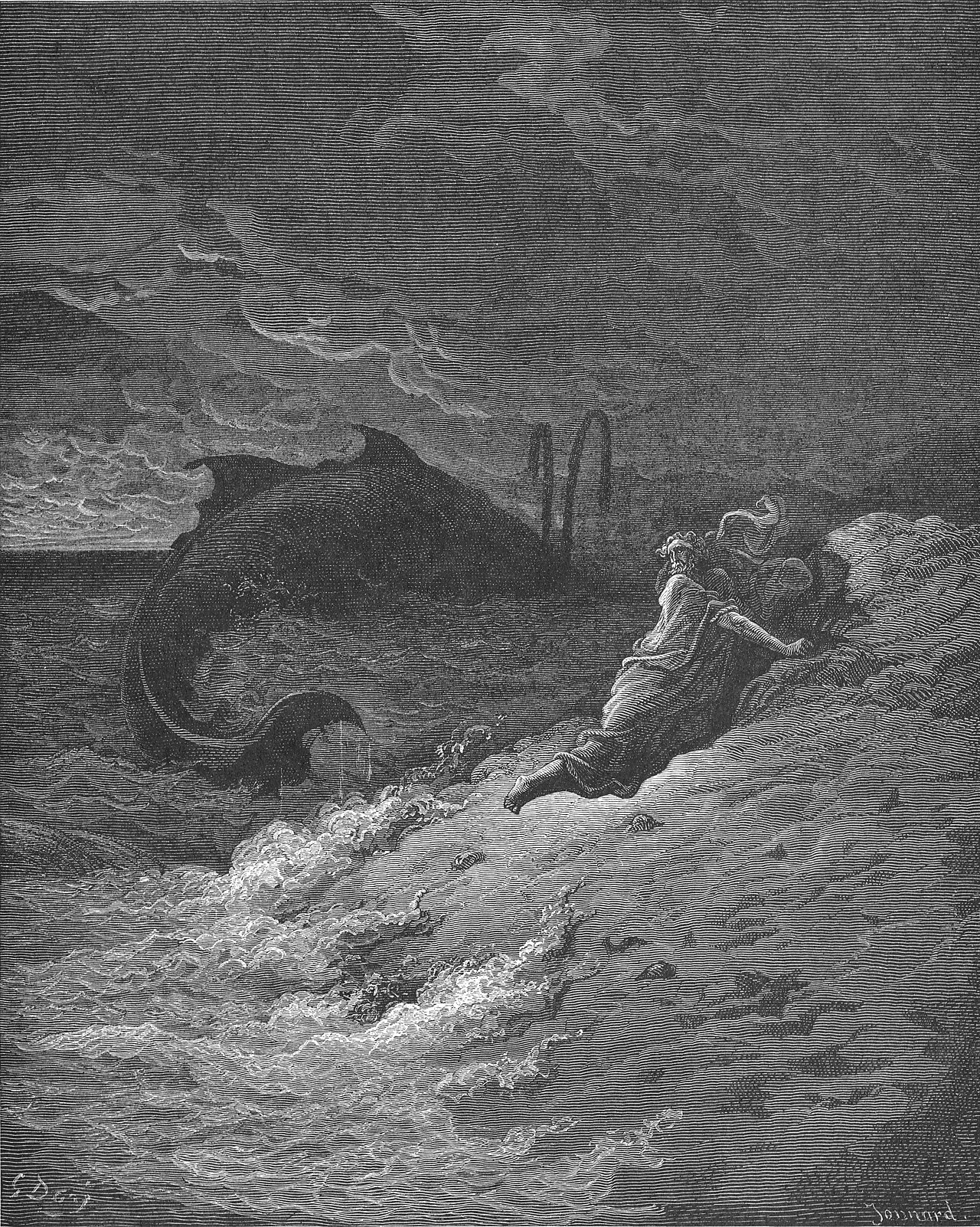
The waters compassed me about, even to the soul, and the weeds wrapped about his head, place Jonah at the sea floor rather than merely tossed on its surface, the picture of a man already drowned rather than one still swimming. Going down to the bottoms of the mountains, the earth's bars closing on him for ever, describes the grip of the place of the dead itself, and against that finality stands the one line that reverses it, yet hast thou brought up my life from corruption, O Lord my God. Barnes and Wesley both read the bars of the earth as ordinary poetic language for the place of the dead rather than a claim about the fish's own anatomy, the miracle lying in the deliverance rather than in biology.
The record, by era
The Puritans and the Awakening2 voices
The earth was so shut and locked, so barred and bolted, against him, that he was quite cut off from any hope of ever returning to it. Thus helpless, thus hopeless, did Jonah's case seem to be. Those whom God contends with the whole creation is at war with.
Or, rather, we may suppose it spoken while he was yet in the fish's belly, and then it is the language of his faith: "Thou hast kept me alive here, in the pit, and therefore thou canst, thou wilt, bring up my life from the pit; " and he speaks of it with as much assurance as if it were done already: Thou has brought up my life.
The Nineteenth Century1 voice
A commentator
Jamieson, Fausset & Brown1802–1910
Commentary Critical and Explanatory on the Whole Bible (1871)
Compare Ps 18:7, "the foundations of the hills" (Ps 18:15). earth with her bars was about me--Earth, the land of the living, is (not "was") shut against me. for ever--so far as any effort of mine can deliver me. yet hast thou brought up my life from corruption--rather, "Thou bringest . . . from the pit" [MAURER].
The words behind it
12 Hebrew wordsEvery Hebrew word of this verse in the order it stands, with what it means and the door to its own study. The last column counts the times a word stands in the whole Bible: the rarer the word, the more the places it appears belong together.
| Hebrew | Sound | Meaning | Word study | In the Bible |
|---|---|---|---|---|
| לְקִצְבֵ֤י | lekitzvei | to extremities of | H7095 → | |
| הָרִים֙ | harim | mountains | H2022 → | |
| יָרַ֔דְתִּי | yaradti | I went down | H3381 → | 381 times |
| הָאָ֛רֶץ | haaretz | the earth | H776 → | |
| בְּרִחֶ֥יהָ | bericheiha | bars its | H1280 → | |
| בַעֲדִ֖י | vaadi | [were] behind me | H1157 → | |
| לְעוֹלָ֑ם | leolam | for ever | H5769 → | |
| וַתַּ֧עַל | vataal | and you brought up | H5927 → | 890 times |
| מִשַּׁ֛חַת | mishachat | from [the] pit | H7845 → | |
| חַיַּ֖י | chaiyai | life my | H2416 → | 498 times |
| יְהוָ֥ה | yahweh | O Yahweh | H3068 → | 6520 times |
| אֱלֹהָֽי׃ | ʾelohai | God my | H430 → | 2601 times |
לְקִצְבֵ֤יto extremities of
lekitzveiH7095 →
הָרִים֙mountains
harimH2022 →
יָרַ֔דְתִּיI went down
yaradtiH3381 →381 times
הָאָ֛רֶץthe earth
haaretzH776 →
בְּרִחֶ֥יהָbars its
bericheihaH1280 →
בַעֲדִ֖י[were] behind me
vaadiH1157 →
לְעוֹלָ֑םfor ever
leolamH5769 →
וַתַּ֧עַלand you brought up
vataalH5927 →890 times
מִשַּׁ֛חַתfrom [the] pit
mishachatH7845 →
חַיַּ֖יlife my
chaiyaiH2416 →498 times
יְהוָ֥הO Yahweh
yahwehH3068 →6520 times
אֱלֹהָֽי׃God my
ʾelohaiH430 →2601 times
A shaded row is a word that stands 400 times or fewer in the Bible.
The walk
8 stopsEach card is a verse this one points to, and under it the verses that one points to in turn. Where several paths arrive at the same place, that place is listed first: the text keeps returning to it.
Through
Psalms 16:10For You will not abandon my soul to Sheol, nor will You let Your Holy One see decay.
it leads to
- Acts 2:27–31
because You will not abandon my soul to Hades, nor will You let Your Holy One see decay.
- Acts 13:35–38
So also, He says in another Psalm: ‘You will not let Your Holy One see decay.’
- Psalms 49:15
But God will redeem my life from Sheol, for He will surely take me to Himself. Selah
- Revelation 1:18
the Living One. I was dead, and behold, now I am alive forever and ever! And I hold the keys of Death and of Hades.
- Acts 2:27–31
Through
Psalms 143:7Answer me quickly, O LORD; my spirit fails. Do not hide Your face from me, or I will be like those who descend to the Pit.
it leads to
- Psalms 28:1
To You, O LORD, I call; be not deaf to me, O my Rock. For if You remain silent, I will be like those descending to the Pit.
Reached by 2 separate paths from here.
- Psalms 69:17
Hide not Your face from Your servant, for I am in distress. Answer me quickly!
- Psalms 28:1
Through
Isaiah 38:17Surely for my own welfare I had such great anguish; but Your love has delivered me from the pit of oblivion, for You have cast all my sins behind Your back.
it leads to
- Psalms 86:13
For great is Your loving devotion to me; You have delivered me from the depths of Sheol.
Reached by 2 separate paths from here.
- Isaiah 43:25
I, yes I, am He who blots out your transgressions for My own sake and remembers your sins no more.
- Psalms 86:13
Where this verse is studied
On this page
Studies1
About Jonah
This page draws on Adam Clarke, Commentary on the Bible; Albert Barnes, Notes on the Old Testament; Jamieson, Fausset & Brown, Commentary Critical and Explanatory on the Whole Bible; John Wesley, Explanatory Notes upon the Old Testament and Matthew Henry, Commentary on the Whole Bible.