
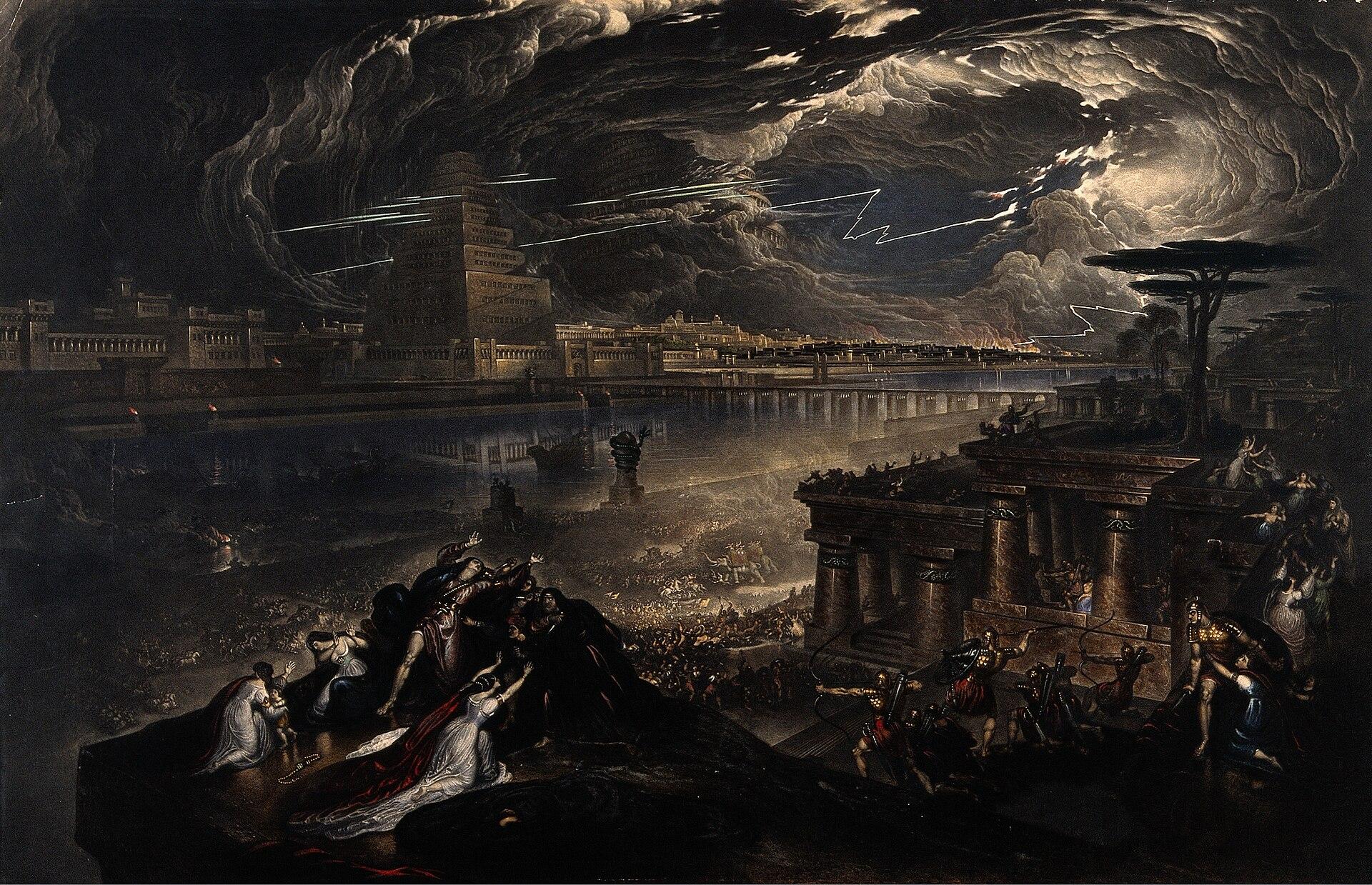
John Martin, The Fall of Babylon, 1831. CC BY 4.0.
Isaiah 13:1 and Isaiah 14:26 · Subject · Featured Study
The Oracles Against the Nations
Isaiah 13 to 23 holds ten burdens, nine against Babylon, Philistia, Moab, Damascus, Egypt, Tyre and their neighbours, and one against Jerusalem.
This is the plan devised for the whole earth, and this is the hand stretched out over all the nations.
- Books
- Isaiah, Amos
- Hold in memory
- Isaiah 14:27, Isaiah 21:11
Isaiah's word was for Judah's neighbours and for Judah too.
Summary
Isaiah gathered his messages about the nations around Judah in chapters 13 to 23.
- Ten of them open with a Hebrew word for a burden or a load.
- Some of them mourn for a nation, and some promise it a place at Zion.
- Jeremiah, Ezekiel and Amos gave the same kind of message.
Ten Burdens in Eleven Chapters
Ten oracles of Isaiah 13 to 23 open with the words "This is the burden against" or "this burden was received".
This is the burden against Babylon that Isaiah son of Amoz received:The first burden names its prophet and its city.
The Hebrew word is massa, a burden or load, which by a figure also means an utterance.
Jerome wrote that the word means a burden, a load or a weight. Wherever it stands, he said, it signals a heavy message.
In the year that King Ahaz died, this burden was received:Of the ten burdens, only this one carries a date.
Three passages among them carry no burden title. They are the oath over Assyria in chapter 14, the woe on Cush in chapter 18 and Isaiah's sign in chapter 20.
Thirteen Passages in the Order of the Book
The oracles move from Babylon through Judah's neighbours to Tyre, with Jerusalem among them.
Isaiah sets the burden on Jerusalem between the burdens on Arabia and Tyre.
- 13BabylonA burden that names Isaiah son of AmozIsaiah 13:1
- 14AssyriaAn oath of the LORD of HostsIsaiah 14:24
- 14PhilistiaA burden dated to the death of AhazIsaiah 14:28
- 15 and 16MoabTwo cities of Moab ruined in a nightIsaiah 15:1
- 17DamascusThe city left a heap of ruinsIsaiah 17:1
- 18CushA woe on the land of whirring wingsIsaiah 18:1
- 19EgyptThe LORD coming to Egypt on a cloudIsaiah 19:1
- 20Egypt and CushIsaiah sent out without sackcloth or sandalsIsaiah 20:2
- 21The Desert by the SeaAn invader coming from the desertIsaiah 21:1
- 21DumahA voice calling to the watchman from SeirIsaiah 21:11
- 21ArabiaThe caravans of Dedan lodging in the thicketsIsaiah 21:13
- 22Jerusalem, the Valley of VisionA city gone up to its rooftopsIsaiah 22:1
- 23TyreThe ships of Tarshish told to wailIsaiah 23:1
Thirteen passages of Isaiah 13 to 23, each with its chapter, the people it addresses and how it opens.
19, 20, 21, 22, 23
A Plan for the Whole Earth
The LORD swears that His plan for Assyria will stand.
The LORD of Hosts has sworn: “Surely, as I have planned, so will it be; as I have purposed, so will it stand. I will break Assyria in My land; I will trample him on My mountain. His yoke will be taken off My people, and his burden removed from their shoulders.”The oath begins with one empire.
Albert Barnes, in his Notes on Isaiah, read the oath as a comfort given in advance to God's people in their captivity.
Then the angel of the LORD went out and struck down 185,000 men in the camp of the Assyrians. When the people got up the next morning, there were all the dead bodies!Isaiah's own book records how the oath over Assyria was kept.
Jerusalem Among the Nations
Isaiah places a burden on Jerusalem between Arabia and Tyre, and Amos ends his round of the nations with Judah and Israel.
This is the burden against the Valley of Vision: What ails you now, that you have all gone up to the rooftops, O city of commotion, O town of revelry? Your slain did not die by the sword, nor were they killed in battle.The one burden on Judah's own capital stands among the burdens on the nations.
Matthew Henry drew a warning from the title.
“Blessed are their eyes, for they see, and they have seers by office among them. Where Bibles and ministers are there is a valley of vision, from which is expected fruit accordingly; but here is a burden of the valley of vision, and a heavy burden it is. Note, Church privileges, if they be not improved, will not secure men from the judgments of God.”
Matthew Henry · Commentary on the Whole Bible · on Isaiah 22:1Puritan
This is what the LORD says: “For three transgressions of Damascus, even four, I will not revoke My judgment, because they threshed Gilead with sledges of iron.Amos opens with Damascus.
This is what the LORD says: “For three transgressions of Judah, even four, I will not revoke My judgment, because they reject the Law of the LORD and fail to keep His statutes; they are led astray by the lies in which their fathers walked.The same words later fall on Judah.
Albert Barnes looked for the order of Amos's list.
“The order of God’s threatenings seems to have been addressed to gain the hearing of the people. The punishment is first denounced upon their enemies, and that, for their sins, directly or indirectly, against themselves, and God in them. Then, as to those enemies themselves, the order is not of place or time, but of their relation to God’s people.”
Albert Barnes · Notes, Explanatory and Practical, on the Old and New Testaments (1832-1869) · on Amos 1:3Evangelical
This is the word of the LORD about the nations—the word that came to Jeremiah the prophetJeremiah's oracles on the nations stand in chapters 46 to 51.
Then the word of the LORD came to me, saying, “Son of man, set your face against the Ammonites and prophesy against them.Ezekiel's oracles on the nations begin with Ammon in chapter 25.
This is what the LORD, the God of Israel, said to me: “Take from My hand this cup of the wine of wrath, and make all the nations to whom I send you drink from it. And they will drink and stagger and go out of their minds, because of the sword that I will send among them.” So I took the cup from the LORD’s hand and made all the nations drink from it, each one to whom the LORD had sent me,Jeremiah's list of the peoples who drink begins with Jerusalem and the cities of Judah.
Amos 2:4, Jeremiah 46:1, Ezekiel 25:1 to 2, Jeremiah 25:15 to 17
Grief and Hope Inside the Oracles
The oracle on Moab mourns in the first person, and the oracles promise gifts from Cush and worship from Egypt.
Therefore my heart laments for Moab like a harp, my inmost being for Kir-heres.The speaker's own grief breaks into the burden.
At that time gifts will be brought to the LORD of Hosts—from a people tall and smooth-skinned, from a people widely feared, from a powerful nation of strange speech, whose land is divided by rivers—to Mount Zion, the place of the Name of the LORD of Hosts.Cush brings gifts to Mount Zion.
In that day there will be a highway from Egypt to Assyria. The Assyrians will go to Egypt, and the Egyptians to Assyria. The Egyptians and Assyrians will worship together. In that day Israel will join a three-party alliance with Egypt and Assyria—a blessing upon the earth. The LORD of Hosts will bless them, saying, “Blessed be Egypt My people, Assyria My handiwork, and Israel My inheritance.”The oracle closes with former enemies named as God's own.
Yet her profits and wages will be set apart to the LORD; they will not be stored or saved, for her profit will go to those who live before the LORD, for abundant food and fine clothing.The last oracle of the series ends with Tyre's trade given to God.
John Wesley read the verse on Tyre as a prophecy of the conversion of the Tyrians to the true religion.
Isaiah 19:23 to 25, Isaiah 23:18
Fallen, Fallen Is Babylon
The lookout of Isaiah 21 sees the riders coming and hears the cry over Babylon, and an angel repeats it in Revelation 18.
Look, here come the riders, horsemen in pairs.” And one answered, saying: “Fallen, fallen is Babylon! All the images of her gods lie shattered on the ground!”The riders bring the news of the city and its images.
And he cried out in a mighty voice: “Fallen, fallen is Babylon the great! She has become a lair for demons and a haunt for every unclean spirit, every unclean bird, and every detestable beast.Revelation takes up the cry over Babylon the great.
Sources
Scripture is the Berean Standard Bible.
- Strong's H4853, massa, with the Hebrew words of Isaiah 13:1.
- Jerome, Commentary on Isaiah (420), on Isaiah 13:1.
- Albert Barnes, Notes, Explanatory and Practical (1832 to 1869), on Isaiah 14:27 and on Amos 1:3.
- Matthew Henry, Commentary on the Whole Bible (1710), on Isaiah 22:1.
- John Wesley, Explanatory Notes upon the Old Testament (1765), on Isaiah 23:18.
- Jamieson, Fausset and Brown, Commentary Critical and Explanatory on the Whole Bible (1871), on Jeremiah 46:1.
Keep Studying
Read it6
People and groups4
Doctrines2
Subjects6