
2 Kings 19:36
in 2 Kings 19So Sennacherib king of Assyria broke camp and withdrew. He returned to Nineveh and stayed there.
BSB
The same verse in ASV and KJV ▾
ASV
So Sennacherib king of Assyria departed, and went and returned, and dwelt at Nineveh.
KJV
So Sennacherib king of Assyria departed, and went and returned, and dwelt at Nineveh.
⋯
This verse in 2 Kings 19
Commentary
6 notes on this verseA commentator
Albert Barnes1798–1870
Notes, Explanatory and Practical, on the Old and New Testaments (1832-1869)
Dwelt at Nineveh - The meaning is not that Sennacherib made no more expeditions at all, which would he untrue, for his annals show us that he warred in Armenia, Babylonia, Susiana, and Cilicia, during his later years; but that he confined himself to his own part of Asia, and did not invade Palestine or threaten Jerusalem anymore. Nineveh, marked by some ruins opposite Mosul, appears here unmistakably as the Assyrian capital, which it became toward the close of the 9th century B.C. It has previously been mentioned only in Genesis (marginal reference).
This site's exposition
and dwelt at Nineveh
The blast promised at verse 7 and the return promised at verse 33 both land in one plain sentence: Sennacherib withdraws to his own capital and stays there. Nineveh remained his seat for the rest of his reign, which Assyrian records confirm on their own account, the same city Jonah had earlier preached to and the city Nahum's whole book announces the fall of.
The record, by era
The Church Fathers1 voice
A commentator
John ChrysostomDISCOURSES AGAINST JUDAIZING CHRISTIANS 6.3.6-7 · Written in the 5th century.
proposed
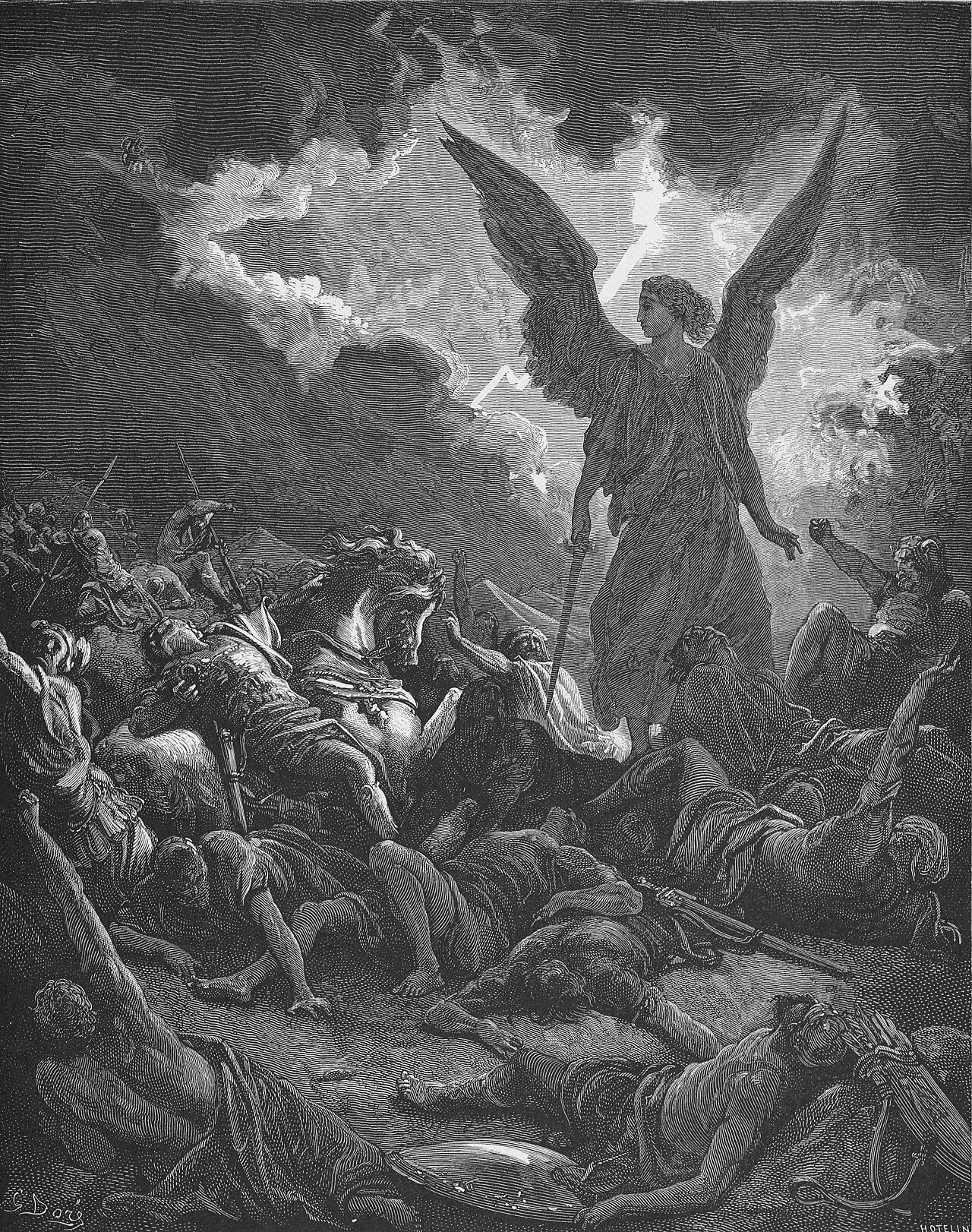
But the Jews will say, "Where is the evidence that God has turned away from us?" Does this still need proof in words? Tell me this. Do not the facts themselves shout it out? Do they not send forth a sound clearer than the trumpet's call? Do you still ask for proof in words when you see the destruction of your city, the desolation of your temple and all the other misfortunes that have come on you? "But people brought these things on us, not God." Rather it was God above all others who did these things. If you attribute them to people, then you must consider that even if people were to have the boldness, they would not have had the power to bring these things to accomplishment, unless it were by God's decree. The barbarian came down on you and brought all Persia with him. He expected that he would catch you all by the suddenness of his attack, and he kept you all locked in the city as if you were caught in the net of a hunter or fisherman. Because God was gracious to you at the time—I repeat, at that time—without a battle, without a war, without a hostile encounter, the barbarian king left 185,000 of his slain soldiers among you and fled, contented that he alone was saved. And God often decided countless other battles in this way. So also now, if God had not deserted you once and for all, your enemies would not have had the power to destroy your city and leave your temple desolate. If God had not abandoned you, the ruin of desolation would not have lasted so long a time, nor would your frequent efforts to rebuild the temple have been in vain.
The Puritans and the Awakening1 voice
2 And he sent Eliakim, which was over the household, and Shebna the scribe, and the elders of the priests, covered with sackcloth, to Isaiah the prophet the son of Amoz. 3 And they said unto him, Thus saith Hezekiah, This day is a day of trouble, and of rebuke, and blasphemy: for the children are come to the birth, and there is not strength to bring forth.
quarantine:scripture (2026-07-29) — verbatim-scripture
The Nineteenth Century2 voices
A commentator
Jamieson, Fausset & Brown1802–1910
Commentary Critical and Explanatory on the Whole Bible (1871)
So Sennacherib king of Assyria . . . went and returned--the same way as he came (2Ki 19:33). The route is described (Isa 10:28-32). The early chariot track near Beyrout is on the rocky edge of Lebanon, which is skirted by the ancient Lycus (Nahr-el Kelb).
Dwelt at Nineveh - This was the capital of the Assyrian empire.
The words behind it
8 Hebrew wordsEvery Hebrew word of this verse in the order it stands, with what it means and the door to its own study. The last column counts the times a word stands in the whole Bible: the rarer the word, the more the places it appears belong together.
| Hebrew | Sound | Meaning | Word study | In the Bible |
|---|---|---|---|---|
| וַיִּסַּ֣ע | vaiyisa' | and he departed | H5265 → | 146 times |
| וַיֵּ֔לֶךְ | vaiyelekh | and he went | H1980 → | 1546 times |
| וַיָּ֖שָׁב | vaiyashov | and he returned | H7725 → | 1056 times |
| סַנְחֵרִ֣יב | sancheriv | Sennacherib | H5576 → | 13 times |
| מֶֽלֶךְ־ | melekh- | [the] king of | H4428 → | 2525 times |
| אַשּׁ֑וּר | ʾashur | Assyria | H804 → | 151 times |
| וַיֵּ֖שֶׁב | vaiyeshev | and he remained | H3427 → | 1079 times |
| בְּנִֽינְוֵֽה׃ | benineveh | in Nineveh | H5210 → |
וַיִּסַּ֣עand he departed
vaiyisa'H5265 →146 times
וַיֵּ֔לֶךְand he went
vaiyelekhH1980 →1546 times
וַיָּ֖שָׁבand he returned
vaiyashovH7725 →1056 times
סַנְחֵרִ֣יבSennacherib
sancherivH5576 →13 times
מֶֽלֶךְ־[the] king of
melekh-H4428 →2525 times
אַשּׁ֑וּרAssyria
ʾashurH804 →151 times
וַיֵּ֖שֶׁבand he remained
vaiyeshevH3427 →1079 times
בְּנִֽינְוֵֽה׃in Nineveh
beninevehH5210 →
A shaded row is a word that stands 400 times or fewer in the Bible.
The walk
8 stopsEach card is a verse this one points to, and under it the verses that one points to in turn. Where several paths arrive at the same place, that place is listed first: the text keeps returning to it.
Through
Jonah 1:2“Get up! Go to the great city of Nineveh and preach against it, because its wickedness has come up before Me.”
it leads to
- Genesis 18:20–21
Then the LORD said, “The outcry against Sodom and Gomorrah is great. Because their sin is so grievous,
- Genesis 10:11
From that land he went forth into Assyria, where he built Nineveh, Rehoboth-Ir, Calah,
- Nahum 1:1
This is the burden against Nineveh, the book of the vision of Nahum the Elkoshite:
- Isaiah 58:1
“Cry aloud, do not hold back! Raise your voice like a ram’s horn. Declare to My people their transgression and to the house of Jacob their sins.
- Jonah 3:2
“Get up! Go to the great city of Nineveh and proclaim to it the message that I give you.”
- Genesis 18:20–21
Through
2 Kings 19:33He will go back the way he came, and he will not enter this city,’ declares the LORD.
it leads to
- 2 Kings 19:28
Because your rage and arrogance against Me have reached My ears, I will put My hook in your nose and My bit in your mouth; I will send you back the way you came.’
- 2 Kings 19:28
Through
2 Kings 19:28Because your rage and arrogance against Me have reached My ears, I will put My hook in your nose and My bit in your mouth; I will send you back the way you came.’
it leads to
- Ezekiel 29:4
But I will put hooks in your jaws and cause the fish of your streams to cling to your scales. I will haul you up out of your rivers, and all the fish of…
- Ezekiel 29:4
Through
2 Kings 19:7Behold, I will put a spirit in him so that he will hear a rumor and return to his own land, where I will cause him to fall by the sword.’”
it leads to
- 2 Kings 7:6
For the Lord had caused the Arameans to hear the sound of chariots, horses, and a great army, so that they said to one another, “Look, the king of Israel must have hired the…
- 2 Kings 7:6
Where this verse is studied
On this page
Studies1
About 2 Kings
Who and where
3 names in this verse with a page on the site.
- PersonDivided kingdomSennacheribKing of Assyria whose siege of Jerusalem in 701 BC ended with the angel of Jehovah in the camp — and whose own annals boast of shu…
- PlaceUpper MesopotamiaAssyriaMesopotamian empire whose capital Nineveh repented at Jonah's preaching and fell to Nahum's burden in 612 BC; the rod of God's ang…
- PlaceAssyriaNinevehThe great city of Assyria that repented in sackcloth at Jonah’s preaching, that Sennacherib returned to after Jerusalem was spared…
This page draws on Adam Clarke, Commentary on the Bible; Albert Barnes, Notes, Explanatory and Practical, on the Old and New Testaments (1832-1869); Alfred Edersheim, Bible History: Old Testament; F. W. Farrar, The Second Book of Kings (Expositor's Bible); Jamieson, Fausset & Brown, Commentary Critical and Explanatory on the Whole Bible; John Chrysostom, DISCOURSES AGAINST JUDAIZING CHRISTIANS 6.3.6-7 and Matthew Henry, Commentary on the Whole Bible.