
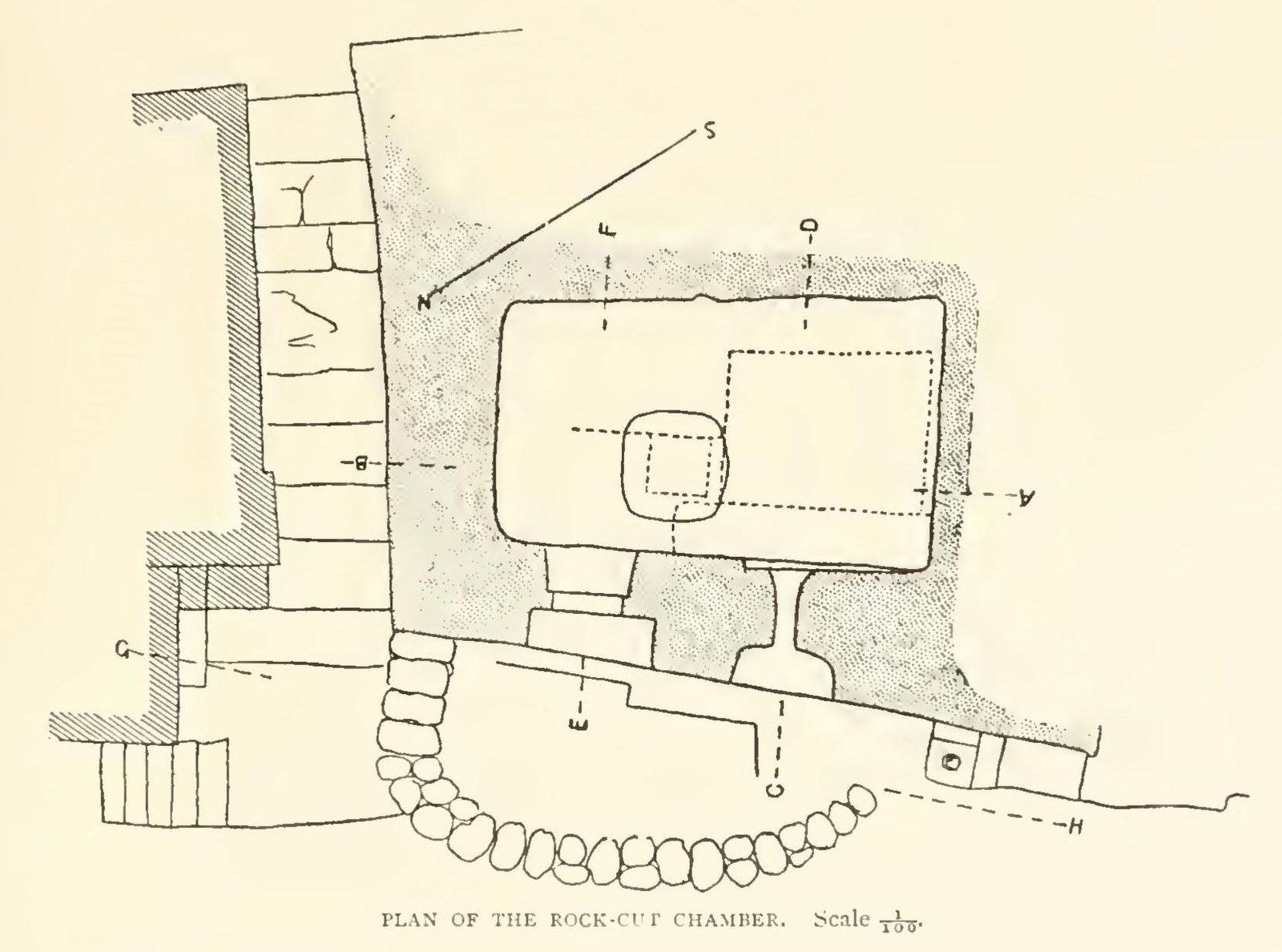
Charles Clermont-Ganneau, plan of the rock-cut chamber at Silwan, 1874. Public domain.
Isaiah 22 · Symbol · Featured Study
The Key of the House of David
Isaiah moves the key of the palace from Shebna to Eliakim, and Revelation places the key of David in the hand of Christ.
I will place on his shoulder the key to the house of David. What he opens no one can shut, and what he shuts no one can open.
- The word
- מַפְתֵּחַ (maphteach), H4668
- First appears
- Isaiah 22:22 “…place on his shoulder the key to the…”
While Shebna was cutting a tomb for himself in the rock, the LORD sent Isaiah to take his office from him.
Summary
The key of the house of David stands for rule over the king's palace. The steward who ran the palace carried it. The risen Christ takes its title for Himself in Revelation 3:7.
- A robe, a sash and authority mark the office in Isaiah 22:21.
- Kings from Solomon to Hezekiah kept an officer over the palace.
- A scribe named Shebna later serves beside Eliakim.
- Two readings name different men as the peg that falls.
The Steward and His Tomb
Isaiah was sent to the officer who ran the king's palace.
The oracle begins with a question about a grave.
This is what the Lord GOD of Hosts says: “Go, say to Shebna, the steward in charge of the palace: What are you doing here, and who authorized you to carve out a tomb for yourself here—to chisel your tomb in the height and cut your resting place in the rock?The rebuke falls on the steward's pride.
Then the oracle turns from Shebna to the man who will follow him.
I will remove you from office, and you will be ousted from your position. On that day I will summon My servant, Eliakim son of Hilkiah. I will clothe him with your robe and tie your sash around him. I will put your authority in his hand, and he will be a father to the dwellers of Jerusalem and to the house of Judah.Here the office changes hands.
The Office Passed On
Eight verses follow the steward's office from Shebna to the letter to Philadelphia.
The office in eight verses.
- What happens to the office
- Shebna is the steward in charge of the palace.
- What happens to the office
- The LORD removes him from office.
- What happens to the office
- Eliakim is clothed for office.
- What happens to the office
- The key is laid on him.
- What happens to the office
- He is driven like a peg into a firm place.
- What happens to the office
- The peg driven into a firm place gives way.
- What happens to the office
- A Shebnah serves as scribe.
- What happens to the office
- Christ holds the key of David.
Each verse shows what happens to the office.
2 Kings 18:18, Revelation 3:7
The Office over the Palace
Four verses name an officer over the palace under four kings.
Solomon's list of officials names one man over the palace.
Ahishar was in charge of the palace; and Adoniram son of Abda was in charge of the forced labor.The office is as old as Solomon's court.
Obadiah held the office under Ahab, and Jotham held it while his father Azariah lived apart with leprosy.
and Ahab summoned Obadiah, who was in charge of the palace. (Now Obadiah greatly feared the LORD,The office stands in the northern kingdom as well.
And the LORD afflicted the king with leprosy until the day he died, so that he lived in a separate house while his son Jotham had charge of the palace and governed the people of the land.The office could pass to the heir to the throne.
Eliakim holds the office when the Rabshakeh comes to Jerusalem.
Then they called for the king; and Eliakim son of Hilkiah the palace administrator, Shebnah the scribe, and Joah son of Asaph the recorder, went out to them.Eliakim acts for the king in a crisis.
2 Kings 15:5, 2 Kings 18:18
One Shebna or Two?
Commentators differ over whether the scribe is the steward demoted.
Isaiah's own account of the coming of the Rabshakeh gives the two names again.
Then Eliakim son of Hilkiah the palace administrator, Shebna the scribe, and Joah son of Asaph the recorder, went out to him.Isaiah gives the same names in his own account.
Jamieson, Fausset and Brown took him for the same man, serving now as a scribe. Adam Clarke, printing Robert Lowth's note, took the scribe for a different man from the steward. Albert Barnes thought another man of the same name more likely and left the question open.
The Inscriptions at Silwan
Clermont-Ganneau called Silwan the great City of the Dead.
Charles Clermont-Ganneau found two old Hebrew inscriptions cut side by side in the rock at Silwan and had them sent to the British Museum.
He wrote that he could read one word with certainty, the word for house.
In a note he said he had sometimes wondered whether this was the tomb of Shebna or of one of his colleagues. He added, “it is as well to be on one's guard against these too sanguine illusions.”
The Word Yated
The prophet calls Eliakim a peg.
The word for the peg is yated, H3489 in Strong's Concordance, the numbered index of the Bible's Hebrew and Greek words; it stands 25 times in the Old Testament.
The Key of David at Philadelphia
The letter to Philadelphia opens with the key of David.
To the angel of the church in Philadelphia write: These are the words of the One who is holy and true, who holds the key of David. What He opens no one can shut, and what He shuts no one can open. I know your deeds. See, I have placed before you an open door, which no one can shut. For you have only a little strength, yet you have kept My word and have not denied My name.The letter gives the reason for the open door.
Charles Ellicott read the open door as “an opening for preaching the gospel, an opportunity of doing good”. Albert Barnes read it as “access to a thing rather than egress from a thing”.
How the Teachers Read It
Teachers from the sixth century to the eighteenth read the tomb, the steward and the key.
Primasius of Hadrumetum (died 560)
COMMENTARY ON THE APOCALYPSE 3:7
A sixth-century commentator on the Apocalypse read the opening and the shutting as the law disclosed to the faithful.
“The secrets of the divine law are disclosed to the faithful by the power of Christ alone, and they are closed to the unbelievers. However, when he loosens, no one shuts, and when he binds, no one loosens.”
on Revelation 3:7Patristic
Matthew Henry (1662 to 1714)
Commentary on the Whole Bible
Of Shebna's tomb, Matthew Henry wrote that “it is a pity that the grave-stone should forget the grave.”
“He is God's servant, has approved himself faithfully so in other employments, and therefore God will call him to this high station. Those that are diligent in doing the duty of a low sphere stand fairest for preferment in God's books.”
on Isaiah 22:20Puritan
About this saying1 paragraph
From Eliakim's call he drew a rule about faithfulness in small things.
Whose Peg Gives Way?
Barnes and Henry name Shebna, and Keil and Delitzsch name Eliakim.
Two readings of the falling peg.
| Reading | The peg | Held by | A work to read |
|---|---|---|---|
| Shebna falls | Shebna, who thought himself fixed in his office. | Matthew Henry; Albert Barnes | Barnes, Notes on Isaiah 22:25 |
| Eliakim falls | Eliakim, whose house later fails him. | Keil and Delitzsch; the Cambridge Bible | Keil and Delitzsch, Commentary on the Old Testament, on Isaiah 22:25 |
Shebna fallsMatthew Henry; Albert Barnes
Matthew Henry read the peg as “Shebna, who thinks himself immovably fixed in his office”.
Barnes put it in four words: “Not Eliakim, but Shebna.”
Against this reading stands the order of the chapter, since Isaiah 22:25 follows the promises to Eliakim in Isaiah 22:23 and 24.
Eliakim fallsKeil and Delitzsch; the Cambridge Bible
Keil and Delitzsch named the Targum, Jerome and Hitzig as right “in assuming that Eliakim is the peg”.
The Cambridge Bible read Isaiah 22:25 as “The fall of Eliakim’s house, described under the same metaphor.”
Against this reading stands Isaiah 22:23, which drives Eliakim into a firm place, and his later service as palace administrator in 2 Kings 18 and 19.
A Pillar That Stays
Isaiah's oracle ends with a peg that gives way.
The one who overcomes I will make a pillar in the temple of My God, and he will never again leave it. Upon him I will write the name of My God, and the name of the city of My God (the new Jerusalem that comes down out of heaven from My God), and My new name.The letter to Philadelphia promises a place that lasts.
Sources
Scripture is the Berean Standard Bible.
- Hebrew word tags for Isaiah 22:22 and 22:23.
- Strong's Concordance, entries H4668 and H3489.
- Charles Clermont-Ganneau, Archaeological Researches in Palestine during the Years 1873-1874, volume 1, page 305.
- Jamieson, Fausset and Brown, Commentary Critical and Explanatory on the Whole Bible, 1871, on Isaiah 22:15.
- Adam Clarke, Commentary on the Bible, 1832, on Isaiah 22, printing Robert Lowth's note.
- Albert Barnes, Notes, Explanatory and Practical, on Isaiah 22:15, Isaiah 22:25 and Revelation 3:8.
- Charles Ellicott, Commentary for English Readers, on Revelation 3:8.
- Keil and Delitzsch, Biblical Commentary on the Old Testament, on Isaiah 22:25.
- The Cambridge Bible for Schools and Colleges, on Isaiah 22:25.
- Matthew Henry, Commentary on the Whole Bible, 1710, on Isaiah 22:16, 22:20 and 22:25.
- Primasius of Hadrumetum, Commentary on the Apocalypse, on Revelation 3:7.