
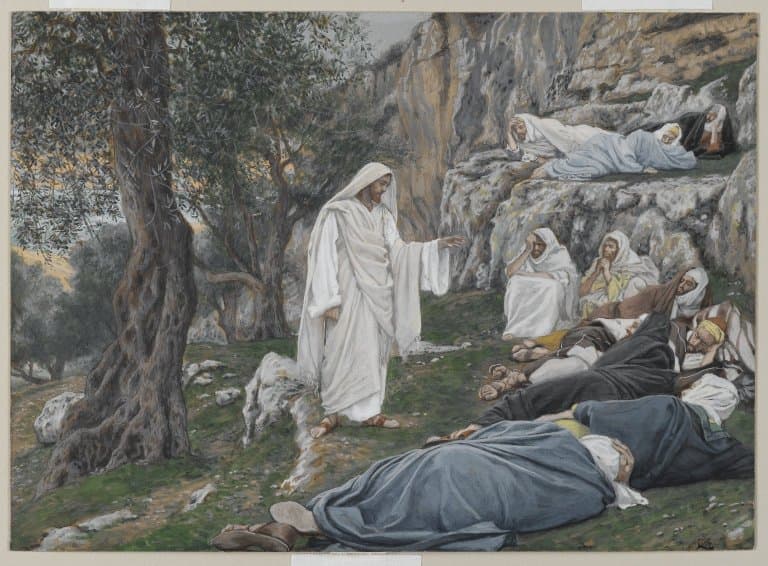
Mark 6:30 to 32 · Passage · Stress and Weariness
Come Away and Rest a While
Mark 6:30 to 32 follows the mission of the Twelve and comes just before the feeding of the five thousand.
Mark's word for having time to eat, eukaireo, stands only three times in the New Testament, and in Mark 6:31 it describes the time the apostles did not have.
And He said to them, “Come with Me privately to a solitary place, and let us rest for a while.” For many people were coming and going, and they did not even have time to eat.
- The passage
- Mark 6:30 to 34, Mark 6:7 to 13, Mark 1:35
- Book
- Mark
- Hold in memory
- Mark 6:31
Summary
The apostles came back from preaching and healing and told Jesus everything they had done and taught. So many people were coming and going that they could not even eat, and Jesus called them away by boat to a solitary place to rest. The passage shows the Lord who sends His servants to work also calling them apart to rest.
- The call to rest came from Jesus Himself, who asked the apostles to come with Him, so the rest He offered was rest in His company (Mark 6:31).
- The rest was planned for a solitary place, the kind of place where Jesus Himself went early in the morning to pray (Mark 1:35).
- The crowd reached the shore first, and Jesus answered them with compassion and teaching before He fed the five thousand (Mark 6:33 to 34).
The Apostles Come Back
Mark's Greek gives the call its place, its length and its reason.
Come Away and Rest a While studies Mark 6:30 to 32, where Jesus takes His apostles aside after their first mission. It is one of the texts of the trial of stress and weariness, the weight of work and care that wears a person down.
The question it answers is why Jesus called His workers away from a crowd that needed them, and what became of the rest He planned. It gives the Greek of the call and the alternation of labour and retreat in Mark 6 laid beside its verses. It also gives the setting of the death of John, Jesus' own times of prayer in solitary places, and the readings of whether the crowd cost the apostles their rest.
Jesus' words begin with deute, come here, and ask the apostles to come kat' idian, privately, to a solitary place and to anapausasthe oligon, rest a little. Anapausasthe is a command in the aorist middle, from anapauo, the verb Jesus uses when He promises the weary in Matthew 11:28, "I will give you rest."
The reason Mark gives ends with eukairoun, from eukaireo, to have opportunity or leisure, so the apostles had no leisure even to eat. The same pressure had met Jesus before, when a crowd gathered at His home "so that He and His disciples could not even eat" (Mark 3:20).
Work and Withdrawal in Mark 6
Mark 6 moves from the mission to the crossing, the crowd and the mountain.
Mark sets the call to rest between two stretches of work and follows it with a second withdrawal for prayer.
| Verse | Kind | The Berean words |
|---|---|---|
| Mark 6:7 | Work | Jesus called the Twelve to Him and began to send them out two by two |
| Mark 6:12 to 13 | Work | So they set out and preached that the people should repent. They also drove out many demons and healed many of the sick |
| Mark 6:30 | Report | the apostles gathered around Jesus and brought Him news of all they had done and taught |
| Mark 6:32 | Withdrawal | they went away in a boat by themselves to a solitary place |
| Mark 6:33 | The crowd | They ran together on foot from all the towns and arrived before them. |
| Mark 6:34 | Work | He had compassion on them, because they were like sheep without a shepherd. And He began to teach them many things. |
| Mark 6:45 to 46 | Withdrawal | After bidding them farewell, He went up on the mountain to pray. |
Mark uses one adjective, eremos, for the solitary place of the call and the crossing (Mark 6:31 to 32) and for the place the disciples call desolate when the hour grows late (Mark 6:35). In that desolate place Jesus took the five loaves and the two fish, and five thousand men ate (Mark 6:41 to 44).
Mark 6:34 is one of the verses of the Gospels that name the compassion of Jesus.
The Mission and the Death of John
Mark tells of John's death between the sending of the Twelve and their return.
Between the sending and the return Mark tells how Herod heard of Jesus and how John the Baptist had been beheaded (Mark 6:14 to 29). Matthew 14:13 ties Jesus' departure to the news about John, and Luke 9:10 names the town they went toward as Bethsaida.
Jesus' Own Withdrawals
The Gospels record Jesus Himself leaving the crowds for solitary places to pray.
One evening at Capernaum the whole town gathered at the door while Jesus healed the sick (Mark 1:32 to 34). Then, "Early in the morning, while it was still dark, Jesus got up and slipped out to a solitary place to pray" (Mark 1:35).
Luke says that as the news about Him spread, "He frequently withdrew to the wilderness to pray" (Luke 5:16).
The rest Jesus offered His apostles belongs to the larger teaching of rest that runs from the seventh day of creation to the Letter to the Hebrews.
How the Passage Has Been Read
A Nonconformist commentator of the eighteenth century read the call for what it shows of Christ's care.
1662 to 1714 · Matthew Henry
Commentary on the Whole Bible
The quotation1 quotation
“Note, Christ takes cognizance of the frights of some, and the toils of others, of his disciples, and provides suitable relief for both, rest for those that are tired, and refuge for those that are terrified. With what kindness and compassion doth Christ say to them, Come, and rest!”
Matthew Henry · Commentary on the Whole Bible · on Mark 6:31Puritan
Was the Rest Set Aside?
Two readings of what the crowd's arrival meant for the rest, with their holders and the objection to each.
The crowd overtook the plan, and the work that followed was a gladnessAlbert Barnes; Bede
Albert Barnes, in his Notes, Explanatory and Practical (1832 to 1869), wrote, "They intended to go privately. It appears, however, that their intention became known, and multitudes followed them."
Bede is printed in the Catena Aurea of Thomas Aquinas. He saw in the crowd "how great was the happiness of that time, both from the toil of the teachers, and from the diligence of the learners".
The objection: the disciples still crossed with Jesus by themselves (Mark 6:32), and after the feeding He sent them away by boat while He dismissed the crowd (Mark 6:45).
The rest stood as Christ's provision for His workersTheophylact of Ohrid; Adam Clarke
Theophylact, in the same Catena Aurea, gave the reason Christ makes His disciples rest. It was "that men who are set over others may learn, that they who labour in any work or in the word deserve rest, and ought not to labour continually".
Adam Clarke took the same view in his Commentary on the Bible (1832). He wrote, "Rest is necessary for those who labor; and a zealous preacher of the Gospel will as often stand in need of it as a galley slave."
The objection: Mark records no rest after they land, and the day ends with the disciples setting bread before five thousand men (Mark 6:41 to 44).
Rest in His Company
The call holds for servants of Christ whose work leaves no time to eat.
The chapter holds the call to rest and the compassion for the crowd together in one day.
A servant worn down by work may take the call as leave to stop and rest. A doctor's care for exhaustion of body or mind belongs beside prayer.
Sources
Scripture is the Berean Standard Bible.
- STEP Bible, Translators Amalgamated Greek New Testament (Tyndale House, Cambridge), CC BY 4.0.
- STEP Bible brief lexicon of Extended Strongs for Greek (Tyndale House, Cambridge), CC BY 4.0, with the Strong's glosses.
- Matthew Henry, Commentary on the Whole Bible (1710), on Mark 6:31.
- Thomas Aquinas, Catena Aurea on the Gospel of Mark, chapter 6 (English translation, Oxford), printing Bede and Theophylact.
- Adam Clarke, Commentary on the Bible (1832), on Mark 6:31.
- Albert Barnes, Notes, Explanatory and Practical, on the Old and New Testaments (1832 to 1869), on Mark 6:32 to 34.
Keep Studying
Read it1
Studies5
People and groups7
Places1
Doctrines1
In this trial5
Trials of life1