
Also called: chokmah, sophia, understanding, prudence, skilled living, the fear of the LORD
This subject covers skilled living that begins with the fear of the LORD, and the books that teach it. The doing of what God said belongs to Obedience. God's own reckoning of right and wrong belongs to Judgment.
What Wisdom covers, and where it stops
This subject covers skilled living that begins with the fear of the LORD, and the books that teach it. The doing of what God said belongs to Obedience. God's own reckoning of right and wrong belongs to Judgment.
On this page, 8 sections
The one drawing
Across the canon
Old Testament
New Testament
The other 53 books of the canon carry none.
12 passages
Where Scripture speaks
The passages this subject stands on, in canon order.
And I have filled him with the Spirit of God, with skill, ability, and knowledge in all kinds of craftsmanship,Therefore give Your servant an understanding heart to judge Your people and to discern between good and evil. For who is able to govern this great people of Yours?”behold, I will do what you have asked. I will give you a wise and discerning heart, so that there has never been nor will ever be another like you.And God gave Solomon wisdom, exceedingly deep insight, and understanding beyond measure, like the sand on the seashore.But where can wisdom be found, and where does understanding dwell?And He said to man, ‘Behold, the fear of the Lord, that is wisdom, and to turn away from evil is understanding.’”The Law of the LORD is perfect, reviving the soul; the testimony of the LORD is trustworthy, making wise the simple.So teach us to number our days, that we may present a heart of wisdom.The fear of the LORD is the beginning of wisdom; all who follow His precepts gain rich understanding. His praise endures forever!Your commandments make me wiser than my enemies, for they are always with me.The fear of the LORD is the beginning of knowledge, but fools despise wisdom and discipline.For the LORD gives wisdom; from His mouth come knowledge and understanding.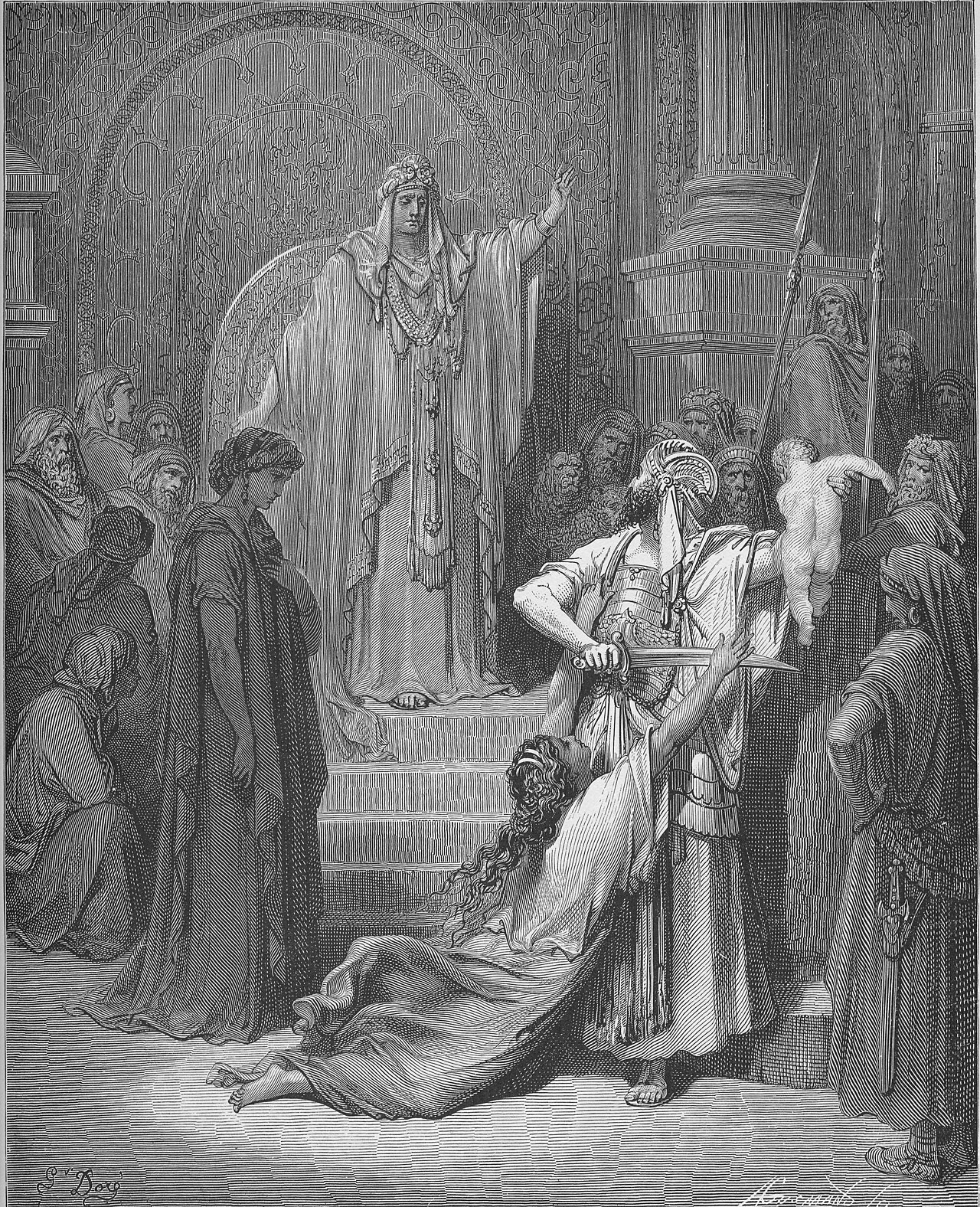
Wisdom in Scripture, in full
Wisdom in Scripture (Hebrew hokmah, H2451) is skilled living before God, not accumulated information. Its first appearances are not proverbs but craftsmen: the wise-hearted "whom I have filled with the spirit of wisdom" to make the priestly garments (Exod 28:3), then Bezalel, filled with the Spirit of God "in wisdom" for tabernacle work (Exod 31:3) (a signal that wisdom covers the whole of life), building, ruling, judging, speaking: under God, not a specialized virtue for sages alone.
Solomon's court supplies the paradigm case: asked what he wanted, he requested a hearing heart rather than riches or long life, and was given wisdom "exceeding much" as a result (1 Kings 3:9-12; 4:29).
Proverbs then states the thesis that governs the whole wisdom corpus, in two matched forms: "the fear of Jehovah is the beginning of knowledge" opens the book (Prov 1:7), and "the fear of Jehovah is the beginning of wisdom" returns at its hinge (Prov 9:10, echoed in Ps 111:10): reverence for God as the entry door, not one input among several. Wisdom there is gift before it is discipline (Prov 2:6), and it is pursued as the "principal thing" (Prov 4:7), worth more than silver (Prov 3:13-14).
The canon does not let this thesis go uncontested. Job 28 is the wisdom literature's own interruption of itself: a poem asking where wisdom can be found, cataloguing everything humanity can mine, smelt, and trade, concluding that wisdom is not among them; it belongs to God alone, and is disclosed only as "the fear of the Lord" (Job 28:12-28). Ecclesiastes goes further, conceding that wisdom itself has a cost: "in much wisdom is much grief"
(Eccl 1:18), and that wisdom, like everything under the sun, cannot outrun mortality, yet Qoheleth still lands on the same floor as Proverbs: "fear God, and keep his commandments; for this is the whole duty of man" (Eccl 12:13). The honest tension is real and left standing: wisdom is genuinely good and genuinely limited: it will not answer every question (Job), and it does not exempt the wise from death or grief (Ecclesiastes). Scripture commends wisdom without over-promising what it delivers.
A second thread, easy to miss on a first read, is wisdom personified: in Proverbs 8, wisdom speaks in the first person as present with God "in the beginning of his way," a "master workman" beside him at creation (Prov 8:22-30). This poetic figure becomes theologically load-bearing once the New Testament identifies Christ as the one "in whom are all the treasures of wisdom and knowledge hidden" (Col 2:3) and, more starkly, as "the wisdom of God" himself (1 Cor 1:24, 30).
Isaiah's messianic oracle anticipates this: the Spirit of wisdom and understanding rests on the coming Branch (Isa 11:2). The Gospels show the pattern lived out rather than merely predicted; the child Jesus "grew, and waxed strong, filled with wisdom" and "advanced in wisdom and stature" (Luke 2:40, 52), a genuinely human development, not a divine shortcut.
Paul takes the Proverbs-versus-Job tension and drives it through the cross: the crucifixion of the Messiah, foolishness to the world, is in fact "the power of God, and the wisdom of God" (1 Cor 1:24), so that "the wisdom of this world is foolishness with God" (1 Cor 3:19): the same inversion Jesus voices when he thanks the Father for hiding these things from the wise and revealing them to the childlike (Matt 11:25).
None of this makes wisdom irrelevant to practical living; James, writing in the same proverb-dense idiom as the Old Testament wisdom books, makes it available and urgent: "if any of you lacketh wisdom, let him ask of God, who giveth to all liberally" (James 1:5), then distinguishes it from its counterfeit: a wisdom "from above" marked by purity, peace, gentleness, and mercy, set against an earthly, sensual wisdom that produces jealousy and faction (James 3:17).
Across the canon, wisdom moves from craft skill to court gift to unattainable divine possession to incarnate person to cross-shaped foolishness to daily prayer request: one thread, held together by the fear of the Lord at its root and Christ as its fullest disclosure.
4 voices
What teachers have said
When wise and good men die, it is a comfort to think that wisdom and goodness do not die with them: it is folly to think, that there will be a great, irreparable loss of us when we are gone, since God has the residue of the spirit, and can raise up others more fit to do his work.
John Wesley · Explanatory Notes upon the Old Testament, 1765
Behold, we have heard of the prudence of the serpent; now let us be admonished about the simplicity of the dove
Gregory the Dialogist · Forty Gospel Homilies, Homily 30
Written before 604.
The spiritual man is able to judge everything, whether it is Greek or barbarian, wise or foolish. He cannot be judged by anyone because of the depth of his understanding and his responses.
Origen of Alexandria · Commentary on 1 Corinthians 1.11.44-45
Written before 253.
there is more need of wisdom and prudence to repair what has gone to decay than to build anew. In public matters there is occasion for the ancients and wise men to be the repairers of the breaches and the restorers of paths to dwell in.
Matthew Henry · Commentary on the Whole Bible, 1710
Where it leads
Everything the site holds on wisdom
On this page
The words underneath
Each card is one Hebrew or Greek word behind wisdom. It gives the sense, the count across the canon, and the number in Strong's 1890 concordance.
chokmah: wisdom
Hebrew · H2451Strong's entry: wisdom (in a good sense)
skill for right living, rooted in reverence for God
153 times in the Old Testament · chokmah, in full →
tabun: understanding
Hebrew · H8394Strong's entry: intelligence; by implication, an argument; by extension, caprice
discernment beneath knowledge
42 times in the Old Testament · tabun, in full →
sophia: wisdom
Greek · G4678Strong's entry: wisdom (higher or lower, worldly or spiritual)
fulfilled and embodied in Christ
51 times in the New Testament · sophia, in full →
sakal: be prudent
Hebrew · H7919Strong's entry: to be (causatively, make or act) circumspect and hence, intelligent
wisdom that acts, not just knows
62 times in the Old Testament · sakal, in full →
23 verses
The complete list
This subject carries 35 curated verses. 12 of them are quoted above, and the other 23 stand here, book by book. Open a book to read the references with a clause of each verse.
Proverbs6
- Proverbs 3:5Trust in the LORD with all your heart, and lean not on your own understanding;
- Proverbs 3:13Blessed is the man who finds wisdom, the man who acquires understanding,
- Proverbs 4:7Wisdom is supreme; so acquire wisdom. And whatever you may acquire, gain understanding.
- Proverbs 8:22The LORD created me as His first course, before His works of old.
- Proverbs 8:30Then I was a skilled craftsman at His side, and His delight day by day, rejoicing always in His...
- Proverbs 9:10The fear of the LORD is the beginning of wisdom, and knowledge of the Holy One is understanding.
Ecclesiastes4
- Ecclesiastes 1:2“Futility of futilities,” says the Teacher, “futility of futilities! Everything is futile!”
- Ecclesiastes 1:18For with much wisdom comes much sorrow, and as knowledge grows, grief increases.
- Ecclesiastes 7:12For wisdom, like money, is a shelter, and the advantage of knowledge is that wisdom preserves...
- Ecclesiastes 12:13When all has been heard, the conclusion of the matter is this: Fear God and keep His...
Matthew2
Luke2
1 Corinthians4
- 1 Corinthians 1:24but to those who are called, both Jews and Greeks, Christ the power of God and the wisdom of...
- 1 Corinthians 1:30It is because of Him that you are in Christ Jesus, who has become for us wisdom from God: our...
- 1 Corinthians 2:7No, we speak of the mysterious and hidden wisdom of God, which He destined for our glory before...
- 1 Corinthians 3:19For the wisdom of this world is foolishness in God’s sight. As it is written: “He catches the...
Character
The subjects beside it
On this page
Subjects28