
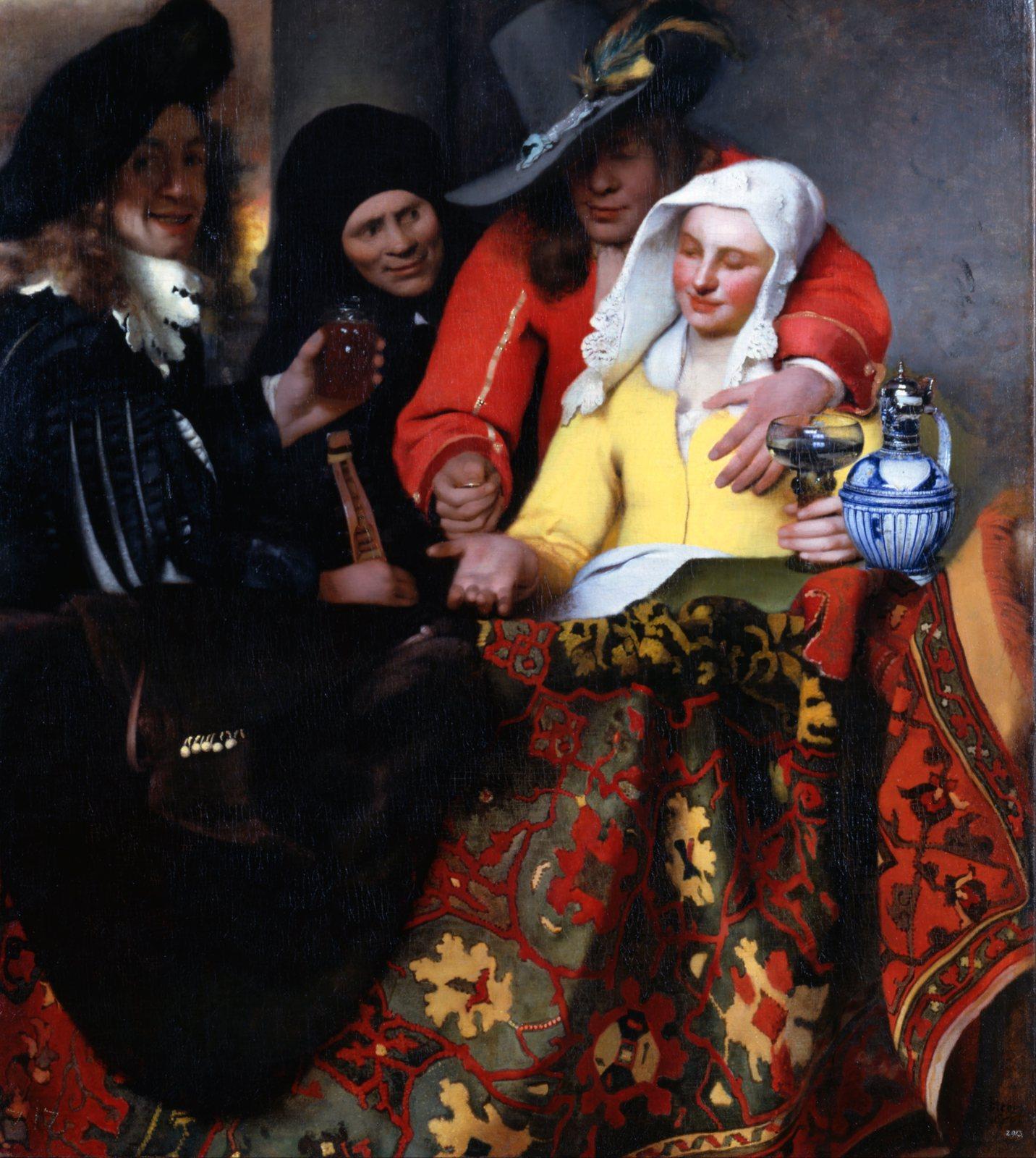
Johannes Vermeer, The Procuress, 1656. Public domain.
Proverbs 2, 5, 6, 7 and 9 · Symbol · Featured Study
The Strange Woman and the Woman Named Folly
Proverbs draws a forbidden woman four times and sets the woman named Folly against Wisdom.
Folly calls to the simple in the same words Wisdom used earlier in the chapter.
Do not let your heart turn aside to her ways; do not stray into her paths.
- The word
- זָרָה (zarah), H2114
- First appears
- Proverbs 2:16 “…the forbidden woman, from the stranger with seductive…”
Summary
The first nine chapters of Proverbs are a father's lessons to his son. Four lessons warn against a forbidden woman. Chapter 9 adds a second woman who calls from her door. Readers differ on who the first woman is.
- Her portraits stand in Proverbs 2, 5, 6 and 7.
- Wisdom and Folly both call from the heights of the city.
- Readers have taken her as a foreign woman, another man's wife, Folly herself or false teaching.
A Father's Warning
The father first warns his son in chapter 2.
Who is the woman the father of Proverbs fears for his son? He first names her in chapter 2.
It will rescue you from the forbidden woman, from the stranger with seductive wordsThe son is kept from her by the wisdom the chapter has promised him.
who abandons the partner of her youth and forgets the covenant of her God.The second line names the covenant she has forgotten.
The verses that follow give her end, and they say that none who go to her return (Proverbs 2:18 to 19).
Four Portraits and Folly
Each portrait names her and ends with where her way goes.
Every portrait of the forbidden woman, and Folly's house, ends in the loss of life.
| Passage | What the Berean text calls her | Where her way ends |
|---|---|---|
| Proverbs 2:16 to 19 | “the forbidden woman” and “the stranger with seductive words” | “For her house sinks down to death” |
| Proverbs 5:3 to 5 | “the forbidden woman” | “Her feet go down to death; her steps lead straight to Sheol.” |
| Proverbs 6:24 to 26 | “the evil woman” and “the adulteress” | “the adulteress preys upon your very life” |
| Proverbs 7:5 to 27 | “the adulteress” and “the stranger with seductive words” | “For she has brought many down to death; her slain are many in number.” |
| Proverbs 9:13 to 18 | “The woman named Folly” | “But they do not know that the dead are there” |
In Proverbs 9 Folly copies Wisdom's place and Wisdom's call, and offers stolen bread in place of Wisdom's meal.
| Line | Wisdom | Folly |
|---|---|---|
| Her place | “she calls out from the heights of the city” | “on a seat in the heights of the city” |
| Her call | “Whoever is simple, let him turn in here!” | The same words, in Proverbs 9:16 |
| Her table | “Come, eat my bread and drink the wine I have mixed.” | “Stolen water is sweet, and bread eaten in secret is tasty!” |
| Her guests | “Leave your folly behind, and you will live” | “her guests are in the depths of Sheol” |
The Portrait of Chapter 7
The longest portrait follows one young man from the street to her house.
In chapter 7 the father watches from his window as a young man lacking judgment crosses the street near her corner at twilight. She comes out to meet him.
Then a woman came out to meet him, with the attire of a harlot and cunning of heart.Her dress and her heart are named before she speaks.
She tells him that her husband is away from home (Proverbs 7:19). Albert Barnes noted that she does not say my husband in the Hebrew, only the man. The young man follows her like an ox going to the slaughter (Proverbs 7:22).
The Two Words
Zarah and nokriyah name her in Proverbs 2:16, and kesiluth names Folly.
The first word, zarah, is a form of the verb zur, which James Strong numbers H2114. He defines it as to turn aside, hence to be a foreigner, strange or profane, and in one verb form to commit adultery. In chapters 1 to 9 the Hebrew text uses it of this woman at Proverbs 2:16, Proverbs 5:3, Proverbs 5:20 and Proverbs 7:5. It names the adulteress again at Proverbs 22:14.
The second word, nokriyah, is H5237 in Strong's numbering. He defines it as strange in a variety of degrees, from foreign to non-relative to adulterous. The same word names the foreign women Solomon loved in 1 Kings 11:1.
Folly's name in Proverbs 9:13 is kesiluth, H3687, which Strong defines as silliness. The Hebrew Bible uses the word only here.
Voices on Her House
Matthew Henry and Clement of Alexandria wrote on her in two different ways.
Clement of Alexandria (died 215)
The Stromata Book 1
Clement found in the foreign woman a lesson on how a Christian uses the learning of his age.
“When Scripture says, ‘Do not keep going steady with a foreign woman,’ it is advising us to make use of secular education but not to settle there permanently. Each generation received beneficial gifts at the appropriate points, but they were in preparation for the Word of the Lord.”
on Proverbs 5:20Patristic
Matthew Henry (1662 to 1714)
Commentary on the Whole Bible
Henry's note on Proverbs 7:27 sets her rich house against its end.
“Her house, though richly decked and furnished, and called a house of pleasure, is the way to hell; and her chambers are the stair-case that goes down to the chambers of death and everlasting darkness.”
on Proverbs 7:27Puritan
Who Is She?
Each reading has its holders and its objection.
A woman of another nationEllicott's Commentary for English Readers
Ellicott read zarah as a woman of another family and nokriyah as a woman of another nation. He thought Solomon's example of marrying foreign women, in 1 Kings 11:1, had become common in Israel.
The objection: the Cambridge Bible holds that neither word here refers to nationality. It points to the covenant of her God in Proverbs 2:17 and the absent husband of Proverbs 7:19 to 20.
Another man's wife in IsraelThe Cambridge Bible; Adam Clarke
The Cambridge Bible reads both words as one who is not a man's own wife. It finds married women of the true religion in view. Adam Clarke, on Proverbs 5:3, wrote of a woman who is not a man's own, whether Jewess or heathen.
The objection: Ellicott held that the second word marks a woman of another nation.
Folly in personEllicott; the Pulpit Commentary
Ellicott read the woman of Proverbs 9:13 as Folly personified, set against Wisdom. The Pulpit Commentary read chapter 9 as the invitation of Folly, shown in the guise of an adulteress.
The objection: the Cambridge Bible reads the word woman and the language of Proverbs 9:17 as pointing to one particular form of vice.
False teaching or worldly learningBede; Clement of Alexandria
Bede, in his Commentary on Proverbs, read her unstable ways in Proverbs 5:6 as the ways of heretical deception. Clement, in the first book of his Stromata, read her as secular learning.
The objection: Barnes read Proverbs 7 as a picture of an adulteress of an Eastern city, set against Wisdom as the young man's sister.
Her Guests
Wisdom's own speech ends with the choice the two houses put before the son.
For whoever finds me finds life and obtains the favor of the LORD. But he who fails to find me harms himself; all who hate me love death.”Wisdom's last words set life against death, the choice the father has drawn four times.
Sources
Scripture is the Berean Standard Bible.
- James Strong, Exhaustive Concordance of the Bible, entries H2114, H5237 and H3687, with every verse that carries each word.
- On Proverbs 2:16: Ellicott's Commentary for English Readers; the Cambridge Bible for Schools and Colleges.
- On Proverbs 9:13: Ellicott's Commentary for English Readers; the Cambridge Bible for Schools and Colleges; the Pulpit Commentary.
- Matthew Henry, Commentary on the Whole Bible (1710), on Proverbs 7:27; Clement of Alexandria, The Stromata, book 1, on Proverbs 5:20; Adam Clarke, Commentary on the Bible (1832), on Proverbs 5:3; Albert Barnes, Notes on the Old Testament, on Proverbs 7:1 and 7:19; Bede, Commentary on Proverbs, on Proverbs 5:6.
Keep Studying
Studies1
People and groups1
Doctrines1
Values1