
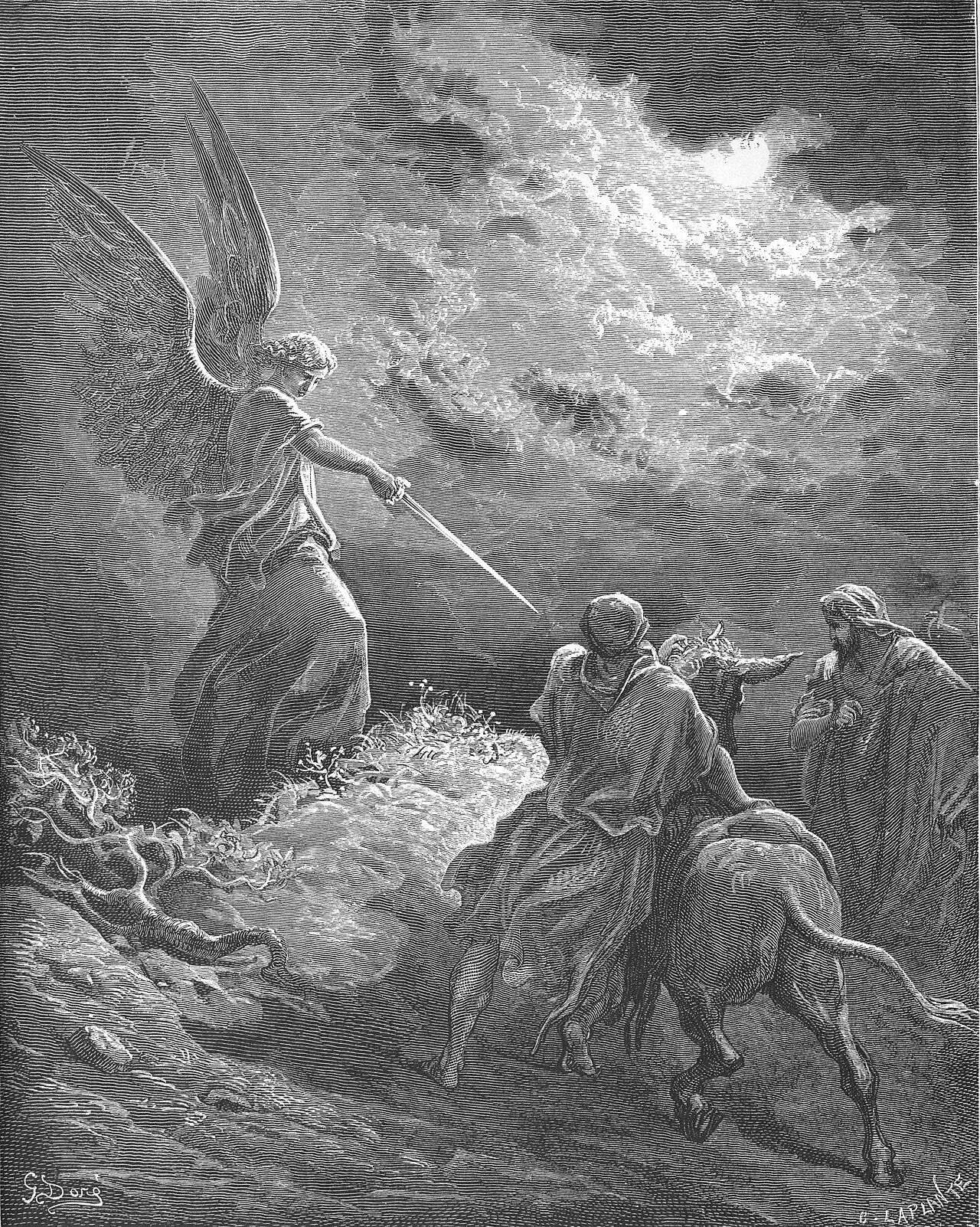
Numberschapter 22
41 verses · Moses, by tradition · 15th to 13th century BC · The Law
He sent messengers therefore unto Balaam the son of Beor to Pethor, which is by the river of the land of the children of his people, to call him, saying, Behold, there is a people come out from Egypt: behold, they cover the face of the earth, and they abide over against me:
Introduction
Moses, by tradition, The Law, Numbers Overview.
This chapter opens the last section of Numbers, set on the plains of Moab across the Jordan from Jericho. The book was kept for the generation about to cross the river, and here its view moves from Israel's camp to a foreign court. Israel never learns what is being planned against it. The chapter brings in Balaam, a diviner famous across the region, and the king who wants to hire him. Listen for the talk of fees and honour, and for the animal on the road who sees more than her rider. Peter, Jude and the book of Revelation all remember this man, and the chapter shows why.
Context
- Who
- A nation being cursed by a professional without knowing it was happening
- What
- A narrative in which the king of Moab sends twice for the diviner Balaam, and an angel meets Balaam on the road.
- Where
- The plains of Moab by the Jordan across from Jericho, the court of Balak, and Pethor near the Euphrates.
- When
- The fortieth year after the exodus, while Israel camped on the plains of Moab before the crossing, about 1406 BC by the count of 1 Kings 6:1, or near 1230 BC on a later dating of the exodus.
- Why
- To show that the LORD guards His people from dangers they never see and holds a hired prophet to His word.
Historical context
The chapter belongs to two men outside Israel. Balak son of Zippor was king of Moab, and Balaam son of Beor was a diviner fetched from Pethor by the river, which Deuteronomy 23:4 places in Mesopotamia.
Show the rest of the historical context, 6 more paragraphs
The year is the fortieth and the place is fixed by verse 1. Every remaining law, census and ruling in Numbers is given from this camp.
Moab takes counsel with the elders of Midian. Moab came of Lot and Midian came of Abraham by Keturah at Genesis 25:1 to 2, so the two peoples hiring a curse are relations of the nation they fear.
The occasion is fear of an army Moab had no permission to attack, since Deuteronomy 2:9 records the command that Israel leave Moab alone.
A first hearer knew that hiring a ritual specialist was ordinary statecraft. Kings across the ancient Near East employed diviners to weaken an enemy before battle, and there were fees, protocols and reputations. Balak's messengers arrive with the fee for divination in hand, which is how the business worked.
He also knew how far Pethor was. Sending hundreds of miles up the Euphrates for a specialist rather than using a local one is a measure of how seriously Moab took the camp on its doorstep. And he would have understood the joke of the road, since a man hired for his sight is carried by an animal that sees the angel he cannot.
The name was known in that country outside Israel's books. A plaster inscription uncovered at Tell Deir Alla in Jordan in 1967, written in an Aramaic dialect centuries later, opens with the words of Balaam son of Beor, a seer of the gods.
Significance
Israel sat in the valley cooking supper and knew none of this. The chapter's first message to them was that battles were being fought over their heads that they never saw.
Show the rest of the significance, 1 more paragraph
Its second message was about the limits of the trade. The most famous curser in that world could not get a sentence out that God had not authorised, and he said so himself before he left home.
This chapter in Jewish lifeWhat this chapter is in Jewish life and reading.
How it is read
Rashi reads the opening of the chapter as fear working backwards from the last one. Balak told his people that the two kings they had relied on could not resist Israel, and the whole nation took fright at what he said (Rashi on Numbers 22:2:1, citing Midrash Tanchuma, Balak 2). Moab and Midian had been enemies, and Rashi holds that fear of Israel made peace between them (Rashi on Numbers 22:4:1, citing Sanhedrin 105a). He also explains why Moab asked Midian for counsel. Moses had grown up in Midian, so Moab asked what the strength of Israel's leader was. Midian answered, "His power lies only in his mouth (in prayer)", and Moab concluded, "Then we must come against them with a man whose power lies in his mouth" (Rashi on Numbers 22:4:1).
Balaam is read by Rashi as a man of standing and of appetite. On the name of his town Rashi reports a reading that he was "like a money changer before whom everyone lays coins", because every king sent him letters for advice. He adds the plain sense in the same comment, that the word is the name of the place (Rashi on Numbers 22:5:1). He takes the night visit of God as the mark of a prophet outside Israel. "The Holy Spirit rested upon him only at night time, and similarly in the case of all the prophets of the heathen peoples" (Rashi on Numbers 22:8:1). He reads the question about the men as a test, and has Balaam draw the wrong lesson from it. Balaam concluded, "I will select a time when I can curse and when He will not observe it" (Rashi on Numbers 22:9:1). In the answer Balaam gives, Rashi hears vanity. "Although I am of no importance in Your eyes, I am of importance in the eyes of kings" (Rashi on Numbers 22:10:1).
The refusal itself is staged by Rashi as a bargain being closed down step by step. Balaam offered to curse Israel from where he stood, and was told not to curse them. He offered to bless them instead, and was told they were blessed already. Rashi closes the exchange with a proverb about a hornet, "neither any of your honey nor any of your sting" (Rashi on Numbers 22:12:1, citing Midrash Tanchuma, Balak 6). He holds that Balaam would admit his subjection to God only in arrogant terms, which is why he said he had been refused leave to go with princes of that rank (Rashi on Numbers 22:13:1). At the offer of a house full of silver and gold Rashi is blunt. Rashi says of them, "This tells us that he was avaricious and covetous of other peoples wealth" (Rashi on Numbers 22:18:1). When Balaam asked the second embassy to stay the night as well, Rashi holds that "His mouth tripped him up", because they too would go away disappointed (Rashi on Numbers 22:19:1).
The ride to Moab is read the same way. Rashi holds that Balaam saddled the animal himself, and takes it as a sign that hatred makes a man forget his own standing. He then sets Abraham against him, who had risen early and saddled his own ass long before (Rashi on Numbers 22:21:1, citing Sanhedrin 105b). Of the anger of God at the going, Rashi says that Balaam "perceived that the matter was evil in the eyes of the Omni-present and yet he longed to go" (Rashi on Numbers 22:22:1). He explains why the animal saw the angel and the man did not. God "gave an animal power to see more than the man", because a man who possesses sense would be disturbed in mind by the sight (Rashi on Numbers 22:23:1). On the three places where the angel stood, he reports a reading from the Tanchuma that the angel showed Balaam symbols of the three patriarchs (Rashi on Numbers 22:26:1).
Ibn Ezra comments at two places here and the corpus carries neither text, because the licence Sefaria reports for it does not permit keeping it. He stands cited and unquoted at Ibn Ezra on Numbers 22:14:1 and 22:15:1.
A Christian reader will find less distance here than elsewhere. The classical reading takes Balaam as greedy, proud and set on a course he knew to be wrong, and the New Testament judges him in the same terms. This site sets out that judgment at /featured/balaams-donkey and in src/components/book/guides/numbers/NumbersGuide.tsx, which names 2 Peter 2:15 and 2:16, Jude 11 and Revelation 2:14. Where the two readings part is over what the oracles are worth, and that question belongs to the next two chapters rather than to this one.
What the rabbis say
The corpus carries forty locators on this chapter and the text of none, so each is cited and linked here rather than quoted. Thirty-three of them are midrashic and seven are Talmudic. Two works carry twelve each. Bamidbar Rabbah stands at 20:1, 20:3, 20:4, 20:6, 20:8, 20:10, 20:11, 20:13, 20:14, 20:16, 20:18 and 20:20. Midrash Aggadah stands at Numbers 22:13:1, 22:19:1, 22:25:1, 22:28:1, 22:31:1, 22:33:1, 22:34:1, 22:35:1, 22:37:1, 22:39:1 and 22:40:1, and at Numbers 21:30:2.
The rest of the midrashic locators sit in three works. Midrash Lekach Tov stands at Numbers 22:8:1, 22:16:1, 22:24:1, 22:29:1 and 22:38:1. Bereshit Rabbah stands at 19:11, 55:8 and 74:15, and Midrash Tanchuma Buber at Balak 12:5. The Talmudic locators are fewer. Avot DeRabbi Natan stands at 29:4, with Recension B at 23:4, 44:5 and 45:2. Kiddushin stands at 4a:8 and Avodah Zarah at 4b:2, with the Jerusalem Talmud at Sheviit 6:1:20. What each of them teaches is a saying of the rabbis, and is reported as theirs wherever this site quotes one. The quotations wait on a fetch that carries the text, because the corpus holds these locators without it.
Sources: Rashi, Rashi on Numbers 22:2:1 to 22:26:1, the Pentateuch with Rashi's commentary translated by M. Rosenbaum and A. M. Silbermann, 1929 to 1934, public domain; Ibn Ezra, Ibn Ezra on Numbers 22:14:1 and 22:15:1, cited by ref because the licence the corpus reports does not permit keeping the text; The Sefaria corpus, scripts/data/sources/sefaria/numbers/22.json, the 33 Midrash and 7 Talmud locators of this chapter, fetched 2026-09-19; MannaFest, src/components/book/guides/numbers/NumbersGuide.tsx and src/app/featured/balaams-donkey/page.tsx, for the New Testament judgment of Balaam.
The heads below are this chapter's scenes. The numbered points under each are its verses.
Balak sends money to hire a curse
Numbers 22:1-3
The plains of Moab are the camp for the rest of the book, and every remaining law, census and ruling in Numbers is given there. Israel sits beside Moab under Deuteronomy 2:9, Do not harass the Moabites or provoke them to war. Moab was terrified anyway, and that fear starts the next three chapters.
Numbers 22:1
“The plains - Hebrew ערבה ‛ărābâh; the word is the plural of that which is used to denote the whole depressed tract along the Jordan and the Dead Sea, and onward, where it is still called the Arabah (compare Num 21:4 note), to the Elanitic gulf. On this side Jordan by Jericho - Rather, across the Jordan of Jericho, i. e., that part of Jordan which skirted the territory of Jericho. This form of expression indicates the site of the camp in its relation to the well-known city of Jericho. See Deu 1:1.”
Albert Barnes reads verse 4 beside 21:26 and suggests that Balak was a Midianite who took the throne after the Amorite victories weakened Moab. He notes that Zippor means bird, a name like those of the Midianite princes Oreb and Zeeb. Matthew Henry sees the irony in what Balak saw. Israel had just broken Sihon, the king who took Moab's land.
Numbers 22:2
“Balak the son of Zippor - The comparison of Num 22:4 with Num 21:26 suggests that Balak was not the hereditary king but a Midianite, and that a change of dynasty had taken place. His father’s name, Zippor, “Bird,” reminds us of those of other Midianites, e. g., Oreb, “Crow,” Zeeb, “Wolf.” Possibly the Midianite chieftains had taken advantage of the weakness of the Moabites after the Amorite victories to establish themselves as princes in the land.”
John Wesley reads the dread as a promise kept, since Deuteronomy 2:25 foretold fear of Israel on all nations and Exodus 15:15 spoke of Moab in particular. John Calvin notes that the fear had no ground, because God had exempted Moab from attack. He adds that it spread from the king to the whole nation. It then drew in Midian.
Numbers 22:4-5
Moab, from Lot, consults the elders of Midian, from Abraham by Keturah at Genesis 25:1-2, so the peoples hiring a curse are kin of the nation they fear. Balaam comes from Pethor, which is by the Euphrates, and Deuteronomy 23:4 places it in Aram-naharaim. A plaster text found at Tell Deir Alla in 1967, centuries later, names Balaam son of Beor a seer of the gods.
Numbers 22:4
“We read of Midianites near Mount Sinai, Exod. ii, and iii, which seem to have been a colony of this people, that went out to seek new quarters, as the manner of those times was, but the body of that people were seated in those parts. Lick up - That is, consume and utterly destroy, in which sense the fire is said to lick up the water and sacrifices, 1 Kings xviii, 38.”
John Wesley · Explanatory Notes upon the Old Testament (1765)evangelical
Jamieson, Fausset and Brown give Balaam as lord or devourer of people. They read Beor, or Bosor in its Chaldee form, as destruction. Matthew Henry notes that Balaam lived in the country Abraham came from, where Laban had lived, though nearer diviners were to be had. Balak sent that far for the man with the greatest name.
Numbers 22:5
“He sent messengers therefore unto Balaam--that is, "lord" or "devourer" of people, a famous soothsayer (Jos 13:22). son of Beor--or, in the Chaldee form, Bosor--that is, "destruction." Pethor--a city of Mesopotamia, situated on the Euphrates.”
Jamieson, Fausset & Brown · Commentary Critical and Explanatory on the Whole Bible (1871)reformed
1 more voice on this verse
Numbers 22:5
“Balaam the son of Beor was from the first a worshipper in some sort of the true God; and had learned some elements of pure and true religion in his home in the far East, the cradle of the ancestors of Israel. But though prophesying, doubtless even before the ambassadors of Balak came to him, in the name of the true God, yet prophecy was still to him as before a mere business, not a religion. The summons of Balak proved to be a crisis in his career: and he failed under the trial.”
Numbers 22:6-7
Balak speaks the promise of Genesis 12:3, those you bless are blessed, and hires a man to run it backwards. The fees for divination in hand go ahead of the question, and Joshua 13:22 calls Balaam the diviner. Nehemiah 13:2 gives the errand in one line: they hired Balaam to call down a curse, and God turned the curse into a blessing.
The embassy is joint, and Jamieson, Fausset and Brown note that these Midianite elders are called kings at 31:8. The same commentators liken the fee to a fortune teller's and expect a royal present to be handsome. Matthew Henry reads it as the real argument. The compliments of verse 6 came first, and the money was meant to settle the matter.
Numbers 22:7
“The rewards of divination - Whoever went to consult a prophet took with him a present, as it was on such gratuitous offerings the prophets lived; but here more than a mere present is intended, perhaps every thing necessary to provide materials for the incantation. The drugs, etc., used on such occasions were often very expensive. It appears that Balaam was very covetous, and that he loved the wages of unrighteousness, and probably lived by it; see 2Pe 2:15.”
Adam Clarke · Commentary on the Bible (1810-1826)evangelical
Numbers 22:8-9
Balaam answers Moab using the covenant name, and God comes to him that night. Calvin treats him as a diviner God overruled, others allow him a real gift turned to hire, and the book never calls him a prophet of Israel. The question, Who are these men with you?, is the kind God put to Adam and Cain, men who knew the answer.
Numbers 22:8
“His real character has long been a subject of discussion. Some, judging from his language, have thought him a saint; others, looking to his conduct, have described him as an irreligious charlatan; and a third class consider him a novice in the faith, who had a fear of God, but who had not acquired power over his passions [HENGSTENBERG].”
Jamieson, Fausset & Brown · Commentary Critical and Explanatory on the Whole Bible (1871)reformed
John Gill takes the visit as a dream, as God came by night to Abimelech at Genesis 20:3 and to Laban. The question was asked to lead Balaam on and to try his honesty. John Wesley reads the question as a way to make Balaam repeat the errand aloud before God. Hearing it might shame him.
Numbers 22:9
“And God came unto Balaam,.... In a dream very probably, as he did to Abimelech and Laban, Gen 20:3, and said, what men are these with thee? who lodged with him that night. This he said, not as ignorant who they were, or from whence they came, or what they came about; but in order to lead on to a discourse with Balaam, and to have from him the account of the men, and their business, and to try his fidelity in relating the affair.”
Numbers 22:10-12
He repeats Balak's message and drops the end of it, keeping the request to curse and leaving out the king's confession that whom Balaam blesses is blessed. God answers in three parts inside one verse, do not go, do not curse, and the ground of both, for they are blessed. The ground is the point, since the blessing on that people was Abraham's and no fee alters it.
Numbers 22:10
“And Balaam said unto God,.... In answer to the question he put to him: Balak the son of Zippor, king of Moab, hath sent unto me; these men, and a message by them: saying; as follows.”
John Gill says Balaam relates Balak's words faithfully to God, knowing he could not deceive God though he could deceive men. The wording shifts slightly from verse 6. There Balak hoped to defeat Israel, and here the hope is to fight against them. Either way the request to curse stands at the centre.
Numbers 22:11
“Behold, there is a people come out of Egypt,.... In this, and the following part of the verse, he faithfully and punctually relates the words of Balak to him by his messengers, as well knowing he could not deceive the omniscient God, or hide anything from him, though he could deceive men; and conceal the truth from them, to serve a purpose; See Gill on Num 22:5, Num 22:6.”
for they are blessed: Matthew Henry notes that Israel had provoked God many times in the wilderness, yet God will not let an enemy curse them. He links this to Romans 4:6-7, the blessedness of those whose sin is covered. Adam Clarke reads the ban on going as tied to the errand of cursing. Later God lets him go on other terms.
Numbers 22:12
“Thou shalt not go with them; thou shalt not curse the people - That is, Thou shalt not go with them to curse the people. With them he might go, as we find he afterwards did by God’s own command, but not to curse the people; this was wholly forbidden. Probably the command, Thou shalt not go, refers here to that time, viz., the first invitation: and in this sense it was most punctually obeyed by Balaam; see Num 22:13.”
Adam Clarke · Commentary on the Bible (1810-1826)evangelical
Numbers 22:13-14
God said the people are blessed, and Balaam tells the princes that the LORD has refused to let me go with you. That version leaves a door open for a better offer. The princes shorten it again for Balak, Balaam refused to come with us, so by the time it reaches the king the refusal belongs to the man.
Numbers 22:13
“The permission granted to Balaam is in accordance with the ordinary procedure of Providence. God often gives up men to follow the impulse of their own lusts; but there is no approval in thus leaving them to act at the prompting of their own wicked hearts (Jos 13:27).”
Jamieson, Fausset & Brown · Commentary Critical and Explanatory on the Whole Bible (1871)reformed
Matthew Henry reads the report as flattery. The princes hid from Balak that God had forbidden the attempt, and so left the king free to think a better offer would win. Henry draws from it that great men are poorly served by those who keep their faults from them. The second embassy follows from this silence.
Numbers 22:14
“Balaam refuseth to come with us - “Observe,” says Mr. Ainsworth, “Satan’s practice against God’s word, seeking to lessen the same, and that from hand to hand, till he bring it to naught.”
Adam Clarke · Commentary on the Bible (1810-1826)evangelical
More honorable princes, and a house full of silver
Numbers 22:15-17
The second embassy is more numerous and more distinguished, and the offer climbs from a fee to I will honor you richly and do whatever you say. Balak treats a settled answer as an opening price. 2 Peter 2:15 names what was on the table, the wages of wickedness, which Balaam loved.
Numbers 22:15
“Balak, like the ancient pagan world generally, not only believed in the efficacy of the curses and incantations of the soothsayers, but regarded their services as strictly venal. Hence, when his first offer was declined, he infers at once that he had not bid high enough.”
Matthew Henry hears a king turned suitor to a diviner. He reads let nothing hinder you as reaching further than Balak may have meant, to God, conscience and any fear of sin or shame. The only thing that had hindered Balaam was God's word at verse 12. Balak's plea asks him to set it aside.
Ambrose of Milan names love of money as the old vice Balak counted on, and says it would have won had God not held Balaam back. Matthew Henry notes that the first offer baited greed and this one adds pride. Honour is now promised beside the fee. Henry calls greed and ambition two limbs of the old man.
Numbers 22:17
“Love of money then is an old and ancient vice, which showed itself even at the declaration of the divine law; for a law was given to check it. On account of love of money Balak thought Balaam could be tempted by rewards to curse the people of our fathers. Love of money would have won the day too, had not God bidden him hold back from cursing.”
Ambrose of Milan · written before 397 · On the Duties of the Clergy 2.26.130patristic
Numbers 22:18-19
His first sentence is true and strong: a house full of silver and gold could not carry him beyond the command of the LORD my God. The next asks what else the LORD has to tell me, though God had answered flatly the night before. Henry reads the second inquiry as the tell, since a man who dislikes his answer asks again.
Numbers 22:18
“I cannot go beyond the word of the Lord my God - Balaam knew God too well to suppose he could reverse any of his purposes; and he respected him too much to attempt to do any thing without his permission. Though he was covetous, yet he dared not, even when strongly tempted both by riches and honors, to go contrary to the command of his God.”
Adam Clarke · Commentary on the Bible (1810-1826)evangelical
Readers weigh this request differently. Adam Clarke allows that Balaam could not know whether God would reveal more, and so might ask innocently. Jamieson, Fausset and Brown read it as a hope to bend God's will by a second request, as he had already bent his own conscience. The first answer at verse 12 was plain.
Numbers 22:19
“Ye also - i. e., as the other envoys before you. Had Balaam possessed a sincere spirit of obedience, he would have found in the first instructions Num 22:12 a final decision upon the matter. His hypocritical importunity with God when the fresh messengers came from Balak demonstrates his aversion to God’s declared will.”
Numbers 22:20-21
The permission carries a limit, you must only do what I tell you, and the next verse says God’s anger was kindled because Balaam was going. Readers divide: Calvin takes the leave as given in anger, Henry blames the appetite, and Keil and Delitzsch find the fault in the desire behind the second asking.
Numbers 22:20
“It was in anger that God said to Balaam, "Go with them," and we have reason to think that Balaam himself so understood it, for we do not find him pleading this allowance when God reproved him for going. Note, As God sometimes denies the prayers of his people in love, so sometimes he grants the desires of the wicked in wrath.”
Matthew Henry · Commentary on the Whole Bible (1707-1721)puritan
1 more voice on this verse
Numbers 22:20
“If the men come - go with them - This is a confirmation of what was observed on the twelfth verse; though we find his going was marked with the Divine displeasure, because he wished, for the sake of the honors and rewards, to fulfill as far as possible the will of the king of Moab. Mr. Shuckford observes that the pronoun הוא hu is sometimes used to denote a person’s doing a thing out of his own head, without regard to the directions of another.”
Adam Clarke · Commentary on the Bible (1810-1826)evangelical
Jamieson, Fausset and Brown picture the kind of animal persons of rank rode, with a saddle that was a pad or an outer cloak. Balaam sets out with the princes of Moab, yet in verse 22 only his two servants are beside him. John Wesley supposes the rest of the company had gone ahead. Balaam followed at a distance.
Numbers 22:21
“29 And Balaam said unto the ass, Because thou hast mocked me: I would there were a sword in mine hand, for now would I kill thee. 30 And the ass said unto Balaam, Am not I thine ass, upon which thou hast ridden ever since I was thine unto this day? was I ever wont to do so unto thee?”
Matthew Henry · Commentary on the Whole Bible (1707-1721)puritan
A donkey sees what the prophet cannot
The angel of the LORD stood in the road to oppose him, and the Hebrew is satan, an ordinary noun for one who blocks another's path, used of a man at 1 Samuel 29:4. The man blocked is on an errand he had leave to take. Two servants ride with him, and only the animal beneath him sees anything.
Numbers 22:22
“God's anger was kindled because he went--The displeasure arose partly from his neglecting the condition on which leave was granted him--namely, to wait till the princes of Moab "came to call him" [Nu 22:20], and because, through desire for "the wages of unrighteousness" [2Pe 2:15], he entertained the secret purpose of acting in opposition to the solemn charge of God.”
Jamieson, Fausset & Brown · Commentary Critical and Explanatory on the Whole Bible (1871)reformed
2 more voices on this verse
Numbers 22:22
“Because he went - Because he went of his own accord, with the princes of Moab, and did not wait till they came to call him, which was the sign and condition of God's permission, but rather himself rose and called them. The apostle describes Balaam's sin here to be, that he ran greedily into an error for reward, Jude i, 11.”
John Wesley · Explanatory Notes upon the Old Testament (1765)evangelical
Numbers 22:22
“The angel - i. e., the Angel that led the Israelites through the wilderness (compare Num 20:16 and references), and subsequently appeared as the Captain of the Lord’s host to Joshua Jos 6:13. In desiring to curse Israel, Balaam was fighting against Israel’s Leader. The presence of the Angel in his path was designed to open his eyes, blinded by sin, to the real character of his course of conduct.”
Numbers 22:23-25
The obstruction repeats and the space tightens with each repetition, first open field, then a path between two vineyard walls where a foot gets crushed. Every time the animal moves to save his life she is beaten for the thing that saved it. A man hired for his sight is riding a beast that sees what he cannot.
Numbers 22:23
“How vainly did Balaam boast that he was a man whose eyes were open, and that he saw the visions of the Almighty ( ch. xxiv. 3, 4 ), when the ass he rode on saw more than he did, his eyes being blinded with covetousness and ambition and dazzled with the rewards of divination! Note, Many have God against them, and his holy angels, but are not aware of it.”
Matthew Henry · Commentary on the Whole Bible (1707-1721)puritan
1 more voice on this verse
Numbers 22:23
“And the ass saw the angel - When God granted visions those alone who were particularly interested saw them while others in the same company saw nothing; see Dan 10:7; Act 9:7.”
Adam Clarke · Commentary on the Bible (1810-1826)evangelical
Jamieson, Fausset and Brown describe such paths as so narrow that a man could hardly pass a beast. The walls on either side were stone or mud fences built to keep the rains from washing the soil away. Albert Barnes reads the walls as a sign of a city nearby. Balaam was close to his goal.
Numbers 22:24
“In a path of the vineyards - i. e., in a path shut in by vineyard-walls on each side. The progress from the road through the open field Num 22:23 to that walled in, and thence to the strait place, where there was no room to turn Num 22:26, shows that Balaam was approaching a city, no doubt that which was the goal of his journey.”
The crushed foot saved Balaam's life. Matthew Henry notes that it only angered him, and he draws from it that a mishap on the road should send a traveller to ask whether his way is right before God. Adam Clarke quotes Ainsworth, who reads the crushed foot as a light correction before a heavier one.
Numbers 22:25
“The sick are to be admonished to consider how great health of the heart is in bodily affliction, which recalls the mind to knowledge of itself, and renews the memory of infirmity which health for the most part casts away, so that the spirit, which is carried out of itself into elation, may be reminded by the smitten flesh from which it suffers to what condition it is subject. Which thing is rightly signified to Balaam (had he but been willing to follow obediently the voice of God) in the very retardation of his journey.”
Gregory the Dialogist · written before 604 · The Book of Pastoral Rule, Part 3patristic
1 more voice on this verse
Numbers 22:25
“Now what was the guilt which Balaam incurred, but that he spoke one thing, and designed another? For God requires a clean vessel, not one defiled by uncleanness and pollution. Balaam therefore was tried, not approved, for he was full of deceit and treachery.”
Ambrose of Milan · written before 397 · Letters 41-50patristic
Numbers 22:26-27
The third station has no room on either hand, and the animal answers the only way left to her by lying down under him. His anger is kindled in exactly the words used of God's anger at verse 22, and the staff takes over from the hand. The narrowing carries the sense of the scene, since the road he chose runs out.
Numbers 22:26
“And the angel - stood in a narrow place - In this carriage of the angel says Mr. Ainsworth the Lord shows us the proceedings of his judgments against sinners: First he mildly shakes his rod at them but lets them go untouched. Secondly he comes nearer and touches them with an easy correction as it were wringing their foot against the wall.”
Adam Clarke · Commentary on the Bible (1810-1826)evangelical
Matthew Henry notes that the donkey had never behaved this way, which should have told Balaam something was wrong. He reads her lying down as a lesson her rider would soon follow. At verse 31 Balaam himself falls facedown before the angel. Henry adds that a heart set on evil pushes through every check put in its way.
Numbers 22:28-30
The LORD opened the donkey’s mouth, and she asks a question: What have I done to you that you have beaten me these three times? Balaam wishes for a sword to kill her, and the sword he wants is drawn in a hand he cannot see. In 2 Peter 2:16 the donkey spoke with a man’s voice and restrained the prophet’s madness.
Numbers 22:28
“The Lord opened the mouth of the ass - And where is the wonder of all this? If the ass had opened her own mouth, and reproved the rash prophet, we might well be astonished; but when God opens the mouth, an ass can speak as well as a man. It is worthy of remark here, that Balaam testifies no surprise at this miracle, because he saw it was the Lord’s doing.”
Adam Clarke · Commentary on the Bible (1810-1826)evangelical
Matthew Henry points to the weakness in the threat. A man who hopes to ruin Israel with words cannot even kill his own donkey without a sword. John Wesley offers two reasons Balaam was not startled by her speech. Either he was used to evil spirits speaking through such creatures, or anger blinded him to how strange it was.
Numbers 22:29
“Balaam said - Balaam was not much terrified with the ass's speaking, because perhaps he was accustomed to converse with evil spirits, who appeared to him and discoursed with him in the shape of such creatures. Perhaps he was so blinded by passion, that he did not consider the strangeness of the thing.”
John Wesley · Explanatory Notes upon the Old Testament (1765)evangelical
Matthew Henry finds three arguments in the donkey's words: she is Balaam's own, she has carried him all his life, and she has never done this before. He draws from the last that a rare offence should soften anger. Henry also says that dominion over the creatures forbids tyranny over them. Balaam can only answer no.
Numbers 22:30
“God has given to man a dominion over the creatures: they are delivered into his hand to be used, and put under his feet to be ruled. Even wicked people have a title to the possessions God gives to them, which they are not to be wronged of. The dominion God has given us over the creatures is a good reason why we should not abuse them.”
Matthew Henry · Commentary on the Whole Bible (1707-1721)puritan
Numbers 22:31-33
Both openings read opened, though the Hebrew uses one verb for a mouth and another for uncovering eyes, and the seer needed his own uncovered by God. The angel states the charge, your way is perverse before me, and says the donkey is the reason her rider is alive. Balaam ends facedown before a figure his donkey had watched three times.
The angel's first question is about the donkey. Matthew Henry takes it that God calls men to account for the abuse of His creatures. Albert Barnes renders perverse as headlong and sets it beside 2 Peter 2:16 and the prophet's madness. The rider was hurrying where he should not go.
Numbers 22:32
Is perverse - Rather, is headlong. Compare Peter’s words 2Pe 2:16, “the madness of the prophet.”
1 more voice on this verse
Numbers 22:32
“Note, When our eyes are opened we shall see what danger we are in in a sinful way, and how much it was for our advantage to be crossed in it, and what fools we were to quarrel with our crosses which helped to save our lives.”
Matthew Henry · Commentary on the Whole Bible (1707-1721)puritan
John Wesley draws out the edge of the angel's words. The sword was for Balaam alone, so every turn the donkey made was for his sake and his anger at her was unjust. Adam Clarke observes how often small creatures and trivial things become the means of saving a life. The beast he beat had kept him alive.
Numbers 22:33
“I had slain thee - I had slain thee alone, and not her, therefore her turning aside and falling down was wholly for thy benefit, not for her own, and thy anger against her was unjust and unreasonable.”
John Wesley · Explanatory Notes upon the Old Testament (1765)evangelical
Numbers 22:34-35
His confession is I have sinned, and his ground is ignorance: I did not realize that you were standing in the road. His offer to turn back comes with a condition, if this is displeasing in your sight, and he is sent on under the limit of verse 20. The errand stands, and the man now knows what escorts him.
Numbers 22:34
“I have sinned . . . if it displease thee, I will get me back again--Notwithstanding this confession, he evinced no spirit of penitence, as he speaks of desisting only from the outward act. The words "go with the men" was a mere withdrawal of further restraint, but the terms in which leave was given are more absolute and peremptory than those in Nu 22:20.”
Jamieson, Fausset & Brown · Commentary Critical and Explanatory on the Whole Bible (1871)reformed
1 more voice on this verse
Numbers 22:34
“If it displease thee, I will get me back again - Here is a proof, that though he loved the wages of unrighteousness, yet he still feared God; and he is now willing to drop the enterprise if God be displeased with his proceeding. The piety of many called Christians does not extend thus far; they see that the thing displeases God, and yet they proceed. Reader, is this thy case?”
Adam Clarke · Commentary on the Bible (1810-1826)evangelical
Go with the men: The older commentators read these words two ways. Albert Barnes hears a command, with Balaam now overruled as an instrument of God's purpose. Matthew Henry reads the limit as a prediction, that Balaam would speak only God's word whether he wished to or not. Either way, the curse was already out of reach.
Only the word God puts in my mouth
Numbers 22:36-38
Balak goes out to the Moabite city on the Arnon border, the boundary Numbers 21:13 had fixed. His greeting is a reproach with money in it: Am I really not able to richly reward you? Balaam answers with another true sentence, I must speak only the word that God puts in my mouth, and chapters 23 and 24 show him keeping it while 31:16 records his counsel.
Numbers 22:36
“2 And Balak the son of Zippor saw all that Israel had done to the Amorites. 3 And Moab was sore afraid of the people, because they were many: and Moab was distressed because of the children of Israel. 4 And Moab said unto the elders of Midian, Now shall this company lick up all that are round about us, as the ox licketh up the grass of the field.”
Matthew Henry · Commentary on the Whole Bible (1707-1721)puritan
Jamieson, Fausset and Brown note that custom sent a host further out the higher his guest's rank, and Balak had come to his border. Matthew Henry reads the questions as those of a king who feels slighted, since the delay seemed to treat his honours as unworthy. Henry turns it into a question for his readers. God is able to promote to honour, so why delay coming to Him?
Numbers 22:37
“Balak, as king, was in his own kingdom the fountain of honour, and Balaam should have his choice of all the preferments that were in his gift; he therefore thinks himself affronted by Balaam's delays, which looked as if he thought the honours he prepared not worthy his acceptance.”
Matthew Henry · Commentary on the Whole Bible (1707-1721)puritan
Readers hear this answer in different tones. Jamieson, Fausset and Brown call it a pious answer that admits a power above him. Matthew Henry hears vexation in it, a man chafing at a hook in his nose like the one Isaiah 37:29 names for Sennacherib. Both hear a man under restraint.
Numbers 22:38
“The word that God putteth in my mouth, that shall I speak - Here was a noble resolution, and he was certainly faithful to it: though he wished to please the king, and get wealth and honor, yet he would not displease God to realize even these bright prospects. Many who slander this poor semi-antinomian prophet, have not half his piety.”
Adam Clarke · Commentary on the Bible (1810-1826)evangelical
Numbers 22:39-41
Balak sacrificed cattle and sheep and sent portions to Balaam and the princes, so the arrangement opens with a shared meal. In the morning he takes him up to Bamoth-baal, a shrine of the country's god. He shows him only the outskirts of the camp, and tries the same partial view again at 23:13.
Numbers 22:39
“And Balaam went with Balak,.... From Ar of Moab, or, however, from the place where they met, to the royal city where Balak had his palace, and seems to be the place following: and they came to Kirjathhuzoth; which Jarchi interprets a city full of streets, a populous place, having a multitude of men, women, and children in the streets of it; and the same writer suggests as if Balak's view in this was to move the pity of Balaam, that such a number of people might not be rooted out and destroyed.”
Adam Clarke reads the sacrifice as an attempt to win the favour of Balak's gods, and perhaps of the LORD too, for the errand ahead. Matthew Henry calls it a thanksgiving to the gods of Moab for the guest's safe arrival. A feast on the sacrifice followed. Balaam's first meal in Moab came from its altars.
Numbers 22:40
“And Balak offered oxen, etc. - This was to gain the favor of his gods, and perhaps to propitiate Jehovah, that the end for which he had sent for Balaam might be accomplished.”
Adam Clarke · Commentary on the Bible (1810-1826)evangelical
Jamieson, Fausset and Brown tie these heights to the worship of Baal of Peor or of Chemosh, and point ahead to 25:3. Matthew Henry gives Balak two reasons for the place. He hoped its holiness would help the divination, and its height gave a view of the camp. Balak chose the ground with care.
Numbers 22:41
“That - he might see the utmost part of the people - As he thought Balaam must have them all in his eye when he pronounced his curse, lest it might not extend to those who were not in sight. On this account he took him up into the high places of Baal.”
Adam Clarke · Commentary on the Bible (1810-1826)evangelical
1 more voice on this verse
Numbers 22:41
“The high places of Baal - Consecrated to the worship of Baal, that is, of Baal Peor, who was their Baal or God. The utmost part - That is, all that people, even to the utmost and remotest of them, as appears by comparing this with, chap. xxiii, 13.”
John Wesley · Explanatory Notes upon the Old Testament (1765)evangelical
How this psalm is built
The form: Narrative, the hiring of a professional diviner and the journey it sets going, as Keil and Delitzsch classes it.
The patterns in this chapter
| Device | What it does | Where to see it |
|---|---|---|
| The message that shrinks in every mouth | God says Israel is blessed. Balaam reports to the princes that leave was withheld from him personally. The princes shorten it again for Balak, that Balaam refuses to come with us. By the time the news reaches the king the refusal belongs to the man. | Numbers 22:12, Numbers 22:13, Numbers 22:14 |
| Three times, counted by an animal | The obstruction repeats three times and the space tightens at each one, first the open field, then a path between two vineyard walls, then a place with no room on either side. The donkey asks at verse 28 why she has been struck these three times. | Numbers 22:23, Numbers 22:25, Numbers 22:26, Numbers 22:28 |
| Satan in the road | The word rendered adversary at verse 22 is the Hebrew satan, an ordinary noun for one who stands in another man's path. It is used of men at 1 Samuel 29:4 and of Hadad the Edomite at 1 Kings 11:14. What stands in this road is the angel of the LORD.Keil and Delitzsch, Biblical Commentary on the Old Testament: The Pentateuch, on Numbers 22:22. | Numbers 22:22 |
| Two openings, one English word | The King James gives the same English word for the opening of the donkey's mouth at verse 28 and the opening of Balaam's eyes at verse 31. The Hebrew uses one verb for unstopping a mouth and another for uncovering eyes, and the seer needed his own uncovered like any other man. | Numbers 22:28, Numbers 22:31 |
| What men are these with you | The question put to Balaam at verse 9 is the kind God asked Adam among the trees and Cain in the field. It is put to a man who knows the answer perfectly well, and it opens the exchange rather than gathering information. | Numbers 22:9 |
The chapter works by irony held steady. A man hired for his sight rides an animal that sees what he cannot, and every time she moves to save his life she is beaten for it. He offers no remark at all on the fact that his donkey is speaking, and she is the second speaking animal in Scripture after the serpent of Genesis 3.
11 more paragraphs on the patterns
Balak states the Abrahamic formula of Genesis 12:3 in his own mouth at verse 6 and then hires a man to run it backwards over the seed it was given to. Nehemiah 13:2 gives the whole errand in one line, that they hired Balaam against them to curse them, and God turned the curse into a blessing.
The true sentences in this chapter are spoken by the man the New Testament condemns. He says at verse 18 that a house full of silver and gold could not carry him past the word of the LORD his God. His next sentence asks God about a matter God had answered flatly the night before. Matthew Henry reads the second inquiry as the tell.
The historical value
Balaam is named outside the Bible. A plaster inscription was uncovered at Tell Deir Alla in Jordan in 1967, written in an Aramaic dialect and dated to about the eighth century BC. It opens with the words of Balaam son of Beor, a seer of the gods, and describes visions he received at night. The dossier for this book states the verdict plainly. The inscription's own oracle is not the biblical one, and the name and the role match.
The New Testament's use
Peter names what was on the table and calls it the wages of unrighteousness. He then reads the road as the dumb donkey speaking with a man's voice to restrain the madness of the prophet, at 2 Peter 2:15 to 16. Jude 11 says Balaam ran greedily after the reward. Revelation 2:14 names the counsel he finally gave, which Numbers 31:16 also records.
The debated point
What Balaam was has divided readers for centuries. John Calvin treats him as a diviner whom God overruled for his own ends. Others allow him a real gift turned to hire. The book lets him say true things from beginning to end and never calls him a prophet of Israel, and Joshua 13:22 uses the word soothsayer of him when it records his death.
How verses 20 and 22 hold together is the second dispute. The permission arrives with a condition, verse 21 records no call from the men, and verse 22 says God's anger was kindled because he went. Calvin takes the leave as given in anger and to the man's ruin. Matthew Henry puts the anger on the appetite rather than on the road itself. Keil and Delitzsch locate the fault in the desire he brought to the second asking.
Where to go deeper
The scene on the road is set out at Balaam's donkey. Balaam himself is owed a feature page, and this row carries the full presentation until it stands. The plague his counsel produced is set out at the covenant of Phinehas.
Keep studying
People1
Sources for this chapter
The summary
Jamieson, Fausset & Brown, Commentary Critical and Explanatory; John Calvin, Commentaries; John Wesley, Notes on the Old Testament and Matthew Henry, Complete Commentary.
The form and classifications
John Calvin, Commentary on the Four Last Books of Moses, 1563, on Numbers 22:20; John H. Walton, Victor H. Matthews and Mark W. Chavalas, The IVP Bible Background Commentary: Old Testament, 2000, on Numbers 22 and Keil and Delitzsch, Biblical Commentary on the Old Testament: The Pentateuch, 1866 to 1891, on Numbers 22.
The exposition
Adam Clarke, Commentary on the Bible; Albert Barnes; Ambrose of Milan, On the Duties of the Clergy 2.26.130; Jamieson, Fausset & Brown; John Calvin; John Gill; John Wesley, Notes on the Old Testament; Keil and Delitzsch, Biblical Commentary on the Old Testament: The Pentateuch and Matthew Henry.