
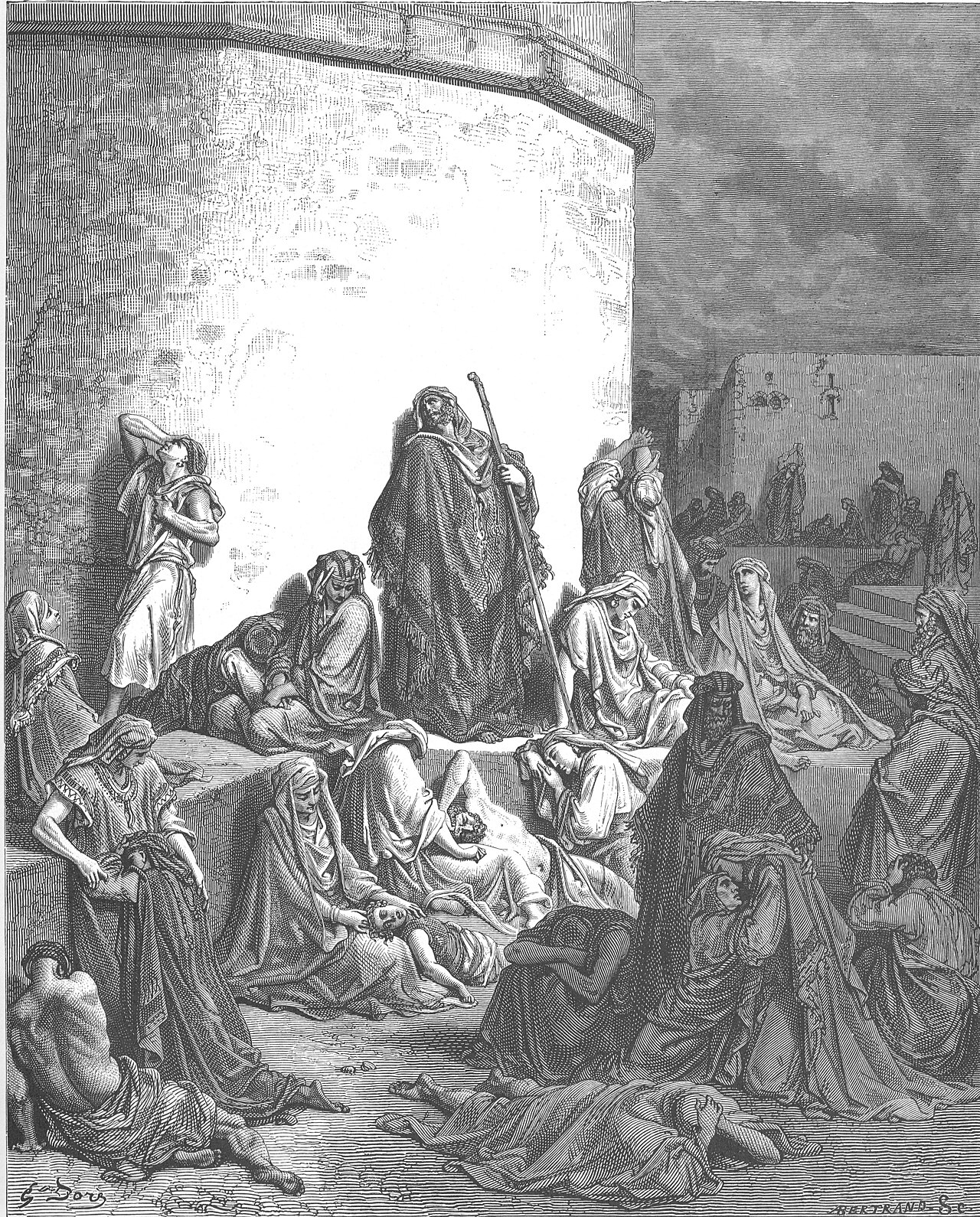
Lamentationschapter 3
66 verses · Jeremiah, by tradition · about 586 BC · The Prophets
Because of the loving devotion of the LORD we are not consumed, for His mercies never fail.
Introduction
Jeremiah, by tradition, The Prophets, Lamentations Overview.
Tradition gives this poem to Jeremiah, and many readers hear his own life in it, the prophet beaten, jailed and let down into a muddy cistern. Here a single man speaks for a whole ruined people. It is the longest and most tightly built poem in the book, with three verses given to each letter of the Hebrew alphabet. Listen for the place where the speaker stops describing what has been done to him and begins to remember what he knows of God. Nothing around him has changed at that point. Listen too for how the poem teaches a person to wait.
Context
- Who
- A community that needed somebody to say I as well as we
- What
- One man's lament over his own suffering that turns, at its centre, to hope in the faithfulness of God.
- Where
- Among the ruins of Jerusalem, in the voice of one sufferer who pictures himself walled in and thrown into a pit.
- When
- The first years after the fall of Jerusalem in 586 BC; the poem gives no date of its own.
- Why
- To give each survivor a voice that says I as well as we, and to show how hope can stand while the ruin remains.
Historical context
This is the centre of the book and it is the most tightly built. Where the other chapters give one verse per letter of the alphabet, this one gives three, sixty-six verses, in groups of three beginning with the same letter. The tightest possible form is used for the deepest possible grief, which is not a coincidence.
Show the rest of the historical context, 3 more paragraphs
The suffering is described through captivity and pit imagery. He has walled me about so I cannot escape, he has put heavy chains on me, he has shut out my prayer; and then, they flung me alive into the pit and cast stones on me, water closed over my head. Anyone who knew the story of the prophet in the muddy cistern would hear it here.
Then, exactly at the middle, the poem turns on a memory rather than a change in circumstances: the steadfast love of the LORD never ceases, his mercies never come to an end, they are new every morning, great is your faithfulness. Nothing outside has improved. The city is still rubble.
What follows is practical counsel for waiting: it is good that a man should bear the yoke in his youth; let him sit alone in silence; let him put his mouth in the dust, there may yet be hope. And an argument about God's character: he does not afflict from his heart, he will have compassion according to the abundance of his steadfast love.
Significance
For the first hearers the shift to a single voice mattered. Corporate grief can be a fog. One man saying I am the man who has seen affliction gives everyone else a place to stand.
Show the rest of the significance, 1 more paragraph
And the famous lines about new mercies are not a bright saying pasted over a disaster. They come in the exact middle of the most disciplined lament in Scripture, spoken by someone who has just finished describing being walled in, chained, shot at, and buried in a pit.
This chapter in Jewish lifeWhat this chapter is in Jewish life and reading.
What is done
No part of this chapter is read on a weekly Sabbath. The site's own table in src/lib/hebraic/readings.ts printed parashot total 0 and haftarah uses total 0 for this book. It records one public reading: the whole book, on the eve of the fast of Tisha B'Av, read at night in a darkened room with the congregation seated low as mourners sit. It sources the practice to Shulchan Aruch, Orach Chayim 559.
Rashi's own text ties one piece of the liturgy to this chapter. At the twentieth verse he reports that the Midrash Aggadah reads the words as addressed to God. He then says that "On this [explanation] the liturgical author based" a line of prayer. The line reads: "With this I know that You have to remember, but my soul is bowed down within me until You remember" (Rashi on Lamentations 3:20:1). The corpus does not name the poem or the day it is said.
How it is read
Rashi is the one commentator on this chapter whose English the corpus carries, quoted here from The Metsudah Five Megillot, Lakewood, N.J., 2001, which Sefaria reports as CC-BY. The translation is modern, so every quotation is held to fifty words or fewer. The edition sets numbered notes of its own inside Rashi's text, and only Rashi's own words are quoted as his.
Rashi hears the prophet's own voice in the chapter's first words. "Yirmiyahu lamented", he says (Rashi on Lamentations 3:1:1). The prophet saw more torment than all who foretold the ruin, "for the Beis Hamikdosh was not destroyed in their days, but it was [destroyed] in my days". The third verse he reads the same way: "I alone am constantly smitten, for the entire repetition of His blows is upon me" (Rashi on Lamentations 3:3:1).
In a second reading of the fourth verse he takes the wasting of the flesh as the road into exile. Young and old "lay outdoors on the ground with neither pillow nor cushion, and their flesh wore out" (Rashi on Lamentations 3:4:1). The prayer shut out at the eighth verse he explains in one line: "He shut the windows of the heavens before it" (Rashi on Lamentations 3:8:1). The crooked paths of the ninth are the roads the exiles took to avoid the enemy: "I go out on the crooked road" (Rashi on Lamentations 3:9:1). The bear of the tenth verse is God Himself: "The Holy One, Blessed Is He, turned into a bear in wait for me" (Rashi on Lamentations 3:10:1). The edition's note sets another reading beside it from Eikhah Rabbah 3:4, which takes the bear as Nevuchadnetzar.
The twentieth verse carries two readings, and Rashi keeps both. By the plain sense, the soul remembers its own affliction and is bowed down. "This is the simple meaning according to the context of the verse" (Rashi on Lamentations 3:20:1). By the Midrash Aggadah, the words are said to God: "I know that in the end You will remember what was done to me" (Rashi on Lamentations 3:20:1).
From the twenty-first verse the chapter turns, and Rashi marks the turn. "After my heart told me that my hope from God was gone, I will reply this to my heart, and I will continue to hope" (Rashi on Lamentations 3:21:1). He says the answer runs through the whole section to the words on why a living man should complain (Rashi on Lamentations 3:22:1). The edition's note places those words at the thirty-ninth verse. At the twenty-third verse, "Your kindnesses are renewed from day to day" (Rashi on Lamentations 3:23:1). At the twenty-fourth, "God is my portion; therefore it is proper that I should hope in Him" (Rashi on Lamentations 3:24:1).
The corpus carries five further notes on this chapter without an English text, each marked linked because Sefaria holds no English version of the ref. They stand cited and unquoted at Ibn Ezra on Lamentations 3:2:1, 3:6:1, 3:14:1, 3:15:1 and 3:17:1. The chapter file stops short of the chapter's end. Its commentary entries run to the twenty-fourth verse and its locators to the fortieth, and nothing past the fortieth verse is carried here.
What the rabbis say
The corpus carries forty rabbinic locators on this chapter, one on each of its first forty verses, and the text of none, so each is cited and linked here rather than quoted. Eikhah Rabbah stands on the first verse at 3:1, the seventh at 3:3, the tenth at 3:4 and the thirteenth at 3:5. It stands on the nineteenth at 3:7, the twenty-second at 3:8, the twenty-fifth at 3:9 and the thirty-fourth at 3:12. Eikhah Rabbah, Petichta 18, stands on the fifteenth. Midrash Lekach Tov on Lamentations stands at 3:5:1, 3:11:1, 3:14:1, 3:20:1, 3:26:1, 3:30:1, 3:32:1, 3:35:1 and 3:36:1.
Aggadat Bereshit stands at 8:3 on the third verse, 67:3 on the fourth, 8:4 on the twenty-first, 61:1 and 61:2 on the twenty-seventh and twenty-eighth, 40:3 on the thirty-seventh and 62:1 on the thirty-ninth. Bereshit Rabbati, Parashat Vayera 34, stands on the twelfth verse. Devarim Rabbah 2:34 stands on the twenty-fourth, and Bamidbar Rabbah 11:7 on the thirty-eighth.
The Talmud and the works beside it hold the rest. Avodah Zarah 5a:19 is set on the sixth verse, Bava Metzia 59a:5 on the eighth, Jerusalem Talmud Taanit 4:5:14 on the eighteenth, Chullin 7a:3 on the thirty-first and Berakhot 5a:9 on the fortieth. Avot DeRabbi Natan 1:8 stands on the twenty-third, and its Recension B at 41:4 on the sixteenth and 12:1 on the twenty-ninth. Ein Yaakov stands at Rosh Hashanah 2:4 on the ninth verse, and Ein Yaakov (Glick Edition) at Khagigah 1:14 on the second, Shabbat 2:7 on the seventeenth and Megillah 1:20 on the thirty-third. What each of them teaches is a saying of the rabbis, and is reported as theirs wherever this site quotes one. The quotations wait on a fetch that carries the text.
Sources: Rashi, Rashi on Lamentations 3:1:1 to 3:24:1, The Metsudah Five Megillot, Lakewood, N.J., 2001, reported CC-BY; Ibn Ezra, Ibn Ezra on Lamentations 3:2:1, 3:6:1, 3:14:1, 3:15:1 and 3:17:1, cited by ref because the corpus carries no English text; The Sefaria corpus, scripts/data/sources/sefaria/lamentations/3.json, the 40 Talmud and Midrash locators of this chapter; The site's own files, src/lib/hebraic/readings.ts, probed for this book and printing parashot total 0, haftarah uses total 0, and the festival reading on the eve of the fast of Tisha B'Av, sourced there to Shulchan Aruch, Orach Chayim 559.
The heads below are this chapter's scenes. The numbered points under each are its verses.
I Am the Man That Hath Seen Affliction
Lamentations 3:1-6
I am the man who has seen affliction: Chapter 3 is a triple acrostic, sixty-six verses giving three verses to each of the twenty-two letters. The voice moves from the city to one man: “I am the man who has seen affliction under the rod of God’s wrath”. He is made to “walk in darkness instead of light”.
Lamentations 3:1
“I am the man that hath seen affliction - Either the prophet speaks here of himself, or he is personating his miserable countrymen. This and other passages in this poem have been applied to Jesus Christ’s passion; but, in my opinion, without any foundation.”
Adam Clarke · Commentary on the Bible (1810-1826)evangelical
1 more voice on this verseWhat preachers and commentators have said about this verse, in their own words.
Lamentations 3:1
“Jeremiah, then, does not here plead his own private cause, but shews to his own nation what remedy there was for them in such a state of despair, even to have an immediate recourse to God, and on the one hand to consider their sins, and on the other to look to the mercy of God, so that they might entertain hope, and exercise themselves in prayer.”
John Calvin · Commentaries (1554)reformed
made me walk in darkness: Adam Clarke notes that darkness often stands for affliction in Scripture and light for prosperity. Thomas Aquinas read the verse as comfort taken away after the rod of Lamentations 3:1, and he set it beside Job 3:23. The man is driven away from light.
turning His hand against: Jamieson, Fausset and Brown read the Hebrew as blow after blow from the hand that once kept the man safe. Barnes hears a hand turning again and again. All day long comes back at Lamentations 3:14 and Lamentations 3:62, where the enemies mock him in song.
Lamentations 3:3
Is he turned; he turneth - Or, “surely against me” hath he turned “his hand” again and again “all the day long.”
He has worn away: With the second triplet the flesh and bones of the man carry the wrath of God. Albert Barnes reads worn away as strength slowly wasted in grief, and shattered bones as sharp pain. Matthew Henry pictured a man about to die.
Lamentations 3:4
“Made old - Or, wasted: his strength slowly wasted as he pined away in sorrow. He hath broken my bones - This clause completes the representation of the sufferer’s physical agonies. Here the idea is that of acute pain.”
He has besieged me: The words come from siege warfare. John Gill and Adam Clarke both saw behind them the mounds the Chaldeans set against the city, and Gill notes the prophet was within it. Gill also ties this bitterness to the gall of Lamentations 3:19, and Albert Barnes reads hardship as weariness.
like those dead for ages: Psalm 143:3 has nearly the same words, as Thomas Aquinas saw, and Jamieson, Fausset and Brown add Psalm 88:5 to 6. Barnes places this darkness among the dead. John Gill heard in it both the dark pit of the prophet and the grave of the people in exile.
Lamentations 3:7-9
He has walled me in so I cannot escape: Affliction is pictured as a prison: “He has walled me in so I cannot escape; He has weighed me down with chains”. The last line takes away direction as well as escape: “He has barred my ways with cut stones; He has made my paths crooked”.
Lamentations 3:7
“He hath hedged me about, that I cannot go out,.... When in prison, or in the dungeon, or during the siege of Jerusalem; though the phrase may only denote in general the greatness of his troubles, with which he was encompassed, and how inextricable they were; like a hedge about a vineyard, or a wall about a city, which could not easily be got over: he hath made my chain heavy; his affliction intolerable.”
1 more voice on this verse
Lamentations 3:7
“He has hedged me about, that I cannot get out. " When Jerusalem was besieged it was said to be compassed in on every side, Luke xix. "I am chained; and as some notorious malefactors are double-fettered, and loaded with irons, so he has made my chain heavy.”
Matthew Henry · Commentary on the Whole Bible (1707-1721)puritan
He shuts out my prayer: Prayer, the last way left, is shut as well. Albert Barnes reads the verb as shutting in, a cell so closed that the cry cannot pass out. Thomas Aquinas set the verse beside Psalm 22:2, and the same complaint comes back for the whole people at Lamentations 3:44.
He has barred my ways with cut stones: John Gill notes that cut stones make a dressed and fitted wall, a barrier built to last. Albert Barnes pictures the man leaving the blocked road for side paths that bend and bring him back where he began. Every exit is closed.
Lamentations 3:9
“Inclosed - Or, hedged Lam 3:7. Hath, made crooked - Or, “hath” turned aside. A solid wall being built across the main road, Jeremiah turns aside into by-ways, but finds them turned aside, so that they lead him back after long wandering to the place from where he started.”
Lamentations 3:10-13
He is a bear lying in wait: The Lord's dealing is pictured as an ambush: “He is a bear lying in wait, a lion hiding in ambush”. The predator gives way to violence: “He forced me off my path and tore me to pieces”. Then comes the archer, who “set me as the target for His arrow”.
Lamentations 3:10
“He was unto me as a bear lying in wait,.... For its prey, which seizes on it at once, and tears it in pieces; such were the Chaldeans to the Jews by divine permission: and as a lion in secret places; lurking there, in order to take every opportunity and advantage, and fall upon any creature that comes that way. The same thing is signified here as before; see Hos 5:14.”
1 more voice on this verse
Lamentations 3:10
“Having dwelt upon the difficulties which hemmed in his path, he now shows that there are dangers attending upon escape. Lam 3:11 The meaning is, “God, as a lion, lying in wait, has made me turn aside from my path, but my flight was in vain, for springing upon me from His ambush lie has torn me in pieces.” Desolate - Or, astonied, stupefied that he cannot flee. The word is a favorite one with Jeremiah.”
tore me to pieces: The bear and the lion of Lamentations 3:10 finish their attack. Albert Barnes reads the verse as a flight that failed, the man forced off his path and torn by the beast. John Gill and Matthew Henry hear Hosea 5:14, where the LORD tears like a lion and goes away.
Lamentations 3:11
“He hath turned aside my ways,.... Or caused me to depart or go back from the way I was in, and so fall into the hand of the enemy that lay in wait, as before. Jarchi interprets the word of thorns, and of scattering the way with thorns, and hedging it up with them, so that there was no passing, Hos 2:6; the sense seems to be the same with Lam 3:9; and pulled me in pieces: as any creature that falls into the hands of a bear or lion.”
He bent His bow: John Gill notes the Chaldeans shot arrows into the city, and he compares Job 7:20, where Job complains God has set him as a target. Adam Clarke quotes an Eastern saying that the only escape from the arrow of God is to turn to the Lord.
Lamentations 3:12
“He hath bent his bow,.... Which is put for all the instruments, of war; the Chaldeans were archers, and shot their arrows into the city: and set me as a mark for the arrow; as a target to shoot at; signifying that God dealt with him, or his people, as enemies, the object of his wrath and indignation; and if he directed his arrow against them, it must needs hit them; there was no escaping his vengeance; see Job 7:20.”
1 more voice on this verse
Lamentations 3:12
“He hath bent his bow, and set me as a mark for the arrow - One might conjecture that the following thought in the Toozek i Teemour was borrowed from this: - “One addressed the caliph Aaly, and said, ‘If the heavens were a bow, and the earth the cord thereof; if calamities were arrows, man the butt for those arrows; and the holy blessed God the unerring marksman; where could the sons of Adam flee for succor?’ The caliph replied, ‘The children of Adam must flee unto the Lord.’” This was the state of poor Jerusalem.”
Adam Clarke · Commentary on the Bible (1810-1826)evangelical
He pierced my kidneys: The Hebrew calls the arrows the sons of His quiver, as Adam Clarke explains. A thing that comes from another is often named its son. The kidneys lie deep within the body, and Matthew Henry says the arrows of God fly swift and pierce deep.
Lamentations 3:13
“The arrows of his quiver - בני אשפתו beney ashpatho, “The sons of his quiver.” The issue or effect; the subject, adjunct, or accident, or produce of a thing, is frequently denominated its son or child. So arrows that issue from a quiver are here termed the sons of the quiver.”
Adam Clarke · Commentary on the Bible (1810-1826)evangelical
Lamentations 3:14-18
I am a laughingstock to all my people: “He has intoxicated me with wormwood”, the bitter plant Deuteronomy 29:18 names as the fruit of turning from the covenant. The unit ends at its lowest point, with hope named as gone: “My strength has perished, along with my hope from the LORD”.
Lamentations 3:14
“Jeremiah herein was a type of Messiah. "All my people" (Joh 1:11).”
Jamieson, Fausset & Brown · Commentary Critical and Explanatory on the Whole Bible (1871)reformed
He has filled me with bitterness: Adam Clarke notes the Hebrew plural, bitternesses, bitter upon bitter, and he calls bitterness a figure for affliction in almost every tongue. John Gill hears the bitter herbs of the Passover. The wormwood comes back at Lamentations 3:19.
Lamentations 3:15
“He hath filled me with bitterness - במרורים bimrorim, with bitternesses, bitter upon bitter. He hath made me drunken with wormwood - I have drunk the cup of misery till I am intoxicated with it. Almost in all countries, and in all languages, bitterness is a metaphor to express trouble and affliction. The reason is, there is nothing more disagreeable to the taste than the one; and nothing more distressing to the mind than the other. An Arabic poet. Amralkeis, one of the writers of the Moallakat, terms a man grievously afflicted a pounder of wormwood.”
Adam Clarke · Commentary on the Bible (1810-1826)evangelical
1 more voice on this verse
Lamentations 3:15
“He hath filled me with bitterness,.... Or "with bitternesses" (m); instead of food, bitter herbs; the allusion perhaps is to the bitter herbs eaten at the passover, and signify bitter afflictions, sore calamities, of which the prophet and his people had their fill.”
He has ground my teeth with gravel: Jamieson, Fausset and Brown explain the gravel as grit baked into bread made in ashes, and they compare Proverbs 20:17. Matthew Henry heard Psalm 102, where ashes are eaten like bread. Even food has turned against the man.
Lamentations 3:16
“He hath also broken my teeth with gravel stones - What a figure to express disgust, pain, and the consequent incapacity of taking food for the support of life; a man, instead of bread, being obliged to eat small pebbles till all his teeth are broken to pieces by endeavoring to grind them. One can scarcely read this description without feeling the toothache. The next figure is not less expressive.”
Adam Clarke · Commentary on the Bible (1810-1826)evangelical
My soul has been deprived of peace: The Hebrew word for peace is shalom, the soundness of a whole life. Matthew Henry writes that the man has been without prosperity so long that he has lost the very idea of it. Thomas Aquinas set the verse beside Psalm 89:39 and the covenant renounced.
Lamentations 3:17
“And thou hast removed my soul far off from peace,.... From the time the city was besieged by the Chaldeans, and now the people was carried captive; who could have no true peace, being in a foreign land, in an enemy's country, and out of their own, and far from the place of divine worship; nor could the prophet have any peace of soul, in the consideration of these things, the city, temple, and nation, being desolate, though he himself was not in captivity.”
This line is the lowest point of the chapter. Adam Clarke calls hope the first and last help of the man in misery, and Thomas Aquinas hears despair. The answer comes soon, as hope comes back at Lamentations 3:21 and the LORD becomes the portion of the soul at 3:24.
Lamentations 3:18
“And my hope - That first, that last support of the miserable - it is gone! it is perished! The sovereign God alone can revive it.”
Adam Clarke · Commentary on the Bible (1810-1826)evangelical
Lamentations 3:19-21
Remember my affliction and wandering: The man recalls “the wormwood and the gall”, and at first memory only rehearses the pain: “Surely my soul remembers and is humbled within me”. The turn comes, “Yet I call this to mind, and therefore I have hope”. Hope follows the recalling, and the grief before it stands.
Lamentations 3:19
“It was an affliction that was misery itself. My affliction and my transgression (so some read it), my trouble and my sin that brought it upon me; this was the wormwood and the gall in the affliction and the misery. It is sin that makes the cup of affliction a bitter cup.”
Matthew Henry · Commentary on the Whole Bible (1707-1721)puritan
is humbled within me: Adam Clarke marks a change of mind at this verse. The complaint gives way to a man humbled under the hand of God, and in Clarke's reading that humbling lets hope come back at 3:21. Thomas Aquinas took the memory here to be of good days once known.
Lamentations 3:20
“By soul - is humbled in me - It is evident that in the preceding verses there is a bitterness of complaint against the bitterness of adversity, that is not becoming to man when under the chastising hand of God; and, while indulging this feeling, all hope fled. Here we find a different feeling; he humbles himself under the mighty hand of God, and then his hope revives, Lam 3:21.”
Adam Clarke · Commentary on the Bible (1810-1826)evangelical
His Mercies Are New Every Morning
Yet I call this to mind: The turn comes in this line. Jamieson, Fausset and Brown take this to point forward to the mercies, and they report Calvin took it to point back to the man's weakness. Albert Barnes reads a resolve to bring the truth back to the heart, knowing that God hears the contrite.
Lamentations 3:21
Third, memory results regards faithfulness. "But this I call to mind, and therefore I have hope." Hence Sirach 51:8 says: "Then I remembered thy mercy, O Lord, and thy work from of old."
Thomas Aquinas · written before 1274 · Commentary on Lamentationspatristic
2 more voices on this verse
Lamentations 3:21
“This I recall - Rather, “This will I bring back to my heart, therefore will I hope.” Knowing that God hears the prayer of the contrite, he begins again to hope.”
Lamentations 3:21
“MEMORY is very often the servant of despondency. Despairing minds call to remembrance every dark foreboding in the past and every gloomy feature in the present. Memory stands like a handmaiden clothed in sackcloth, presenting to her master a cup of mingled gall and wormwood. Like Mercury, she hastens with winged heel to gather fresh thorns with which to fill the uneasy pillow and to bind fresh rods with which to scourge the already bleeding heart. There is, however, no necessity for this. Wisdom will transform Memory into an angel of comfort.”
Lamentations 3:22-24
Because of the loving devotion of the LORD we are not consumed: What was recalled is named here: “Because of the loving devotion of the LORD we are not consumed, for His mercies never fail”. The next verse says the mercies “are new every morning”. “The LORD is my portion” answers verse 18, where his hope from the LORD had perished.
Lamentations 3:22
“It is of the Lord’s mercies that we are not consumed - Being thus humbled, and seeing himself and his sinfulness in a proper point of view, he finds that God, instead of dealing with him in judgment, has dealt with him in mercy; and that though the affliction was excessive, yet it seas less than his iniquity deserved. If, indeed, any sinner be kept out of hell, it is because God’s compassion faileth not.”
Adam Clarke · Commentary on the Bible (1810-1826)evangelical
1 more voice on this verse
Lamentations 3:22
“That great is his faithfulness. Though the covenant seemed to be broken, they owned that it still continued in full force; and, though Jerusalem be in ruins, the truth of the Lord endures for ever. Note, Whatever hard things we suffer, we must never entertain any hard thoughts of God, but must still be ready to own that he is both kind and faithful.”
Matthew Henry · Commentary on the Whole Bible (1707-1721)puritan
They are new every morning: The loving devotion of Lamentations 3:22 is renewed daily. Adam Clarke tied the line to the Watchman of Israel who never sleeps, keeping His people through each night. Matthew Henry notes that this faithfulness was confessed while Jerusalem lay in ruins, and it answers the lost hope of Lamentations 3:18.
Lamentations 3:23
“They are new every morning - Day and night proclaim the mercy and compassion of God. Who could exist throughout the day, if there were not a continual superintending Providence? Who could be preserved in the night, if the Watchman of Israel ever slumbered or slept?”
Adam Clarke · Commentary on the Bible (1810-1826)evangelical
Portion is the word for a share of the land. Albert Barnes points to Numbers 18:20, where the LORD tells Aaron that He Himself is the share of the priests. Matthew Henry notes that every portion on earth will perish, and with the land lost the soul still has God.
Lamentations 3:24
“The Lord is my portion - “My portion is Yahweh,” see Num 18:20; Psa 16:5 ff. Therefore will I hope in him - A more full expression of the confidence present in the prophet’s mind in Lam 3:21, but based now upon God’s faithfulness in showing mercy.”
Lamentations 3:25-27
The LORD is good to those who wait for Him: The confession becomes instruction: “The LORD is good to those who wait for Him, to the soul who seeks Him”. The unit closes with a proverb of discipline taken up: “It is good for a man to bear the yoke while he is still young”.
Lamentations 3:25
“In these three verses, each beginning in the Hebrew with the word good, we have first the fundamental idea that Yahweh Himself is good, and if good to all, then especially is He so to those who being in adversity can yet wait in confidence upon His mercy. Lam 3:26 And quietly wait - literally, “and be in silence,” i. e. abstain from all complaining.”
1 more voice on this verse
Lamentations 3:25
"There is none good but one, God the Father." This word they declare is peculiar to the Father of Christ, who, however, is different from the God who is creator of all things, to which creator he gave no appellation of goodness. Let us see now if, in the Old Testament, the God of the prophets and the Creator and Legislator of the word is not called good. What are the expressions that occur in the psalms?
Origen of Alexandria · written before 253 · On First Principles 2:5.4patristic
wait quietly for the salvation of the LORD: Verses 25 to 27 each open in Hebrew with the word good, as Albert Barnes points out. He reads the waiting as silence without complaint. Jamieson, Fausset and Brown compare the silence of Aaron in Leviticus 10:3 and of Job in Job 40:4 to 5, men who kept quiet.
Lamentations 3:26
“It is good that a man should both hope - Hope is essentially necessary to faith; he that hopes not, cannot believe; if there be no expectation, there can be no confidence. When a man hopes for salvation, he should not only waft for it, but use every means that may lead to it; for hope cannot live, if there be no exercise. If hope become impatient, faith will be impossible: for who can believe for his salvation when his mind is agitated? He must therefore quietly wait.”
Adam Clarke · Commentary on the Bible (1810-1826)evangelical
bear the yoke while he is still young: John Gill finds two kinds of yoke in the verse, the law of God in the Targum and the rod of correction in Aben Ezra. Origen set the verse and those after it against Celsus, to show the cheek offered to the one who strikes stood in the old Scriptures.
Lamentations 3:27
“It is good for a man that he bear the yoke in his youth. Either the yoke of the commandments, as the Targum; or of correction, as Aben Ezra; of afflictions, as fatherly chastisements; both senses may be retained.”
1 more voice on this verse
Lamentations 3:27
“YOKE-BEARING is not pleasant, but it is good. It is not every pleasant thing that is good, nor every good thing that is pleasant. Sometimes the goodness may be just in proportion to the unpleasantness. Now, it is childish to be always craving for sweets—those, who by reason of use have had their senses exercised, should prefer the wholesome to the palatable. It ought to reconcile us to that which is unsavory when we are informed that it is good! A little child is not easily reconciled that way, because, as yet, he cannot think and judge.”
Let Him Sit Alone and Keep Silence
Lamentations 3:28-30
Let him sit alone in silence: The posture is chosen: “Let him sit alone in silence, for God has disciplined him”. With his face in the dust he still looks toward hope, “perhaps there is still hope”. The unit closes in nonresistance, “Let him offer his cheek to the one who would strike him”.
Lamentations 3:28
“He does not fight against the yoke (Jer 31:18; Ac 9:5), but accommodates himself to it. alone--The heathen applauded magnanimity, but they looked to display and the praise of men. The child of God, in the absence of any witness, "alone," silently submits to the will of God. borne it upon him--that is, because he is used to bearing it on him.”
Jamieson, Fausset & Brown · Commentary Critical and Explanatory on the Whole Bible (1871)reformed
1 more voice on this verse
Lamentations 3:28
“THUS the Prophet describes the conduct of a person in deep anguish of heart. When he does not know what to do, his soul, as if by instinct, humbles itself. He gets into some secret place, he utters no speech, he gives himself over to moaning and to tears, and then he bows himself lower and yet lower before the Divine Majesty, as if he felt that the only hope for him in the extremity of his sorrow was to make complete submission to God and to lie in the very dust before Him.”
Charles Spurgeon · written before 1892 · The Metropolitan Tabernacle Pulpit, Sermon No. 2468: “Solitude, Silence, Submission” (lightly modernized text, CCEL edition)Particular Baptist
The man lies with his face in the dust before God. Jamieson, Fausset and Brown read the next words as the doubt of the man about himself, a whisper that there may still be hope. Spurgeon preached verses 28 and 29 to any soul under the weight of sin.
Lamentations 3:29
The mouth in the dust is the attitude of suppliant and humble submission to God's dealings as righteous and loving in design (compare Ezr 9:6; 1Co 14:25). if so be there may be hope--This does not express doubt as to whether GOD be willing to receive the penitent, but the penitent's doubt as to himself; he whispers to himself this consolation, "Perhaps there may be hope for me."
Jamieson, Fausset & Brown · Commentary Critical and Explanatory on the Whole Bible (1871)reformed
Let him offer his cheek: Jamieson, Fausset and Brown see Isaiah 50:6 fulfilled here, where the Servant gives his cheeks to those who strike him. Albert Barnes calls this the harder task, for many who bow to God resent suffering that comes through men. Augustine cited the verse on patience.
Lamentations 3:30
“He giveth his cheek to him that smiteth - He has that love that is not provoked. He is not quarrelsome, nor apt to resent injuries; he suffers long and is kind. Or, it may be rendered, “let him give his cheek.” He is filled full with reproach - Though all this take place, yet let his “trust be in God, who will not cast off for ever.” God will take his part, and bring him safely through all hardships.”
Adam Clarke · Commentary on the Bible (1810-1826)evangelical
Lamentations 3:31-33
For the Lord will not cast us off forever: Grief and compassion come from the same hand: “Even if He causes grief, He will show compassion according to His abundant loving devotion”. The Hebrew behind willingly in verse 33 reads literally from His heart: “For He does not willingly afflict or grieve the sons of men”.
Lamentations 3:31
“Is it not evident that the Lord Jesus is angry with us when we sin in order that he may convert us through fear of his indignation? His indignation, then, is not the carrying out of vengeance but rather the working out of forgiveness, for these are his words: "If you shall turn and lament, you shall be saved." He waits for our lamentations here, that is, in time, that he may spare us those that shall be eternal. He waits for our tears that he may pour forth his goodness.”
Ambrose of Milan · written before 397 · Concerning Repentance 1.5.22-24patristic
2 more voices on this verse
Lamentations 3:31
“The Lord - אדני Adonai; but one of my ancient MSS. has יהוה Jehovah. The above verse is quoted in reference to our Lord’s passion, by Mat 26:62.”
Adam Clarke · Commentary on the Bible (1810-1826)evangelical
Lamentations 3:31
“Therefore the sufferer is thus penitent, thus patient, because he believes that God is gracious and merciful, which is the great inducement both to evangelical repentance and to Christian patience.”
Matthew Henry · Commentary on the Whole Bible (1707-1721)puritan
He will show compassion: Grief and compassion come from the same hand, and the compassion is measured by abundant loving devotion, the word of 3:22. Ambrose read the anger of the Lord as working toward forgiveness, waiting for tears in time to spare tears in eternity. Thomas Aquinas traced both acts to divine mercy.
He does not willingly afflict: The Hebrew reads from His heart, as Jamieson, Fausset and Brown note, and they compare Ezekiel 33:11. Matthew Henry says that in all the affliction of His people He is afflicted, and His soul is grieved. Adam Clarke likens Him to a good father with a rod.
Lamentations 3:33
“He does not afflict any willingly (literally, "from His heart," that is, as if He had any pleasure in it, Eze 33:11), much less the godly (Heb 12:10).”
Jamieson, Fausset & Brown · Commentary Critical and Explanatory on the Whole Bible (1871)reformed
1 more voice on this verse
Lamentations 3:33
“He comes out of his place to punish, for his place is the mercy-seat. He delights not in the misery of any of his creatures, but, as it respects his own people, he is so far from it that in all their afflictions he is afflicted and his soul is grieved for the misery of Israel.”
Matthew Henry · Commentary on the Whole Bible (1707-1721)puritan
Lamentations 3:34-36
To crush underfoot all the prisoners of the land: The unit lists three wrongs: to crush prisoners, “to deny a man justice before the Most High”, and “to subvert a man in his lawsuit”. In the Hebrew all three hang on one main clause held to the end, “of these the Lord does not approve”.
Lamentations 3:34
“To crush under his feet - He can neither gain credit nor pleasure in trampling upon those who are already bound, and in suffering; such he knows to be the state of man here below. From which it most assuredly follows, that God never afflicts us but for our good, nor chastises but that we may be partakers of his holiness. All the prisoners of the earth - By the prisoners of the earth, or land, Dr. Blayney understands those insolvent debtors who were put in prison, and there obliged to work out the debt.”
Adam Clarke · Commentary on the Bible (1810-1826)evangelical
2 more voices on this verse
Lamentations 3:34
“If men injure them under colour of law, and in the pretended administration of justice,--if they turn aside the right of a man, so that he cannot discover what his rights are or cannot come at them, they are out of his reach,--if they subvert a man in his cause, and bring in a wrong verdict, or give a false judgment, let them know, (1.) That God sees them.”
Matthew Henry · Commentary on the Whole Bible (1707-1721)puritan
Lamentations 3:34
“This triplet has an infinitive in the beginning of each verse, the governing finite verb being in the end of La 3:36, "the Lord approveth not," which is to be repeated in each verse.”
Jamieson, Fausset & Brown · Commentary Critical and Explanatory on the Whole Bible (1871)reformed
to deny a man justice: Jamieson, Fausset and Brown note that each verse of this triplet opens with an infinitive, and all three wait for the verdict of the Lord. Justice denied is done before the Most High. Adam Clarke saw no gain in reading the Most High here as a chief of the people.
Lamentations 3:35
“To turn aside the right of a man - To make a man lose his right, because one of the higher orders opposes him. Dr. Blayney thinks that עליון elyon, instead of being referred to God, should be considered as pointing out one of the chief of the people. I do not see that we gain any thing by this.”
Adam Clarke · Commentary on the Bible (1810-1826)evangelical
Here the sentence of the triplet closes on its verb. Adam Clarke explains the Hebrew verb as a refusal to look, the Lord turning His face from the wrong in disgust. Albert Barnes lists the three wrongs as cruelty to prisoners, a corrupt tribunal and justice perverted.
Lamentations 3:36
“To subvert a man in his cause - To prevent his having justice done him in a lawsuit, etc., by undue interference, as by suborning false witnesses, or exerting any kind of influence in opposition to truth and right. - Blayney. The Lord approved not - Instead of אדני Adonai, seventeen MSS., of Kennicott’s, and one ancient of my own, have יהוה Yehovah. Approveth not, לא ראה lo raah, doth not see, turns away his face from it, abhors it.”
Adam Clarke · Commentary on the Bible (1810-1826)evangelical
Lamentations 3:37-39
Who has spoken and it came to pass: Verse 38 traces calamity and blessing to one source, “adversity and good”, the Hebrew pair of evil and good the Law set in Deuteronomy 30:15. Verse 39 answers complaint from the same ground: “Why should any mortal man complain, in view of his sins?”
Lamentations 3:37
“Why then does a loving God, who disapproves of suffering when inflicted by man upon man, Himself send sorrow and misery? “Because of sins.” Lam 3:37 Literally, “Who is this that spake and it was done, though אדני 'ădonāy commanded it not?” Lam 3:39 So long as God spares a man’s life, why does he complain? The chastisement is really for his good; only let him use it aright, and he will be thankful for it in the end.”
adversity and good come from the mouth: Matthew Henry notes that the Hebrew points to this adversity and this good, both from the Most High. Thomas Aquinas read the line against men who put down every event to chance, naming Cicero. Adversity here is the fall of the city in 587/586 BC.
Why should any mortal man complain: Adam Clarke read the Hebrew as a living man. Jamieson, Fausset and Brown add that life itself is a gift the sinner could have lost. A saying of the Desert Fathers makes the verse a rule for every trial: look to your own sins.
Lamentations 3:39
“Wherefore doth a living man complain - He who has his life still lent to him has small cause of complaint. How great soever his affliction may be, he is still alive; therefore, he may seek and find mercy unto eternal life. Of this, death would deprive him; therefore let not a living man complain.”
Adam Clarke · Commentary on the Bible (1810-1826)evangelical
1 more voice on this verse
Lamentations 3:39
“If sin were punished as it deserves, life itself would be forfeited by the sinner. "Complaining" (murmuring) ill becomes him who enjoys such a favor as life (Pr 19:3). for the punishment of his sins--Instead of blaming God for his sufferings, he ought to recognize in them God's righteousness and the just rewards of his own sin.”
Jamieson, Fausset & Brown · Commentary Critical and Explanatory on the Whole Bible (1871)reformed
Let Us Search and Try Our Ways and Turn Again
Lamentations 3:40-42
Let us examine and test our ways: The single voice becomes a summons to the whole people: “Let us examine and test our ways, and turn back to the LORD”. The confession is stated plainly with its last clause kept: “We have sinned and rebelled; You have not forgiven”.
Lamentations 3:40
“Let us search - How are we to get the pardon of our sins? The prophet tells us: 1. Let us examine ourselves. 2. “Let us turn again to the Lord.” 3. “Let us lift up our heart;” let us make fervent prayer and supplication for mercy. 4. “Let us lift up our hand;” let us solemnly promise to be his, and bind ourselves in a covenant to be the Lord’s only: so much lifting up the hand to God implies.”
Adam Clarke · Commentary on the Bible (1810-1826)evangelical
Let us lift up our hearts and hands: Albert Barnes renders the Hebrew as lifting the heart to the hands, as if the heart lifted the hands and rose with them to God. Matthew Henry calls lifted hands the posture of prayer and a readiness to receive mercy, citing Psalm 141:2. Heart and hands rise together.
Lamentations 3:41
“We must pray to him, with a believing expectation to receive mercy from him; for that is implied in our lifting up our hands to him (a gesture commonly used in prayer and sometimes put for it, as Ps. cxli. 2 , Let the lifting up of my hands be as the evening sacrifice ); it signifies our requesting mercy from him and our readiness to receive that mercy.”
Matthew Henry · Commentary on the Whole Bible (1707-1721)puritan
The confession is plain, and the pardon has yet to come. Matthew Henry calls the complaint a common mistake of grieving believers, who read lingering judgment as a sign the sin still stood. Albert Barnes takes verses 43 to 66 as the record of a God still punishing His people.
Lamentations 3:42
“Note, It becomes us, when we are in trouble, to justify God, by owning our sins, and laying the load upon ourselves for them. Call sin a transgression, call it a rebellion, and you do not miscall it. This is the result of their searching and trying their ways; the more they enquired into them the worse they found them.”
Matthew Henry · Commentary on the Whole Bible (1707-1721)puritan
Lamentations 3:43-51
You have covered Yourself in anger and pursued us: The people say of themselves what the man said of himself: “You have covered Yourself in anger and pursued us; You have killed without pity”. The hardest complaint follows, “You have covered Yourself with a cloud that no prayer can pass through”, and their standing is “scum and refuse”.
Lamentations 3:43
“In verses 43-66, far from pardoning, God is still actively punishing His people. Rather, “Thou hast covered” Thyself “with wrath and pursued (Lam 1:3 note) us.” The covering (here and in Lam 3:44) is that of clothing and enwrapping.”
1 more voice on this verse
Lamentations 3:43
“Their enemies persecuted and slew them, but that was not the worst of it; they were but the instruments in God's hand: " Thou hast persecuted us, and thou hast slain us, though we expected thou wouldst protect and deliver us." They complain that there was a wall of partition between them and God, and, (1.) This hindered God's favours from coming down upon them.”
Matthew Henry · Commentary on the Whole Bible (1707-1721)puritan
covered Yourself with a cloud: Albert Barnes explains the covering of Lamentations 3:43 and 3:44 as clothing, God wrapped as in a garment. Thomas Aquinas and Jamieson, Fausset and Brown read the cloud as the sins of the people, citing Isaiah 59:2 and 44:22. The shut prayer of Lamentations 3:8 belongs to all the people.
Lamentations 3:44
"This cloud is so thick that our prayers seem as if they were lost in it; they cannot pass through; we cannot obtain an audience." Note, The prolonging of troubles is sometimes a temptation, even to praying people, to question whether God be what they have always believed him to be, a prayer-hearing God.
Matthew Henry · Commentary on the Whole Bible (1707-1721)puritan
scum and refuse among the nations: The Hebrew words name what is swept out of a house and cast away. Paul uses the same words of the apostles in 1 Corinthians 4:13, as John Gill and Matthew Henry note. The people God chose are made the dust of the nations.
Lamentations 3:45
“Thou hast made us as the offscouring and refuse in the midst of the people. Had given them up into the hands of the Gentiles, the Chaldeans, to be treated as the dirt of the streets, as the sweepings of a house; or the dross of metal; or anything that is vile, mean, and contemptible. The apostle seems to have some reference to this passage; and his words may be an illustration of it, 1Co 4:13.”
Waters Flowed Over My Head; I Said, I Am Cut Off
All our enemies open their mouths: The same complaint stands at Lamentations 2:16, as John Gill notes, and the open mouths are those of lions or of men who mock. Gill cites the Targum, which adds evil decrees to the insults. Matthew Henry says the fallen are often mocked by lesser men.
Lamentations 3:46
“All our enemies have opened their mouths against us. Like lions and other beasts of prey, to devour us; or in way of scorn and derision; pouring out their reproaches upon us, and scoffs at us, for our religion, and the worship of God, and on account of present miseries and distresses; see Lam 2:16. The Targum adds, "to decree against us evil decrees.''”
Panic and pitfall have come: The Hebrew sets two words of nearly the same sound side by side, and the Berean keeps the echo in panic and pitfall. The trap has closed. Thomas Aquinas reads verses 46 to 48 as the enemies making ready to take the people captive.
Lamentations 3:47
“Fear and a snare - See on Jer 48:13 (note).”
Adam Clarke · Commentary on the Bible (1810-1826)evangelical
Streams of tears flow: The voice turns from the people back to the single man, and John Gill hears the prophet speaking in his own person. The line echoes Jeremiah 9:1, where he wishes his eyes were a fountain of tears. Barnes calls the tears the prophet's sympathy.
Lamentations 3:48
“Mine eye runneth down with rivers of waters,.... Denoting the greatness of his grief and trouble at the afflictions of his people, and the vast profusion of tears on that account. Here the prophet speaks in his own person, expressing the anguish of his soul he felt, and the floods of tears he shed: for the destruction of the daughter of my people; for those that were slain of them, or carried captive; see Jer 9:1. The Targum is, "for the destruction of the congregation of my people.''”
1 more voice on this verse
Lamentations 3:48
“The deep sympathy of the prophet, which pours itself forth in abundant tears over the distress of his people. Lam 3:51 Or, “Mine eye” causeth pain to my soul, i. e. maketh my soul ache, because of the sad fate of the maidens (Lam 1:4, Lam 1:18, ...).”
My eyes overflow unceasingly: Matthew Henry notes two marks of the weeping, its flood and its constancy, without a day of relief. Thomas Aquinas compares Jeremiah 9:18 to 19, where the eyes overflow with water. The next verse sets the limit of the tears.
until the LORD looks down from heaven: This verse fixes the end point of the weeping. John Gill reads it as the LORD scattering the cloud of Lamentations 3:44 and looking on His people with favour. Matthew Henry puts it simply, that one favourable look from heaven will set all to rights.
Lamentations 3:50
“Till the Lord look do: on, and behold from heaven. Disperses and dissipates the cloud that was about him; shines forth and manifests himself, and looks favourably upon his people, and delivers them out of their troubles: this the prophet was in hope of, and was waiting for; but, till it came to pass, could have no rest and comfort. The Targum is, "till he look and behold my injury;'' as if he had regard to his own personal injury done him; but the former sense is best.”
1 more voice on this verse
Lamentations 3:50
"If God, who now covers himself with a cloud, as if he took no notice of our troubles ( Job xxii. 13 ), would but shine forth, all would be well; if he look upon us, we shall be saved, " Ps. lxxx. Bad as the case is, one favourable look from heaven will set all to rights.
Matthew Henry · Commentary on the Whole Bible (1707-1721)puritan
because of all the daughters of my city: Adam Clarke reads the daughters of the city as the villages, and Jamieson, Fausset and Brown agree, calling them towns taken by the enemies. Albert Barnes reads them as young women of the city, whose grief is told in Lamentations 1:4 and 1:18. What the eye sees, the soul feels.
Lamentations 3:51
“Mine eye affecteth mine heart - What I see I feel. I see nothing but misery; and I feel, in consequence, nothing but pain. There have been various translations of the original: but they all amount to this. The daughters of my city - The villages about Jerusalem.”
Adam Clarke · Commentary on the Bible (1810-1826)evangelical
Lamentations 3:52-54
Without cause my enemies hunted me like a bird: “They dropped me alive into a pit and cast stones upon me”, a scene that matches the cistern Jeremiah was lowered into in Jeremiah 38:6. Drowning language marks the low point: “The waters flowed over my head, and I thought I was going to die”.
Lamentations 3:52
“They have done it without cause, without any provocation given them. Though God was righteous, they were unrighteous. David often complains of those that hated him without cause; and such are the enemies of Christ and his church, John xv.”
Matthew Henry · Commentary on the Whole Bible (1707-1721)puritan
1 more voice on this verse
Lamentations 3:52
“Mine enemies chased me - From this to the end of the chapter the prophet speaks of his own personal sufferings, and especially of those which he endured in the dungeon. See Jer 38:6, etc.”
Adam Clarke · Commentary on the Bible (1810-1826)evangelical
They dropped me alive into a pit: Albert Barnes reads the line as an attempt on the life of the prophet, a pit with a stone over its mouth. Adam Clarke refers the verse to the cistern of Jeremiah 38:6, where Jeremiah was let down into a cistern. Henry applies it to men cast into dark prisons.
Lamentations 3:53
“They have cut off my life in the dungeon - Or, “They destroyed my life in the pit,” i. e. tried to destroy it by casting me into the cistern, and covering the month with a stone. See the margin reference.”
The waters flowed over my head: Jamieson, Fausset and Brown note the pit of Jeremiah 38:6 held no water, so the water is a figure for trouble that overflows a man. They compare Psalm 69:2. Albert Barnes also reads the waters as great anguish of mind.
Lamentations 3:54
“Waters flowed over mine head,.... As in a pit or dungeon, where there is not only mire and clay, but much water, into which persons being put, sink, and are covered therewith; see Psa 69:1; this is to be understood metaphorically of the waters of afflictions, which overflowed and overwhelmed the people of the Jews.”
I Called Upon Thy Name Out of the Lowest Dungeon
Lamentations 3:55-58
I called on Your name, O LORD, out of the depths of the Pit: The pit becomes the place of prayer: “I called on Your name, O LORD, out of the depths of the Pit”. The narrative closes on deliverance already given, “You defend my cause, O Lord; You redeem my life”, set before the plea against his enemies.
Lamentations 3:55
“A prayer for deliverance and for vengeance upon his enemies. Lam 3:55 Out of the low dungeon - “The lowest pit” of Psa 88:6. Some consider that Ps. 69 was composed by Jeremiah, and is the prayer referred to here (Jer 38:6 note). Lam 3:56 Thou hast heard - In sending Ebedmelech to deliver me. The next clause signifies “Hide not thine ear to my relief to my cry,” i. e. to my cry for relief.”
You heard my plea: Jamieson, Fausset and Brown find two kinds of prayer in the Hebrew, a breath of prayer in secret and a loud cry. Adam Clarke thought the man in the pit could only whisper. Spurgeon drew comfort from this for any soul whose prayer feels weak, since God hears a breath.
Lamentations 3:56
“Thou hast heard--namely formerly (so in La 3:57, 58). breathing . . . cry--two kinds of prayer; the sigh of a prayer silently breathed forth, and the loud, earnest cry (compare "prayer," "secret speech," Isa 26:16, Margin; with "cry aloud," Ps 55:17).”
Jamieson, Fausset & Brown · Commentary Critical and Explanatory on the Whole Bible (1871)reformed
1 more voice on this verse
Lamentations 3:56
“Hide not thine ear at my breathing - He dared not even to complain, nor to cry, nor to pray aloud: he was obliged to whisper his prayer to God. It was only a breathing.”
Adam Clarke · Commentary on the Bible (1810-1826)evangelical
You drew near when I called on You: Spurgeon set this verse against the man's earlier words at Lamentations 3:8 and Lamentations 3:44, where prayer seemed shut out. Experience has proved his fears wrong. John Gill hears Isaiah 41:10, and he reports that the Targum has God send an angel to draw near and deliver.
Lamentations 3:57
How different are our experiences from our fears! This man of God had said, "When I cry and shout He shuts out my prayer." He had said again, "You have covered Yourself with a cloud, that our prayer should not pass through." He had added to that, "Surely against me is He turned." But now he corrects his misapprehensions. Neither was prayer shut out, nor had God turned against him, for he joyfully confesses, "You drew near in the day that I called upon You: You said, Fear not."
1 more voice on this verse
Lamentations 3:57
“Thou drewest near in the day that I called upon thee,.... When persons draw nigh to God in a way of duty, and particularly in this of prayer, and calling on his name; he draws nigh to them in a way of grace and mercy, and manifests himself to them, and works salvation for them. The Targum is, "thou didst cause an angel to draw near to deliver me in the day that I prayed unto thee:'' thou saidst, fear not; any of thine enemies; or that thou shouldest not be delivered from them; see Isa 41:10.”
You defend my cause: The LORD takes up the cause of the man as his advocate, and He redeems his life as a near kinsman would. Thomas Aquinas pairs the verse with Psalm 43:1. Spurgeon notes that the prophet speaks of what he has seen in his own life.
Lamentations 3:58
Here the judge and his justice is commended: "Thou hast taken up my cause, O Lord, thou hast redeemed my life." That is, during past times. As concurs Psalm 43:1: "Vindicate me, O God, and defend my cause against an ungodly people."
Thomas Aquinas · written before 1274 · Commentary on Lamentationspatristic
Lamentations 3:59-66
You have seen, O LORD, the wrong done to me: The last unit brings the case against the enemies to the Judge: “You have seen, O LORD, the wrong done to me”. It lists their insults before the closing plea, “You will pay them back what they deserve, O LORD, according to the work of their hands”.
You have seen all their malice: Jamieson, Fausset and Brown read the malice as vengeance, the enemies' wish to repay, and they compare the plots of Jeremiah 11:19. Thomas Aquinas cites Jeremiah 18:18, where the people of Judah plot against Jeremiah. Adam Clarke notes that every plot lies open to God.
Lamentations 3:60
“Thou hast seen - all their imaginations - Every thing is open to the eye of God. Distressed soul! though thou knowest not what thy enemies meditate against thee; yet he who loves thee does, and will infallibly defeat all their plots, and save thee.”
Adam Clarke · Commentary on the Bible (1810-1826)evangelical
You have heard their insults: Sight now gives way to hearing. John Gill notes that God heard the taunts spoken aloud and even the schemes still forming in silent thought. The words all their plots against me close both this verse and Lamentations 3:60.
Lamentations 3:61
“Thou hast heard their reproach, O Lord,.... Their reproachful words uttered against the prophet and his people, against God himself; their spiteful language, their taunts, and scoffs and jeers: and all their imaginations against me; those he not only saw, as they appeared in their actions; but heard them, as they were expressed by their words; yea, they were manifest to him, while they only were in silent thought forming in the mind.”
the slander and murmuring of my assailants: John Gill joins this verse to the one before it, the same malice in other words, slander on the lips and plots in the mind. Jamieson, Fausset and Brown tie all day long to the mocking song of Lamentations 3:14. The slander never stops.
When they sit and when they rise: Jamieson, Fausset and Brown read the pair as rest and work alike. John Gill compares Psalm 139:2, where God knows a man when he sits and when he rises. The mocking song of Lamentations 3:14 goes on to the end of the chapter.
Lamentations 3:63
“Behold their sitting down, and their rising up,.... All their actions; the whole course of their lives; all which fell under the divine omniscience, Psa 139:2; but that is not barely here meant; but that he would take particular notice hereof, and punish for the same.”
You will pay them back: The last triplet hands the enemies over to God. The verse asks for measured justice, a return according to the work of their hands. Gregory the Dialogist quoted it with the next verse in a homily on those who refused the preaching of the passion of Christ.
Lamentations 3:64
“Whence Jeremiah also says: "You will render to them their recompense, O Lord, according to the works of their hands; You will give them as a shield for the heart Your labor." For lest the darts of preaching should penetrate their hearts, since they disdained the labor of His passion, they held that same labor of His as if it were a shield, so that by the very fact that they saw Him labor even unto death, they would not permit His words to pass through to them.”
Gregory the Dialogist · written before 604 · Forty Gospel Homilies, Homily 22patristic
Put a veil of anguish over their hearts: Translations differ between a veil over the heart and grief of heart, and Adam Clarke read it as a heart made hard and covered over. John Gill reports a view that the word plays on the mocking song of Lamentations 3:63, so their song is turned back on them.
Lamentations 3:65
“Give them sorrow of heart - They shall have a callous heart, covered with obstinacy, and thy execration. The former is their state, the latter their fate. This is the consequence of their hardening their hearts from thy fear. Blayney translates, “Thou wilt give with a hearty concordance thy curse unto them.” That is, Thou wilt give it to them freely, and without reserve; intimating that God felt no longer any bowels of compassion for them.”
Adam Clarke · Commentary on the Bible (1810-1826)evangelical
1 more voice on this verse
Lamentations 3:65
“Give them sorrow of heart,.... That which will cause sorrow of heart; such judgments and punishments as will be grievous to them. Some have observed a likeness between the word here used and that translated "music", Lam 3:63; and think some respect may be had to it; that whereas the people of God had been matter of mirth and music to them, God would give them music, but of another sort; a song, but a doleful one.”
You will pursue them in anger: Adam Clarke calls these lines a declaration of what will come. John Wesley likewise reads such lines as prophecy as well as prayer. Clarke and John Gill both hear Jeremiah 10:11, where the false gods perish under the heavens.
Lamentations 3:66
“Persecute and destroy them in anger,.... As they have persecuted the people of God, do thou persecute them; and never leave pursuing them untie thou hast made a full end of them, as the effect of vindictive wrath and vengeance: from under the heavens of the Lord; which are made by him, and in which he dwells; let them not have the benefit of them, nor so much as the sight of them; but let them perish from under them, Jer 10:11.”
1 more voice on this verse
Lamentations 3:66
“Persecute and destroy them - Thou wilt pursue them with destruction. These are all declaratory, not imprecatory. From under the heavens of the Lord - This verse seems to allude to the Chaldaic prediction, in Jer 10:11. By their conduct they will bring on themselves the curse denounced against their enemies. The Septuagint and Vulgate seem to have read “From under heaven, O Jehovah:” and the Syriac reads, “Thy heavens, O Jehovah!” None of these makes any material change in the meaning of the words.”
Adam Clarke · Commentary on the Bible (1810-1826)evangelical
How this psalm is built
The form: A triple alphabetic acrostic of sixty-six verses, three verses to each letter, with Pe standing before Ayin, as Jamieson, Fausset & Brown classes it.
The patterns in this chapter
| Device | What it does | Where to see it |
|---|---|---|
| Three verses to every letter | Counted over the store's own tagged Hebrew, every verse of each group of three opens with the same letter, Aleph at verses 1 to 3 and Taw at verses 64 to 66. Pe holds verses 46 to 48 and Ayin verses 49 to 51, the order chapters 2 and 4 also keep. Albert Barnes notes that the three Tet verses, 25 to 27, each open with the Hebrew word for good.Albert Barnes, Notes, Explanatory and Practical, on the Old and New Testaments, on Lamentations 3:25. | Lamentations 3:1, Lamentations 3:25, Lamentations 3:46, Lamentations 3:49, Lamentations 3:64 |
| The turn to remembering | Verses 1 to 18 describe what the LORD has done to the speaker, and verse 18 ends with his strength and his hope from the LORD perished. Verse 21 opens with what he calls to mind, and verses 22 to 24 speak of the LORD's loving devotion, His mercies new every morning and His faithfulness. The turn comes from memory, since nothing in the speaker's condition has changed.the site's Lamentations guide, src/components/book/guides/lamentations/LamentationsGuide.tsx, the chapter spine, chapter 3. | Lamentations 3:18, Lamentations 3:21, Lamentations 3:22, Lamentations 3:23, Lamentations 3:24 |
| I, then we, then I | The man speaks as I through verse 24. Verses 25 to 39 teach in general terms what is good for anyone who waits on the LORD. Verses 40 to 47 speak as we and call the people to examine their ways. From verse 48 the speaker is I again, weeping for his people, recalling his rescue from the pit and asking for justice.the site's Lamentations guide, src/components/book/guides/lamentations/LamentationsGuide.tsx, the chapter spine, chapter 3. | Lamentations 3:1, Lamentations 3:25, Lamentations 3:40, Lamentations 3:48, Lamentations 3:55 |
How this chapter is built
2 more paragraphs on the patterns
The poem gives three verses to each letter of the Hebrew alphabet, sixty-six verses in all, with Pe before Ayin. The man describes his affliction through verse 18 and turns to hope at verses 21 to 24. Verses 25 to 39 teach patient waiting, and verses 40 to 47 call the people to confession in the first person plural. From verse 48 the man speaks again, of his tears, his rescue from the pit and his plea for justice.
The letters are counted from the store's tagged Hebrew. Albert Barnes treats the verses as triplets in his Notes, Explanatory and Practical, on the Old and New Testaments at Lamentations 3:25. Jamieson, Fausset and Brown do the same in their Commentary Critical and Explanatory on the Whole Bible at Lamentations 3:34 to 36. The outline follows the chapter spine of the site's Lamentations guide.
Key words
The words this chapter repeats, each one a lemma of the store’s tagged Hebrew however the chapter inflects it, with the verses it stands in. The grammar words are struck out, and the eight terms the psalm says the word of God by stand in the figure above the patterns rather than here. Every row opens that word’s own page.
| Word | Said | No.Strong’s | Meaning | Where it stands |
|---|---|---|---|---|
| גֶּבֶר | geber | H1397 | great man | 1, 27, 35, 39 |
| נֶפֶשׁ | nephesh | H5315 | soul | 17, 20, 24, 25, 51, 58 |
| טוֹב | ṭôwb | H2896 | pleasant | 17, 25, 26, 27, 38 |
| זָכַר | zâkar | H2142 | to remember | 19, 20 |
| אֲדֹנָי | ʼĂdônây | H136 | Lord | 31, 36, 37, 58 |
| יְהֹוָה | Yᵉhôvâh | H3068 | LORD | 18, 22, 24, 25, 26, 40 and 6 more |
Show the next 12 words
| Word | Said | No.Strong’s | Meaning | Where it stands |
|---|---|---|---|---|
| שָׁמַיִם | shâmayim | H8064 | heaven | 41, 50, 66 |
| רָאָה | râʼâh | H7200 | to see | 1, 36, 50, 59, 60 |
| חַי | chay | H2416 | alive | 39, 53, 58 |
| פֶּה | peh | H6310 | lip | 29, 38, 46 |
| שׁוּב | shûwb | H7725 | to return | 3, 21, 40, 64 |
| לֵב | lêb | H3820 | heart | 21, 33, 65 |
| דֶּרֶךְ | derek | H1870 | way | 9, 11, 40 |
| עַיִן | ʻayin | H5869 | eye | 48, 49, 51 |
| יוֹם | yôwm | H3117 | day | 3, 14, 57, 62 |
| עַם | ʻam | H5971 | people | 14, 45, 48 |
| אָמַר | ʼâmar | H559 | to say | 18, 24, 37, 54, 57 |
| נָתַן | nâthan | H5414 | to give | 29, 30, 65 |
Keep studying
Sources for this chapter
The summary
Jamieson, Fausset & Brown, Commentary Critical and Explanatory; John Calvin, Commentaries; John Wesley, Notes on the Old Testament and Matthew Henry, Complete Commentary.
The form and classifications
Jamieson, Fausset & Brown, Commentary Critical and Explanatory on the Whole Bible, on Lamentations 3:34 to 36.
The exposition
Adam Clarke, Commentary on the Bible; Albert Barnes; Ambrose of Milan, Concerning Repentance 1.5.22-24; Augustine of Hippo, REPLY TO FAUSTUS THE MANICHAEAN 19:28; Carl Friedrich Keil, Lamentations; Charles Spurgeon; Desert Fathers, The Desert Fathers, Sayings of the Early Christian Monks; Gregory the Dialogist, Forty Gospel Homilies, Homily 22; Jamieson, Fausset & Brown, Commentary Critical and Explanatory on the Whole Bible; John Calvin, Commentary on Jeremiah and Lamentations; John Gill; John Wesley, Explanatory Notes upon the Old Testament; Matthew Henry, Commentary on the Whole Bible; Origen of Alexandria, AGAINST CELSUS 7:25 and Thomas Aquinas, Commentary on Lamentations.