
Lamentations 3:29
in Lamentations 3Let him bury his face in the dust—perhaps there is still hope.
BSB
The same verse in ASV and KJV ▾
ASV
Let him put his mouth in the dust, if so be there may be hope.
KJV
He putteth his mouth in the dust; if so be there may be hope.
⋯
This verse in Lamentations 3
Commentary
10 notes on this verseSecond, the condition of the person expecting refers to humbleness of location. "Let him put his mouth in the dust—there may yet be hope." Namely, while humbly speaking. Since Isaiah 29:4 reflects: "Then deep from the earth you shall speak, from low in the dust …
This site's exposition
Let him sit alone in silence
on Lamentations 3:28-30
The posture is chosen: “Let him sit alone in silence, for God has disciplined him”. With his face in the dust he still looks toward hope, “perhaps there is still hope”. The unit closes in nonresistance, “Let him offer his cheek to the one who would strike him”.
This site's exposition
Let him bury his face in the dust
The man lies with his face in the dust before God. Jamieson, Fausset and Brown read the next words as the doubt of the man about himself, a whisper that there may still be hope. Spurgeon preached verses 28 and 29 to any soul under the weight of sin.
The record, by era
The Church Fathers1 voice
But all those who call their lands by their own names and have wood and hay and stubble in their thoughts; such as these, since they are strangers to difficulties, become aliens from the kingdom of heaven. Had they however known that "tribulation perfects patience, and patience experience, and experience hope, and hope makes not ashamed," they would have exercised themselves, after the example of Paul. He said, "I bring my body into subjection, lest when I have preached to others, I myself should be a castaway."
The Puritans and the Awakening1 voice
He putteth his mouth in the dust,....
The Nineteenth Century3 voices
A commentator
Charles Spurgeon1834–1892
The Metropolitan Tabernacle Pulpit, Sermon No. 2468: “Solitude, Silence, Submission” (lightly modernized text, CCEL edition) · Written before 1892.
THUS the Prophet describes the conduct of a person in deep anguish of heart. When he does not know what to do, his soul, as if by instinct, humbles itself. He gets into some secret place, he utters no speech, he gives himself over to moaning and to tears, and then he bows himself lower and yet lower before the Divine Majesty, as if he felt that the only hope for him in the extremity of his sorrow was to make complete submission to God and to lie in the very dust before Him.
A commentator
Jamieson, Fausset & Brown1802–1910
Commentary Critical and Explanatory on the Whole Bible (1871)
He does not fight against the yoke (Jer 31:18; Ac 9:5), but accommodates himself to it. alone--The heathen applauded magnanimity, but they looked to display and the praise of men. The child of God, in the absence of any witness, "alone," silently submits to the will of God. borne it upon him--that is, because he is used to bearing it on him.
A commentator
Jamieson, Fausset & Brown1802–1910
Commentary Critical and Explanatory on the Whole Bible (1871)
The mouth in the dust is the attitude of suppliant and humble submission to God's dealings as righteous and loving in design (compare Ezr 9:6; 1Co 14:25). if so be there may be hope--This does not express doubt as to whether GOD be willing to receive the penitent, but the penitent's doubt as to himself; he whispers to himself this consolation, "Perhaps there may be hope for me."
2 more voices on this verse
The Nineteenth Century2 voices
A commentator
Charles Spurgeon1834–1892
The Metropolitan Tabernacle Pulpit, Sermon No. 2468: “Solitude, Silence, Submission” (lightly modernized text, CCEL edition) · Written before 1892.
proposed
THUS the Prophet describes the conduct of a person in deep anguish of heart. When he does not know what to do, his soul, as if by instinct, humbles itself. He gets into some secret place, he utters no speech, he gives himself over to moaning and to tears, and then he bows himself lower and yet lower before the Divine Majesty, as if he felt that the only hope for him in the extremity of his sorrow was to make complete submission to God and to lie in the very dust before Him. It seems to me that such conduct as this, which is characteristic of every truly gracious man in his hour of trouble, should also be the mark of all who are seeking God's Grace—those who are not yet saved, but who are conscious of their need of salvation. I must, surely, be speaking right into the heart of some who are feeling the crushing weight and heavy burden of their guilt. If you cannot do anything else, dear Friends, do what these two verses say, in order that, afterwards, you may be able to take that grand Gospel step of faith in Jesus Christ which will certainly bring you into peace andjoy! Those of you who have the Revised Version will notice a correction which has been made long ago by all competent scholars—"Let him sit alone and keep silent, because He has laid it upon him. Let him put his mouth in the dust; if so be there may be hope." It does not matter which way you read the passage, because the conduct of one gracious man is virtually a precept to another, yet it is satisfactory to find that if we are under the burden of sin, we are here commanded to do as the Prophet did in his time of need. My objective, just now, is to explain this line of conduct, in the hope that some who are in trouble will at once heartily follow it. I.
He putteth his mouth in the dust - Lives in a state of deep humility. If so be there may be hope - Because there is room for hope.
The words behind it
6 Hebrew wordsEvery Hebrew word of this verse in the order it stands, with what it means and the door to its own study. The last column counts the times a word stands in the whole Bible: the rarer the word, the more the places it appears belong together.
| Hebrew | Sound | Meaning | Word study | In the Bible |
|---|---|---|---|---|
| יִתֵּ֤ן | yiten | let him put | H5414 → | 2011 times |
| בֶּֽעָפָר֙ | beafar | in the dust | H6083 → | |
| פִּ֔יהוּ | pihu | mouth his | H6310 → | 498 times |
| אוּלַ֖י | ʾulai | perhaps | H194 → | |
| יֵ֥שׁ | yesh | there | H3426 → | |
| תִּקְוָֽה׃ | tikvah | [is] hope | H8615 → |
יִתֵּ֤ןlet him put
yitenH5414 →2011 times
בֶּֽעָפָר֙in the dust
beafarH6083 →
פִּ֔יהוּmouth his
pihuH6310 →498 times
אוּלַ֖יperhaps
ʾulaiH194 →
יֵ֥שׁthere
yeshH3426 →
תִּקְוָֽה׃[is] hope
tikvahH8615 →
A shaded row is a word that stands 400 times or fewer in the Bible.
The walk
8 stopsEach card is a verse this one points to, and under it the verses that one points to in turn. Where several paths arrive at the same place, that place is listed first: the text keeps returning to it.
Through
Romans 3:19Now we know that whatever the law says, it says to those who are under the law, so that every mouth may be silenced and the whole world held accountable to God.
it leads to
- Galatians 3:10
All who rely on works of the law are under a curse. For it is written: “Cursed is everyone who does not continue to do everything written in the Book of the Law.”
- Galatians 3:22–23
But the Scripture pronounces all things confined by sin, so that by faith in Jesus Christ the promise might be given to those who believe.
- Galatians 3:10
Through
Luke 18:13But the tax collector stood at a distance, unwilling even to lift up his eyes to heaven. Instead, he beat his breast and said, ‘God, have mercy on me, a sinner!’
it leads to
- Ezra 9:6
and said: “O my God, I am ashamed and embarrassed to lift up my face to You, my God, because our iniquities are higher than our heads, and our guilt has reached the heavens.
- 1 John 1:8–10
If we say we have no sin, we deceive ourselves, and the truth is not in us.
- 1 Timothy 1:15
This is a trustworthy saying, worthy of full acceptance: Christ Jesus came into the world to save sinners, of whom I am the worst.
- Psalms 41:4
I said, “O LORD, be gracious to me; heal me, for I have sinned against You.”
- Ezra 9:6
Through
Job 40:4“Behold, I am insignificant. How can I reply to You? I place my hand over my mouth.
it leads to
- Proverbs 30:32
If you have foolishly exalted yourself or if you have plotted evil, put your hand over your mouth.
- Proverbs 30:32
Through
Joel 2:14Who knows? He may turn and relent and leave a blessing behind Him—grain and drink offerings for the LORD your God.
it leads to
- Jonah 3:9
Who knows? God may turn and relent; He may turn from His fierce anger, so that we will not perish.”
- Jonah 3:9
Where this verse is studied
On this page
Studies17
On this verse
On this chapter
About Lamentations
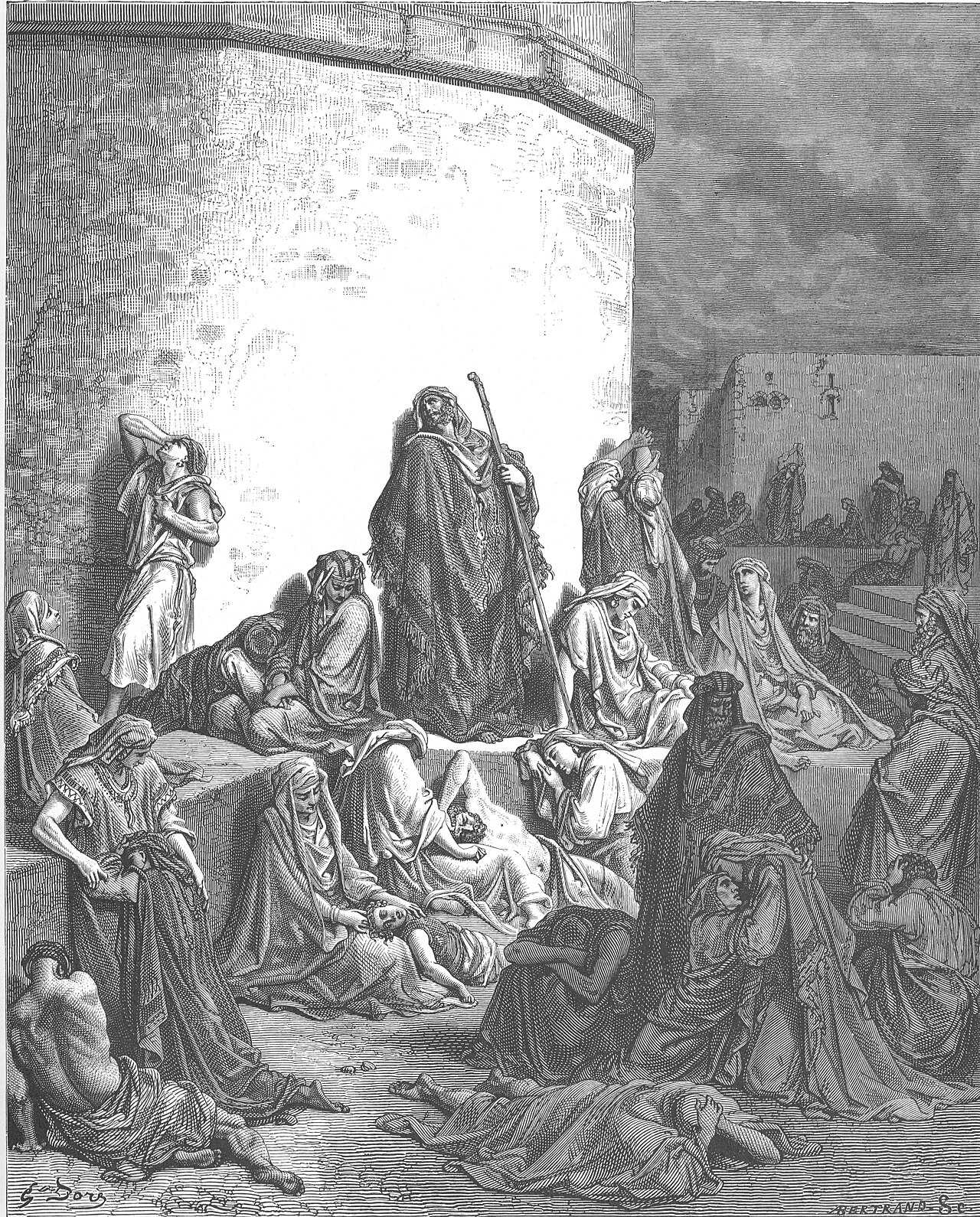
This page draws on Adam Clarke, Commentary on the Bible; Athanasius of Alexandria, FESTAL LETTERS 13:4; Charles Spurgeon, The Metropolitan Tabernacle Pulpit, Sermon No. 2468: “Solitude, Silence, Submission” (lightly modernized text, CCEL edition); Jamieson, Fausset & Brown, Commentary Critical and Explanatory on the Whole Bible; John Gill, Exposition of the Old Testament; John Gill, Exposition of the Old Testament (1748-1763) and Thomas Aquinas, Commentary on Lamentations.