
Lamentations 3:48
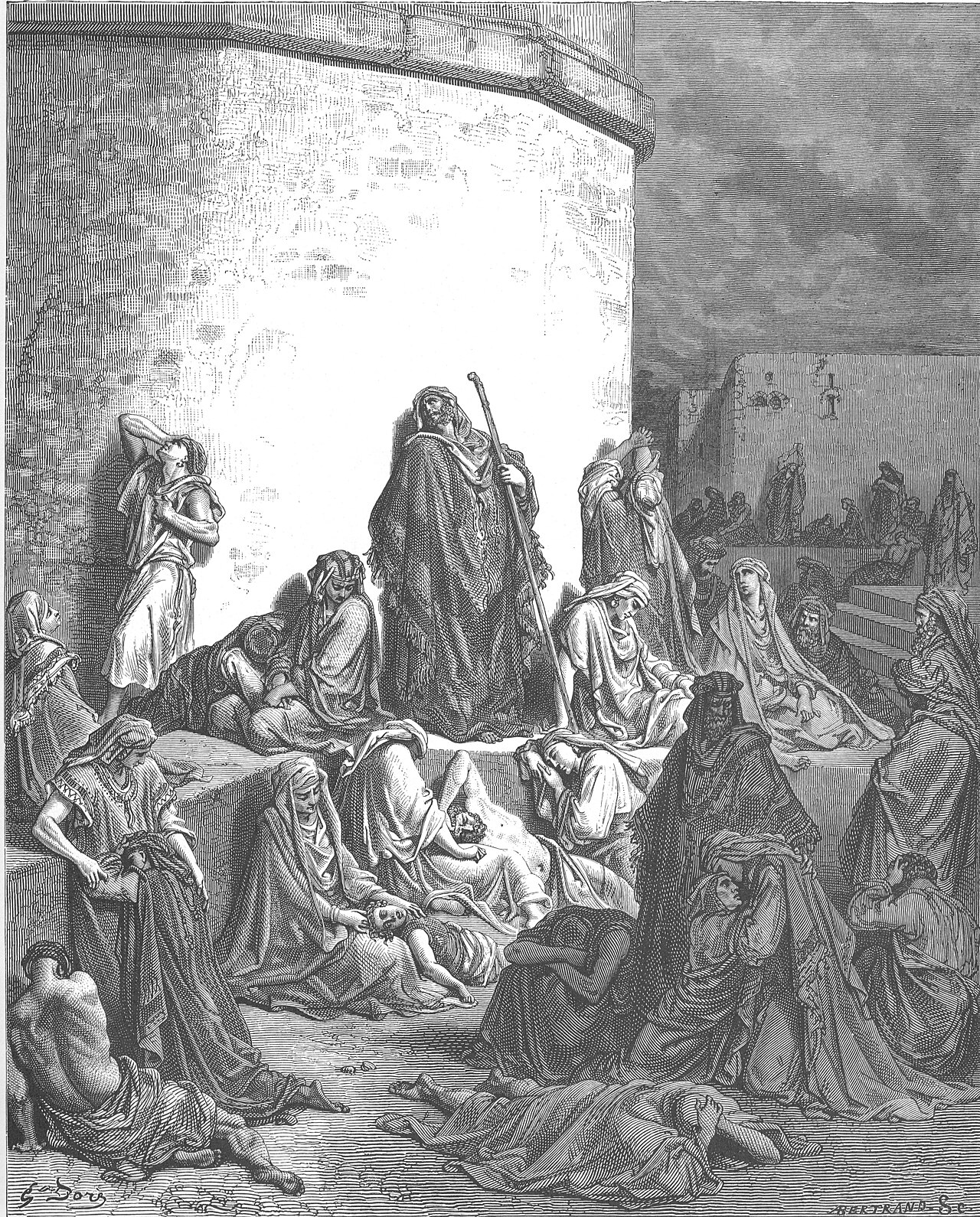
in Lamentations 3Streams of tears flow from my eyes over the destruction of the daughter of my people.
BSB
The same verse in ASV and KJV ▾
ASV
Mine eye runneth down with streams of water, for the destruction of the daughter of my people.
KJV
Mine eye runneth down with rivers of water for the destruction of the daughter of my people.
⋯
This verse in Lamentations 3
Commentary
5 notes on this verseMine eye runneth down with rivers of waters,.... Denoting the greatness of his grief and trouble at the afflictions of his people, and the vast profusion of tears on that account. Here the prophet speaks in his own person, expressing the anguish of his soul he felt, and the floods of tears he shed: for the destruction of the daughter of my people; for those that were slain of them, or carried captive; see Jer 9:1. The Targum is, "for the destruction of the congregation of my people.''
The record, by era
The Medieval Church1 voice
Benevolence on the enemy's part, excitement against indications of evil inflicted by the enemy, are here viewed. First is noticed the preparation for capturing, second, the captivity itself. To the idea, preparation for capturing, three more references are made. First is the enemies' preparation: "All …
The Puritans and the Awakening1 voice
): My eye runs down with rivers of water, so abundant was their weeping; it trickles down and ceases not, so constant was their weeping, without any intermission, there being no relaxation of their miseries. The distemper was in continual extremity, and they had no better day.
quarantine:debris (2026-07-29) — leading-punctuation+unbalanced-parens
The Nineteenth Century2 voices
A commentator
Albert Barnes1798–1870
Notes, Explanatory and Practical, on the Old and New Testaments (1832-1869)
The deep sympathy of the prophet, which pours itself forth in abundant tears over the distress of his people. Lam 3:51 Or, “Mine eye” causeth pain to my soul, i. e. maketh my soul ache, because of the sad fate of the maidens (Lam 1:4, Lam 1:18, ...).
Mine eye runneth down - I weep incessantly.
The words behind it
8 Hebrew wordsEvery Hebrew word of this verse in the order it stands, with what it means and the door to its own study. The last column counts the times a word stands in the whole Bible: the rarer the word, the more the places it appears belong together.
| Hebrew | Sound | Meaning | Word study | In the Bible |
|---|---|---|---|---|
| פַּלְגֵי־ | palgei- | streams of | H6388 → | |
| מַ֙יִם֙ | mayim | water | H4325 → | 581 times |
| תֵּרַ֣ד | terad | it goes down | H3381 → | 381 times |
| עֵינִ֔י | ʾeini | eye my | H5869 → | 887 times |
| עַל־ | ʾal- | on | H5921 → | 5755 times |
| שֶׁ֖בֶר | shever | [the] brokenness of | H7667 → | 45 times |
| בַּת־ | bat- | [the] daughter of | H1323 → | 588 times |
| עַמִּֽי׃ ס | ʾami | people my | H5971 → | 1873 times |
פַּלְגֵי־streams of
palgei-H6388 →
מַ֙יִם֙water
mayimH4325 →581 times
תֵּרַ֣דit goes down
teradH3381 →381 times
עֵינִ֔יeye my
ʾeiniH5869 →887 times
עַל־on
ʾal-H5921 →5755 times
שֶׁ֖בֶר[the] brokenness of
sheverH7667 →45 times
בַּת־[the] daughter of
bat-H1323 →588 times
עַמִּֽי׃ סpeople my
ʾamiH5971 →1873 times
A shaded row is a word that stands 400 times or fewer in the Bible.
The walk
8 stopsEach card is a verse this one points to, and under it the verses that one points to in turn. Where several paths arrive at the same place, that place is listed first: the text keeps returning to it.
Through
Jeremiah 9:1Oh, that my head were a spring of water, and my eyes a fountain of tears! I would weep day and night over the slain daughter of my people.
it leads to
- Isaiah 22:4
Therefore I said, “Turn away from me, let me weep bitterly! Do not try to console me over the destruction of the daughter of my people.”
Reached by 3 separate paths from here.
- Jeremiah 13:17
But if you do not listen, I will weep in secret because of your pride. My eyes will overflow with tears, because the LORD’s flock has been taken captive.
- Lamentations 2:11
My eyes fail from weeping; I am churning within. My heart is poured out in grief over the destruction of the daughter of my people, because children and infants faint in the streets of…
- Isaiah 22:4
Through
Jeremiah 9:18Let them come quickly and take up a lament over us, that our eyes may overflow with tears, and our eyelids may gush with water.
it leads to
- Jeremiah 9:1
Oh, that my head were a spring of water, and my eyes a fountain of tears! I would weep day and night over the slain daughter of my people.
Reached by 3 separate paths from here.
- Jeremiah 9:1
Through
Lamentations 2:18The hearts of the people cry out to the Lord. O wall of the Daughter of Zion, let your tears run down like a river day and night. Give yourself no relief, and your…
it leads to
- Lamentations 1:16
For these things I weep; my eyes flow with tears. For there is no one nearby to comfort me, no one to revive my soul. My children are destitute because the enemy has prevailed.
Reached by 2 separate paths from here.
- Psalms 119:145
I call with all my heart; answer me, O LORD! I will obey Your statutes.
- Lamentations 1:16
Through
Jeremiah 4:19My anguish, my anguish! I writhe in pain! Oh, the pain in my chest! My heart pounds within me; I cannot be silent. For I have heard the sound of the horn, the alarm…
it leads to
- Habakkuk 3:16
I heard and trembled within; my lips quivered at the sound. Decay entered my bones; I trembled where I stood. Yet I must wait patiently for the day of distress to come upon the…
- Habakkuk 3:16
Through
Lamentations 2:11My eyes fail from weeping; I am churning within. My heart is poured out in grief over the destruction of the daughter of my people, because children and infants faint in the streets of…
it leads to
- Lamentations 1:20
See, O LORD, how distressed I am! I am churning within; my heart is pounding within me, for I have been most rebellious. Outside, the sword bereaves; inside, there is death.
- Lamentations 1:20
Where this verse is studied
About Lamentations
This page draws on Adam Clarke, Commentary on the Bible; Albert Barnes, Notes, Explanatory and Practical, on the Old and New Testaments (1832-1869); John Gill, Exposition of the Old Testament (1748-1763); Matthew Henry, Commentary on the Whole Bible and Thomas Aquinas, Commentary on Lamentations.