
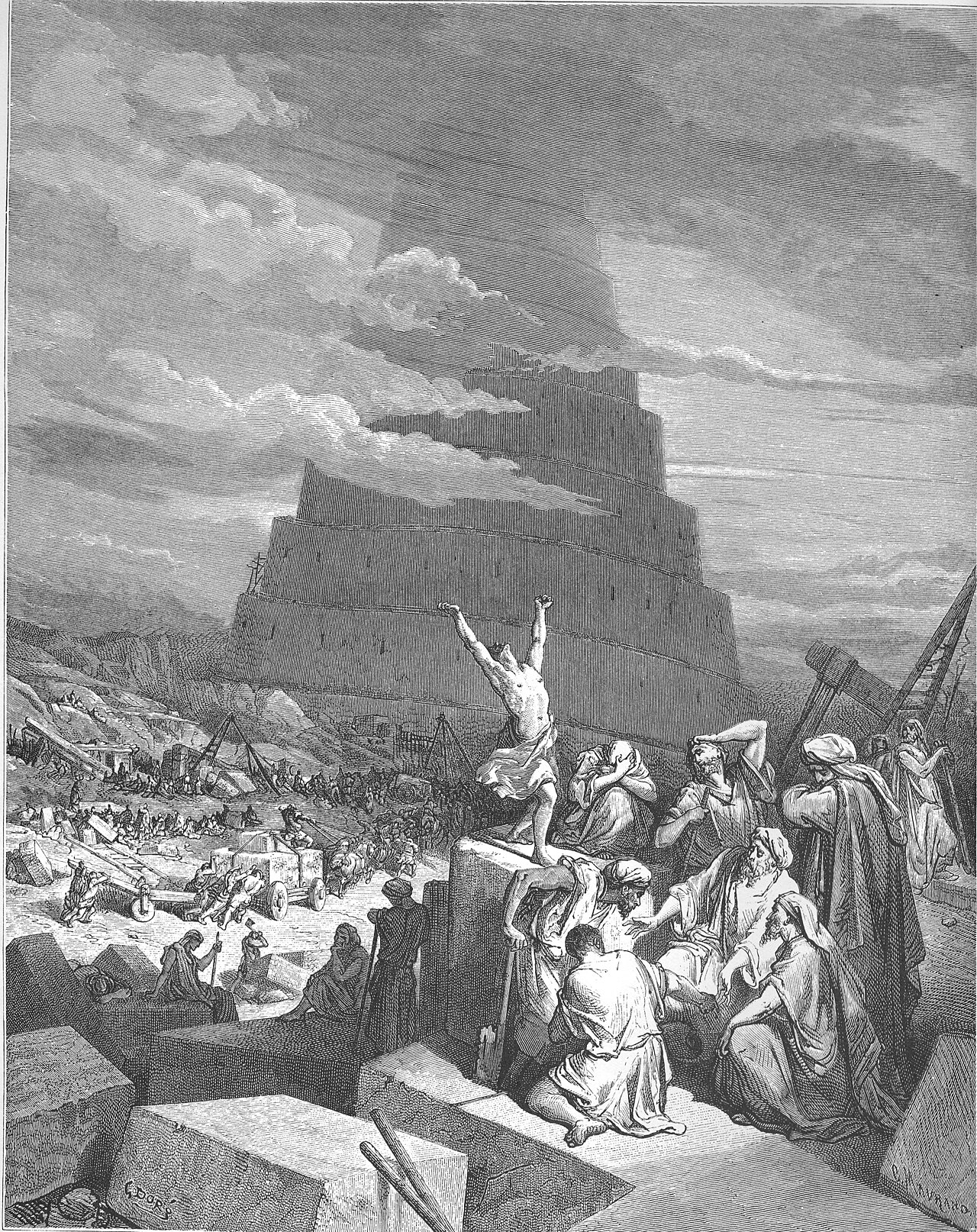
Genesischapter 11
32 verses · Moses, by tradition · 15th to 13th century BC · The Law
Now the whole world had one language and a common form of speech.
Introduction
Moses, by tradition, The Law, Genesis Overview.
Moses wrote this chapter, by tradition, for Israel in the wilderness, a people lately brought out of the greatest empire of their day. It closes the first part of Genesis, the story of the whole human race, and opens the story of one family. The first half is a short scene set on a plain in Mesopotamia, and the second half is a list of names and ages. Listen for the builders' words and for God's answer in the same form. Then follow the count of years as it falls, and watch for the one line in the list that stops the count. The book turns on it.
Context
- Who
- Israel in the wilderness, learning why God began again with one family
- What
- A narrative of the city and tower at Babel, followed by the genealogy that runs from Shem down to Abram.
- Where
- The plain of Shinar in southern Mesopotamia, then Ur of the Chaldeans, and Haran on the road toward Canaan.
- When
- The tower stands before recorded history and carries no date, and the chapter closes on Terah's household shortly before 2091 BC by the traditional chronology, which some place a few centuries later.
- Why
- To show how the nations came to be scattered and to narrow the book from the whole human race to the one family God would call.
Historical context
The chapter carries two things, the building at Babel and then the fifth and sixth named sections of the book, the generations of Shem at Genesis 11:10 and the generations of Terah at Genesis 11:27. The second of those is the turn from the whole earth to one family.
Show the rest of the historical context, 4 more paragraphs
Southern Mesopotamia has no stone and little timber, so builders used what the river gave them. The chapter says brick for stone and bitumen for mortar. Sun-dried brick crumbles and kiln-fired brick lasts, and firing brick was expensive, which marks a serious state project.
A tower with its top in the heavens describes a ziggurat, a stepped and solid brick platform with a shrine on top and a stairway up its side, built so that a god could come down to the city. Dozens have been excavated and the great one at Ur still stands in part.
The stated motive is a name and a refusal to be scattered. Mesopotamian kings put their names into the foundations of their buildings, and inscribed bricks carrying a royal name are common finds.
The chapter then narrows to Terah's family in Ur, a wealthy river city given to the moon god, and follows them a thousand miles up the Euphrates to Haran, another centre of the moon god on the main caravan road.
Significance
For Israel this explained the world they lived in, with many languages, many nations, and a Babylon that had been reaching for heaven from the beginning.
Show the rest of the significance, 1 more paragraph
It also set the contrast that governs everything after it. The men at Babel said, let us make a name for ourselves, and to Abram God said, I will make your name great.
This chapter in Jewish lifeWhat this chapter is in Jewish life and reading.
What is done
This chapter closes the second portion of the annual cycle, and the portion ends with its last verse (src/lib/hebraic/readings.ts). A congregation hears the tower, the line of Shem and the death of Terah as the end of one Sabbath's reading. The call of Abram opens the next portion on the Sabbath after it. The card above carries the portion and the prophetic reading set beside it.
How it is read
Rashi is quoted here from the public domain Rosenbaum and Silbermann edition. Radak and Sforno are quoted from the CC-BY translation of Eliyahu Munk, HaChut Hameshulash.
Rashi reads the one language of the first verse as Hebrew (Rashi on Genesis 11:1:1, citing Midrash Tanchuma, Noach 19). On the one speech he gives three readings of the plan the builders made. The first is open war on heaven. The second turns the words toward the One in the universe. The third takes the word as sharp speech. The builders reckoned that the sky shook once in every one thousand six hundred and fifty six years, and set out to prop it up (Rashi on Genesis 11:1:2).
He reads the coming down of God in the fifth verse as a lesson for judges rather than a need of God. A judge is to see the case and understand it before he calls a defendant guilty (Rashi on Genesis 11:5:1). On the plural of the seventh verse he answers as he answered at the making of man. God took counsel with the court of heaven out of His meekness (Rashi on Genesis 11:7:1, citing Sanhedrin 38b). A Christian reader takes that plural as a word spoken within God, and the two readings are named here with their holders.
Sforno reads the line of Shem by what the text leaves out. The chapter records no death for these generations, where the generations before the flood each ended with one, because this line runs toward something rather than toward an ending (Sforno on Genesis 11:11:1). Radak reads the generations of Terah as proof that grandsons are counted as offspring (Radak on Genesis 11:27:1). On the thirtieth verse he holds that the barrenness is stated so plainly to mark the birth of Isaac as a miracle twice over, in the bearing and in the age (Radak on Genesis 11:30:1).
Ibn Ezra carries three comments on this chapter that the corpus holds by reference alone, because the licence Sefaria reports for the English version keeps the text out. They are Ibn Ezra on Genesis 11:2:1, 11:4:1 and 11:26:1.
What the rabbis say
Rashi carries the best known traditional insights of this chapter, and each stands here as what the rabbis taught.
The builders feared being scattered. Rashi reports that the thing they feared came on them, in the words of Proverbs 10:24 (Rashi on Genesis 11:8:1, citing Sanhedrin 107b and Midrash Tanchuma, Noach 18). He reports the ruling that the generation of the dispersion has no portion in the world to come (Rashi on Genesis 11:9:1, citing Sanhedrin 107b). He then reports the question the rabbis asked beside it. The generation of the flood was drowned although it never stretched out a hand against God, and this generation did so and lived on. The answer given is that the men of the flood were robbers who quarrelled among themselves.
The insight this chapter is best known for is the furnace at Ur. Rashi reports the Midrash that Terah accused his son Abram before Nimrod of smashing his idols, and that Nimrod threw Abram into a fiery furnace. Haran waited to see the end, saying that he would side with whoever won. When Abram came out alive Haran said he was on the side of Abram, and they threw Haran into the furnace and he was burned (Rashi on Genesis 11:28:1, citing Genesis Rabbah 38:13). This is why the text says he died in the presence of his father.
On the names of the twenty ninth verse Rashi reports that Iscah is Sarah. She was called Iscah because "she could see the future by holy inspiration", and because people looked at her beauty (Rashi on Genesis 11:29:1, citing Megillah 14a). He reports that the death of Terah is written before the departure of Abram although Terah lived sixty years beyond it (Rashi on Genesis 11:32:1).
The corpus records forty places where the Midrash and the Talmud cite this chapter, thirty four under Midrash and six under Talmud, with the locator for each one and no text. Bereshit Rabbah reads the second verse at 38:7, the third at 38:8, the sixth at 26:4, the seventh at 38:10 and the ninth at 38:11. It reads the tenth verse at 37:7, the twelfth at 24:3, the fifteenth at 58:7 and the twenty sixth at 39:7. It reads the twenty seventh verse at 30:4 and 38:12, the twenty eighth at 38:13 and the twenty ninth at 38:14 and 45:1.
Bamidbar Rabbah reads the fourth verse at 21:23, the tenth at 2:21, the twenty sixth at 14:12, the twenty eighth at 2:26 and the thirtieth at 9:10. Aggadat Bereshit reads the fifth verse at 16:1, the eighth at 8:3 and the thirtieth at 53:3. Eikhah Rabbah reads the second verse at Petichta 23, Seder Olam Rabbah reads the seventeenth at 2:2, and the Mekhilta of Rabbi Yishmael reads the sixth at Tractate Shirah 5:9.
The Talmud is cited at Avodah Zarah 53b:13 on the first nine verses, at Avodah Zarah 19a:1 on the fourth and at Bava Batra 91a:16 on the thirty first. Avot DeRabbi Natan is cited at 12:7 on the tower as a whole and at 34:6 on the fifth verse, and its second recension at 37:1 on the seventh.
Sources: Rashi, Rashi on Genesis 11, in Pentateuch with Rashi's commentary by M. Rosenbaum and A. M. Silbermann, 1929 to 1934, public domain, about 1090; Radak, Radak on Genesis 11:27:1 and 11:30:1, in HaChut Hameshulash, translated by Eliyahu Munk, CC-BY, about 1200; Sforno, Sforno on Genesis 11:11:1, in HaChut Hameshulash, translated by Eliyahu Munk, CC-BY, about 1520; Ibn Ezra, his three comments on Genesis 11, cited by reference; the licence Sefaria reports for the English version keeps the text out of the corpus; The Midrash and the Talmud, the forty locators on Genesis 11 in scripts/data/sources/sefaria/genesis/11.json; MannaFest, the annual cycle table at src/lib/hebraic/readings.ts, 2026.
The heads below are this chapter's scenes. The numbered points under each are its verses.
A Tower with Its Top in Heaven
Genesis 11:1-2
the whole world had one language: Chapter 10 has already divided the nations by language three times over. This chapter goes back and tells how it happened. The plain of Shinar is the ground where Nimrod's kingdom began at 10:10. The people moved eastward and settled there, and the word to Noah's sons at 9:1 was to fill the earth.
Genesis 11:1
“And the whole earth was of one language - Now while they all understood one another, they would be the more capable of helping one another, and the less inclinable to separate.”
John Wesley · Explanatory Notes upon the Old Testament (1765)evangelical
1 more voice on this verseWhat preachers and commentators have said about this verse, in their own words.
Genesis 11:1
“If there were any different languages before the flood, yet Noah's only, which it is likely was the same with Adam's, was preserved through the flood, and continued after it.”
Matthew Henry · Commentary on the Whole Bible (1707-1721)puritan
ConnectionsGenesis 11:9
they found a plain in the land of Shinar: Clarke reads the verse as the people moving from the east, out of the land beyond the Euphrates, which Scripture calls the east. Balaam came from Pethor on the Euphrates. The plain they found in the land of Shinar is where Babel and its tower would stand.
Genesis 11:2
“As they journeyed from the east - Assyria, Mesopotamia, and the country on the borders and beyond the Euphrates, are called the east in the sacred writings. Balaam said that the king of Moab had brought him from the mountains of the east, Num 23:7. Now it appears, from Num 22:5, that Balaam dwelt at Pethor, on the river Euphrates.”
Adam Clarke · Commentary on the Bible (1810-1826)evangelical
Genesis 11:3-4
Brick stands in for stone and tar for mortar, so nothing in the tower came out of the ground they stood on. Their stated aim was to make a name for themselves, and God gives that name to Abram at 12:2, to the man who leaves. Their other aim was to keep from being scattered over all the earth. That is the one thing 9:1 had told them to do.
Genesis 11:3
“Let us make brick - It appears they were obliged to make use of brick, as there was an utter scarcity of stones in that district; and on the same account they were obliged to use slime, that is, bitumen, (Vulg). ασφαλτος, (Septuagint) for mortar: so it appears they had neither common stone nor lime-stone; hence they had brick for stone, and asphaltus or bitumen instead of mortar.”
Adam Clarke · Commentary on the Bible (1810-1826)evangelical
Henry reads the city and tower as the one city of all the earth, and he thinks Nimrod's band built it. Jamieson, Fausset and Brown take a tower that reaches to the heavens as a figure for great height. Irenaeus read the tower as a name left behind.
Genesis 11:4
“And they arose and came from the land of the east; and, as they went through the land, they chanced upon the land of Shinar, which was exceeding broad; where they took in hand to build a tower. They sought means thereby to go up to heaven, and be able to leave their work as a memorial to those men who should come after them.”
Irenaeus · written before 202 · The Demonstration of the Apostolic Preachingpatristic
2 more voices on this verse
Genesis 11:4
“And they said, go to, let us build us a city and a tower,.... Some Jewish writers (r) say, these are the words of Nimrod to his people; but it is a question whether he was now born, or if he was, must be too young to be at the head of such a body of people; but they are spoken to one another, or by the principal men among them to the common people, advising and encouraging to such an undertaking.”
Genesis 11:4
"No," say they, "we will not, we will live and die together." In order hereunto, they engage themselves and one another in this vast undertaking. That they might unite in one glorious empire, they resolve to build this city and tower, to be the metropolis of their kingdom and the centre of their unity. It is probable that the band of ambitious Nimrod was in all this.
Matthew Henry · Commentary on the Whole Bible (1707-1721)puritan
ConnectionsActs 2:5–6
Genesis 11:5-6
the LORD came down to see the city: The tower reaches to the heavens, and the LORD comes down to see it. That is the passage's own measure of its height. Jacob is shown a stairway at 28:12 with its top reaching to heaven and the LORD standing above it, and that one God set up. Verse 6 grants that the plan would have held: nothing they devise will be beyond them.
Genesis 11:5
“Are they stronger than he? (2.) Their sinfulness and obnoxiousness. They were the sons of Adam, so it is in the Hebrew; nay, of that Adam, that sinful disobedient Adam, whose children are by nature children of disobedience, children that are corrupters.”
Matthew Henry · Commentary on the Whole Bible (1707-1721)puritan
as one people speaking the same language: Clarke takes one people with the same language to mean one people with one purpose. Wesley reads the words of the LORD as the danger in that one people, who would leave the face of the earth empty and swallow the few sons of God. The scattering saved the few.
Genesis 11:6
“And the Lord said, Behold the people is one, and they have all one language - And if they continue one, much of the earth will be left uninhabited, and these children of men, if thus incorporated, will swallow up the little remnant of God's children, therefore it is decreed they must not be one.”
John Wesley · Explanatory Notes upon the Old Testament (1765)evangelical
2 more voices on this verse
Genesis 11:6
“The people is one, etc. - From this, as before observed, we may infer, that as the people had the same language, so they had a unity of design and sentiment. It is very likely that the original language was composed of monosyllables, that each had a distinct ideal meaning, and only one meaning; as different acceptations of the same word would undoubtedly arise, either from compounding terms, or, when there were but few words in a language, using them by a different mode of pronunciation to express a variety of things.”
Adam Clarke · Commentary on the Bible (1810-1826)evangelical
Genesis 11:6
“God had tried, by his commands and admonitions, to bring them off from this project, but in vain; therefore he must take another course with them. See here, First, The sinfulness of sin, and the wilfulness of sinners; ever since Adam would not be restrained from the forbidden tree, his unsanctified seed have been impatient of restraint and ready to rebel against it.”
Matthew Henry · Commentary on the Whole Bible (1707-1721)puritan
Genesis 11:7-8
Come, let Us go down: The men say Come, let us make bricks; the LORD says Come, let Us go down. The two councils stand side by side in the same words. Genesis 1:26 carries the same plural in God's own speech. What the city was built to prevent is what falls on them, and the LORD scatters them over the face of all the earth.
Genesis 11:7
“Go to - A form of speech which, whatever it might have signified formerly, now means nothing. The Hebrew העה habah signifies come, make preparation, as it were for a journey, the execution of a purpose, etc. Almost all the versions understand the word in this way; the Septuagint have δευτε, the Vulgate venite, both signifying come, or come ye. This makes a very good sense, Come, let its go down, etc. For the meaning of these latter words see Gen 1:26, and Gen 18:21.”
Adam Clarke · Commentary on the Bible (1810-1826)evangelical
1 more voice on this verse
Genesis 11:7
“The imagination of a late writer, that God did not confound their tongues, but their religious worship, is grounded on criticisms concerning the meaning of the Hebrew word, which are absolutely false. Beside, would God confound their religious worship? Surely, He is a God of order, and not of confusion.”
John Wesley · Explanatory Notes upon the Old Testament (1765)evangelical
they stopped building the city: The building that stops is the city, the thing the people built to stay together. Henry held that the whole world's first language was Hebrew, and that from that day the Hebrews alone kept it until the exile in Babylon. Gregory of Nyssa read it as one language confused.
Genesis 11:8
“His country: Ur of the Chaldees. This was the land of his nativity, an idolatrous country, where even the children of Eber themselves had degenerated. Note, Those who are, through grace, heirs of the land of promise, ought to remember what was the land of their nativity, what was their corrupt and sinful state by nature, the rock out of which they were hewn.”
Matthew Henry · Commentary on the Whole Bible (1707-1721)puritan
it is called Babel: The city that set out to make itself a name carries the name of its own judgment. Babel sounds like the Hebrew balal, to confuse, and verse 9 says the LORD confused the language there. Babylon runs from this verse through the prophets to Revelation 17 and 18. Matthew Henry sets Pentecost against this scene, where men out of every nation hear one message each in his own tongue.
Genesis 11:9
“Therefore is the name of it called Babel - בבל babel, from בל bal, to mingle, confound, destroy; hence Babel, from the mingling together and confounding of the projects and language of these descendants of Noah; and this confounding did not so much imply the producing new languages, as giving them a different method of pronouncing the same words, and leading them to affix different ideas to them. Besides Mr. Hutchinson’s opinion, (see on Gen 11:4 (note)), there have been various conjectures concerning the purpose for which this tower was built.”
Adam Clarke · Commentary on the Bible (1810-1826)evangelical
1 more voice on this verse
Genesis 11:9
“Just as when holy men live together, it is a great grace and blessing; so, likewise, that congregation is the worst kind when sinners dwell together. The more sinners there are at one time, the worse they are. Indeed, when the tower was being built up against God, those who were building it were disbanded for their own welfare. The conspiracy was evil. The dispersion was of true benefit even to those who were dispersed.”
Jerome · written before 420 · HOMILIES 21patristic
From Shem Down to Abram
Genesis 11:10-11
This is the account of Shem: This is the fifth of the eleven accounts, and it narrows the field to one line out of Shem. Arphaxad is born two years after the flood, so the line is counted from the flood and reaches back behind the tower. Shem lived 500 years after that and had other sons and daughters.
Genesis 11:10
“These are the generations of Shem,.... Or a genealogy of the posterity of Shem; not of all of them, only of those of the line which led to Abraham, by which might appear the true line in which the Messiah from Adam through Abraham sprung: Shem was one hundred years old, and begat Arphexad two years after the flood; by which it is pretty plain that he was younger than Japheth; See Gill on Gen 10:21 of Arphaxad his son; see Gill on Gen 10:22.”
2 more voices on this verse
Genesis 11:10
“These are the generations of Shem - This may he called the holy family, as from it sprang Abraham, Isaac, Jacob, the twelve patriarchs, David, Solomon, and all the great progenitors of the Messiah. We have already seen that the Scripture chronology, as it exists in the Hebrew text, the Samaritan, the Septuagint, Josephus, and some of the fathers, is greatly embarrassed; and it is yet much more so in the various systems of learned and unlearned chronologists.”
Adam Clarke · Commentary on the Bible (1810-1826)evangelical
Genesis 11:10
“That nothing is left upon record concerning those of this line, but their names and ages; the Holy Ghost seeming to hasten thro' them to the story of Abraham. How little do we know of those that are gone before us in this world, even those that lived in the same places where we live! Or indeed of those who are our contemporaries, but in distant places.”
John Wesley · Explanatory Notes upon the Old Testament (1765)evangelical
ConnectionsGenesis 5:1
Shem lived 500 years: after Arphaxad was born, so by the Hebrew numbers of this chapter he was still alive when Abram was born. John Gill reckons from the same figures that Shem was younger than Japheth. His other sons stand in the table at 10:22.
Genesis 11:12-15
When Arphaxad was 35 years old: The list keeps the shape of Genesis 5 and drops its refrain. Every man in Genesis 5 ended with and then he died, and no death is recorded here. The ages at fatherhood fall too, from a hundred and more in Adam's line to 35 years for Arphaxad and 30 for Shelah. Chapter 10 named Arphaxad among the sons of Shem, and here Shelah became the father of Eber.
Genesis 11:12
“And Arphaxad lived thirty five years, and begat Salah. Arphaxad is the first on record that had a son born to him so early; of Salah; see Gill on Gen 10:24.”
1 more voice on this verse
Genesis 11:12
“And Arphaxad lived - The Septuagint bring in here a second Cainan, with an addition of one hundred and thirty years. St. Luke follows the Septuagint, and brings in the same person in the same way. But the Hebrew text, both here and in 1 Chronicles 1:1-28, is perfectly silent on this subject, and the best chronologists have agreed in rejecting this as a spurious generation.”
Adam Clarke · Commentary on the Bible (1810-1826)evangelical
Arphaxad lived 403 years: Arphaxad lived 438 years, and Gill notes that the Latin gives the 403 years as 303. He also passes on the report of a Jewish writer, Rabbi Gedaliah, that the city of Babel was begun in the years of Arphaxad. The tower then stands in this line of Shem.
Genesis 11:13
“And Arphaxad lived, after he begat Salah, four hundred and three years,.... In all four hundred and thirty eight; the Vulgate Latin wrongly reads, three hundred and three: and begat sons and daughters; not mentioned by name: he died, as the above Arabic writer (z) says, in the month Nisan, A. M. 2696; and a Jewish writer (a) says he died in the forty eighth year of Isaac, and who also says (b), that in his days they began to build the city of Babel. (z) Apud Ibid. p. 260. (a) R. Gedaliah, ut supra. (Shalshalet, fol.”
When Shelah was 30 years old: Shelah became a father five years younger than Arphaxad had, as John Gill observes. Bede notes that the Greek translation of the seventy has one hundred and thirty years here, adding a century to the age. The Greek adds it again at Eber, Peleg and Serug.
Genesis 11:14
“And Salah lived thirty years, and begat Eber. He had a son born to him five years sooner than his father had; of Eber; see Gill on Gen 10:25.”
1 more voice on this verse
Genesis 11:14
“Sale also lived thirty years and begot Heber. The seventy interpreters have it one hundred and thirty.”
Bede · written before 735 · Commentary on Genesis (Hexaemeron)patristic
Shelah lived 403 years: Shelah lived 433 years in all, and his other sons and daughters leave no further record in Scripture, as John Gill notes. Gill passes on a Jewish chronologer's claim that Shelah died in the fourteenth year of Jacob. Several of these fathers were alive in Abram's day.
Genesis 11:15
“And Salah lived, after he begat Eber, four hundred and three years,.... In all four hundred and thirty three: and begat sons and daughters; of whom also there is no other account: the same Arabic writer (c) says, he died in the month, Adar, which is called Barhamath, at the close of A. M. 2950; and the Jewish chronologer (d) says, he died in the fourteenth year of Jacob. (c) Ut supra, (Apud Ibid.) p. 261. (d) R. Gedaliah, ut supra. (Shalshalet, fol. 1. 2.)”
Genesis 11:16-19
When Eber was 34 years old: Eber lived 464 years in all, and his son Peleg 239. The lifespan halves in one generation, and it keeps falling down the rest of the list. Abram is called Abram the Hebrew at 14:13, and the word is drawn from Eber's name. The line runs Eber to Peleg to Reu.
Genesis 11:16
“And Eber lived thirty four years, and begat Peleg. Of Peleg, see Gill on Gen 10:25.”
Eber lived 430 years: John Gill names one of these other children from 10:25, Joktan, whose sons fill the list of peoples after him in chapter 10. Matthew Henry notes that Eber outlived every man born after the flood, and he suggests it was the reward of his piety. The promised line runs through Peleg.
Genesis 11:17
“And Eber lived, after he begat Peleg, four hundred and thirty years,.... All the years of his life were four hundred and sixty four: and he begat sons and daughters; one of which is elsewhere mentioned, whose name is Joktan, Gen 10:25 according to the above Jewish writer (e), he died in the seventy ninth year of Jacob. (e) R. Gedaliah, Shalshalet, fol. 1. 2.”
When Peleg was 30 years old: Peleg's name is explained at 10:25, where the earth was divided in his days. The Book of Jubilees opens its account of the tower with Peleg's marriage and the birth of his son, so it sets Babel in this generation. Reu is that son.
Genesis 11:18
“And Peleg lived thirty years, and begat Reu.”
1 more voice on this verse
Genesis 11:18
“Indeed, Phaleg lived thirty years and begot Reu. The seventy interpreters have it one hundred and thirty.”
Bede · written before 735 · Commentary on Genesis (Hexaemeron)patristic
Peleg lived 209 years: Among the other sons and daughters, Arabic writers cited by John Gill named Melchizedek the priest as a son of Peleg. Gill also reports a Jewish chronicler who puts Peleg's death in the forty-eighth year of Abraham. Scripture itself names none of these children.
Genesis 11:19
“And Peleg lived, after he begat Reu, two hundred and nine years,.... In all two hundred and thirty nine, little more than half the age of his father: and begat sons and daughters; but not named the Arabic writers (g) say he begat Melchizedek the priest, and that he died in the month Elul, A. M. 3126; and a Jewish writer (h) says he died in the forty eighth year of Abraham. (g) Elmacinus apud Hottinger. p. 269. (h) R. Gedaliah, ut supra. (Shalshalet, fol. 1. 2.)”
Genesis 11:20-26
When Reu was 32 years old: The years keep falling, Reu at 239, Serug at 230 and Nahor at 148. Ten generations run from Shem to Abram here, matching the ten from Adam to Noah in Genesis 5. Abram is named first of Terah's three sons. Adam Clarke reads that order as one of dignity, the place Genesis keeps giving the chosen son.
Genesis 11:20
“And Reu lived thirty two years, and begat Serug. He is thought to give name to a city called Sarug, which, according to the Arabic geographer (i), was near Charrae, or Haran, in Chaldea; and another Arabic writer (j) speaks of a city called to this day "Sarug", which he places in Mesopotamia. (i) Apud Bochart. Phaleg. l. 2. c. 14. col. 95. (j) Comment. ad Tab. Ilchanic apud Hyde, Hist. Relig. Pers. c. 2. 57.”
Reu lived 207 years: Reu's son Serug gives his name, by John Gill's account, to a town called Sarug near Haran in Mesopotamia. The servant of chapter 24 travels to the city of Nahor in the same country. The family's names are also its map.
When Serug was 30 years old: Serug's son Nahor is Abram's grandfather, and John Gill notes that Terah gave the same name to one of his own sons at verse 26. The family passed names down the line. The younger Nahor stays in Mesopotamia, and Rebekah comes from his house in chapter 24.
Genesis 11:22
“And Serug lived thirty years, and begat Nahor. The grandfather of Abraham, one of the same name was Abraham's brother, Gen 11:26.”
Serug lived 200 years: Serug lived 230 years. Gill passes on the report of eastern writers that other gods were first served in his years and the city of Damascus became a kingdom then. The land of Haran and Ur held that worship, and Terah became the father of Abram in it.
Genesis 11:23
“And Serug lived, after he begat Nahor, two hundred years,.... The years of his life were two hundred and thirty: and he begat sons and daughters; nowhere else mentioned: he died, according to the above Jewish writer (o), in the one hundredth year of Abraham, and in his days, according to the eastern writers (p), idolatry began, and the kingdom of Damascus was set up (q); and Samirus, king of the Chaldeans, invented weights and measures, weaving silk, and the art of dying (s). (o) R. Gedaliah, Shalshalet. fol. 2. 1. (p) Apud Hyde, ut supra. (Hist. Relig. Pers. c.”
When Nahor was 29 years old: Nahor fathers Terah at 29, the youngest age in the list. John Gill names Terah as the first father of this line of Shem to fall away to idolatry. The line blessed in Shem at 9:26 reaches an idolater two generations before the call.
Genesis 11:24
“And Nahor lived twenty nine years, and begat Terah. The father of Abraham, and the first of the patriarchs of this line of Shem that fell off from the true religion to idolatry.”
Nahor lived 119 years: Nahor lived 148 years. Henry traces the years falling down this list to the seventy or eighty years Moses gives in Psalm 90, and he says God shortened them as the earth filled with people. After Nahor only Terah lived 200 years.
When Terah was 70 years old: Terah lived 205 years and Abram left Haran at seventy-five, so Abram was born when Terah was 130, and Clarke reads the 70 years as Terah's age when Haran was born. Haran was the father of Lot and the eldest. Bede notes that here the Greek years agree with the Hebrew.
Genesis 11:26
“And Terah lived seventy years, and he begot Abram, Nahor, and Haran. The seventy interpreters in this generation alone do not differ at all from the Hebrew truth.”
Bede · written before 735 · Commentary on Genesis (Hexaemeron)patristic
1 more voice on this verse
Genesis 11:26
“And Terah lived seventy years, and begat Abram, Nahor, and Haran - Haran was certainly the eldest son of Terah, and he appears to have been born when Terah was about seventy years of age, and his birth was followed in successive periods with those of Nahor his second, and Abram his youngest son. Many have been greatly puzzled with the account here, supposing because Abram is mentioned first, that therefore he was the eldest son of Terah: but he is only put first by way of dignity.”
Adam Clarke · Commentary on the Bible (1810-1826)evangelical
Terah Leaves Ur for Haran
Genesis 11:27-28
This is the account of Terah: The sixth account is the narrowest so far, down from the nations of chapter 10 to Terah's household in one town. Lot arrives as an orphan and stays with Abram. Haran is the first man in this list said to die, and he died in his father's lifetime, in Ur of the Chaldeans. Jerome passes on a Hebrew tradition that read Ur as fire and told of Abraham delivered out of it, and he reports it as their story.
Genesis 11:27
“His country: Ur of the Chaldee's - An idolatrous country, where even the children of Eber themselves degenerated. His relations, mentioned for his sake, and because of their interest in he following story. His father was Terah, of whom it is said, Josh. xxiv, 2, that he served other gods on the other side the flood; so early did idolatry gain footing in the world.”
John Wesley · Explanatory Notes upon the Old Testament (1765)evangelical
Haran died in his native land: Bede reads during his father Terah's lifetime as time and presence together, so Haran died in his father's sight. Jamieson, Fausset and Brown place Ur at Orfa and take the name as light or fire. Fire worship was practised there.
Genesis 11:28
“It is likewise said that he died in Ur of the Chaldees, before the happy removal of the family out of that idolatrous country. Note, It concerns us to hasten out of our natural state, lest death surprise us in it. His wife was Sarai, who some think, was the same with Iscah, the daughter of Haran.”
Matthew Henry · Commentary on the Whole Bible (1707-1721)puritan
1 more voice on this verse
Genesis 11:28
“Ur--now Orfa; that is, "light," or "fire." Its name probably derived from its being devoted to the rites of fire-worship. Terah and his family were equally infected with that idolatry as the rest of the inhabitants (Jos 24:15).”
Jamieson, Fausset & Brown · Commentary Critical and Explanatory on the Whole Bible (1871)reformed
Genesis 11:29-30
Abram and Nahor took wives for themselves: The wives are named, Sarai and Milcah, and then the account halts on one flat line: Sarai was barren; she had no children. That sentence stands one verse before the promise at 12:2 to make Abram a great nation. She waits twenty-five years for Isaac. Rebekah waits at 25:21 and Rachel at 29:31, and every generation of the line arrives late.
Genesis 11:29
“Milcah, the daughter of Haran - Many suppose Sarai and Iscah are the same person under two different names; but this is improbable, as Iscah is expressly said to be the daughter of Haran, and Sarai was the daughter of Terah, and half sister of Abram.”
Adam Clarke · Commentary on the Bible (1810-1826)evangelical
Sarai was barren: Aben Ezra, as Gill reports, knew some who said Abram was the one who could have no children, and he answered from Ishmael and the sons of Keturah. Bede reads Sarai, barren in her youth and a mother in old age, as a figure of the Church. The promise waits on her.
Genesis 11:30
“But Sarai was barren; she had no child. Aben Ezra observes, there are some that say that Abraham was impotent, and not Sarai barren; the very reverse of the Scriptures; but as he rightly adds, his son Ishmael and his sons by Keturah show the contrary, see Gen 15:2.”
Terah took his son Abram: Terah is the one who takes the family out, and Abram goes here as his son. They set out from Ur for Canaan and settle in Haran. Stephen says at Acts 7:2 that God appeared to Abraham in Mesopotamia before he lived in Haran, which puts the call back in Ur. Joshua 24:2 says Terah served other gods, so the household setting out for Canaan was an idolatrous one.
Genesis 11:31
“They went forth - front Ur of the Chaldees - Chaldea is sometimes understood as comprising the whole of Babylonia; at other times, that province towards Arabia Deserta, called in Scripture The land of the Chaldeans. The capital of this place was Babylon, called in Scripture The beauty of the Chaldees’ excellency, Isa 13:19. Ur appears to have been a city of some considerable consequence at that time in Chaldea; but where situated is not well known. It probably had its name Ur אור, which signifies fire, from the worship practiced there.”
Adam Clarke · Commentary on the Bible (1810-1826)evangelical
1 more voice on this verse
Genesis 11:31
“AFTER the Flood, when men began to multiply and increase in the earth, it was not very long before they began to turn aside from the living and true God. At first the sons of Noah walked in the light of Divine knowledge, though even among them was found an evil seed. When scattered over the earth after the confusion of tongues at Babel, the earth's hoary fathers carried with them a measure of the knowledge of God which they had received from their sires.”
Terah lived 205 years: The first man in Genesis to set out for Canaan dies short of it, at the place where he stopped. Terah lived 205 years and died in Haran. Hebrews 11:13 says of all of them that they died in faith, without receiving what was promised. Chapter 12 lays the same road on the son as a command.
Genesis 11:32
“On Terah's death in Mesopotamia, where he is said to have lived two hundred and five years, the promises of God made to Abraham now begin to be clarified. So it is written, "And the days of Terah in Haran were two hundred and five years, and he died in Haran." This is not to be taken as if he had spent all his days there but that he there completed the days of his life, which were two hundred and five years.”
Augustine of Hippo · written before 430 · City of God 16.14patristic
How this psalm is built
The form: A narrative of the city and the tower, followed by a genealogy of one line only, the line that led to Abraham, as Gill classes it.
The patterns in this chapter
| Device | What it does | Where to see it |
|---|---|---|
| The builders' word answered by God's word | The men summon one another twice, at verse 3 and at verse 4, and the LORD uses the same summons at verse 7. Adam Clarke notes that the Hebrew word rendered Go to means come, or make preparation for the execution of a purpose, and that nearly all the versions take it so, the Septuagint with its own word for come and the Vulgate with venite. He refers the plural of verse 7 back to the plural of Genesis 1:26. The site's published exposition sets the two summonses side by side and notes that Genesis 1:26 carries the same plural in God's own speech.Adam Clarke, Commentary on the Bible, 1832, on Genesis 11:7. | Genesis 11:3, Genesis 11:4, Genesis 11:7 |
| The scattering they built against | The builders state their purpose at verse 4 as keeping themselves from a scattering across the whole earth, and the same phrase comes back as the judgment at verse 8 and again at verse 9. John Wesley reads the decree behind it: if they continued one, much of the earth would be left uninhabited, and therefore it was determined that they should not remain one. The thing the city was built to prevent is the thing the chapter ends with.John Wesley, Explanatory Notes upon the Old Testament, 1765, on Genesis 11:6. | Genesis 11:4, Genesis 11:8, Genesis 11:9 |
| The name that records the judgment | Verse 9 explains the name of the place by what happened there. Adam Clarke derives Babel from a Hebrew root meaning to mingle, confound and destroy, and takes the name from the mingling and confounding of the projects and the language of Noah's descendants. He also reads the confounding itself as a change in how the same words were pronounced and in the ideas attached to them, rather than as the sudden making of new tongues. The city that set out to make itself a name carries the name of its own judgment.Adam Clarke, Commentary on the Bible, 1832, on Genesis 11:9. | Genesis 11:9 |
| Ten generations on one pattern | From verse 10 to verse 26 each man is given in the same three clauses: his age when his son was born, the years he lived afterwards, and the other sons and daughters. The site's published exposition of verses 12 to 15 notes that the list keeps the shape of Genesis 5 and drops its closing refrain, since every man in that chapter ended with a death and every man here lives on. The ages at fatherhood fall from a hundred and more in Adam's line to thirty five for Arphaxad, and John Gill observes that Arphaxad is the first man on record to have a son born to him so early.John Gill, Exposition of the Old Testament, 1748 to 1763, on Genesis 11:12. | Genesis 11:10, Genesis 11:12, Genesis 11:26 |
The debate over what was confused
16 more paragraphs on the patterns
The chapter says the LORD confused the speech of the builders. What that means in practice is argued three ways.
The plain reading is that new tongues were given, so that men who had understood one another could no longer do so. John Wesley holds it and defends it against a rival, and its strength is that the chapter's own explanation of the name and its statement about understanding both point that way, and that the nations of chapter 10 already stand under separate languages.
Adam Clarke reads the change as smaller and stranger. He holds that the confounding did not so much imply the producing of new languages as the giving to men of a different method of pronouncing the same words, and of leading them to affix different ideas to them. The strength of that reading is that it keeps one original language in view and makes the judgment a change that could pass through a whole population at once, and Clarke builds it on his own view that the original language was composed of monosyllables, each with one distinct meaning. The objection is that the chapter reports a judgment that stopped the work at once, and a drift in pronunciation and sense is the sort of thing that takes generations.
A third position, that God confounded their religious worship rather than their speech, is reported by John Wesley from a writer of his own day and rejected by him. He calls the criticisms of the Hebrew word that it rests on absolutely false, and argues from God's character that He is a God of order and would not confound worship. The position is known here only through the man answering it, so a reader should weigh it as reported rather than as stated by its own holder.
The debate over who built the tower
Matthew Henry reads the project as a bid for empire and holds it probable that the hand of the ambitious Nimrod was in all of it, since the people resolve to build a city and tower to be the metropolis of their kingdom and the centre of their unity. That reading joins the chapter to 10:10, where Nimrod's kingdom begins at Babel in Shinar, and it explains how a scattered people came to act as one.
John Gill reports that some Jewish writers take the words of verse 4 as Nimrod's own words to his people, and then puts the objection himself: it is a question whether Nimrod was yet born, and if he was he must have been too young to stand at the head of such a body of people. He reads the words instead as spoken by the people to one another, or by the principal men among them to the common people. His ground is the chapter's own grammar, which gives the speech to the builders as a body and names nobody.
John Wesley reads the motive rather than the man. He holds that while all understood one another they would be the more capable of helping one another and the less inclined to separate, and that they resolved to live and die together. On that reading the tower is a refusal of the command at 9:1 to fill the earth, and no ringleader is needed. The objection is that a whole population does not undertake a work of that size without leaders, which is the point Henry presses.
The debate over the order of Terah's sons
Verse 26 names Abram, Nahor and Haran after Terah's seventieth year, and a reader naturally takes Abram as the eldest. Adam Clarke argues the opposite and gives his arithmetic: Haran was certainly the eldest, born when Terah was about seventy, with Nahor and then Abram following, and Abram is put first only by way of dignity. His support is the numbers, since Abram was seventy five when he left Haran and Terah died at two hundred and five, which puts Terah at a hundred and thirty when Abram was born.
The objection is that the arithmetic depends on placing Terah's death before Abram's departure, which Acts 7:4 supports and Genesis itself does not state in order, and that reading a list by dignity rather than by birth is a convention the verse does not announce. The wider chronological question this raises is carried on the Genesis 12 page, under the date of the patriarchs.
The New Testament's use
The New Testament takes up this chapter in three ways, all of them outside the tower narrative, which the apostles leave unquoted.
The genealogy is the first. Luke's genealogy of Jesus walks back up the line of verses 10 to 26, and Adam Clarke notes that Luke follows the Septuagint in bringing in a second Cainan after Arphaxad, a name the Hebrew text of Genesis and of 1 Chronicles 1 do not carry.
The call is the second. The site's published exposition of verse 31 records Stephen's statement at Acts 7:2 that God appeared to Abraham in Mesopotamia before he lived in Haran, which places the first call in Ur, before the move this chapter reports. The same exposition sets Hebrews 11:13 beside Terah's death at verse 32, where the whole company is said to have died in faith without receiving what was promised.
The third is a reading rather than a citation. The site's published exposition of verse 9 records that Matthew Henry sets Pentecost against this scene, where men of every nation each hear one message in his own tongue. Acts 2 does not quote Genesis 11, and the pairing is the commentator's, so a student should take it as an argument about the shape of the two events.
Keep studying
Studies8
Sources for this chapter
The summary
Jamieson, Fausset & Brown, Commentary Critical and Explanatory; John Calvin, Commentaries; John Wesley, Notes on the Old Testament and Matthew Henry, Complete Commentary.
The context
John Gill, Exposition of the Old Testament and Matthew Henry, Commentary on the Whole Bible.
The form and classifications
Adam Clarke, Commentary on the Bible, 1832, on Genesis 11:10; John Gill and John Wesley, Explanatory Notes upon the Old Testament, 1765, on Genesis 11:10.
The exposition
Adam Clarke, Commentary on the Bible; Bede, Commentary on Genesis (Hexaemeron); Book of Jubilees, Book of Jubilees, Charles' 1913 translation; Chuck Missler, The Book of Genesis; Gregory of Nyssa, Answer to Eunomius' Second Book; Irenaeus, The Demonstration of the Apostolic Preaching; Jamieson, Fausset & Brown, Commentary Critical and Explanatory on the Whole Bible; Jerome, Hebrew Questions on Genesis; John Calvin, Commentary on Genesis; John Gill, Exposition of the Old Testament; John Wesley, Explanatory Notes upon the Old Testament and Matthew Henry, Commentary on the Whole Bible.