
Genesis 11:7
in Genesis 11Come, let Us go down and confuse their language, so that they will not understand one another’s speech.”
BSB
The same verse in ASV and KJV ▾
ASV
Come, let us go down, and there confound their language, that they may not understand one another’s speech.
KJV
Go to, let us go down, and there confound their language, that they may not understand one another’s speech.
⋯
This verse in Genesis 11
Commentary
20 notes on this verseGo to - A form of speech which, whatever it might have signified formerly, now means nothing. The Hebrew העה habah signifies come, make preparation, as it were for a journey, the execution of a purpose, etc. Almost all the versions understand the word in this way; the Septuagint have δευτε, the Vulgate venite, both signifying come, or come ye. This makes a very good sense, Come, let its go down, etc. For the meaning of these latter words see Gen 1:26, and Gen 18:21.
This site's exposition
Come, let Us go down
on Genesis 11:7-8
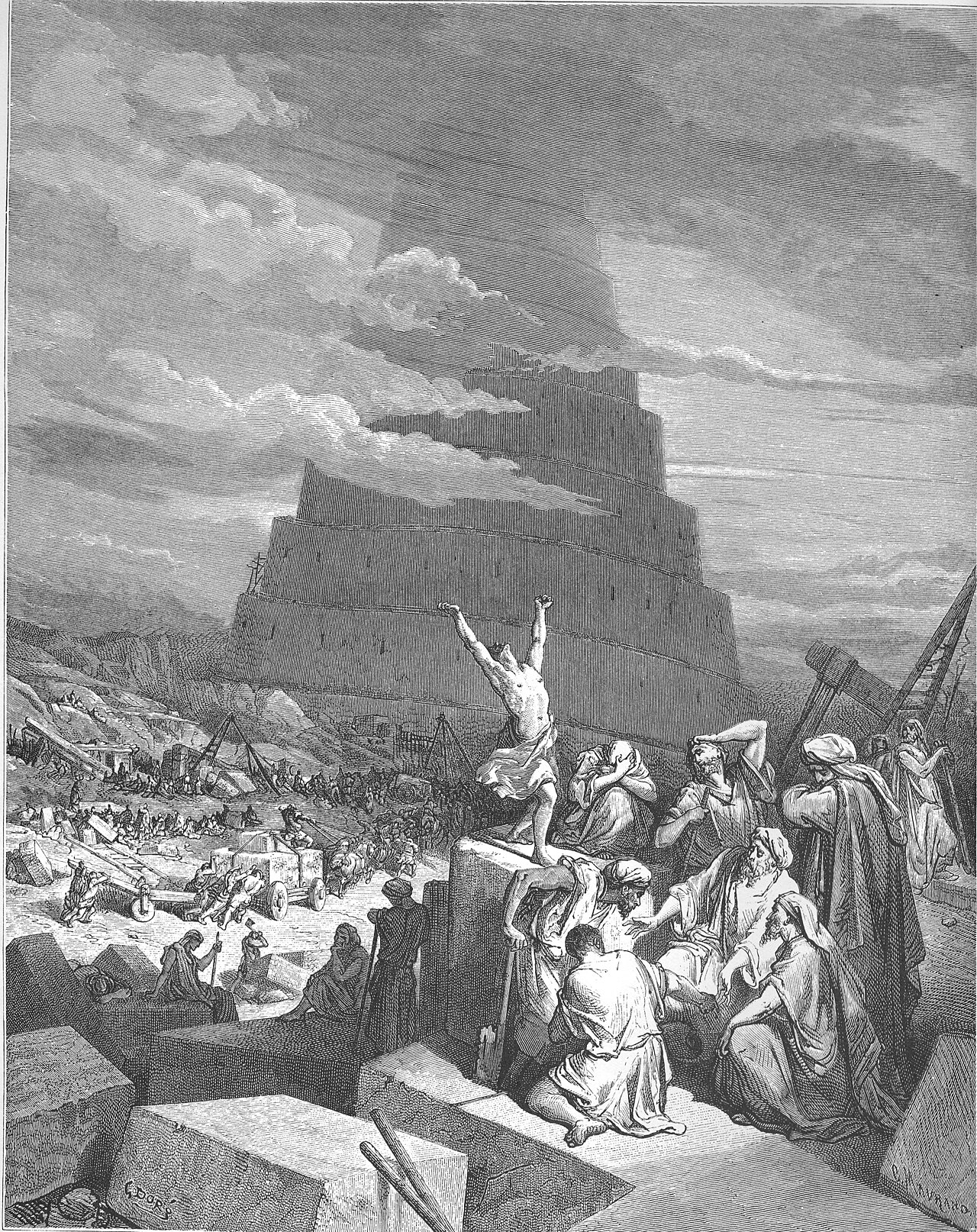
The men say Come, let us make bricks; the LORD says Come, let Us go down. The two councils stand side by side in the same words. Genesis 1:26 carries the same plural in God's own speech. What the city was built to prevent is what falls on them, and the LORD scatters them over the face of all the earth.
The record, by era
The Church Fathers5 voices
It is conceivable that here there may have been an allusion to the Trinity, if we suppose that the Father said to the Son and the Holy Spirit, "Come, let us descend and confound their tongue." The supposition is sound. But if so, we must rule out the possibility that angels were meant. And surely it is more proper for the angels to come to God unbidden, moved by grace, that is, by the thoughts that make them devoutly submissive to unchanging truth, as to the eternal law that rules their heavenly court. The angels are not their own criterion of truth, but, depending on creative truth, they move unbidden toward it as toward a fountain of life from which they must imbibe what they do not have of themselves. And their motion is without change, since they keep coming, never to depart.
A commentator
JosephusAntiquities of the Jews - Book I, Chapter 4, Sections 1-3 · Written before 100.
proposed
1. Now the sons of Noah were three, - Shem, Japhet, and Ham, born one hundred years before the Deluge. These first of all descended from the mountains into the plains, and fixed their habitation there; and persuaded others who were greatly afraid of the …
But after some time had elapsed, He is again found using an expression more distinctly plural when He says: Come, let us go down and confound their language—an expression which can no longer be thought applicable to two only, but to three or more.
For the writers of Chaldaean history as being more ancient, and living farther east, have mentioned in their works both the deluge and the building of the Tower, since they saw that Tower with their own eyes under the process of construction, being no doubt …
This in fact is the way the Lord is accustomed to behave. This is what he did in the beginning in the case of the [first] woman as well. She had abused the status conferred on her, and for that reason he subjected her to her husband. Again, too, in the case of Adam, since he drew no advantage from the great ease he enjoyed and from life in the garden but rather rendered himself liable to punishment through the fall, God drove him out of the garden and inflicted on him everlasting punishment in the words "thorns and thistles let the earth yield." So when the people in the present case, who had been dignified with similarity of language, used the privilege given them for evil purposes, he put a stop to the impulse of their wickedness through creating differences in language. "Let us confuse their speech," he says, "so that they will be unable to understand one another's language." His purpose was that, just as similarity of language achieved their living together, so difference in language might cause dispersal among them.
13 more voices on this verse
The Church Fathers5 voices
A commentator
Eusebius of CaesareaPreparation for the Gospel, BOOK IX, CHAPTER XIV · Written before 339.
proposed
AGAIN, whereas Moses wrote an account of the building of the tower, and how from one language men passed into the confusion of many dialects, the author just before mentioned, in his work entitled Of Assyrian History, bears the like testimony, speaking as follows: [ABYDENUS] 'But there are some who say that the men who first arose out of the earth, being puffed up by their strength and great stature, and proudly thinking that they were better than the gods, raised a huge tower, where Babylon now stands: and when they were already nearer to heaven, the winds came to the help of the gods, and overthrew their structure upon them, the ruins of which were called Babylon. And being up to that time of one tongue, they received from the gods a confused language; and afterwards war arose between Cronos and Titan. [JOSEPHUS] 'And the place in which they built the tower is now called Babylon, because of the confusion of what at first was clear in their language. For the Hebrews call confusion "Babel."
They foolishly began to build a tower that touched the stars and thought they might be able to climb the skies with it. But God, seeing that their work proceeded because they spoke the same language, intervened and caused them to speak different languages.
A commentator
Gregory of NyssaAnswer to Eunomius' Second Book, Section 276 · Written before 395.
proposed
And if any one cites the confusion of tongues that took place at the building of the tower, as contradicting what I have said, not even there is God spoken of as creating men's languages, but as confounding the existing one, that all might not hear all. For when all lived together and were not as yet divided by various differences of race, the aggregate of men dwelt together with one language among them; but when by the Divine will it was decreed that all the earth should be replenished by mankind, then, their community of tongue being broken up, men were dispersed in various directions and adopted this and that form of speech and language, possessing a certain bond of union in similarity of tongue, not indeed disagreeing from others in their knowledge of things, but differing in the character of their names. For a stone or a stick does not seem one thing to one man and another to another, but the different peoples call them by different names. So that our position remains unshaken, that human language is the invention of the human mind or understanding. For from the beginning, as long as all men had the same language, we see from Holy Scripture that men received no teaching of God's words, nor, when men were separated into various differences of language, did a Divine enactment prescribe how each man should talk. But God, willing that men should speak different languages, gave human nature full liberty to formulate arbitrary sounds, so as to render their meaning more intelligible.
But I do not understand how he can imagine the overturning of the tower (of Babel) to have happened with a similar object to that of the deluge, which effected a purification of the earth, according to the accounts both of Jews and Christians. For, in order that the narrative contained in Genesis respecting the tower may be held to convey no secret meaning, but, as Celsus supposes, may be taken as true to the letter, the event does not on such a view appear to have taken place for the purpose of purifying the earth; unless, indeed, he imagines that the so-called confusion of tongues is such a purificatory process. But on this point, he who has the opportunity will treat more seasonably when his object is to show not only what is the meaning of the narrative in its historical connection, but what metaphorical meaning may be deduced from it. Seeing that he imagines, however, that Moses, who wrote the account of the tower, and the confusion of tongues, has perverted the story of the sons of Aloeus, and referred it to the tower, we must remark that I do not think any one prior to the time of Homer has mentioned the sons of Aloeus, while I am persuaded that what is related about the tower has been recorded by Moses as being much older not only than Homer, but even than the invention of letters among the Greeks. Who, then, are the perverters of each other's narratives? Whether do they who relate the story of the Aloadæ pervert the history of the time, or he who wrote the account of the tower and the confusion of tongues the story of the Aloadæ? Now to impartial hearers Moses appears to be more ancient than Homer.
A commentator
Book of JubileesBook of Jubilees Chapter 10, sections 18-27, Charles' 1913 translation · Written before -100.
proposed
And in the three and thirtieth jubilee, in the first year in the second week, Peleg took to himself a wife, whose name was Lomna the daughter of Sina'ar, and she bare him a son in the fourth year of this week, and he called …
The Medieval Church3 voices
But when the threatenings of the mighty God Are fulfilled, which he threatened mortals once, When in Assyrian land they built a tower;-- 120 (And they all spoke one language, and resolved To mount aloft into the starry heaven; But on the air the Immortal …
Come, let us go down and there confuse their language. It is said to those who were present: Come, because indeed this itself never decreases from divine contemplation, and it is always to increase in divine contemplation; and never to withdraw from the heart is …
He says, let us confuse their language there, so that everyone may not hear the voice of his neighbor. Justly is the evil intent punished, even to which the effect does not succeed; because indeed the dominion of command is in the language, pride is …
The Puritans and the Awakening4 voices
The imagination of a late writer, that God did not confound their tongues, but their religious worship, is grounded on criticisms concerning the meaning of the Hebrew word, which are absolutely false. Beside, would God confound their religious worship? Surely, He is a God of order, and not of confusion.
The imagination of a late writer, that God did not confound their tongues, but their religious worship, is grounded on criticisms concerning the meaning of the Hebrew word, which are absolutely false. Beside, would God confound their religious worship? Surely, He is a God of order, and not of confusion.
Go to, let us go down, and there confound their language,....
Now observe here, [1.] The mercy of God, in moderating the penalty, and not making it proportionable to the offence; for he deals not with us according to our sins.
The Nineteenth Century1 voice
A commentator
Jamieson, Fausset & Brown1802–1910
Commentary Critical and Explanatory on the Whole Bible (1871)
proposed
confound their language--literally, "their lip"; it was a failure in utterance, occasioning a difference in dialect which was intelligible only to those of the same tribe. Thus easily by God their purpose was defeated, and they were compelled to the dispersion they had combined to prevent.
quarantine:debris (2026-07-29) — starts-lowercase
The words behind it
11 Hebrew wordsEvery Hebrew word of this verse in the order it stands, with what it means and the door to its own study. The last column counts the times a word stands in the whole Bible: the rarer the word, the more the places it appears belong together.
| Hebrew | Sound | Meaning | Word study | In the Bible |
|---|---|---|---|---|
| הָ֚בָה | havah | give ! | H3051 → | 34 times |
| נֵֽרְדָ֔ה | neredah | let us go down | H3381 → | 381 times |
| וְנָבְלָ֥ה | venavelah | and let us confuse | H1101 → | |
| שָׁ֖ם | sham | there | H8033 → | 834 times |
| שְׂפָתָ֑ם | sefatam | language their | H8193 → | 176 times |
| אֲשֶׁר֙ | ʾasher | that | H834 → | 5497 times |
| לֹ֣א | lo' | not | H3808 → | 5168 times |
| יִשְׁמְע֔וּ | yishmeu | they will hear | H8085 → | 1159 times |
| אִ֖ישׁ | ʾish | each | H376 → | 1663 times |
| שְׂפַ֥ת | sefat | [the] language of | H8193 → | 176 times |
| רֵעֵֽהוּ׃ | reehu | neighbor his | H7453 → | 188 times |
הָ֚בָהgive !
havahH3051 →34 times
נֵֽרְדָ֔הlet us go down
neredahH3381 →381 times
וְנָבְלָ֥הand let us confuse
venavelahH1101 →
שָׁ֖םthere
shamH8033 →834 times
שְׂפָתָ֑םlanguage their
sefatamH8193 →176 times
אֲשֶׁר֙that
ʾasherH834 →5497 times
לֹ֣אnot
lo'H3808 →5168 times
יִשְׁמְע֔וּthey will hear
yishmeuH8085 →1159 times
אִ֖ישׁeach
ʾishH376 →1663 times
שְׂפַ֥ת[the] language of
sefatH8193 →176 times
רֵעֵֽהוּ׃neighbor his
reehuH7453 →188 times
A shaded row is a word that stands 400 times or fewer in the Bible.
The walk
8 stopsEach card is a verse this one points to, and under it the verses that one points to in turn. Where several paths arrive at the same place, that place is listed first: the text keeps returning to it.
Through
Psalms 33:10The LORD frustrates the plans of the nations; He thwarts the devices of the peoples.
it leads to
- 2 Samuel 15:31
Now someone told David: “Ahithophel is among the conspirators with Absalom.” So David pleaded, “O LORD, please turn the counsel of Ahithophel into foolishness!”
Reached by 2 separate paths from here.
- Psalms 21:11
Though they intend You harm, the schemes they devise will not prevail.
- Job 5:12–13
He thwarts the schemes of the crafty, so that their hands find no success.
- Isaiah 44:25
who foils the signs of false prophets and makes fools of diviners, who confounds the wise and turns their knowledge into nonsense,
- Proverbs 21:30
There is no wisdom, no understanding, no counsel that can prevail against the LORD.
- 2 Samuel 15:31
Through
Genesis 1:26Then God said, “Let Us make man in Our image, after Our likeness, to rule over the fish of the sea and the birds of the air, over the livestock, and over all the…
it leads to
- Colossians 3:10
and have put on the new self, which is being renewed in knowledge in the image of its Creator.
- Ephesians 4:24
and to put on the new self, created to be like God in true righteousness and holiness.
- Psalms 8:4–8
what is man that You are mindful of him, or the son of man that You care for him?
- Colossians 3:10
Where this verse is studied
On this page
Studies7
About Genesis
This page draws on 18 works. Open the list of works
This page draws on Adam Clarke, Commentary on the Bible; Augustine of Hippo, City of God 16.6; Bede, Commentary on Genesis (Hexaemeron); Book of Jubilees, Book of Jubilees Chapter 10, sections 18-27, Charles' 1913 translation; Commodian, SONG OF TWO PEOPLES 165-69; Cosmas Indicopleustes, The Christian Topography, Book 5; Cosmas Indicopleustes, The Christian Topography, Book 12; Eusebius of Caesarea, Preparation for the Gospel, BOOK IX, CHAPTER XIV; Gregory of Nyssa, Answer to Eunomius' Second Book, Section 276; Jamieson, Fausset & Brown, Commentary Critical and Explanatory on the Whole Bible; John Calvin, Commentary on Genesis; John Chrysostom, HOMILIES ON GENESIS 30.13; John Gill, Exposition of the Old Testament (1748-1763); John Wesley, Explanatory Notes upon the Old Testament; Josephus, Antiquities of the Jews - Book I, Chapter 4, Sections 1-3; Matthew Henry, Commentary on the Whole Bible; Origen of Alexandria, Contra Celsum, Book IV, Chapter 21 and Sibylline Oracles, Sibylline Oracles Book III: 117-129.