
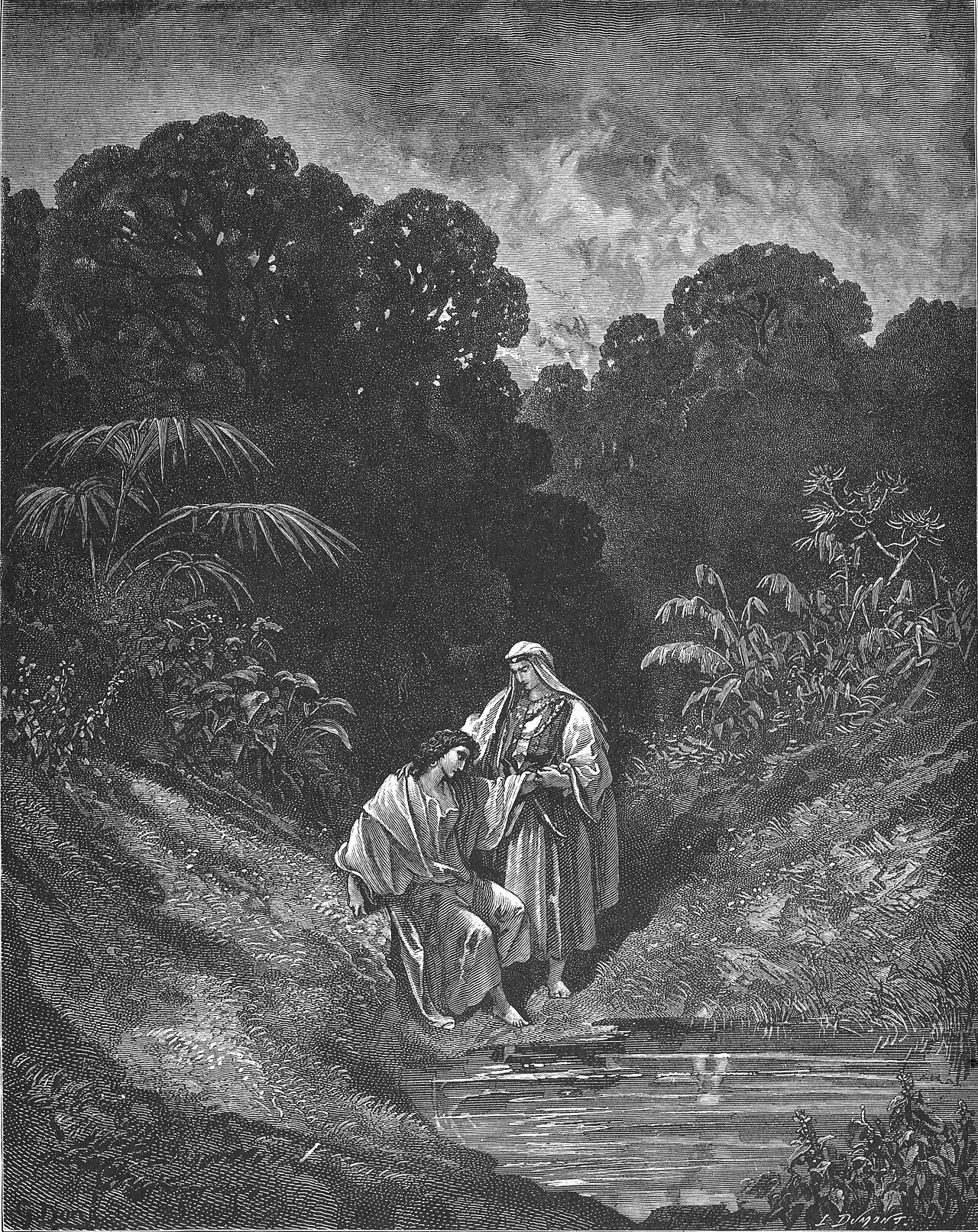
1 Samuelchapter 20
42 verses · Samuel, Nathan and Gad, by tradition · 10th century BC · History
And thou shalt not only while yet I live shew me the kindness of the Lord, that I die not:
Introduction
Samuel, Nathan and Gad, by tradition, History, 1 Samuel Overview.
This chapter is the last meeting at court between David and Jonathan, the king's heir. It was written for readers under David's dynasty who knew that Jonathan's family was spared for his sake. The two friends plan a test around a feast, and the feast shows them the truth. Listen for the covenant language, sworn in the LORD's name and reaching to their descendants. Watch where Jonathan's loyalty falls when his own succession is at stake. The parting at the end is heard again in 2 Samuel 9.
Context
- Who
- Israelites whose calendar ran on the new moon and who knew where each man sat at the king's table
- What
- An account of Jonathan testing his father's intent at the new moon feast and warning David by a signal of arrows.
- Where
- Gibeah of Benjamin, at the king's table and in a field outside the town by the stone Ezel.
- When
- About 1019 BC, over the two days of a new moon feast, on the traditional reckoning.
- Why
- To show Jonathan choosing the LORD's anointed over his own succession and binding both houses by covenant.
Historical context
The chapter belongs to Jonathan, Saul's eldest son and heir to the throne he is about to sign away, and to David, the king's son in law and his most successful commander, now hunted. The time is the two days of a new moon feast, about 1019 BC on the traditional conservative reckoning the site's published historical layer follows. The place is Gibeah of Benjamin, the king's own town, and the two scenes are the royal table and a field outside the town where nothing said can be overheard.
Show the rest of the historical context, 4 more paragraphs
The occasion is a test: David asks Jonathan to explain his absence from the feast and to watch how the king takes the news.
A first hearer knew what the new moon was, since it opened each month in Israel's calendar and was kept with sacrifices and a feast. Attendance at the king's table on such a day was expected of his officers and his family, with the seating fixed by rank, so one empty place is visible to every man in the room. Saul says nothing on the first day, since ritual uncleanness would keep a man from the offerings.
He knew that David's excuse was a real institution, since a yearly clan sacrifice gathered an extended family at its ancestral town and outranked a royal summons in the ordinary run of things. He knew what the covenant language meant, since an oath sworn in the name of the LORD with a curse attached bound a man and his descendants.
He knew what the archery lesson was for, since two men could not talk in the open at Gibeah unseen, and the words shouted to the boy carry the message while the boy learns nothing.
Significance
Jonathan is the heir who has understood what his father cannot accept, and he chooses the anointed man over his own succession. For hearers living under David's dynasty, that choice made Jonathan the pattern of covenant loyalty in the whole story.
Show the rest of the significance, 2 more paragraphs
Saul states the cost out loud at verse 31, that Jonathan's kingdom cannot be established while the son of Jesse lives, and then throws at his own son the spear already thrown twice at David.
The parting in the field is the last time the two men meet as free men, and the oath they swore in the LORD's name outlived them both.
This chapter in Jewish lifeWhat this chapter is in Jewish life and reading.
How it is read
This is the chapter where the commentators explain a Jewish calendar practice, because the plan turns on the New Moon. Rashi states that Jonathan could say the next day was the renewal of the moon, and no more than that. The day of Rosh Chodesh could be declared only by a court, and the day itself stood unknown until the court sanctified it (Rashi on I Samuel 20:5:1, the Metsudah Tanach series, Lakewood, N.J., CC-BY). He adds that the New Moon was kept as a festive day, and that no one who ate at the king's table stayed away from the meal on it (same ref). He repeats the custom of the table at the second mention of the day (Rashi on I Samuel 20:18:1, same edition). On the day after, he reads it as a working day set against the festival, following Targum Yonoson (Rashi on I Samuel 20:19:1, same edition). On David's word about the distance between him and death he keeps the plain sense, that one step took him out of the king's presence before the spear struck the wall. He records Radak's figurative reading beside it, that only a short distance stood between David and death (Rashi on I Samuel 20:3:1, same edition). On the divine name in Jonathan's promise he marks the form as an oath (Rashi on I Samuel 20:12:1, same edition). On the covenant itself he reads Jonathan as binding David to keep kindness with his household after him (Rashi on I Samuel 20:14:1, same edition). That kindness holds when judgment falls on his father's house (Rashi on I Samuel 20:15:1, same edition). On the arrows he explains the sign as a message the serving boy could not read. He cites Maseches Yevamos 13b there on the grammar of the word for to the side (Rashi on I Samuel 20:20:1, same edition). He notes the ordinary difficulty of finding a shot arrow, which is what makes the sign work either way (Rashi on I Samuel 20:21:1, same edition). Radak stands as a citation at I Samuel 20:1:1, 20:2:1 and 20:24:1, and Metzudat David at 20:4:1, 20:11:1 and 20:17:1. The corpus holds no English version of them.
What the rabbis say
The corpus records thirty-three rabbinic locators on this chapter, twenty-five of them Midrash and eight Talmud, each a locator without text. David's question about his own guilt draws the largest cluster of the chapter. It draws Bereshit Rabbah 74:10, Midrash Aggadah, Numbers 33:1:1, Midrash Lekach Tov, Genesis 31:37:1, Midrash Sekhel Tov, Bereshit 27:43:2 and Midrash Sekhel Tov, Bereshit 31:36:1. It also draws Midrash Shmuel 22:5, Midrash Tanchuma Buber, Vayetzei 5:1, Pesikta DeRav Kahana 14:1, Tractate Soferim 7:4, Yalkut Shimoni on Torah 130:13 and Yalkut Shimoni on Torah 168:1. The step between David and death draws Jerusalem Talmud Sanhedrin 2:3:5 and Midrash Lekach Tov, Exodus 2:4:1. Jonathan's offer to do whatever David asks draws Midrash Lekach Tov, Genesis 6:7:9. The New Moon draws Megillah 31a:18 and Tractate Soferim 17:9, which is where the rabbis take up the reading of the day. The empty place at the table draws Pesachim 3a:11, Ein Yaakov, Pesakhim 1:6, Ein Yaakov (Glick Edition), Pesakhim 1:1 and Yalkut Shimoni on Torah 55:2. The second day of the feast draws Bamidbar Rabbah 18:17, Jerusalem Talmud Taanit 4:3:5, Pesikta DeRav Kahana 18:1 and Pesikta Rabbati 32:1. Saul's rage at his son draws Arakhin 16b:11 and Arakhin 16b:12. Ein Yaakov, Arakhin 3:8 stands beside them. The same verse draws Midrash Lekach Tov, Leviticus 19:17:1, Midrash Tanchuma, Mishpatim 7:6 and Otzar Midrashim, The Aleph Bet of ben Sira 1:10. Jonathan leaving the table draws Midrash Sekhel Tov, Bereshit 46:17:5. The rabbis teach in these places, and this site reports them as their teaching rather than as a rule of the text.
Sources: Rashi, Rashi on I Samuel 20:3:1, 20:5:1, 20:12:1, 20:14:1, 20:15:1, 20:18:1, 20:19:1, 20:20:1 and 20:21:1, the Metsudah Tanach series, Lakewood, N.J., CC-BY; Radak, Radak on I Samuel 20:1:1, 20:2:1 and 20:24:1, cited only, no English version in the corpus; and Radak on the step between David and death as Rashi carries it; Metzudat David, Metzudat David on I Samuel 20:4:1, 20:11:1 and 20:17:1, cited only.
The heads below are this chapter's scenes. The numbered points under each are its verses.
What have I done? A covenant renewed out in the field
1 Samuel 20:1-3
David flees from Naioth in Ramah and goes straight to Jonathan rather than into hiding. His three questions ask for a specific charge, and Jonathan cannot believe that his father's oath at 19:6 is already broken. David vows that "there is but a step between me and death," and the covenant of 18:3 is about to be tested and renewed.
1 Samuel 20:1
“While Saul was under the constraining influence of the spirit of prophecy, David escaped from Naioth, and, probably by Samuel’s advice, returned to Saul’s court to commune with Jonathan. Nothing could be a better evidence of his innocence than thus putting himself in Jonathan’s power. Perhaps something passed between Samuel and Saul on the subject, since it appears from 1Sa 20:5, 1Sa 20:25, 1Sa 20:27, that Saul expected David at the feast of the new moon.”
Jonathan's confidence has a basis. At 19:1 Saul gave the order to kill David to Jonathan himself, and Adam Clarke notes that Jonathan expected any new plan to reach him the same way, trusting the oath of 19:6.
1 Samuel 20:2
“My father will do nothing - Jonathan thought that his father could have no evil design against David, because of the oath which he had sworn to himself 1Sa 19:6; and at any rate, that he would do nothing against David without informing him.”
Adam Clarke · Commentary on the Bible (1810-1826)evangelical
there is but a step between me and death: By David's account, Saul now hides his plans from his son. Albert Barnes notes that David answers Jonathan's denial by repeating his claim under oath. Charles Spurgeon preached on this line that David escaped by knowing his danger, where ignorance of it would have walked him into Saul's hand.
1 Samuel 20:3
“THIS was David's description of his own condition. King Saul was seeking to destroy him. The bitter malice of that king would not be satisfied with anything short of the blood of his rival. Jonathan did not know this. He could not believe so badly of his father as that he could wish to kill the champion of Israel, the brave, true-hearted young David. And so he assured David that it could not be so—that he had not heard of any plots against him. But David, who knew better, said, "It is certainly so.”
1 more voice on this verse
1 Samuel 20:3
“And David sware moreover - Rather, “yet again.” He met Jonathan’s denial by repeating his statement and confirming it with an oath.”
1 Samuel 20:4-6
Jonathan's open promise, "Whatever you desire, I will do for you," becomes the shape of David's test: the New Moon meal the king kept publicly will show whether Saul still means to kill him. David's excuse, if missed, is "an annual sacrifice for his whole clan" at Bethlehem. An absence that draws anger rather than disappointment will answer David's question without a word spoken to Saul.
1 Samuel 20:4
“Then said Jonathan unto David,.... Now giving credit to what he had said, and in order to comfort and support him under the apprehensions he had of danger: whatsoever thy soul desireth, I will even do it for thee; for the preservation of his life, by speaking to his father on his behalf, endeavouring to dissuade him from his evil intentions, or by hiding and concealing him in some obscure place, that he might not execute his evil designs upon him, or by any method he could point out to him.”
2 more voices on this verse
1 Samuel 20:4
Here some make the charge that the apostle has divided the human being into two parts, and that he states that a human's combined essence conflicts with itself, and that the body has a contest with the soul. But this is clearly not so, for by "the flesh" he does not mean the body; if he did, what would be the sense of the clause immediately following, "for it lusts," he says, "against the Spirit"? Yet the body does not move but is moved, is not an agent but is acted upon.
John Chrysostom · written before 407 · COMMENTARY ON GALATIANS 5patristic
1 Samuel 20:4
“The method of trial he proposed was very natural, and would certainly discover how Saul stood affected to him. The two next days Saul was to dine publicly, upon occasion of the solemnities of the new moon, when extraordinary sacrifices were offered and feasts made upon the sacrifices.”
Matthew Henry · Commentary on the Whole Bible (1707-1721)puritan
Albert Barnes notes that the New Moon opened each month with special sacrifices and trumpets, and its peace offerings supplied the tables of those who offered them. David's seat at the king's table was expected. He asks to stay hidden until the third evening, covering both days of the feast.
1 Samuel 20:5
“The new moon, or beginning of each month, was celebrated with especial sacrifices and blowing of trumpets (marginal references.) The feast was kept with great solemnity as “a day of gladness,” and we may presume that the “peace offerings” offered on the occasion furnished the tables of those that offered.”
Matthew Henry takes the excuse as a picture of Jesse's household. The clan kept a yearly day of thanksgiving and prayer, and Henry calls it a house with a church in it. The excuse holds up as a gathering Saul would know and respect.
1 Samuel 20:6
“They kept a day of thanksgiving in their family for the comforts they enjoyed, and of prayer for the continuance of them. By this it appears that the family David was of was a very religious family, a house that had a church in it.”
Matthew Henry · Commentary on the Whole Bible (1707-1721)puritan
1 Samuel 20:7-9
David reads Saul’s temper as the sign itself, calm meaning safety and rage meaning a settled purpose to kill. He reminds Jonathan, "you have brought me into a covenant with you before the LORD," and offers to let Jonathan kill him himself if iniquity is found in him. Jonathan refuses even to entertain it.
David speaks to the king's son as his servant. He rests his plea on the covenant sworn before the LORD, which makes Jonathan answerable to God for his dealing with David. Matthew Henry calls such dealing the kindness of the LORD, the faithfulness God shows those he takes into covenant.
1 Samuel 20:8
“If there be in me iniquity - If thou seest that I am plotting either against the state, or the life of thy father, then slay me thyself.”
Adam Clarke · Commentary on the Bible (1810-1826)evangelical
1 more voice on this verse
1 Samuel 20:8
“21 And, behold, I will send a lad, saying, Go, find out the arrows. If I expressly say unto the lad, Behold, the arrows are on this side of thee, take them; then come thou: for there is peace to thee, and no hurt; as the L ORD liveth. 22 But if I say thus unto the young man, Behold, the arrows are beyond thee; go thy way: for the L ORD hath sent thee away.”
Matthew Henry · Commentary on the Whole Bible (1707-1721)puritan
Jonathan's promise to tell David sets up the problem of the next verse. John Gill notes that a harsh answer from Saul would make it unsafe for Jonathan to come in person or to trust a messenger. The arrows of verses 20 to 22 solve both.
1 Samuel 20:9
“And Jonathan said, far be it from thee,.... To entertain such a thought of me, or to have the least suspicion of me, that I should conceal my father's ill intentions against thee, if known to me: for if I knew certainly that evil were determined by my father to come upon thee, then would I not tell it thee? certainly I would; canst thou doubt of my kindness and fidelity? surely thou hast no reason, when such a covenant of friendship subsists between us, and there has not been the least breach of it on either side.”
1 Samuel 20:10-11
David's practical question forces the two friends out of the palace and into a field belonging to Gibeah, where no servant of Saul can overhear them. The privacy the scene requires is itself evidence of how far things have fallen: a king's son and the king's own son in law can no longer plan safely inside the king's house. The move outdoors sets up both the covenant oath of verses 12 to 17 and the archery signal that follows it.
1 Samuel 20:10
“Then said David to Jonathan, who shall tell me?.... The disposition of Saul's mind towards him, whether he gave a kind answer to the report of Jonathan concerning him: or what if thy father answer thee roughly? or hard words, as the Targum, whether he answers in a kind, loving, and smooth manner, or whether in a rough and angry one: the question is here, how he should be informed of this, since especially, if in the latter, it would not be safe for Jonathan to come himself to him, nor could he well trust the message with any other.”
Jonathan proposes the move, and both men go. The field where they talk is the ground where David hides and where the arrows fly in verses 35 to 40. John Gill adds that out there the two could speak freely and at length.
1 Samuel 20:11
“And Jonathan said unto David, come, and let us go out into the field,.... That they might more fully, and freely, and familiarly talk of this affair between them, without any danger of being overheard by the servants of Saul, as they were in his palace, where they now were: and they went out both of them into the field; which belonged to Gibeah.”
The sign of the arrows agreed on
1 Samuel 20:12-13
Jonathan swears "By the LORD, the God of Israel" that he will sound out his father and send word either way, binding the promise with a curse on himself. His closing line, "May the LORD be with you, just as He has been with my father," is spoken by Saul's own heir. Clarke takes it as evidence that Jonathan already knew the kingdom had been appointed to David.
1 Samuel 20:12
“Jonathan said - O Lord God of Israel - There is, most evidently, something wanting in this verse. The Septuagint has, The Lord God of Israel doth Know. The Syriac and Arabic, The Lord God of Israel is Witness. Either of these makes a good sense.”
Adam Clarke · Commentary on the Bible (1810-1826)evangelical
Jonathan binds himself with the oath form Saul swore against him at 14:44, when the king vowed his son's death over the honey. Saul swore it to kill, and Jonathan swears it to save. Adam Clarke notes that the Septuagint, Syriac and Arabic frame the opening of the oath with the LORD as knower or witness.
1 Samuel 20:13
“The Lord be with thee, as he hath been with my father - From this, and other passages here it is evident that Jonathan knew that the Lord had appointed David to the kingdom.”
Adam Clarke · Commentary on the Bible (1810-1826)evangelical
1 Samuel 20:14-15
Jonathan asks first for himself, "treat me with the LORD’s loving devotion," then widens the request to his whole household, even when the LORD cuts off every one of David's enemies. The same word returns at 2 Samuel 9:3, where David asks whether any of Saul's house remains to receive God's kindness and finds Mephibosheth. Jonathan asks here for what David grants there, before David has any throne.
1 Samuel 20:14
“Show me the kindness of the Lord - When thou comest to the kingdom, if I am alive, thou shalt show kindness to me, and thou shalt continue that kindness to my family after me.”
Adam Clarke · Commentary on the Bible (1810-1826)evangelical
1 more voice on this verse
1 Samuel 20:14
“I die not - That thou do not kill me or mine, as princes of another line use to kill the nearest relations of the former line, from whom the kingdom was translated to them. A covenant - The covenant which before was personal, he now extends to the whole house of David, expecting a reciprocal enlargement of it on David's side, which doubtless he obtained.”
John Wesley · Explanatory Notes upon the Old Testament (1765)evangelical
John Wesley explains the fear behind the request. A king from a new line commonly killed the house of the old one, and Jonathan asks David to break that custom. John Gill counts Saul and his sons among the enemies the LORD would cut off.
1 Samuel 20:15
“But also thou shalt not cut off thy kindness from my house for ever,.... His family should partake of it as well as himself: no, not when the Lord hath cut off the enemies of David, everyone from the face of the earth; Saul and his sons, and everyone that should oppose his settlement in the kingdom: Jonathan's meaning is, that the covenant between them should not be only between them personally, but include their posterity, as follows.”
1 Samuel 20:16-17
So Jonathan made a covenant with the house of David: The covenant sworn person to person at 18:3 is now made "with the house of David," sealed with a call on the LORD to "hold David’s enemies accountable" if it is broken. Verse 17 has Jonathan make David "reaffirm his vow out of love for him," for the reason given at 18:1 and 18:3. The repeated swearing marks how many times this one bond is restated before the chapter ends.
1 Samuel 20:16
“Note, True friends cannot but covet to transmit to theirs after them their mutual affections. Thy own friend, and thy father's friend, forsake not. He calls the kindness of the Lord, because it is such kindness as God shows to those he takes into covenant with himself; for he is a God to them and to their seed; they are beloved for the fathers' sakes.”
Matthew Henry · Commentary on the Whole Bible (1707-1721)puritan
The phrase loved David as he loved himself matches the measure of Leviticus 19:18, where Israel is told to love a neighbor as oneself. Jonathan keeps it toward the man who will take his throne. Matthew Henry adds that true friends want their love to pass to their children.
1 Samuel 20:18-19
Jonathan restates the plan of verse 5 and adds a meeting place, "the stone Ezel," and three days for David to stay hidden. The name Ezel is otherwise unknown in Scripture, and older readers who take it to mean departure treat the name as fitting rather than as proof. The plan now has a place, a signal and a deadline, all set before either man knows what Saul will do.
1 Samuel 20:18
“Then Jonathan said to David, tomorrow is the new moon,.... The first day of the month, as David had before observed, 1Sa 20:5, and thou shalt be missed, because thy seat will be empty; or be inquired after, because not in his usual place at mealtime.”
The hiding place of this verse points back to 19:2 and 3, when Jonathan hid David in a field and spoke to Saul where David could hear. Albert Barnes notes that the Septuagint reads argab, a heap of stones, here and at verse 41. David returns to known ground.
1 Samuel 20:19
“The stone Ezel - It is not mentioned elsewhere, except possibly in 1Sa 20:41, where see the note.”
1 Samuel 20:20-23
Three arrows and a boy sent to fetch them let Jonathan warn David without a face-to-face word, the number matching the three days David waits at the stone. Verse 23 seals the covenant of verses 12 to 17 with "the LORD is a witness between you and me forever" as its oath. The care Jonathan takes to hide a warning in archery shows how far Saul’s court has fallen.
1 Samuel 20:20
“I will shoot three arrows - Jonathan intended that David should stay at the stone Ezel, where probably there was some kind of cave, or hiding place; that, to prevent all suspicion, he would not go to him himself, but take his servant into the fields, and pretend to be exercising himself in archery; that he would shoot three arrows, the better to cover his design; and that, if he should say to his servant, who went to bring back the arrows, “The arrows are on this side of thee,” this should be a sign to David that he might…”
Adam Clarke · Commentary on the Bible (1810-1826)evangelical
The safe signal is spoken aloud to the boy, so an ordinary errand carries the message. Adam Clarke notes that the archery practice was meant to keep anyone from suspecting a meeting. Jonathan swears even the safe signal by the LORD's life.
Jonathan names the LORD as the one sending David away. The flight that follows is set under God's direction from its first step. Adam Clarke reads this second signal as word that Saul had fixed on David's death and only flight could save him.
1 Samuel 20:22
“25 And the king sat upon his seat, as at other times, even upon a seat by the wall: and Jonathan arose, and Abner sat by Saul's side, and David's place was empty. 26 Nevertheless Saul spake not any thing that day: for he thought, Something hath befallen him, he is not clean; surely he is not clean.”
Matthew Henry · Commentary on the Whole Bible (1707-1721)puritan
John Gill reads the LORD here as witness to the covenant between the two houses and as the one who holds to account whoever breaks it. The Targum makes it the Word of the LORD standing between Jonathan and David as witness. Verse 42 swears it again over their descendants.
1 Samuel 20:23
“And as touching the matter which thou and I have spoken of,.... The covenant they had made between them and their families: behold, the Lord be between me and thee for ever: as a witness of the covenant, and a revenger of those that should break it; so the Targum,"behold, the Word of the Lord be between me and thee a witness for ever.''”
An empty seat at the new moon feast
1 Samuel 20:24-26
The plan is carried out exactly, and Saul sits "in his usual place by the wall, opposite Jonathan and beside Abner," with David’s place empty. Saul says nothing the first day, assuming David is "ceremonially unclean," the explanation any Israelite would reach for before treachery. Only four men sit at that table, so one empty seat cannot go unnoticed for long.
Adam Clarke places Saul in the chief seat against the wall, the place of the king. Abner, commander of the army, sits beside him. The same Abner makes Saul's son Ish-bosheth king after Saul dies, at 2 Samuel 2:8 and 9.
1 Samuel 20:25
“The king sat upon his seat - It seems that there was one table for Saul, Jonathan, David, and Abner; Saul having the chief seat, that next to the wall. As only four sat at this table, the absence of any one would soon be noticed.”
Adam Clarke · Commentary on the Bible (1810-1826)evangelical
Albert Barnes explains the rule behind Saul's guess. The meat of the feast came from peace offerings, and Leviticus 7:20 barred anyone unclean from eating them. Many kinds of uncleanness lasted only until evening, so a second day's absence called for another reason.
1 Samuel 20:26
“He is not clean - The new moon being a religious feast, and the meat to be eaten being peace-offerings, no one could assist at the feast who had any ceremonial uncleanness upon him (marginal references).”
1 Samuel 20:27-29
By the second day the ordinary explanation has run out, and Saul asks Jonathan directly, calling David only "the son of Jesse" and not by name. Jonathan gives the excuse rehearsed at verse 6, a clan sacrifice at Bethlehem and a brother’s summons, true as far as it goes. Bethlehem covers for David, the town that sent him to Saul’s camp as an errand boy in chapter 17.
1 Samuel 20:27
“It is a bad thing for us, except in case of necessity, to omit an opportunity of statedly attending on God in solemn ordinances. Thomas lost a sight of Christ by being once absent from a meeting of the disciples. But that which displeased Saul was that hereby he missed the opportunity he expected of doing David a mischief.”
Matthew Henry · Commentary on the Whole Bible (1707-1721)puritan
Jonathan repeats the words David gave him at verse 6 almost exactly. He answers as the one who granted the leave, which puts the absence on his own authority. Matthew Henry notes that Saul cared about the absence only as a lost chance to harm David.
1 Samuel 20:28
“That he was absent upon a good occasion, keeping the feast in another place, though not here, sent for by his elder brother, who was now more respectful to him than he had been ( ch. xvii.”
Matthew Henry · Commentary on the Whole Bible (1707-1721)puritan
Adam Clarke describes such clan sacrifices as festal meals. The animals were first offered to God and their blood poured out, and then the invited guests ate the meat. David's excuse sets one sacred meal against another, the clan's table against the king's.
1 Samuel 20:29
“Our family hath a sacrifice - Such sacrifices were undoubtedly festal ones; the beasts slain for the occasion were first offered to God, and their blood poured out before him; afterwards all that were bidden to the feast ate of the flesh. This was a family entertainment, at the commencement of which God was peculiarly honored.”
Adam Clarke · Commentary on the Bible (1810-1826)evangelical
1 Samuel 20:30-31
Saul’s rage says outright what the narrative has shown since chapter 16, that while David lives "neither you nor your kingship shall be established" for Jonathan. His insult against Jonathan’s mother is aimed at Jonathan’s loyalty, the charge of a father with no other to bring. The son who gave away his robe and sword at 18:4 is told by Saul that he has thrown away a crown.
1 Samuel 20:30
“It will prove to our advantage at last, however for the present it may be thought a disparagement, and a prejudice to our secular interest. It is probable Saul knew that David was anointed to the kingdom by the same hand that anointed him, and then not Jonathan, but himself, was the fool, to think to defeat the counsels of God.”
Matthew Henry · Commentary on the Whole Bible (1707-1721)puritan
1 more voice on this verse
1 Samuel 20:30
“The principle on which it is founded seems to be, that to a genuine filial instinct it is a more inexpiable offense to hear the name or character of a parent traduced, than any personal reproach. This was, undoubtedly, one cause of "the fierce anger" in which the high-minded prince left the table without tasting a morsel.”
Jamieson, Fausset & Brown · Commentary Critical and Explanatory on the Whole Bible (1871)reformed
Matthew Henry judges it probable that Saul knew David had been chosen for the kingship. On that reading, the king is fighting against the LORD. Saul now tells Jonathan to send for David and bring him to die, the order of 19:1 given to his son again.
1 Samuel 20:31
“How necessary it is to put a hook in its nose and a bridle in its jaws! Jonathan was fully satisfied that evil was determined against David, which put him out of frame exceedingly: he rose from table, thinking it high time when his life was struck at, and would eat no meat, for they were not to eat of the holy things in their mourning.”
Matthew Henry · Commentary on the Whole Bible (1707-1721)puritan
1 Samuel 20:32-34
Jonathan asks what David has done and gets no answer in words. Saul hurls his spear at his own son, the weapon already thrown at David at 18:11 and 19:10, so the spear meant for one target reaches the other. Jonathan leaves the table "in fierce anger," and the text says he was "grieved by his father’s shameful treatment of David," not by the blow he avoided.
The test David set at verse 7 is answered here. Saul's fury was to be the sign that his intent was fixed, and the spear removes any doubt Jonathan still held. Matthew Henry writes that Jonathan was now fully satisfied of the danger to David.
1 Samuel 20:33
“And Saul cast a javelin at him to smite him,.... So provoked to wrath was he by what he said.”
Jamieson, Fausset and Brown trace part of the anger to the insult against Jonathan's mother in verse 30. Matthew Henry adds that a man in mourning could not eat the holy food of a feast, and Jonathan leaves the second day's meal untouched. His fast marks grief at the king's own table.
1 Samuel 20:34
“Jonathan arose - in fierce anger - We should probably understand this rather of Jonathan’s grief than of his anger, the latter clause explaining the former: for he was grieved for David. He was grieved for his father - he was grieved for his friend.”
Adam Clarke · Commentary on the Bible (1810-1826)evangelical
The lad sent home; two friends part weeping
1 Samuel 20:35-38
The plan reaches its appointed hour, with a small boy present who knows nothing of what the arrows mean. Jonathan shoots beyond him, the signal agreed at verse 22, then cries out for haste, words the boy hears about arrows and David hears about his life. Every word Jonathan speaks here is aimed past the boy at David hiding within earshot.
1 Samuel 20:35
“6 If thy father at all miss me, then say, David earnestly asked leave of me that he might run to Bethlehem his city: for there is a yearly sacrifice there for all the family. 7 If he say thus, It is well; thy servant shall have peace: but if he be very wroth, then be sure that evil is determined by him.”
Matthew Henry · Commentary on the Whole Bible (1707-1721)puritan
Jonathan shoots while the boy is still running, so the arrow is sure to land beyond him. The danger signal is certain. Adam Clarke notes that Jonathan took only his servant into the field so that no one would suspect a meeting with David.
1 Samuel 20:36
“And he said unto his lad, run, find out now the arrows which I shoot,.... He no doubt told him the mark which he should shoot at, the stone Ezel, and bid him look out about that for them: and as the lad ran; before he had got to the mark: he shot an arrow beyond him: or it; beyond the lad, or beyond the mark he shot at; purposely shooting with great strength, that he might exceed, and thereby give notice to David how things stood, which was the sign agreed on.”
Jonathan phrases the signal as a question, which any bystander would take as a call about a stray arrow. Matthew Henry notes that David understood the word beyond better than the lad did. It told him to flee.
John Gill reads the hurry as Jonathan's wish to send the boy home quickly and gain a few minutes alone with David. Gill also notes that the written Hebrew has arrow and the margin has arrows. Kimchi counted the three arrows promised at verse 20.
1 Samuel 20:38
“And Jonathan cried after the lad, make speed, haste, stay not,.... But bring the arrows to him directly, that he might dismiss him; for, observing that no man was passing by, he was desirous of embracing the opportunity for a few minutes to have an interview with David alone before he fled: and Jonathan's lad gathered up the arrows; for though the textual reading is singular, the marginal is plural, to show, as Kimchi observes, that he cast three arrows, as he said he would, 1Sa 20:20; and came to his master; with them.”
1 more voice on this verse
1 Samuel 20:38
“Make speed, haste, stay not - Though these words appear to be addressed to the lad, yet they were spoken to David, indicating that his life was at stake, and only a prompt flight could save him.”
Adam Clarke · Commentary on the Bible (1810-1826)evangelical
1 Samuel 20:39-40
The narrator states that "the boy did not know anything" and that only Jonathan and David knew the arrangement. Jonathan sends him back to the city with the equipment, and his part ends without his learning what he carried out. Only two men in the kingdom know what the arrows meant, which is how a covenant Saul would kill to break has to be kept.
1 Samuel 20:39
“But the lad knew not anything,.... What was meant by shooting the arrows, and by shooting them beyond where he was, and by bidding him make haste to bring them: only Jonathan and David knew the matter; what was signified by them, those being signs agreed upon between them.”
Adam Clarke notes that the Hebrew word behind equipment means instruments, here the bow, quiver and arrows. John Gill names the city as Gibeah, Saul's home. With the boy gone, the field is empty for the farewell of verse 41.
1 Samuel 20:40
“And Jonathan gave his artillery unto his lad,.... "His vessels" (l) or instruments; his arms, as the Targum, his quiver, bow, and arrows: and said unto him, go, carry them to the city; to Gibeah, to Jonathan's house, or to his apartments at court there. (l) את כליו "vasa sua", Montanus; "instrumenta sua", Piscator; "arma sua", V. L. Tigurine version.”
2 more voices on this verse
1 Samuel 20:40
“Jonathan gave his artillery unto his lad--that is, his missive weapons. The French word artillerie, signifies "archery." The term is still used in England, in the designation of the "artillery company of London," the association of archers, though they have long disused bows and arrows.”
Jamieson, Fausset & Brown · Commentary Critical and Explanatory on the Whole Bible (1871)reformed
1 Samuel 20:40
“Jonathan gave his artillery - I believe this to be the only place in our language where the word artillery is not applied to cannon or ordnance. The original (כלי keley) signifies simply instruments, and here means the bow, quiver, and arrows.”
Adam Clarke · Commentary on the Bible (1810-1826)evangelical
1 Samuel 20:41-42
David comes out of hiding and bows three times before Jonathan, though both now know the throne is passing the other way. They weep together, "though David wept more," since Jonathan returns to his father's house while David leaves every comfort he has known. The parting oath restates the covenant a last time, "between your descendants and mine forever," sworn over children neither man yet has.
1 Samuel 20:41
“A place toward the south - An unintelligible description; one expects a repetition of the description of David’s hiding-place in 1Sa 20:19. The Septuagint in both places has “argab,” a word meaning a “heap of stones.” If this be the true reading, David’s hiding-place was either a natural cavernous rock which was called “Argab,” or some ruin of an ancient building, equally suited for a hiding-place.”
1 more voice on this verse
1 Samuel 20:41
“The separation of two such faithful friends was equally grievous to them both, but David's case was the more deplorable; for, when Jonathan was returning to his family and friends, David was leaving all his comforts, even those of God's sanctuary, and therefore his grief exceeded Jonathan's, or perhaps it was because his temper was more tender and his passions were stronger.”
Matthew Henry · Commentary on the Whole Bible (1707-1721)puritan
Go in peace: Albert Barnes reads Jonathan's return to the city as filial duty. He keeps his place beside his father, and Barnes finds no complete break between them. The two men meet once more, at Horesh in 23:16 to 18, before Jonathan dies with Saul on Mount Gilboa.
1 Samuel 20:42
“Jonathan went into the city - From which one may infer, what the after history also indicates, that Jonathan’s filial duty and patriotism prevented a complete rupture with his father. Jonathan’s conduct in this, as in everything, was most admirable.”
How this psalm is built
The form: A covenant scene carried inside a court narrative, sworn in a field, tested at a feast and sworn again at the parting, as 17 classes it.
The patterns in this chapter
| Device | What it does | Where to see it |
|---|---|---|
| The oath sworn until the chapter is made of it | The bond cut at 18:3 is sworn again five times inside this one chapter. Jonathan binds himself with a curse at verses 12 and 13, and asks for the kindness of the LORD at verses 14 and 15. He formalizes the covenant between the two houses at verses 16 and 17. He seals the archery arrangement with the LORD be between thee and me for ever at verse 23, and repeats it over children neither man yet has at verse 42. The exposition note on verses 16 and 17 reads the repetition as the text marking how many separate times one bond is restated before the chapter closes.The site's published exposition note on 1 Samuel 20:16 to 17, data/commentary/1-samuel-20-exposition.json, catchword "made a covenant with the house of David", citing John Gill, Exposition of the Old Testament, 1748 to 1763, and Matthew Henry, Commentary on the Whole Bible, 1708 to 1710. | 1 Samuel 18:3, 1 Samuel 20:12, 1 Samuel 20:16, 1 Samuel 20:23, 1 Samuel 20:42 |
| The kindness of the LORD, asked here and paid in the next book | Jonathan asks David at verse 14 to deal with him in the kindness of the LORD while he lives, and widens the request at verse 15 to his whole house after him. The exposition note records that the same word returns once more in these two books, at 2 Samuel 9:3. There David asks whether any of Saul's house remains that he might show him the kindness of God, and there he finds Mephibosheth. The request is made years before Saul's line falls and before David has a throne to grant it from.The site's published exposition note on 1 Samuel 20:14 to 15, data/commentary/1-samuel-20-exposition.json, catchword "shew me the kindness of the Lord, that I die not", citing Adam Clarke, Commentary on the Bible, 1810 to 1826, and Keil and Delitzsch, Biblical Commentary on the Books of Samuel. | 1 Samuel 20:14, 1 Samuel 20:15, 2 Samuel 9:3 |
| The javelin that finds the son | Saul throws his spear at Jonathan at verse 33. The exposition note sets that throw beside the two thrown at David at 18:11 and 19:10, so the weapon aimed at one target in this book finally reaches the other. Jonathan asks what David has done and gets no answer in words. The note is careful about his grief at verse 34, which the text gives for David and for the shame his father has done him rather than for the blow he avoided.The site's published exposition note on 1 Samuel 20:32 to 34, data/commentary/1-samuel-20-exposition.json, catchword "Wherefore shall he be slain? what hath he done", citing John Gill, Exposition of the Old Testament, 1748 to 1763, and Adam Clarke, Commentary on the Bible, 1810 to 1826. | 1 Samuel 18:11, 1 Samuel 19:10, 1 Samuel 20:33 |
| Words spoken past the boy | Every word Jonathan speaks in the archery scene at verses 35 to 38 is aimed past the lad at David hiding within earshot. The boy hears urgency about fetching arrows, and David hears urgency about his own life. The narrator states at verse 39 that the lad knew nothing of the arrangement, and Jonathan sends him back into the city with the bow. The exposition note holds that his ignorance protects him as much as it protects the secret, since he can report nothing.The site's published exposition notes on 1 Samuel 20:35 to 38 and 20:39 to 40, data/commentary/1-samuel-20-exposition.json, catchwords "went out into the field at the time appointed" and "the lad knew not any thing", citing Adam Clarke, Commentary on the Bible, 1810 to 1826, and John Gill, Exposition of the Old Testament, 1748 to 1763. | 1 Samuel 20:35, 1 Samuel 20:38, 1 Samuel 20:39 |
| Three arrows for three days | Jonathan sets a three day span at verse 19 for David to stay hidden before returning to the stone Ezel. The signal he designs at verses 20 to 22 uses three arrows and a lad sent to fetch them. The exposition note reads the number of the arrows as matching the number of the days. The whole arrangement is built to look like an ordinary afternoon of archery to anyone watching from the town.The site's published exposition note on 1 Samuel 20:20 to 23, data/commentary/1-samuel-20-exposition.json, catchword "I will shoot three arrows on the side", citing Adam Clarke, Commentary on the Bible, 1810 to 1826, and John Gill, Exposition of the Old Testament, 1748 to 1763. | 1 Samuel 20:19, 1 Samuel 20:20, 1 Samuel 20:22 |
Where the chapter stands in the book's argument
9 more paragraphs on the patterns
The site's published guide puts this chapter inside the third act, David anointed and tested, which runs from 16:1 to 31:13. The guide draws that act as a secret anointing, a decade of persecution and a throne not yet possessed. The same guide draws the book as one crossing, under the heading The Hinge and the subtitle three acts, and the crossing point where a king falls as a shepherd rises. This chapter stands after the crossing: Saul still holds the court, the table and the army, and the heir at that table is arranging for the other man's house to spare his own.
The chapter before ends with David among the prophets at Naioth in Ramah. The exposition note on verses 1 to 3 has him leave that company and go straight to Jonathan rather than into hiding. What this chapter hands to chapter 21 is a man with no company, no provision and no weapon, which is the state Ahimelech's first question at Nob fastens on.
The two accounts of the empty seat
The feast is carried out exactly as it was planned at verses 18 to 23. The exposition note on verses 24 to 26 records the seating, with Saul in his usual place, Jonathan across from him, Abner at the king's side and David's place left empty. The same note reads Saul's silence on the first day as the ordinary assumption of ceremonial uncleanness before the peace offerings. The note adds that only four men sit at that table, so one empty seat cannot go unnoticed for long.
On the second day Saul asks directly, and the exposition note on verses 27 to 29 marks that he still calls David only the son of Jesse rather than by name. The same form of words returns in the next chapters from Saul and from Doeg, at 22:7 and 22:9.
Where the chapter reaches
The word Jonathan asks for at verses 14 and 15 is the word the site's published dossier puts on its word ladder as chesed, covenant loyalty, at Strong's h2617. The dossier glosses it there as kindness and covenant loyalty, and notes it as the loyalty a covenant binds a man to keep. The dossier's note on that entry points the clause forward to the day David looks for Saul's grandson, and the guide's Keep Studying list carries the door at /word/h2617 labelled chesed: covenant loyalty.
The covenant itself began at 18:3. The site's published dossier timeline carries the scene before it as the covenant of the robe at 18:4, where Jonathan strips off his robe and his weapons and gives them to David. This chapter is where that gift is named for what it cost.
The kindness sworn here is discharged in the next book at 2 Samuel 9:3. The exposition note on verses 14 and 15 names that verse as the one other place the word stands in these two books.
Keep studying
Sources for this chapter
The summary
Jamieson, Fausset & Brown, Commentary Critical and Explanatory; John Wesley, Notes on the Old Testament and Matthew Henry, Complete Commentary.
The form and classifications
The site's published exposition note on 1 Samuel 20:16 to 17, data/commentary/1-samuel-20-exposition.json, the note at 20:16 to 17, catchword "made a covenant with the house of David", citing John Gill, Exposition of the Old Testament, 1748 to 1763, and Matthew Henry, Commentary on the Whole Bible, 1708 to 1710; The site's published exposition note on 1 Samuel 20:4 to 6, data/commentary/1-samuel-20-exposition.json, the note at 20:4 to 6, catchword "Whatsoever thy soul desireth, I will even do it", citing John Gill, Exposition of the Old Testament, 1748 to 1763, and Jamieson, Fausset and Brown, Commentary Critical and Explanatory on the Whole Bible, 1871; The site's published guide for the book of 1 Samuel, src/components/book/guides/1-samuel/Book1SamuelGuide.tsx, the act entry keyed david, range 16:1 to 31:13 and The site's published historical layer for 1 Samuel 20, scripts/data/historical-context/ch3-jdg-rut-1sa.mjs, the 1sa chapter 20 row, citing Roland de Vaux, Ancient Israel: Its Life and Institutions, and Keil and Delitzsch, Biblical Commentary on the Old Testament: The Books of Samuel.
The exposition
Adam Clarke, Commentary on the Bible; Albert Barnes; Charles Spurgeon, The Metropolitan Tabernacle Pulpit, Sermon No. 1870: “But a Step” (lightly modernized text, CCEL edition); Jamieson, Fausset & Brown, Commentary Critical and Explanatory on the Whole Bible; John Gill; John Wesley, Explanatory Notes upon the Old Testament; Keil and Delitzsch, Biblical Commentary on the Books of Samuel and Matthew Henry, Commentary on the Whole Bible.