
1 Kingschapter 18
46 verses · Jeremiah, by tradition · 6th century BC · History
And it came to pass after many days, that the word of the Lord came to Elijah in the third year, saying, Go, shew thyself unto Ahab; and I will send rain upon the earth.
Introduction
Jeremiah, by tradition, History, 1 Kings Overview.
The writer of Kings is not named, and Jewish tradition gives the book to Jeremiah. Here he sets the most public scene in his work. His first hearers were exiles tempted, as their fathers had been, to keep the LORD and to honour other gods beside Him. The chapter is prophetic narrative staged as a trial, with a nation gathered as the jury. It asks a people who have tried to hold two loyalties to choose one. Listen for the question put to the crowd before the contest begins, and for the cry the people raise at the end, which is the meaning of the prophet's own name.
Context
- Who
- Israelites who were worshipping two gods at once and knew it
- What
- An account of Elijah's return to Ahab, the contest with the prophets of Baal on Mount Carmel, and the end of the drought.
- Where
- Mount Carmel, the ridge above the Mediterranean on the border with Phoenicia, the brook Kishon below it, and the road to Jezreel.
- When
- About 862 BC, in the third year of the drought as verse 1 counts it; the year is a reckoning.
- Why
- To show before the whole nation that the LORD is God and Baal is nothing, and to call a divided people to one allegiance.
Historical context
The chapter belongs to Elijah again, and to Obadiah, who feared the LORD and ran Ahab's household at the same time.
Show the rest of the historical context, 6 more paragraphs
The time is the third year of the drought, when the famine was severe enough that the king of Israel was out searching springs for grass to keep his horses alive.
Carmel is a wooded ridge running to the sea at the northwest edge of the land, on the border between Israelite and Phoenician territory. It was a holy mountain claimed from both sides, which is what makes it the ground for a contest over which god owns the country.
The occasion is a summons, since Ahab gathers all Israel and the prophets to the mountain at Elijah's demand.
A first hearer knew what the numbers meant. Four hundred and fifty prophets of Baal and four hundred of Asherah ate at Jezebel's table, which put them on the royal payroll, while a hundred prophets of the LORD were hidden in caves.
He also knew the ritual, which the Canaanite texts and the classical writers report as a long invocation, a limping dance, and self wounding with blades until the blood ran. Deuteronomy 14:1 had forbidden Israel that practice by name, and Elijah's taunts at verse 27 land on what Baal's own myths claimed.
The Kishon, where the prophets are taken at the end, is the brook that swept away Sisera's chariots in Deborah's song.
Significance
The question Elijah opens with was aimed at the crowd rather than at the prophets. Israel had kept the LORD and Baal together, and the chapter names that mixture as the disease.
Show the rest of the significance, 1 more paragraph
The people's cry at the end, the LORD, He is God, is the meaning of Elijah's own name. For the first hearers that was the verdict of a national trial, pronounced by the whole assembly.
This chapter in Jewish lifeWhat this chapter is in Jewish life and reading.
What is done
This is one of two chapters in the second half of 1 Kings that the annual cycle reads aloud, and it is heard twice in the year rather than once. Two different portions take their Haftarah from it. One takes the drought and the contest. The other takes the run to Jezreel that carries straight on into the next chapter. A congregation therefore meets this chapter once at the mountain and once on the road away from it, months apart and beside two different Torah readings (src/lib/hebraic/readings.ts, the portions numbered 21 and 41). The card above this paragraph prints both readings and their verses.
The rites differ in where the first of the two readings begins. The Ashkenazi rite opens it at the head of the chapter. The congregation hears the years of drought, the search for grass, the meeting with the steward and the hidden prophets before it reaches the mountain. The Sephardi rite opens it well into the chapter, at the gathering itself, so the reading is the contest and its aftermath alone. Both close at the same verse, where the people fall on their faces. A reader who has heard this Haftarah in one community and then in another has heard two different lengths of the same event, and both are the printed cycle.
That the Torah portion paired with the first reading is the one carrying the golden calf is the table's own pairing rather than a writer's arrangement (readings.ts, portion 21). Why the pairing was made is a question this card leaves open, because no work in this repository states a reason for it. The two texts share their shape. In each of them a people at a mountain decides between the LORD and another god, while one man stands against the crowd. That is the reading of the writer of this row, and it is offered as that.
How it is read
The corpus carries one note here with English text from Radak rather than from Rashi, and it stands on the first verse, where the word comes in the third year. Radak reads the drought as having worked. He writes that "Because of the drought many people repented and improved their ways." (Radak on I Kings 18:1:2). He adds, "additionally, there were 7 thousand people in Israel who did not bow down to Baal." (Radak on I Kings 18:1:2, Sefaria Community Translation, CC0). That number is the one the prophet is given at Horeb in the next chapter, so the classical commentary answers his complaint there before he makes it.
Rashi reads the steward of the house as the point of the chapter's first half. The note on the killing of the prophets is there, he says, to show how much that man feared God (Rashi on I Kings 18:4:1, The Metsudah Tanach series, Lakewood, N.J, CC-BY). The search for grass is read plainly, as a hope that the animals would be kept alive (Rashi on I Kings 18:5:1). On the steward's fear of being killed Rashi points to the Talmud at Sanhedrin. Hiding the prophets in two caves is read there as the strategy Jacob used against Esau, dividing a household so that half would survive. The alternative given is that a cave held fifty and no more (Rashi on I Kings 18:9:1). The oath the king had taken, that the prophet could not be found, Rashi reads as an oath about the searchers rather than about the prophet (Rashi on I Kings 18:10:1).
At the mountain the corpus is short and exact. The question put to the people Rashi glosses as "Two thoughts, because you do not know how to decide who is God" (Rashi on I Kings 18:21:1). That reads their silence as indecision rather than as refusal. On the choosing of the bull he carries a midrashic reading. The animal would not go to the other altar and ran under the prophet's cloak. The prophet sent it with the words "Go, for through the both of you the Omnipresent will be sanctified." (Rashi on I Kings 18:26:1). Radak's plainer alternative is that the king supplied the animals and the prophets of Baal took the one they chose. The mockery at noon Rashi renders from Targum Yonatan, "for you say he is one to be feared." (Rashi on I Kings 18:27:1).
Malbim, Radak and Metzudat David comment across the chapter as well. The corpus carries their refs with the reason that Sefaria holds no English version of them, so they stand here cited and unquoted. The corpus holds Malbim on I Kings 18:2:1, 18:6:1, 18:11:1, 18:13:1 and 18:23:1. It holds Radak on I Kings 18:3:1, 18:12:1, 18:19:1 and 18:20:1. It holds Metzudat David on I Kings 18:7:1, 18:14:1, 18:17:1, 18:18:1, 18:22:2, 18:24:1 and 18:25:1. Metzudat David's seven sit almost entirely on the exchange between the king and the prophet and on the terms of the test, which is the stretch of the chapter a congregation hears in both rites.
What the rabbis say
The corpus carries forty rabbinic locators for this chapter and the text of none, so each is cited and linked here rather than quoted. They are spread more evenly than in any other chapter of this lane, one or two on almost every verse from the first to the last. That is what a chapter read aloud in the cycle tends to attract.
The drought and the steward carry the first run. On the first verse the corpus carries Aggadat Bereshit 44:2, with Bava Metzia 106a:8 across the first and second and Berakhot 10a:26 and Ein Yaakov (Glick Edition), Berakhot 1:52 on the second. On the third, where the steward is introduced as one who feared the LORD greatly, it carries Bereshit Rabbati, Parashat Vayeshev 28 and Ein Yaakov (Glick Edition), Sanhedrin 4:26. On the fourth, where he hides a hundred prophets by fifty in a cave, it carries Aggadat Bereshit 59:4 and Sanhedrin 39b:13. The second of those is the passage Rashi cites in his own note. On the tenth it carries Ein Yaakov (Glick Edition), Megillah 1:17 and Ein Yaakov, Megillah 1:22. On the twelfth it carries Ein Yaakov (Glick Edition), Nedarim 8:2 and Ein Yaakov, Nedarim 8:2. On the thirteenth it carries Bamidbar Rabbah 19:2 and Bereshit Rabbah 76:3, and on the fifteenth, Ruth Rabbah, Petichta 2. On the seventeenth, where the king calls the prophet the troubler of Israel, it carries Midrash Sekhel Tov, Bereshit 34:30:1. On the nineteenth, where the summons to Carmel is given, it carries Aggadat Bereshit 80:2.
The contest carries the rest. On the question to the people at the twenty-first the corpus carries Midrash Tehillim 119:29 and Otzar Midrashim, Midrash on Psalms, Addendum to Psalm 118 52. On the terms of the test at the twenty-third it carries Bamidbar Rabbah 23:9 and Midrash Tanchuma Buber, Masei 6:1, and on the twenty-fourth, Pirkei DeRabbi Eliezer 10:4. The long morning of the other prophets carries Eikhah Rabbah, Petichta 10 and Esther Rabbah 3:4 on the twenty-sixth. It carries Midrash Sekhel Tov, Bereshit 31:7:1 and Midrash Sekhel Tov, Shemot 8:25:6 on the twenty-seventh. Makkot 21a:3 stands on the twenty-eighth, where they cut themselves, in a tractate on stripes and forbidden markings.
The repairing of the altar and what followed carry one locator each. Midrash Tanchuma Buber, Vayishlach 30:4 stands on the thirtieth. Aggadat Bereshit 77:4 stands on the thirty-first, where twelve stones are taken for twelve tribes, and Bava Batra 16a:19 on the thirty-second. The prayer carries Aggadat Bereshit 10:2 on the thirty-sixth and Berakhot 31b:27 on the thirty-seventh, a tractate on prayer itself. The fire carries Devarim Rabbah 10:3 on the thirty-eighth, and the people's cry Jerusalem Talmud Taanit 3:4:4 on the thirty-ninth, which is a tractate on public fasts called for rain. The killing at the brook carries Pesikta Rabbati 33:1 on the fortieth. The rain carries Midrash Tehillim 78:2 on the forty-first and Kohelet Rabbah 11:2:1 on the forty-second. Introductions to Tanaitic Literature, Introduction to Mishnah and Tosefta, Remains of Ancient Tannaitic Compilations 329 stands on the forty-third, where the servant is sent seven times. The sky darkening carries Midrash Sekhel Tov, Shemot 7:16:5 on the forty-fifth. The run before the chariot carries Ein Yaakov (Glick Edition), Zevachim 12:2 on the forty-sixth, where the second of the two Haftarah readings begins. What each of them teaches is a saying of the rabbis, and is reported as theirs wherever this site quotes one. The quotations wait on a fetch that carries the text.
Sources: Radak, Radak on I Kings 18:1:2, Sefaria Community Translation, CC0; and Radak on I Kings 18:3:1, 18:12:1, 18:19:1 and 18:20:1, cited by ref because the corpus carries no English text; Rashi, Rashi on I Kings 18:4:1, 18:5:1, 18:9:1, 18:10:1, 18:21:1, 18:26:1 and 18:27:1, The Metsudah Tanach series, Lakewood, N.J, CC-BY; Metzudat David, Metzudat David on I Kings 18:7:1, 18:14:1, 18:17:1, 18:18:1, 18:22:2, 18:24:1 and 18:25:1, cited by ref because the corpus carries no English text; Malbim, Malbim on I Kings 18:2:1, 18:6:1, 18:11:1, 18:13:1 and 18:23:1, cited by ref because the corpus carries no English text; The reading table, src/lib/hebraic/readings.ts, the portions numbered 21 and 41 and their Haftarah and Sephardi fields, printed by haftarahUsesForChapter for this chapter; The Sefaria corpus, scripts/data/sources/sefaria/1-kings/18.json, the 40 Talmud and Midrash locators of this chapter.
The heads below are this chapter's scenes. The numbered points under each are its verses.
Obadiah, who hid a hundred prophets in caves
1 Kings 18:1-2
in the third year: The drought that began with a sentence at 17:1 ends the same way: the word of the LORD comes, and rain is promised before any contest is proposed. Kings dates the word in the third year; Luke 4:25 and Jas 5:17 give the whole span as three years and six months, the New Testament's own reckoning of the closed heaven. Carmel is not a duel to see whether rain will come but a public settling of who sends it.
1 Kings 18:1
“The third year - i. e., in the third year of his sojourn with the widow. The whole period of drought was three years and a half Luk 4:25; Jas 5:17: of this, probably about one year was passed by Elijah in the torrent-course of Cherith, and two years and a half at Sarepta.”
Elijah walks toward the king who has hunted him through every kingdom, and Jamieson, Fausset and Brown see in it the courage of a man sure of the care of God. John Gill notes that the famine pressed hardest in Samaria, where Ahab kept his court. The king felt the drought daily.
1 Kings 18:2
“And Elijah went to show himself unto Ahab,.... Which showed his cheerful and ready obedience to the will of God, and his great courage and magnanimity, to face a king enraged against him, and that sought his life: and there was a sore famine in Samaria; the metropolis of the kingdom, where Ahab kept his court, and therefore must be sensible of it, and bore the greater indignation against the prophet who had foretold it.”
1 more voice on this verse
1 Kings 18:2
“Elijah went--a marvellous proof of the natural intrepidity of this prophet, of his moral courage, and his unfaltering confidence in the protecting care of God, that he ventured to approach the presence of the raging lion. there was a sore famine in Samaria--Elijah found that the famine was pressing with intense severity in the capital.”
Jamieson, Fausset & Brown · Commentary Critical and Explanatory on the Whole Bible (1871)reformed
1 Kings 18:3-6
Obadiah, which was the governor of his house: Inside Ahab's own palace stands a man who fears the LORD greatly and has a hundred prophets hidden in two caves on bread and water, fed under Jezebel's nose. The narrator sets the king's errand beside it without comment: Ahab divides the land with his steward to hunt grass for the horses, a kingdom's ruler searching fountains for fodder and not for the God who shut them. Obadiah's caves answer Elijah's later claim to be alone before Elijah ever makes it.
1 Kings 18:3
“And Ahab called Obadiah, which was the governor of his house,.... Perhaps his steward: the Jews (m) take him to be Obadiah the prophet, who wrote the small prophecy that goes by his name: (now Obadiah feared the Lord greatly:) who, though he did not go up to Jerusalem to worship, which ceremonial service was dispensed with in him, yet he did not worship the calves, nor Baal, but served the Lord in a spiritual manner. (m) T. Bab. Sanhedrin, fol. 39. 2.”
2 more voices on this verse
1 Kings 18:3
“Obadiah feared the Lord greatly--Although he did not follow the course taken by the Levites and the majority of pious Israelites at that time of emigration into Judah (2Ch 11:13-16), he was a secret and sincere worshipper.”
Jamieson, Fausset & Brown · Commentary Critical and Explanatory on the Whole Bible (1871)reformed
1 Kings 18:3
“Obadiah’s name, “servant of Yahweh,” indicates his religious character. It corresponds to the modern Arabic name Abdallah. Ahab could scarcely have been ignorant of Obadiah’s faithfulness to Yahweh; and it tells in favor of the monarch’s tolerance that he should have maintained an adherent of the old religion in so important an office. There seems to be no doubt that the worst deeds of Ahab’s reign sprang less from his own free will and natural disposition than from the evil counsels, or rather perhaps the imperious requirements, of his wife.”
Albert Barnes notes that this verse and verse 13 hold the only record of the slaughter of the prophets by Jezebel. He adds that the limestone hills of Samaria are full of large caves, easily enlarged by hand. Fifty men could hide in one.
1 Kings 18:4
“We have no details of Jezebel’s deed of blood. Some have conjectured that it was the answer of Jezebel to Elijah’s threat, and that the command given him to hide in Cherith alone saved him from being one of the victims. This view receives some support from Obadiah’s act and words 1Ki 18:13. Fifty in a cave - The limestone formation of Judaea and Samaria abounds with large natural caverns, the size of which is easily increased by art.”
Albert Barnes separates the two sources of water: the springs flow all year, and the valleys are stream beds that run dry in an ordinary summer. Ahab hopes to keep part of the livestock alive. Matthew Henry notes that this king kept a faithful servant of the LORD in charge of his palace.
1 Kings 18:5
Unto all fountains of water and unto all brooks - Rather, “to all springs of water and to all torrent-courses.” The former are the perennial streams; the latter are the torrent-courses which become dry in an ordinary summer. All the beasts - Rather, some, or, “a portion of our beasts.”
1 more voice on this verse
1 Kings 18:5
“Obadiah would not have accepted the place if he could not have had it without bowing the knee to Baal, nor was Ahab so impolitic as to exclude those from offices that were fit to serve him, merely because they would not join with him in his devotions. That man that is true to his God will be faithful to his prince.”
Matthew Henry · Commentary on the Whole Bible (1707-1721)puritan
So they divided the land: Ahab and his steward search the land in person. Jamieson, Fausset and Brown read the famine of verse 2 as pressing hard on the capital itself. The search puts Obadiah alone on the road where Elijah meets him at verse 7.
1 Kings 18:6
“So they divided the land between them, to pass through it,.... And one took one part, and the other the other part: Ahab went one way by himself, and Obadiah went another way by himself; Ahab not caring to trust any but Obadiah, who he knew was a faithful man, lest they should be bribed by those that had grass not to discover it.”
1 Kings 18:7-14
Art thou that my lord Elijah?: Obadiah's long protest is the chapter's measure of Elijah's reputation: no nation or kingdom where Ahab has not sought him, oaths taken from kings that he was not there, and the standing assumption that the Spirit of the LORD carries the prophet where no messenger can follow. A man who has spent three years hiding prophets by fifty is still afraid that this errand will cost his head. The fear is reasonable, and the text lets it speak at full length before Elijah answers it.
1 Kings 18:7
“And as Obadiah was in the way,.... In his district, making his observations: behold, Elijah met him: where is not said; but he was, no doubt, upon the road from Zarephath to Samaria: and he knew him that is, Obadiah knew Elijah, having seen him at Ahab's court before he absconded: and fell on his face, and said, art thou that my lord Elijah? thus doing him honour and reverence both by words and gesture, as being an extraordinary prophet of the Lord.”
Obadiah has just called Elijah lord, and Elijah answers by naming Ahab as the master of Obadiah. John Gill reads the reply as a quiet correction of Obadiah and a mark of respect for the office of the king. Elijah shows no fear of Ahab.
1 Kings 18:8
“And he answered him, I am,.... He did not desire to be concealed, his orders were to show and make himself known to Ahab, and Obadiah was one of his domestic servants: go tell thy lord, behold, Elijah is here; in such a place, ready to face him at any time. Elijah, by calling Ahab the lord of Obadiah, as he tacitly reproves him for calling him lord, shows reverence to Ahab as a king, and yet that he was fearless of him, as he was the prophet and ambassador of the Lord of hosts to him.”
Obadiah calls himself the servant of Elijah, yet he runs the palace of Ahab. Charles Spurgeon calls him a quiet believer, true and steadfast, in a very hard place at court. The errand sets his two loyalties against each other.
1 Kings 18:9
“And he said, what have I sinned,.... Or in what have I offended God or his prophet, that revenge should be taken on me in this way: that thou wouldest deliver thy servant into the hand of Ahab to slay me? for that he supposed would be the consequence of it, as he argues and more plainly expresses his sense in the following words.”
1 more voice on this verse
1 Kings 18:9
“Obadiah thinks that to execute this commission will be fatal to him 1Ki 18:12.”
there is no nation or kingdom: Adam Clarke reads the search as a hunt for the man whose word at 17:1 held back the rain. Ahab meant to force Elijah to bring rain or to punish him for the drought. Elijah had been hiding in Sidon, the land of Jezebel's father.
1 Kings 18:10
“There is no nation or kingdom - He had sent through all his own states and to the neighboring governments to find out the prophet, as he knew, from his own declaration, that both rain and drought were to be the effect of his prayers. Had he found him, he no doubt intended to oblige him to procure rain, or punish him for having brought on this drought.”
Adam Clarke · Commentary on the Bible (1810-1826)evangelical
Obadiah repeats the command of verse 8 word for word, and he repeats it again at verse 14. Each time the words carry his dread. John Gill notes that Elijah had orders to show himself to Ahab, and Obadiah was the servant at hand.
1 Kings 18:11
“And now thou sayest, go tell thy lord, behold, Elijah is here. Which, if I should not be able to make good, would be of fatal consequence to me; and that it is plain he feared, by what he next says.”
Obadiah says he has feared the LORD from his youth, and Charles Spurgeon preached on this line as early piety that grew into eminent piety. Adam Clarke reads the fear of the Spirit carrying Elijah off as a guess about where he had been during the drought. The prophets hold the same belief at 2 Kings 2:16.
1 Kings 18:12
“The Spirit of the Lord shall carry thee - Obadiah supposed that the Spirit of the Lord had carried him to some strange country during the three years and a half of the drought; and as he had reason to think that Ahab would slay Elijah if he found him, and that the God of the prophet would not suffer his servant to fall into such murderous hands, he took for granted that as soon as he should come into danger, so soon would the Spirit of the Lord carry him away, or direct him to some hiding place.”
Adam Clarke · Commentary on the Bible (1810-1826)evangelical
1 more voice on this verse
1 Kings 18:12
“I SUSPECT that Elijah did not think very much of Obadiah. He does not treat him with any great consideration, but addresses him more sharply than one would expect from a fellow-believer. Elijah was the man of action’bold, always to the front, with nothing to conceal; Obadiah was a quiet believer, true and steadfast, but in a very difficult position, and therefore driven to perform his duty in a less open manner. His faith in the Lord swayed his life, but did not drive him out of the court.”
Matthew Henry notes that Obadiah lived up to his name, which means servant of the LORD. Adam Clarke places the slaughter during the drought, when Jezebel, unable to find Elijah, turned on the prophets she could reach. His place at court gave him the means.
1 Kings 18:13
“When Jezebel slew the prophets - This persecution was probably during the dearth, for as this bad woman would attribute the public calamity to Elijah, not being able to find him, she would naturally wreak her vengeance on the prophets of Jehovah who were within her reach.”
Adam Clarke · Commentary on the Bible (1810-1826)evangelical
1 more voice on this verse
1 Kings 18:13
“Yet, bad as things were, (1.) There was one very good man, who was a great man at court, Obadiah, who answered his name-- a servant of the Lord, one who feared God and was faithful to him, and yet was steward of the household to Ahab.”
Matthew Henry · Commentary on the Whole Bible (1707-1721)puritan
Obadiah ends where he began at verse 9, with his own death. Three times in six verses he names Ahab as the one who will kill him. Matthew Henry reads Obadiah as a man faithful to God and to his king alike, and Elijah answers the fear with an oath in verse 15.
1 Kings 18:14
“And now thou sayest, go tell my lord, behold, Elijah is here: and he shall slay me. That is, should he carry such a message to him, and Elijah should be removed elsewhere, and not to be found.”
1 Kings 18:15-16
As the Lord of hosts liveth: Elijah swears by the title that entered Scripture at 1 Sam 1:3 and adds the formula that opened his ministry at 17:1, before whom I stand. The prophet's standing is before the LORD of armies, not before Ahab, which is why he can promise to show himself to the king who has hunted him through every kingdom. The oath settles Obadiah in one sentence.
Matthew Henry notes that Ahab went out looking for grass and found the prophet whose word governed the rain. Ahab goes to meet Elijah himself. Henry reads in the king a guilty conscience that feared a worse judgment.
1 Kings 18:16
“We may suppose it was a great surprise to Ahab to hear that Elijah, whom he had so long sought and not found, was now found without seeking. He went in quest of grass, and found him from whose word, at God's mouth, he must expect rain. Yet his guilty conscience gave him little reason to hope for it, but, rather, to fear some other more dreadful judgment.”
Matthew Henry · Commentary on the Whole Bible (1707-1721)puritan
Art thou he that troubleth Israel?
1 Kings 18:17-18
he that troubleth Israel?: Ahab's greeting hands Elijah the vocabulary of Achan, the troubler whose sin at Jericho cost Israel a battle, and Elijah hands it back: I have not troubled Israel; but thou, and thy father's house. The commentators note the word is the same root the Achan story turns on, so the king is accusing the prophet of the very office the king holds. The charge sheet is specific, forsaken the commandments and followed Baalim, and the contest that follows is its trial.
1 Kings 18:17
“And it came to pass when Ahab saw Elijah,.... As soon as he came up to him, and knew who he was; Abarbinel thinks, because his hair was grown so long that Ahab did not know him certainly, and therefore put the following question: that Ahab said unto him, art thou he that troubleth Israel? by opposing the religion of Baal, which prevailed among them; but chiefly rain being withheld from them according to his word, and at his prayer.”
2 more voices on this verse
1 Kings 18:17
“Art thou he ... - Meaning, “Can it possibly be that thou dost venture to present thyself before me, thou that troublest Israel by means of this terrible drought?” The charge of “troubling” had never before been brought against anyone but Achan (marginal reference “e”); it was one which must have called to the prophet’s recollection Achan’s miserable fate.”
1 Kings 18:17
“But it was utterly false concerning Elijah; so far was he from being an enemy to Israel's welfare that he as the stay of it, the chariots and horsemen of Israel. Note, It has been the lot of the best and most useful men to be called and counted the troublers of the land, and to be run down as public grievances. Even Christ and his apostles were thus misrepresented, Acts xvii.”
Matthew Henry · Commentary on the Whole Bible (1707-1721)puritan
Ephrem the Syrian reads your father's house as Omri and his line, whose customs led the people astray, and Micah 6:16 later condemns the statutes of Omri. Matthew Henry places the trouble with those who bring the judgment on. The prophet only announced it.
1 Kings 18:18
“I have not troubled Israel - Here the cause of the dearth is placed on its true ground: the king and the people had forsaken the true God, and God shut up the heavens that there was no rain. Elijah was only the minister whom God used to dispense this judgment.”
Adam Clarke · Commentary on the Bible (1810-1826)evangelical
1 more voice on this verse
1 Kings 18:18
“Elijah is not the Achan: " I have not troubled Israel, have neither done them any wrong nor designed them any hurt." Those that procure God's judgments do the mischief, not he that merely foretels them and gives warning of them, that the nation may repent and prevent them.”
Matthew Henry · Commentary on the Whole Bible (1707-1721)puritan
1 Kings 18:19-20
which eat at Jezebel’s table: Four hundred and fifty prophets of Baal and four hundred of the groves, salaried at the queen's table, against one man who has been fed by ravens and a widow. Carmel is chosen ground: a headland over the sea, on the border toward Baal's Phoenician homeland, where his rain and lightning ought to be strongest. Ahab gathers all Israel to watch, which is exactly what the LORD intends.
1 Kings 18:19
“Carmel - Not that Carmel, in Judah, but another in Issachar by the midland sea, which he chose as a convenient place being not far from the center of his kingdom, to which all the tribes might conveniently resort, and at some distance from Samaria, that Jezebel might not hinder. Prophets of Baal - Who were dispersed in all the parts of the kingdom.”
John Wesley · Explanatory Notes upon the Old Testament (1765)evangelical
1 more voice on this verse
1 Kings 18:19
“Carmel (Jos 12:22 note) was chosen by the prophet as the scene of the gathering to which he invited, or rather summoned, Ahab. Its thick jungles of copse and numerous dwarf-oaks and olives, would furnish abundant wood for his intended sacrifice. Here was a perennial fountain; and here again an ancient “altar of the Lord” 1Ki 18:30, belonging probably to the old times of non-idolatrous high-place worship - perhaps an erection of one of the patriarchs.”
From morning until noon: O Baal, hear us
Albert Barnes records the local tradition that puts the altar at the southeast end of the ridge, near a spring that never fails. The Arabs call the spot El-Maharrakah, the burning. John Gill notes that only the prophets of Baal appear later, and he suggests Jezebel kept the prophets of Asherah at home.
1 Kings 18:20
“So Ahab sent unto all the children of Israel,.... By messengers, requiring their attendance at Mount Carmel at such a time, at least their chief and principal men: and gathered the prophets together unto Mount Carmel; the four hundred and fifty prophets of Baal, but not the four hundred prophets of the groves; for of them we have no account afterwards, only of the former; it may be they were not at the command of Ahab, only of Jezebel, at whose table they ate, who would not suffer them to go.”
1 more voice on this verse
1 Kings 18:20
“Local tradition places the site of Elijah’s sacrifice, not on the highest point of the mountain (1,728 ft.), but at the southeastern extremity (1,600 ft.) of the ridge, where a shapeless ruin, composed of great hewn stones, and standing amid thick bushes of dwarf-oak, in the near vicinity of a perennial spring, is known to the Arabs as “El-Maharrakah,” “the burning,” or “the sacrifice.” All the circumstances of the locality adapt it for the scene of the contest.”
between two opinions?: The word rendered halt means to limp, and the chapter uses it twice on purpose: the people limp between two opinions here, and Baal's prophets leap, the same verb, about their altar at verse 26. Elijah's demand refuses the mixture Israel had settled into, the LORD and Baal both, which 2 Ki 17:33 will later name as the Samaritan disease, they feared the LORD, and served their own gods. The people answer not a word, because the question permits no third position.
1 Kings 18:21
“The people were mute. They could not but feel the logical force of Elijah’s argument; but they were not prepared at once to act upon it. They wished to unite the worship of Yahweh with that of Baal - to avoid breaking with the past and completely rejecting the old national worship, yet at the same time to have the enjoyment of the new rites, which were certainly sensuous, and probably impure.”
1 more voice on this verse
1 Kings 18:21
“The service of God and the service of sin, the dominion of Christ and the dominion of our lusts, these are the two thoughts which it is dangerous halting between.”
Matthew Henry · Commentary on the Whole Bible (1707-1721)puritan
1 Kings 18:22-24
I, even I only: Elijah states the odds as he feels them, one prophet of the LORD against four hundred and fifty, though Obadiah's hundred in the caves say the arithmetic of despair is not the whole truth, and 19:18 will say it louder with seven thousand. The test he proposes gives Baal every advantage: fire is the storm god's own advertised power, and his prophets choose their bullock first. The God that answereth by fire, let him be God, and all the people call the terms fair.
1 Kings 18:22
“Then said Elijah unto the people, I, even I only remain a prophet of the Lord,.... At least as he thought, all the rest being slain, as he supposed; however there were none present but himself: but Baal's prophets are four hundred and fifty men; which were very great odds he had to contend with.”
1 more voice on this verse
1 Kings 18:22
“I only, remain a prophet of the Lord - That is, I am the only prophet of God present, and can have but the influence of an individual; while the prophets of Baal are four hundred and fifty men! It appears that the queen’s prophets, amounting to four hundred, were not at this great assembly; and these are they whom we meet with 1Ki 22:6, and whom the king consulted relative to the battle at Ramoth-gilead.”
Adam Clarke · Commentary on the Bible (1810-1826)evangelical
Each side lays a bull cut in pieces on the wood and leaves the fire unlit. The terms keep every human hand from the flame. Livestock was dying in the famine of verse 5, and Albert Barnes reads that verse as a hope to save only part of the beasts, so two bulls were a costly offering.
John Wesley notes that Elijah asks for an answer by fire even though the land needed water. Wesley reads the fire as the sign of an accepted offering, the atonement made before the judgment of drought could lift. Rain follows at verse 45.
1 Kings 18:24
“The God that answereth by fire - Elijah gave them every advantage when he granted that the God who answered by fire should be acknowledged as the true God; for as the Baal who was worshipped here was incontestably Apollo, or the sun, he was therefore the god of fire, and had only to work in his own element.”
Adam Clarke · Commentary on the Bible (1810-1826)evangelical
1 more voice on this verse
1 Kings 18:24
“Elijah does not say, The God that answers by water, tho' that was the thing the country needed, but that answers by fire, let him be God; because the atonement was to be made, before the judgment could be removed. The God therefore that has power to pardon sin, and to signify that by consuming the sin-offering, must needs be the God that can relieve us against the calamity.”
John Wesley · Explanatory Notes upon the Old Testament (1765)evangelical
1 Kings 18:25-26
dress it first: From morning until noon the name of Baal is called on by four hundred and fifty professionals, and the narrator's verdict is a silence in three words: no voice, nor any that answered. They leap upon the altar, limping about it in the ritual dance the verb of verse 21 already mocked. The reader has been shown the whole morning so that the evening's thirty-second prayer will stand against it.
1 Kings 18:25
“Elijah gives precedence in everything to the Baal-priests, to take away all ground for cavil in case of failure. It is his object to make an impression on king and people; and he feels rightly that the impression will depend greatly on the contrast between their inability and the power given to him.”
1 more voice on this verse
1 Kings 18:25
“They got their sacrifices ready; and we may well imagine what a noise 450 men made, when they cried as one man, and with all their might, O Baal! hear us, O Baal! answer us; as it is in the margin: and this for some hours together, longer than Diana's worshippers made their cry, Great is Diana of the Ephesians, Acts xix.”
Matthew Henry · Commentary on the Whole Bible (1707-1721)puritan
Their cry O Baal, answer us uses the very word Elijah set as the test at verse 24. Ephrem the Syrian pictures the prophets passing to and fro among the pieces of the bull on the altar. Answer is the key word of the chapter.
Elijah mocked them: At noon Elijah turns satirist: perhaps your god is talking, or pursuing, or on a road, or asleep and must be awaked. Every jibe lands on something Baal's own myths claimed, a god who travels, hunts, and dies into the earth for a season, so the mockery is aimed theology rather than mere abuse. Scripture rarely laughs; when it does, it laughs at idols, as Ps 115 and Isa 44 do at length.
1 Kings 18:27
“The object of Elijah’s irony was two-fold; (1) to stimulate the priests to greater exertions, and so to make their failure more complete, and (2) to suggest to the people that such failure would prove absolutely that Baal was no God.”
1 Kings 18:28-29
till the blood gushed out: The knives and lancets are their manner, self-wounding to force a god's attention, the precise practice Deut 14:1 forbade Israel because sons of the LORD do not bargain in blood. The frenzy runs past midday to the hour of the evening sacrifice, and the narrator closes the audit with a triple silence: neither voice, nor any to answer, nor any that regarded. The time stamp matters; the true altar's hour is about to keep the true altar's schedule.
1 Kings 18:28
“And they cried aloud,.... Trying to make him hear, if possible: and cut themselves after their manner with knives and lancets, till the blood gushed out upon them; so the priests of Heathen deities used to slash themselves on their shoulders, arms, and thighs, in their devotions to them, as many writers observe (z), fancying their gods were delighted with human blood; particularly the priests of Bellona (a), and the worshippers of the Syrian goddess (b), and of the Egyptian Isis (c). (z) Vid. Kipping. Antiqu. Roman. l. 1. c. 10. p. 202. (a) Tertul Apolog. c. 9. Lactant.”
1 more voice on this verse
1 Kings 18:28
“God never required his worshippers thus to honour him; but the service of the devil, though in some instances it pleases and pampers the body, yet in other things it is really cruel to it, as in envy and drunkenness. It seems, this was the manner of the worshippers of Baal. God expressly forbade his worshippers to cut themselves, Deut. xiv.”
Matthew Henry · Commentary on the Whole Bible (1707-1721)puritan
The prophets of Baal kept on raving past midday, and Albert Barnes notes that the Hebrew verb here means to prophesy, as at 22:12. Ishodad of Merv holds that Elijah and the prophets had fixed this hour as the end of the test. Elijah prays at the evening sacrifice in verse 36.
1 Kings 18:29
“And they prophesied - Compare 1Ki 22:12. The expression seems to be used of any case where there was an utterance of words by persons in a state of religious ecstasy. Until the time of the offering etc - Rather, “Until toward the time.” Elijah had built his altar by the actual time of the offering 1Ki 18:36.”
Twelve stones, four barrels three times, and the fire falls
1 Kings 18:30-32
he repaired the altar: Before fire can fall, a broken altar must be mended, and Elijah rebuilds it with twelve stones at the moment the nation has been ten tribes and two for sixty years. The stones cite Jacob by name, unto whom the word of the LORD came, saying, Israel shall be thy name, so the prophet of the northern kingdom sacrifices on behalf of an Israel that no royal border defines. The trench of two measures is dug for water no drought-stricken hillside could spare.
1 Kings 18:30
“He repaired the altar of the Lord - There had been an altar of Jehovah in that place, called, even among the heathens, the altar of Carmel, probably built in the time of the judges, or, as the rabbins imagine, by Saul. Tacitus and Suetonius mention an altar on Mount Carmel, which Vespasian went to consult; there was no temple nor statue, but simply an altar that was respectable for its antiquity. “Est Judaeam inter Syriamque Carmelus; ita vocant montem Deumque: nec simulachrum Deo, aut templum situm tradidere majores: aram tantum, et reverentiam.” - Tacit. Hist. lib. ii., c.”
Adam Clarke · Commentary on the Bible (1810-1826)evangelical
1 more voice on this verse
1 Kings 18:30
“Probably on that mountain they had an eminent high place, where formerly the pure worship of God had been kept up as well as it could be any where but at Jerusalem.”
Matthew Henry · Commentary on the Whole Bible (1707-1721)puritan
Elijah took twelve stones: John Gill ties the words Israel shall be your name to Genesis 32:28, where Jacob received the name after he struggled with God. Moses built an altar with twelve pillars for the twelve tribes at Exodus 24:4. Elijah builds for all twelve tribes.
1 Kings 18:31
“And Elijah took twelve stones, according to the number of the tribes of the sons of Jacob,.... Which he might very easily come at from the mountain: unto whom the word of the Lord came, saying, Israel shall be thy name, which signifies one that has power with God, as Jacob had, when the word came to him to make a change in his name at Penuel, Gen 32:28, and as Elijah hoped and believed he should have at this time, being a prophet, and a worshipper of Israel's God.”
1 more voice on this verse
1 Kings 18:31
“Though ten of the tribes had revolted to Baal, he would look upon them as belonging to God still, by virtue of the ancient covenant with their fathers: and, though those ten were unhappily divided from the other two in civil interest, yet in the worship of the God of Israel they had communion with each other, and they twelve were one.”
Matthew Henry · Commentary on the Whole Bible (1707-1721)puritan
John Gill reckons a seah as a third of an ephah, so two seahs came to more than half a bushel. He also reads the measure as the width of ground that much seed would sow. The trench fills at verse 35.
1 Kings 18:32
“And with the stones he built an altar in the same of the Lord,.... Whom the twelve tribes had formerly worshipped; and though now divided in their civil state, yet ought to be united in the worship of God: and he made a trench about the altar, as great as would contain two measures of seed; or two seahs, one of which was the third part of an ephah, and two of them were more than half a bushel; and this trench or ditch round the altar was as broad as such a measure of seed would sow.”
1 more voice on this verse
1 Kings 18:32
“Twelve barrels of water (probably sea-water, for the sea was near, and so much fresh water in this time of drought was too precious for him to be so prodigal of it), thrice four, he poured upon his sacrifice, to prevent the suspicion of any fire under (for, if there had been any, this would have put it out), and to make the expected miracle the more illustrious.”
Matthew Henry · Commentary on the Whole Bible (1707-1721)puritan
1 Kings 18:33-35
Fill four barrels with water: Four barrels, poured three times, until the wood is soaked, the trench full, and every suspicion of hidden fire drowned; in the third year of drought, water is the costliest thing on the mountain. Elijah spends it like a man removing every explanation but one. The commentators note Carmel's springs and the nearby sea as the likely source, which answers the practical question without shrinking the extravagance.
1 Kings 18:33
“And he put the wood in order ... - He obeyed, that is, all the injunctions of the Law with respect to the offering of a burned sacrifice (marginal reference). He thus publicly taught that the ordinances of the Law were binding upon the kingdom of Israel. Barrels - Rather, “pitchers” or “water-jars,” such as the maidens used to carry on their heads (Gen 24:14-20. Compare Jdg 7:16, Jdg 7:19).”
2 more voices on this verse
1 Kings 18:33
“Moreover, if anyone has not been baptized, let him be converted all the more securely by receiving the remission of his sins, [so that baptism] as a kind of fire may consume his sins, because Christ baptizes in fire and spirit. Hence, you read of this type in the books of Kings, where Elijah placed wood upon the altar and told them to pour water on it from urns. "And he said, 'Do the same the second time.' And they did it the second time.”
Ambrose of Milan · written before 397 · On Elijah and Fasting, Chapter 22, 83patristic
1 Kings 18:33
“If we, in sincerity, offer our hearts to God, he will, by his grace, kindle a holy fire in them. Elijah was no priest, nor were his attendants Levites. Carmel had neither tabernacle nor temple; it was a great way distant from the ark of the testimony and the place God had chosen; this was not the altar that sanctified the gift; yet never was any sacrifice more acceptable to God than this.”
Matthew Henry · Commentary on the Whole Bible (1707-1721)puritan
John Gill counts twelve jars of water in all, one for each of the twelve stones of the altar. Ambrose of Milan read the water and the fire as a picture of baptism, where Christ baptizes with the Holy Spirit and with fire, as Luke 3:16 says. The people did every pouring themselves.
1 Kings 18:34
“And he said, do it the second time, and they did it the second time,.... That is, poured four barrels of water more upon the wood: and he said, do it the third time, and they did it the third time; so that there were in all twelve barrels of water poured on the wood, agreeably to the number of the twelve stones the altar was built with, and may have respect to the same as they.”
The trench of verse 32 now stands full, and verse 38 records the fire licking up this same water. John Gill notes that the water around the altar made any kindling by human means impossible to believe. Gill calls it proof against collusion.
1 Kings 18:35
“And the water ran round about the altar,.... There being such a large effusion of it on it; and he filled the trench also with water; which surrounded the altar, so that it seemed impracticable that any fire should kindle upon it; and this gave full proof and demonstration there could be no collusion in this matter.”
1 Kings 18:36-37
Lord God of Abraham: At the hour of the evening sacrifice Elijah prays about sixty words against Baal's wasted day: no shouting, no blood, no dance. The prayer asks for three knowings, that thou art God in Israel, that I am thy servant, and that I have done all these things at thy word, and then names the end behind the fire, that thou hast turned their heart back again. The fire is not the goal; the turned heart is, and the prayer says so before the fire falls.
1 Kings 18:36
“Elijah sought not his own glory but in subserviency to God's, and for his own necessary vindication. (2.) The edification of the people: " That they may know that thou art the Lord, and may experience thy grace, turning their heart, by this miracle, as a means, back again to thee, in order to thy return in a way of mercy to them." 5.”
Matthew Henry · Commentary on the Whole Bible (1707-1721)puritan
2 more voices on this verse
1 Kings 18:36
“Lord God of Abraham - He thus addressed the Supreme Being, that they might know when the answer was given, that it was the same God whom the patriarchs and their fathers worshipped, and thus have their hearts turned back again to the true religion of their ancestors.”
Adam Clarke · Commentary on the Bible (1810-1826)evangelical
1 Kings 18:36
“The evening sacrifice - This time he chose, that he might unite his prayers with the prayers of the godly Jews at Jerusalem, who at that time assembled together to pray. Lord God of, &c. - Hereby he shews faith in God's ancient covenant, and also reminds the people, of their relation both to God and to the patriarchs.”
John Wesley · Explanatory Notes upon the Old Testament (1765)evangelical
Albert Barnes notes that Elijah speaks of the hearts of the people as already turned, with the change under way as he prayed. Malachi 4:5 and 4:6 later promise that Elijah the prophet will come and turn the hearts of the fathers to their children. The prayer asks for knowledge first.
1 Kings 18:37
“That thou hast turned their heart - The hearts of the people were turning. Elijah speaks of them as already turned, anticipating the coming change, and helping it on.”
the fire of the Lord fell: The narrator inventories the consumption: sacrifice, wood, stones, dust, and the water in the trench, licked up in the order of least to most fireproof. Fire from the LORD marked accepted worship at the tabernacle's opening (Lev 9:24) and will mark the temple's (2 Chr 7:1), so Carmel stands in a short series of inaugurations, here inaugurating nothing but the return of a nation's heart. The stones themselves burning ends any argument about a trick.
1 Kings 18:38
“Then the fire of the Lord fell,.... An extraordinary fire from God out of heaven, as the effects of it show: and consumed the burnt sacrifice; as it had done in former instances, Lev 9:24, and besides this, which is still more extraordinary, and the wood, and the stones, and the dust; of the altar, thereby signifying that even such were not to be used any more: and licked up the water that was in the trench; around the altar, see 1Ki 18:32.”
2 more voices on this verse
1 Kings 18:38
“In the time of Elijah, also, fire came down when he challenged the prophets of the heathen to light up the altar without fire. When they could not do so, he poured water three times over his victim, so that the water ran around about the altar; then he cried out, and the fire fell from the Lord from heaven and consumed the burnt offering. You are that victim. Contemplate in silence each single point. The breath of the Holy Spirit descends on you; he seems to burn you when he consumes your sins.”
Ambrose of Milan · written before 397 · On the Duties of the Clergy 3.18.106-7patristic
1 Kings 18:38
“Then the fire of the Lord fell - It did not burst out from the altar; this might still, notwithstanding the water, have afforded some ground for suspicion that fire had been concealed, after the manner of the heathens, under the altar.”
Adam Clarke · Commentary on the Bible (1810-1826)evangelical
fell on their faces: The people's cry, The LORD, he is the God, said twice, is the exact meaning of Elijah's own name, my God is the LORD, so the crowd's confession pronounces the prophet's name back over him. The commentators have loved that detail since the fathers, and it is philology rather than fancy: Eliyahu carries the sentence in its syllables. Verse 21's silence is answered; the limping has, for one evening, stopped.
1 Kings 18:39
“They fell - In acknowledgment of the true God. He is God - He alone; and Baal is a senseless idol. And they double the words, to note their abundant satisfaction and assurance of the truth of their assertion.”
John Wesley · Explanatory Notes upon the Old Testament (1765)evangelical
1 more voice on this verse
1 Kings 18:39
“Some, we hope, had their hearts thus turned back, but the generality of them were convinced only, not converted, yielded to the truth of God, that he is the God, but consented not to his covenant, that he should be theirs. Blessed are those that have not seen what they saw and yet have believed and been wrought upon by it more than those that saw it.”
Matthew Henry · Commentary on the Whole Bible (1707-1721)puritan
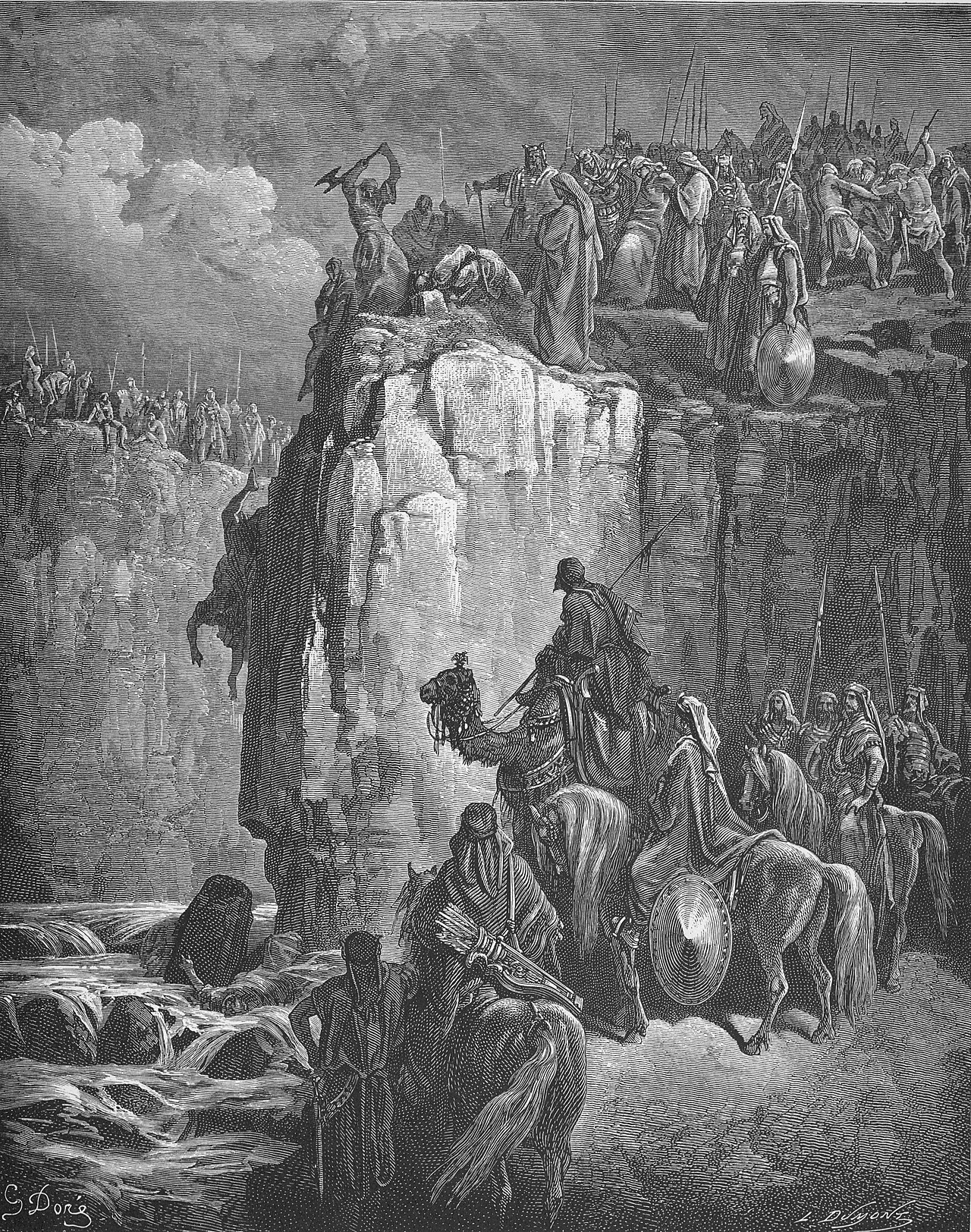
down to the brook Kishon: The slaughter of the prophets executes the law of Deut 13:5 and 18:20, which made leading Israel after other gods a capital matter, and Elijah acts where the king who should have would not. The place carries its own memory: Kishon is the brook that swept away Sisera's chariots in Deborah's song, and it now closes over Baal's prophets. The exposition states the law and the deed and passes no verdict of its own beyond them.
1 Kings 18:40
“Elijah said - He takes the opportunity, whilst the peoples hearts were warm with the fresh sense of this great miracle. The brook Kishon - That their blood might be poured into that river, and thence conveyed into the sea, and might not defile the holy land.”
John Wesley · Explanatory Notes upon the Old Testament (1765)evangelical
1 more voice on this verse
1 Kings 18:40
“If Jehovah be the true God, Baal is a false God, to whom these Israelites had revolted, and seduced others to the worship of him; and therefore, by the express law of God, they were to be put to death, Deut. xiii.”
Matthew Henry · Commentary on the Whole Bible (1707-1721)puritan
A cloud like a man's hand; Elijah outruns the chariot
1 Kings 18:41-44
a sound of abundance of rain: Elijah hears rain while the sky is still brass, and sends Ahab to eat while he himself climbs to pray. The posture is a laborer's, face between his knees, and the method is persistence: seven times the servant looks toward the sea before a cloud the size of a man's hand rises, and Jas 5:17-18 builds its whole doctrine of effectual prayer on this scene by name. The man who called fire with one sentence prays seven rounds for rain that was already promised at verse 1, which is the chapter's quiet lesson on how promises are carried.
put his face between his knees: Adam Clarke pictures Elijah kneeling with his forehead on the ground, so that his face rests between his knees. Jamieson, Fausset and Brown set the two men side by side: Ahab goes up to eat and drink, and Elijah goes up to pray. Both climb Carmel.
1 Kings 18:42
“Put his face between his knees - He kneeled down, and then bowed his head to the earth, so that, while his face was between his knees, his forehead touched the ground.”
Adam Clarke · Commentary on the Bible (1810-1826)evangelical
1 more voice on this verse
1 Kings 18:42
“He was recommended to refresh himself without a moment's delay; and, while the king was thus occupied, the prophet, far from taking rest, was absorbed in prayer for the fulfilment of the promise (1Ki 18:1). put his face between his knees--a posture of earnest supplication still used.”
Jamieson, Fausset & Brown · Commentary Critical and Explanatory on the Whole Bible (1871)reformed
John Wesley reads the watch toward the sea as the wish of Elijah to know the first sign of rain, so that Ahab and the people would credit the rain to the LORD. The servant looks six times and sees nothing there.
1 Kings 18:43
“Go - While I continue praying. Elijah desired to have timely notice of the first appearance of rain, that Ahab and the people might know that it was obtained from Jehovah by the prophet's prayers, and thereby be confirmed in the true religion.”
John Wesley · Explanatory Notes upon the Old Testament (1765)evangelical
Adam Clarke reads the Hebrew as the hollow of a man's hand, a cupped shape, and he describes seeing such a cloud at sea before a violent storm. Jamieson, Fausset and Brown note that in that land a small cloud rising from the sea comes before rain. Elijah acts on the first sign.
1 Kings 18:44
“Behold, there ariseth a little cloud out of the sea, like a man's hand--The clearness of the sky renders the smallest speck distinctly visible; and this is in Palestine the uniform precursor of rain. It rises higher and higher, and becomes larger and larger with astonishing celerity, till the whole heaven is black, and the cloud bursts in a deluge of rain.”
Jamieson, Fausset & Brown · Commentary Critical and Explanatory on the Whole Bible (1871)reformed
1 more voice on this verse
1 Kings 18:44
“There ariseth a little cloud out of the sea, like a man’s hand. - ככף איש kechaph ish, like the hollow of a man’s hand. In the form of the hand bent, the concave side downmost. I have witnessed a resemblance of this kind at sea previously to a violent storm, a little cloud the size of a man’s hand first appearing, and this increasing in size and density every moment, till at last it covered the whole heavens, and then burst forth with incredible fury.”
Adam Clarke · Commentary on the Bible (1810-1826)evangelical
1 Kings 18:45-46
black with clouds and wind: The heaven that was shut for three years goes black in a paragraph, and Ahab drives for Jezreel through the first rain of his reign's fourth year. The hand of the LORD comes on Elijah and he runs the sixteen miles before the king's chariot, a herald's place, honoring the office of the man he had just defeated on the mountain. The chapter ends with prophet and king arriving at Jezebel's city together, and chapter 19 opens with what meets them there.
1 Kings 18:45
“Ahab rode, and went to Jezreel--now Zerin, a distance of about ten miles. This race was performed in the midst of a tempest of rain. But all rejoiced at it, as diffusing a sudden refreshment over all the land of Jezreel.”
Jamieson, Fausset & Brown · Commentary Critical and Explanatory on the Whole Bible (1871)reformed
John Wesley notes that the long cloak would have slowed the run, and he credits the hand of the LORD with strength beyond nature. Jamieson, Fausset and Brown compare the runners who went before the chariots of kings, and Adam Clarke reads only the speed of the race to Jezreel. Elijah ran ahead of the chariot of Ahab.
1 Kings 18:46
“Ran before Ahab - Many think that Elijah ran before the king in order to do him honor; and much learned labor has been spent on this passage in order to show that Elijah had put himself at the head of a company of chanters who ran before the king reciting his praises, or the praises of God; a custom which still exists in Arabian countries! I believe all these entirely mistake the writer’s meaning: Ahab yoked his chariot, and made all speed to Jezreel.”
Adam Clarke · Commentary on the Bible (1810-1826)evangelical
How this psalm is built
The form: Prophetic narrative staged as a public trial, held to settle who sends the rain rather than whether rain will come, as Keil classes it.
The patterns in this chapter
| Device | What it does | Where to see it |
|---|---|---|
| Limping and leaping, the same verb twice | The word behind waver at verse 21 means to limp. The chapter uses it again at verse 26 for the dance of Baal's prophets around their altar. So the crowd limps between two opinions and the professionals limp around a silent god, and the narrator has chosen one verb for both. Keil and Adam Clarke both mark the repetition as deliberate.Carl Friedrich Keil and Adam Clarke, The Books of the Kings, 1872, and Commentary on the Bible, 1832, on 1 Kings 18:21. | 1 Kings 18:21, 1 Kings 18:26 |
| But there was no sound, and no one answered | The narrator audits Baal's morning twice and adds a clause the second time. Verse 26 gives two negatives, and verse 29 gives three, no response, no one answered, no one paid attention. The reader is held through a whole morning of noise so that the short prayer at the hour of the evening sacrifice can stand against it. Keil reads the triple silence as the verdict of the trial before any fire falls.Carl Friedrich Keil, The Books of the Kings, 1872, on 1 Kings 18:29. | 1 Kings 18:26, 1 Kings 18:29 |
| The sacrifice, the wood, the stones, the dust, the water | Verse 38 lists what the fire took, and the list runs from the most burnable thing to the least. Keil notes the order, which ends with the stones of the altar and the water standing in the trench. An inventory that finishes with wet stone closes off every explanation the crowd on the ridge could have offered.Carl Friedrich Keil, The Books of the Kings, 1872, on 1 Kings 18:38. | 1 Kings 18:38 |
| The crowd says the prophet's name back to him | The people fall on their faces at verse 39 and say the LORD, He is God, twice. That sentence is the meaning of the name Eliyahu, which carries it in its own syllables. Adam Clarke and Keil both mark the point, and the commentators have loved it since the fathers. The crowd that would give no answer at verse 21 now pronounces the prophet's name over the whole mountain.Adam Clarke and Carl Friedrich Keil, Commentary on the Bible, 1832, and The Books of the Kings, 1872, on 1 Kings 18:39. | 1 Kings 18:21, 1 Kings 18:39 |
| Rain promised at the start and falling at the end | The word of the LORD at verse 1 promises rain before any contest is proposed, and the sky goes black at verse 45. Everything between the two is the settling of who sends it. Keil and F. W. Farrar read the chapter this way, so Carmel decides ownership of the weather rather than the weather itself.Carl Friedrich Keil and F. W. Farrar, The Books of the Kings, 1872, and The First Book of Kings, The Expositor's Bible, 1893, on 1 Kings 18:1. | 1 Kings 18:1, 1 Kings 18:45 |
The New Testament's use
9 more paragraphs on the patterns
James 5:17 and 18 take this chapter as the standing case for effectual prayer. The argument is that Elijah was a man with a nature like ours, and that he prayed and the heaven gave rain. The scene James is reading is verses 41 to 45, the seven rounds on the summit.
The detail James chooses is worth marking. Elijah called fire with one sentence at verse 36, and he prayed seven times for rain that had already been promised at verse 1. The exposition notes read that as the chapter's quiet lesson on how a promise is carried rather than on how it is obtained.
The debated concept
The first question is what Elijah meant at verse 22. He says he is the only remaining prophet of the LORD, and verse 4 of the same chapter has already told the reader about Obadiah's hundred. Matthew Henry and F. W. Farrar read the line as the odds as Elijah felt them, the arithmetic of a man standing alone in front of a crowd, and 19:18 will correct it with seven thousand. A second reading takes prophet of the LORD in the narrow sense of one still serving in public, since the hundred were in caves. The chapter supplies both verses and states no verdict between them.
The second is the slaughter at verse 40. Keil and John Gill state the law the act stands on, Deuteronomy 13:5 and 18:20, which made leading Israel after other gods a capital matter. Both note that Elijah acted where the king who held the office would not. The place carries its own memory, since the Kishon is the brook that swept away Sisera's chariots in Deborah's song. The chapter's exposition states the law and the deed and passes no verdict of its own beyond them, and this page does the same.
The divine connection
Fire from the LORD had marked accepted worship twice before and once after. It fell at the tabernacle's opening in Leviticus 9:24 and it fell at the temple's dedication in 2 Chronicles 7:1, so Carmel stands in a short series of inaugurations. Keil notes that what Carmel inaugurates is the return of a nation's heart rather than a building.
The prayer says so before the fire falls. Elijah asks for three knowings at verses 36 and 37, that the LORD is God in Israel, that Elijah is His servant, and that he has done all these things at His command. Then he names the end behind them, that You have turned their hearts back again. The turned heart is the request and the fire is the means.
The altar is built for a country that no longer existed as one. Elijah takes twelve stones for the twelve tribes at a moment when the nation had been ten tribes and two for about sixty years. The stones cite Jacob by name, so a prophet of the northern kingdom sacrifices on behalf of an Israel that no royal border defines.
Keep studying
Studies7
Words12
Trails1
Subjects1
Sources for this chapter
The summary
Jamieson, Fausset & Brown, Commentary Critical and Explanatory; John Wesley, Notes on the Old Testament and Matthew Henry, Complete Commentary.
The form and classifications
Adam Clarke, Commentary on the Bible, 1832, on 1 Kings 18:21; Carl Friedrich Keil, The Books of the Kings, 1872, on 1 Kings 18:1; F. W. Farrar, The First Book of Kings, The Expositor's Bible, 1893, on 1 Kings 18:19 and Matthew Henry, Commentary on the Whole Bible, 1710, on 1 Kings 18:41.
The exposition
Adam Clarke, Commentary on the Bible; Albert Barnes, Notes, Explanatory and Practical, on the Old and New Testaments (1832-1869); Alfred Edersheim, Bible History: Old Testament; Ambrose of Milan, Concerning Virginity 2.5.38; Charles Spurgeon, The Metropolitan Tabernacle Pulpit, Sermon No. 584: “A Hearer In Disguise” (lightly modernized text, CCEL edition); Ephrem the Syrian, ON THE FIRST BOOK OF KINGS 16:29; F. W. Farrar, The First Book of Kings (Expositor's Bible); Ishodad of Merv, BOOKS OF SESSIONS 1 KINGS 14:13; Jamieson, Fausset & Brown, Commentary Critical and Explanatory on the Whole Bible; John Gill; John Wesley, Explanatory Notes upon the Old Testament; Keil, The Books of the Kings and Matthew Henry, Commentary on the Whole Bible.