
1 Kings 18:41
in 1 Kings 18And Elijah said to Ahab, “Go up, eat and drink, for there is the sound of a heavy rain.”
BSB
The same verse in ASV and KJV ▾
ASV
And Elijah said unto Ahab, Get thee up, eat and drink; for there is the sound of abundance of rain.
KJV
And Elijah said unto Ahab, Get thee up, eat and drink; for there is a sound of abundance of rain.
⋯
This verse in 1 Kings 18
Commentary
9 notes on this verse"Elijah said to Ahab, 'Go up, eat and drink; for there is a sound of rushing rain.' " Elijah, after acknowledging that the people, thanks to the miracle that he had showed them, had turned away from their evil thoughts, and that the priests of …
The record, by era
The Puritans and the Awakening4 voices
Eat, &c. - Take comfort, and refresh thyself: for neither the king, nor any of the people could have leisure to eat, being wholly intent upon the decision of the great controversy. For there is, &c. - The rain is as certainly coming, as if you heard the noise which it makes.
God reveals his secrets to his servants the prophets; and yet, without a revelation, we may foresee that when man's judgments run down like a river God's mercy will. Rain is the river of God, Ps. lxv. He himself retired to pray (for though God had promised rain, he must ask it, Zech. x.
quarantine:debris (2026-07-29) — unbalanced-parens
9 And he said, What have I sinned, that thou wouldest deliver thy servant into the hand of Ahab, to slay me? 10 As the L ORD thy God liveth, there is no nation or kingdom, whither my lord hath not sent to seek thee: and when they said, He is not there; he took an oath of the kingdom and nation, that they found thee not.
quarantine:scripture (2026-07-29) — scripture-overlap:97%@v9-10
And Elijah said unto Ahab, get thee up,....
The Nineteenth Century1 voice
A commentator
Charles Spurgeon1834–1892
The Metropolitan Tabernacle Pulpit, Sermon No. 3376: “God's Answer to Persistent Prayer” (lightly modernized text, CCEL edition) · Written before 1892.
proposed
FROM the narrative we may learn that things can never be so bad but what God can bring deliverance in His own time. The country had been parched in Palestine for three years. Travelers in the East will tell you how brown and burned that country looks at all times, but how it must have appeared when the clouds cleaved together and all the pastures were turned to dust, I can scarcely conceive. It must have been a terrible and piteous sight when the cattle had perished and the people were ready to die through famine and hunger. Yet, bad as it was, when the clouds had long ago vanished, when the children of three years old did not know what a drop of rain meant, when the skies seemed to be as brass above the heads of poor tortured mortals, then it was that the word of God came to Elijah, saying, "There shall yet be rain." Courage, then! If the times should be full of danger, if there should
3 more voices on this verse
The Nineteenth Century3 voices
A commentator
Charles Spurgeon1834–1892
The Metropolitan Tabernacle Pulpit, Sermon No. 3376: “God's Answer to Persistent Prayer” (lightly modernized text, CCEL edition) · Written before 1892.
proposed
FROM the narrative we may learn that things can never be so bad but what God can bring deliverance in His own time. The country had been parched in Palestine for three years. Travelers in the East will tell you how brown and burned that country looks at all times, but how it must have appeared when the clouds cleaved together and all the pastures were turned to dust, I can scarcely conceive. It must have been a terrible and piteous sight when the cattle had perished and the people were ready to die through famine and hunger.
Get thee up, eat and drink - It appears most evidently that Ahab and the prophet were now on good terms, and this is a farther evidence that the slaying of the false prophets was by the king’s consent.
A commentator
Albert Barnes1798–1870
Notes, Explanatory and Practical, on the Old and New Testaments (1832-1869)
proposed
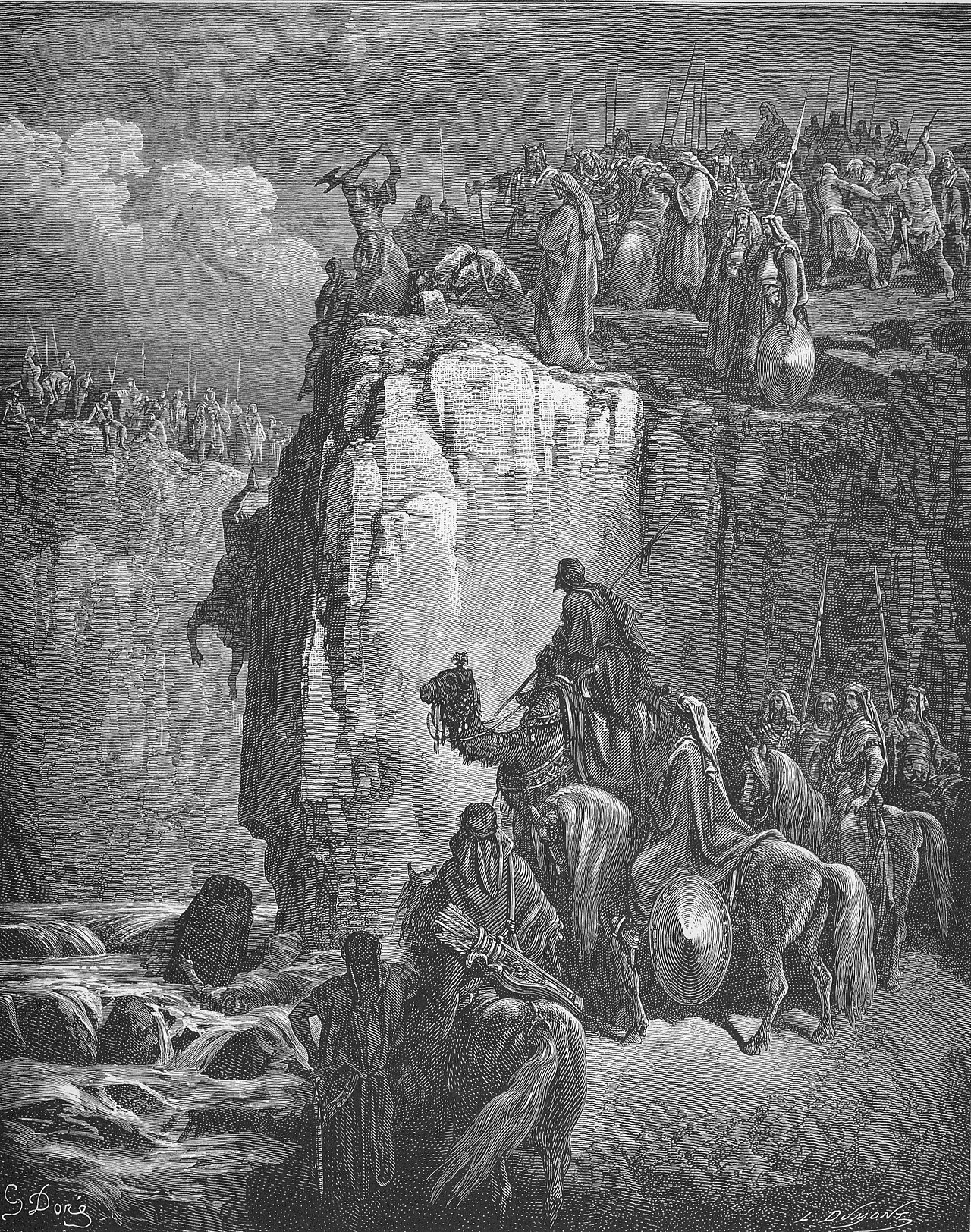
Get thee up, eat and drink - Ahab had descended the hill-side with Elijah, and witnessed the slaughter of the priests. Elijah now bade him ascend the hill again, and partake of the feast which was already prepared, and which always followed upon a sacrifice.
The words behind it
10 Hebrew wordsEvery Hebrew word of this verse in the order it stands, with what it means and the door to its own study. The last column counts the times a word stands in the whole Bible: the rarer the word, the more the places it appears belong together.
| Hebrew | Sound | Meaning | Word study | In the Bible |
|---|---|---|---|---|
| וַיֹּ֤אמֶר | vaiyomer | and he said | H559 → | 5305 times |
| אֵלִיָּ֙הוּ֙ | ʾeliyahu | Elijah | H452 → | 71 times |
| לְאַחְאָ֔ב | leachav | to Ahab | H256 → | 92 times |
| עֲלֵ֖ה | ʾaleh | go up | H5927 → | 890 times |
| אֱכֹ֣ל | ʾekhol | eat | H398 → | 810 times |
| וּשְׁתֵ֑ה | usheteh | and drink | H8354 → | 217 times |
| כִּי־ | ki- | for | H3588 → | 4482 times |
| ק֖וֹל | kol | [the] sound of | H6963 → | 506 times |
| הֲמ֥וֹן | hamon | [the] noise of | H1995 → | 83 times |
| הַגָּֽשֶׁם׃ | hagashem | <the> rain | H1653 → | 35 times |
וַיֹּ֤אמֶרand he said
vaiyomerH559 →5305 times
אֵלִיָּ֙הוּ֙Elijah
ʾeliyahuH452 →71 times
לְאַחְאָ֔בto Ahab
leachavH256 →92 times
עֲלֵ֖הgo up
ʾalehH5927 →890 times
אֱכֹ֣לeat
ʾekholH398 →810 times
וּשְׁתֵ֑הand drink
ushetehH8354 →217 times
כִּי־for
ki-H3588 →4482 times
ק֖וֹל[the] sound of
kolH6963 →506 times
הֲמ֥וֹן[the] noise of
hamonH1995 →83 times
הַגָּֽשֶׁם׃<the> rain
hagashemH1653 →35 times
A shaded row is a word that stands 400 times or fewer in the Bible.
The walk
8 stopsEach card is a verse this one points to, and under it the verses that one points to in turn. Where several paths arrive at the same place, that place is listed first: the text keeps returning to it.
Through
1 Kings 17:1Now Elijah the Tishbite, who was among the settlers of Gilead, said to Ahab, “As surely as the LORD lives—the God of Israel before whom I stand—there will be neither dew nor rain in…
it leads to
- James 5:17
Elijah was a man just like us. He prayed earnestly that it would not rain, and it did not rain on the land for three and a half years.
Reached by 2 separate paths from here.
- Luke 4:25–26
But I tell you truthfully that there were many widows in Israel in the time of Elijah, when the sky was shut for three and a half years and great famine swept over all…
- Luke 1:17
And he will go on before the Lord in the spirit and power of Elijah, to turn the hearts of the fathers to their children and the disobedient to the wisdom of the righteous—to…
- James 5:17
Through
Ecclesiastes 9:7Go, eat your bread with joy, and drink your wine with a cheerful heart, for God has already approved your works:
it leads to
- Ecclesiastes 3:12–13
I know that there is nothing better for them than to rejoice and do good while they live,
- Deuteronomy 12:7
There, in the presence of the LORD your God, you and your households shall eat and rejoice in all you do, because the LORD your God has blessed you.
- Ecclesiastes 10:19
A feast is prepared for laughter, and wine makes life merry, but money is the answer for everything.
- Ecclesiastes 8:15
So I commended the enjoyment of life, because there is nothing better for a man under the sun than to eat and drink and be merry. For this joy will accompany him in his…
- Ecclesiastes 2:24–26
Nothing is better for a man than to eat and drink and enjoy his work. I have also seen that this is from the hand of God.
- Ecclesiastes 3:12–13
Where this verse is studied
On this page
About 1 Kings
Who and where
2 names in this verse with a page on the site.
- PersonDivided kingdomElijahThe Tishbite who shut heaven for three years and a half, called down fire on Carmel, heard the still small voice at Horeb, and wen…
- PersonDivided kingdomAhabSeventh king of the northern kingdom, son of Omri, who "did evil above all that were before him"; Elijah's chief antagonist, conde…
This page draws on Adam Clarke, Commentary on the Bible; Albert Barnes, Notes, Explanatory and Practical, on the Old and New Testaments (1832-1869); Charles Spurgeon, The Metropolitan Tabernacle Pulpit, Sermon No. 3376: “God's Answer to Persistent Prayer” (lightly modernized text, CCEL edition); Ephrem the Syrian, ON THE FIRST BOOK OF KINGS 18:40; John Gill, Exposition of the Old Testament (1748-1763); John Wesley, Explanatory Notes upon the Old Testament and Matthew Henry, Commentary on the Whole Bible.