
1 Kings 18:40
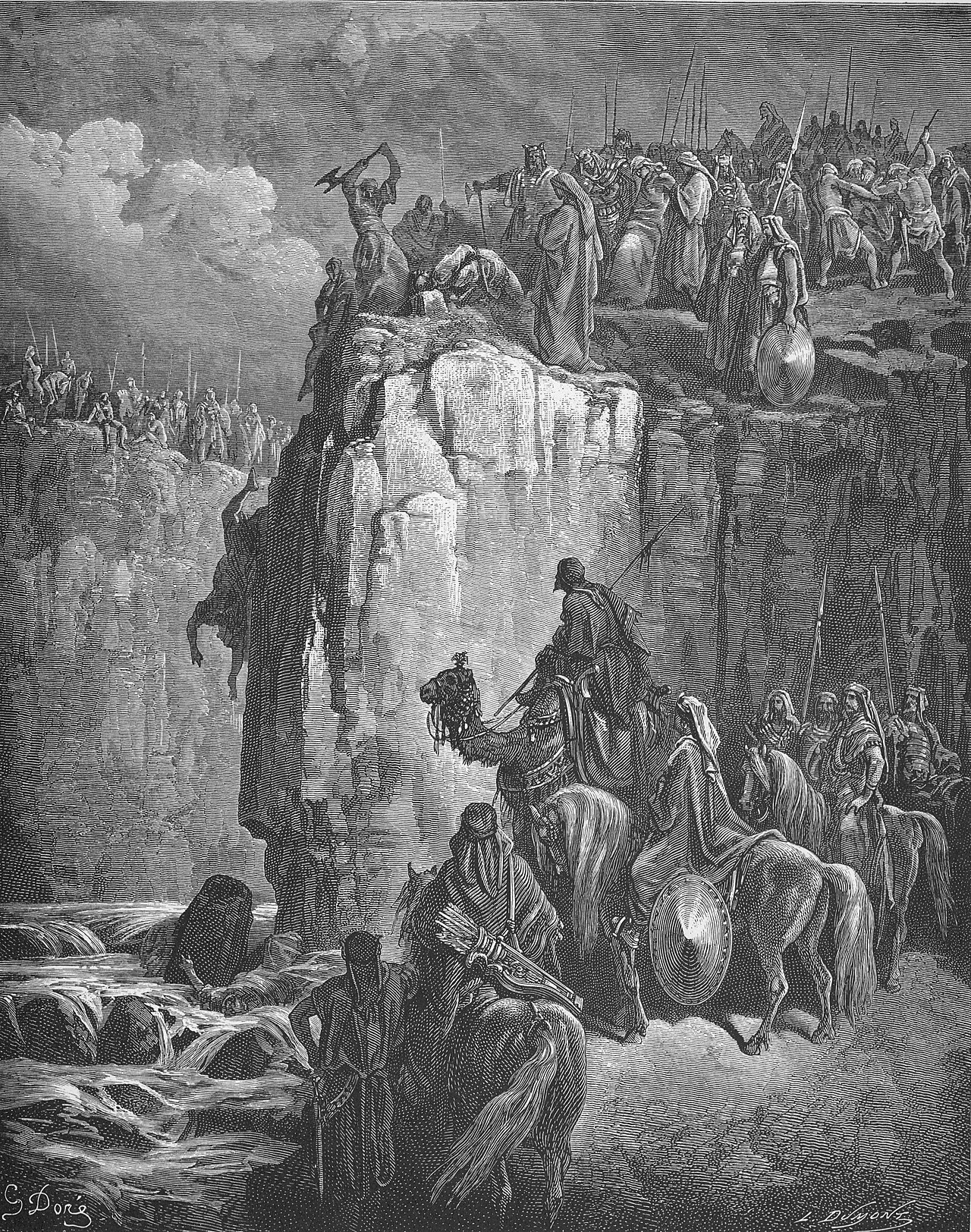
in 1 Kings 18Then Elijah ordered them, “Seize the prophets of Baal! Do not let a single one escape.” So they seized them, and Elijah brought them down to the Kishon Valley and slaughtered them there.
BSB
The same verse in ASV and KJV ▾
ASV
And Elijah said unto them, Take the prophets of Baal; let not one of them escape. And they took them; and Elijah brought them down to the brook Kishon, and slew them there.
KJV
And Elijah said unto them, Take the prophets of Baal; let not one of them escape. And they took them: and Elijah brought them down to the brook Kishon, and slew them there.
⋯
This verse in 1 Kings 18
Commentary
10 notes on this verse"Elijah brought them down to the Wadi Kishon, and cut their throats there." There is no doubt that the people rose against the prophets of shame and brought them before Elijah. But it is not entirely clear who killed them. The Scripture says that Elijah …
This site's exposition
down to the brook Kishon
The slaughter of the prophets executes the law of Deut 13:5 and 18:20, which made leading Israel after other gods a capital matter, and Elijah acts where the king who should have would not. The place carries its own memory: Kishon is the brook that swept away Sisera's chariots in Deborah's song, and it now closes over Baal's prophets. The exposition states the law and the deed and passes no verdict of its own beyond them.
The record, by era
The Puritans and the Awakening3 voices
Elijah said - He takes the opportunity, whilst the peoples hearts were warm with the fresh sense of this great miracle. The brook Kishon - That their blood might be poured into that river, and thence conveyed into the sea, and might not defile the holy land.
If Jehovah be the true God, Baal is a false God, to whom these Israelites had revolted, and seduced others to the worship of him; and therefore, by the express law of God, they were to be put to death, Deut. xiii.
And Elijah said unto them, take the prophets of Baal,....
The Nineteenth Century2 voices
A commentator
Jamieson, Fausset & Brown1802–1910
Commentary Critical and Explanatory on the Whole Bible (1871)
proposed
In vain did they continue invoking their senseless deity from morning till noon, and from noon till evening, uttering the most piercing cries, using the most frantic gesticulations, and mingling their blood with the sacrifice. Elijah exposed their folly and imposture with the severest irony and, as the day was far advanced, commenced his operations.
ELIJAH may be called the Iron Prophet. He was a stern and brave man who flinched not to deliver his Master's message at all hazards. It was right that such a man should be raised up just at that time, for the Sidonian queen, Jezebel, was a woman of imperious spirit, superstitious to the last degree and resolute in carrying out her will. She ruled King Ahab with sovereign sway and had issued her mandate that the Prophets of Jehovah should be slain—a mandate which was all too well obeyed.
3 more voices on this verse
The Nineteenth Century3 voices
ELIJAH may be called the Iron Prophet. He was a stern and brave man who flinched not to deliver his Master's message at all hazards. It was right that such a man should be raised up just at that time, for the Sidonian queen, Jezebel, was a woman of imperious spirit, superstitious to the last degree and resolute in carrying out her will. She ruled King Ahab with sovereign sway and had issued her mandate that the Prophets of Jehovah should be slain—a mandate which was all too well obeyed. None could stand before this tigress until Elijah came and dared her malice to do its worst. That lone man, of heroic soul, stemmed the fearful torrent of idolatry and like a rock in mid-current, firmly stood his ground. He, alone and single-handed, was more than a match for all the priests of the palace and the groves, even as one lion scatters a flock of sheep. On the occasion of our text, you will remember that he had proved the prophets of Baal to be liars and pretenders, and then, like a practical man as he was, he went on to the natural conclusion. The Law of Israel was, "The prophet which shall presume to speak a word in My name, which I have not commanded him to speak, or that shall speak in the name of other gods, even that prophet shall die." And, therefore, the case being proven before all men, Elijah became, himself, the executioner. He bade the people seize the impostors and he himself purpled the Kishon with their blood. "Take the prophets of Baal; let not one of them escape," was the thundering voice of the Prophet of fire. The man did his Master's will thoroughly, never dreaming of compromise. Perhaps it was for this reason that he, with but one other of woman born, ascended to Heaven by an unusual road.
Let not one of them escape - They had committed the highest crime against the state and the people by introducing idolatry, and bringing down God’s judgments upon the land; therefore their lives were forfeited to that law which had ordered every idolater to be slain. It seems also that Ahab, who was present, consented to this act of impartial justice.
A commentator
Albert Barnes1798–1870
Notes, Explanatory and Practical, on the Old and New Testaments (1832-1869)
proposed
Elijah required the people to show their conviction by acts - acts which might expose them to the anger of king or queen, but which once committed would cause them to break with Baal and his worshippers forever. Elijah is said to have slain the “prophets of Baal,” because the people killed them by his orders. Why they were brought down to the torrent-bed of Kishon to be killed, is difficult to explain. Perhaps the object of Elijah was to leave the bodies in a place where they would not be found, since the coming rain would, he knew, send a flood down the Kishon ravine, and bear off the corpses to the sea. Elijah’s act is to be justified by the express command of the Law, that idolatrous Israelites were to be put to death, and by the right of a prophet under the theocracy to step in and execute the Law when the king failed in his duty.
The words behind it
19 Hebrew wordsEvery Hebrew word of this verse in the order it stands, with what it means and the door to its own study. The last column counts the times a word stands in the whole Bible: the rarer the word, the more the places it appears belong together.
| Hebrew | Sound | Meaning | Word study | In the Bible |
|---|---|---|---|---|
| וַיֹּאמֶר֩ | vaiyomer | and he said | H559 → | 5305 times |
| אֵלִיָּ֨הוּ | ʾeliyahu | Elijah | H452 → | 71 times |
| לָהֶ֜ם | lahem | to them | ||
| תִּפְשׂ֣וּ׀ | tifsu | seize | H8610 → | 65 times |
| אֶת־ | ʾet- | <obj.> | H853 → | 10935 times |
| נְבִיאֵ֣י | neviei | [the] prophets of | H5030 → | 314 times |
| הַבַּ֗עַל | habaal | <the> Baal | H1168 → | 82 times |
| אִ֛ישׁ | ʾish | anyone | H376 → | 1663 times |
| אַל־ | ʾal- | may not | H408 → | 724 times |
| יִמָּלֵ֥ט | yimalet | he escape | H4422 → | 95 times |
| מֵהֶ֖ם | mehem | of them | ||
| וַֽיִּתְפְּשׂ֑וּם | vaiyitpesum | and they seized them | H8610 → | 65 times |
| וַיּוֹרִדֵ֤ם | vaiyoridem | and he brought down them | H3381 → | 381 times |
| אֵלִיָּ֙הוּ֙ | ʾeliyahu | Elijah | H452 → | 71 times |
| אֶל־ | ʾel- | to | H413 → | 5510 times |
| נַ֣חַל | nachal | [the] wadi of | H5158 → | 141 times |
| קִישׁ֔וֹן | kishon | Kishon | H7028 → | |
| וַיִּשְׁחָטֵ֖ם | vaiyishchatem | and he slaughtered them | H7819 → | |
| שָֽׁם׃ | sham | there | H8033 → | 834 times |
וַיֹּאמֶר֩and he said
vaiyomerH559 →5305 times
אֵלִיָּ֨הוּElijah
ʾeliyahuH452 →71 times
לָהֶ֜םto them
lahem
תִּפְשׂ֣וּ׀seize
tifsuH8610 →65 times
אֶת־<obj.>
ʾet-H853 →10935 times
נְבִיאֵ֣י[the] prophets of
nevieiH5030 →314 times
הַבַּ֗עַל<the> Baal
habaalH1168 →82 times
אִ֛ישׁanyone
ʾishH376 →1663 times
אַל־may not
ʾal-H408 →724 times
יִמָּלֵ֥טhe escape
yimaletH4422 →95 times
מֵהֶ֖םof them
mehem
וַֽיִּתְפְּשׂ֑וּםand they seized them
vaiyitpesumH8610 →65 times
וַיּוֹרִדֵ֤םand he brought down them
vaiyoridemH3381 →381 times
אֵלִיָּ֙הוּ֙Elijah
ʾeliyahuH452 →71 times
אֶל־to
ʾel-H413 →5510 times
נַ֣חַל[the] wadi of
nachalH5158 →141 times
קִישׁ֔וֹןKishon
kishonH7028 →
וַיִּשְׁחָטֵ֖םand he slaughtered them
vaiyishchatemH7819 →
שָֽׁם׃there
shamH8033 →834 times
A shaded row is a word that stands 400 times or fewer in the Bible.
The walk
8 stopsEach card is a verse this one points to, and under it the verses that one points to in turn. Where several paths arrive at the same place, that place is listed first: the text keeps returning to it.
Through
Deuteronomy 18:20But if any prophet dares to speak a message in My name that I have not commanded him to speak, or to speak in the name of other gods, that prophet must be put…
it leads to
- Deuteronomy 13:1–5
If a prophet or dreamer of dreams arises among you and proclaims a sign or wonder to you,
- Jeremiah 27:15
For I have not sent them, declares the LORD, and yet they are prophesying falsely in My name; therefore I will banish you, and you will perish—you and the prophets who prophesy to you.”
- Jeremiah 28:15–17
Then the prophet Jeremiah said to the prophet Hananiah, “Listen, Hananiah! The LORD did not send you, but you have persuaded this people to trust in a lie.
- Matthew 7:15
Beware of false prophets. They come to you in sheep’s clothing, but inwardly they are ravenous wolves.
- Jeremiah 23:31
“Yes,” declares the LORD, “I am against the prophets who wag their own tongues and proclaim, ‘The LORD declares it.’”
- Deuteronomy 13:1–5
Through
Judges 4:7And I will draw out Sisera the commander of Jabin’s army, his chariots, and his troops to the River Kishon, and I will deliver him into your hand.’”
it leads to
- Psalms 83:9–10
Do to them as You did to Midian, as to Sisera and Jabin at the River Kishon,
Reached by 2 separate paths from here.
- Ezekiel 38:10–16
This is what the Lord GOD says: On that day, thoughts will arise in your mind, and you will devise an evil plan.
- Psalms 83:9–10
Through
Judges 5:21The River Kishon swept them away, the ancient river, the River Kishon. March on, O my soul, in strength!
it leads to
- Judges 4:7
And I will draw out Sisera the commander of Jabin’s army, his chariots, and his troops to the River Kishon, and I will deliver him into your hand.’”
- Judges 4:7
Where this verse is studied
On this page
Studies5
On this verse
About 1 Kings
Who and where
1 name in this verse with a page on the site.
This page draws on 10 works. Open the list of works
This page draws on Adam Clarke, Commentary on the Bible; Albert Barnes, Notes, Explanatory and Practical, on the Old and New Testaments (1832-1869); Charles Spurgeon, The Metropolitan Tabernacle Pulpit, Sermon No. 1058: “No Quarter” (lightly modernized text, CCEL edition); Ephrem the Syrian, ON THE FIRST BOOK OF KINGS 18:40; Jamieson, Fausset & Brown, Commentary Critical and Explanatory on the Whole Bible; John Gill, Exposition of the Old Testament; John Gill, Exposition of the Old Testament (1748-1763); John Wesley, Explanatory Notes upon the Old Testament; Keil, The Books of the Kings and Matthew Henry, Commentary on the Whole Bible.