

Genesis 5 · Hebrews 11 · Jude 14 · Featured Study
Enoch, the Man Who Walked with God
Genesis 5 is the Bible’s first graveyard. Ten generations long, it swings the same hammer eight times: and he died… and he died, nine centuries at a stroke, Adam to Lamech, every line ending in the ground. And then, seventh from Adam, the pattern breaks on four of the strangest words in Scripture: “and he was not; for God took him.”No deathbed, no grave, no explanation, just a man who “walked with God” until one day the walk did not end. Scripture gives him seven verses, Hebrews gives him a place in the hall of faith, Jude calls him a prophet, and the centuries between the Testaments gave him an entire book. This page is about the man himself: what the canon actually says, what the walk means, and why his name became the era’s byword for a human being at home in the councils of heaven.
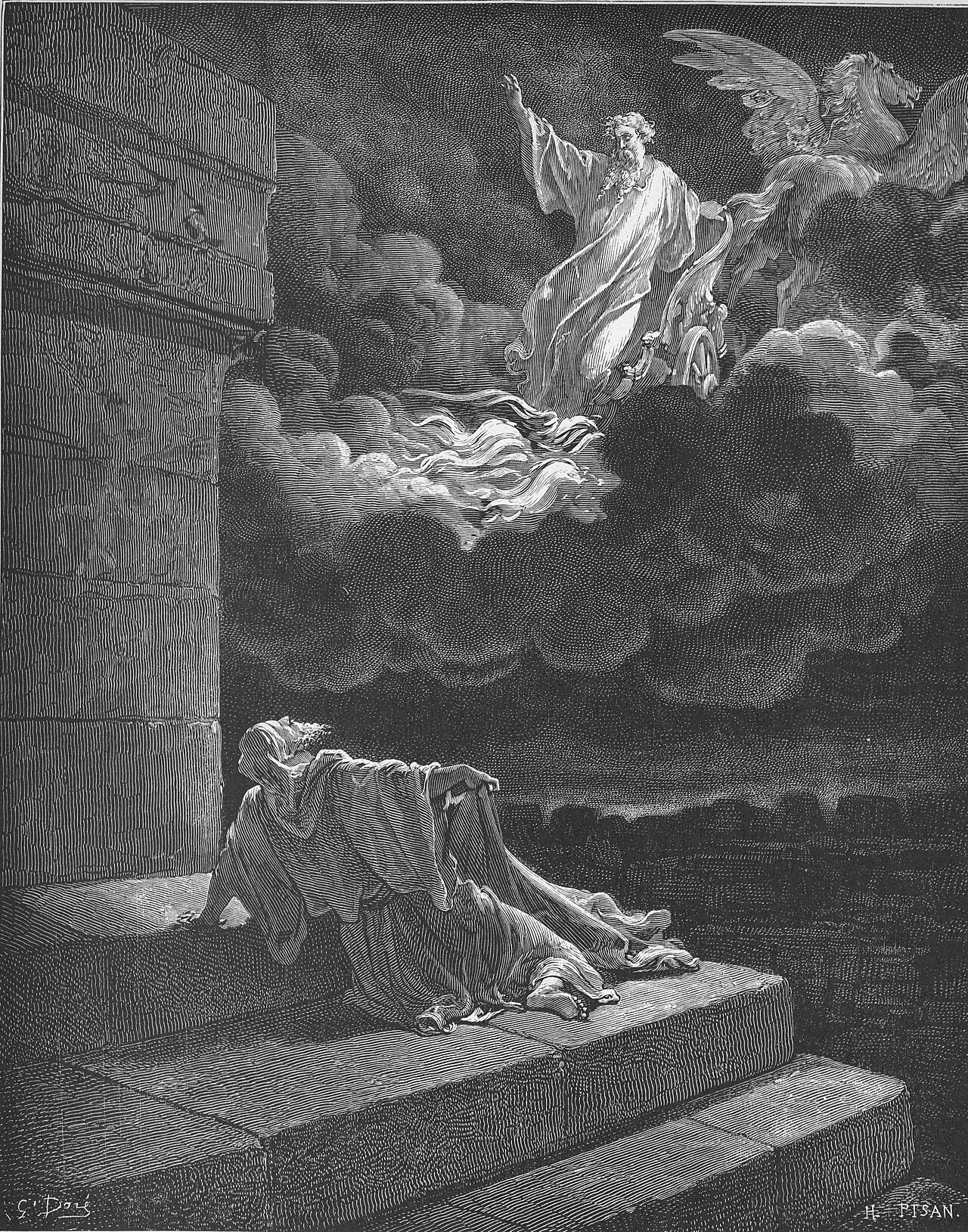
Unknown engraver, God Took Enoch, 19th century. Public domain.
Summary
Genesis 5 repeats 'and he died' eight times, but Enoch's line breaks the pattern: God took him without a death. This page follows the three canon witnesses to Enoch, the man, and shows how the later book that took his name pictured him in heaven's court.
- Genesis 5:24 says Enoch walked with God and was not, for God took him, at 365 years, the shortest life on the chapter's list
- Hebrews 11:5-6 names faith as the reason for his translation, and Jude 14 calls him a prophet, the seventh from Adam
- The Book of Enoch calls him the scribe of righteousness and gives him the oldest full heavenly-throne vision in Jewish literature outside Scripture
- The Enoch-and-Noah type, taken before the Flood versus preserved through it, is presented as a widely held picture in this site's own stream, not a proven doctrine
- The old book about him stays a labeled study resource, while Genesis 5's account of the man himself is canon
Eight Deaths and a Disappearance
Genesis 5, drawn to scale: the chapter's own drumbeat, and the bar that breaks it
- Adam930
and he died
- Seth912
and he died
- Enosh905
and he died
- Kenan910
and he died
- Mahalalel895
and he died
- Jared962
and he died
- Enoch365
God took him
- Methuselah969
and he died
- Lamech777
and he died
- Noah950
and he died
“And after he had become the father of Methuselah, Enoch walked with God 300 years and had other sons and daughters. So Enoch lived a total of 365 years. Enoch walked with God, and then he was no more, because God had taken him away.” Genesis 5:22–24 (BSB)
Twice in three verses: walked with God. The Hebrew verb is halak in its reflexive, habitual form: not a stroll but a settled manner of life, a walking back and forth withsomeone. Scripture uses the same phrase of exactly one other man before the Flood: Noah (Gen 6:9). And his years, 365, have caught readers’ eyes since antiquity: the number of days in a solar year, in a tradition whose Astronomical Book (1 En 72–82) would later argue passionately for the solar calendar. An old observation, offered as exactly that.
- 7thfrom Adam (Jude 14)
- 365years: the one short bar
- ×2“walked with God” in three verses
- 0graves: “he was not”
- Heb 11:5the hall of faith
Three Witnesses, One Man
Genesis narrates, Hebrews interprets, Jude remembers
GENESIS 5:24: THE FACT
“and Enoch walked with God: and he was not; for God took him.”
Four Hebrew clauses, no ornament. The narrator does not even slow down, which is itself the art: in a chapter of tolling bells, the silence is the loudest thing on the page.
HEBREWS 11:5–6: THE MEANING
“By faith Enoch was translated that he should not see death… for he hath had witness borne to him that before his translation he had been well-pleasing unto God.”
Hebrews names the engine: faith. And then generalizes it into one of Scripture’s greatest sentences, “without faith it is impossible to be well-pleasing unto him.” Enoch is the proof-case.
JUDE 14: THE VOICE
“And to these also Enoch, the seventh from Adam, prophesied…”
The New Testament’s last surprise about him: he was a prophet, and one of his words survived. The full treatment of Jude’s quotation (what it does and does not imply) lives on the 1 Enoch study.
The Scribe of Righteousness
the Enoch of the book: heaven's court through a man's eyes
The book that took his name paints him with two strokes. First, a title: “Enoch, thou scribe of righteousness” (1 En 12:4): a man of letters in heaven’s employ. Second, an astonishing job assignment: when the Watchers fall, it is the fallen angels who beg the manto write their petition and carry it upward (chs 12–13). The commentators mark what the story has done: every mediation role is reversed: a human intercedes for angels, and the intercession fails, because their fall, unlike ours, has no redeemer.
Then comes the book’s summit, the oldest full heavenly-ascent vision in Jewish literature outside Scripture, and it reads like a man remembering something too bright to describe:
“And I looked and saw therein a lofty throne: its appearance was as crystal, and the wheels thereof as the shining sun… And the Great Glory sat thereon, and His raiment shone more brightly than the sun and was whiter than any snow… ten thousand times ten thousand (stood) before Him, yet He needed no counsellor.”1 Enoch 14:18, 20, 22 (Charles, 1917) — a labeled study resource, not canon
A reader who knows Daniel 7 will hear the shared court language at once: wheels of fire, raiment white as snow, “ten thousand times ten thousand.” Where that court scene leads, and who stands beside the throne in the book’s later chapters, is the Son of Man study’s whole subject.
Taken Before the Waters
a reading long loved in this site's own stream, presented with its holders
Enoch, Noah, and the shape of the end, the typological readingwidely held in the dispensational stream; a picture, not a proof
Set the two pre-flood walkers side by side. Enoch walks with God and is removed before the judgment falls. Noah walks with God (Gen 6:9) and is preserved throughit. Teachers in this site’s own stream, Chuck Missler foremost among them (Learn the Bible in 24 Hours, the Genesis session): have long read that pair as a deliberate picture: the righteous taken before the hour of trial, and a remnant carried through it. Jesus himself made the era the analogy for His return: “As it was in the days of Noah, so will it be at the coming of the Son of Man” (Matt 24:37, BSB).
Said carefully: this is a type, a picture widely held and lovingly taught, not a verse that states a doctrine. The doctrine’s own texts and the full range of positions live on the site’s prophecy studies. What Genesis itself insists on is simpler and prior: the man who was taken was the man who walked.
The Walk Is the Point
It would be easy to leave Enoch as a curiosity: the man who vanished, the name on a strange old book. Hebrews will not allow it. It files him under faith, between Abel’s sacrifice and Noah’s ark, and draws the universal rule from his seven quiet verses:
“And without faith it is impossible to please God, because anyone who approaches Him must believe that He exists and that He rewards those who earnestly seek Him.” Hebrews 11:6 (BSB)
Enoch’s translation was singular; his walk was not. The same walking-with-God vocabulary becomes the New Testament’s ordinary word for the Christian life: “walk in newness of life,” “walk by the Spirit,” “walk in the light.” What was exceptional in Genesis 5 is offered to everyone in Christ, with something Enoch himself was still waiting for: a Mediator whose intercession does not fail. The old book around his name remains a labeled study resource, and the Bible remains the sixty-six books, but the man himself is canon, and his seven verses ask every reader the same question they have asked for four thousand years: who are you walking with?
The Voices on Enoch
with the work named
Learn the Bible in 24 Hours (Thomas Nelson) — the Genesis session
Marcus Brown's formative teacher. Taught the reading this page presents under its own heading: Enoch removed before the Flood as a picture of the righteous taken before judgment, with Noah preserved through it, a type long cherished in the site's own dispensational stream.
Reversing Hermon (Defender, 2017)
Cite-only, ≤50 words. On the remarkable inversion of 1 Enoch 12–16: fallen angels begging a human scribe to intercede for them, the mediation roles of heaven and earth deliberately reversed around this one righteous man.
On Idolatry, ch. 15; On the Apparel of Women, Book I (c. AD 200)
Public domain. Calls Enoch “the most ancient prophet.” An early-church witness to how seriously the first Christian centuries took both the man and the tradition around him.
1 Enoch 1 (Hermeneia; Fortress Press, 2001)
The standard critical commentary: the source for the scribe-intercessor reading of chapters 12–16 and the throne-vision analysis of chapter 14.
The Book of Enoch (2nd ed., 1912; translation reprinted 1917)
The public-domain translation this site hosts: including the throne vision of chapter 14, which he regarded as among the book's oldest and most remarkable material.
Marcus Brown's own commentary leads above all; within a tier, all voices are equal.
Read the Great Books
the works this study is built on
Genesis 5: the generations of Adam
Scripture: read it in MannaFest’s own reader
The drumbeat chapter itself, with study tools on every verse, the seven verses about Enoch in their full setting.
READ IT →1 Enoch: chapters 12–16
c. 3rd century BC or earlier, a labeled study resource, not canon
The scribe of righteousness, the failed petition, and the throne vision, with chapter-by-chapter commentary in MannaFest’s reader.
READ IT →The Book of Enoch
R. H. Charles · 2nd ed. 1912, translation reprinted 1917
The translation this site hosts, with Charles’s introduction to the man, the book, and the tradition between them.
READ IT FREE →Word studies
The Hebrew and Greek under this study, each word in its own room.