

Follower of John Martin, The Covenant, about 1843. Public domain.
Genesis 9 · Symbol · Featured Study
The Rainbow
Genesis 9, the visions of Ezekiel and John, the Hebrew words of the sign, and the readings in dispute.
The word Genesis uses for the rainbow is the word for a warrior's bow.
I have set My rainbow in the clouds, and it will be a sign of the covenant between Me and the earth.
- The word
- קֶשֶׁת (qeshet), H7198
- First appears
- Genesis 9:13 “I have set My rainbow in the…”
The word Genesis uses for the rainbow is the word for a warrior's bow.
Summary
The rainbow is the sign God gave Noah after the flood. God set it in the clouds as a pledge that the waters will never again destroy all life. The covenant it marks is made with every living creature on the earth. God says that when the bow appears, He will remember it. The prophets see a bow again in visions of God's glory. Ezekiel sees it by the river Chebar, and John sees it around the throne in heaven.
- God's promise in Genesis 9 is made with Noah and his descendants. It also takes in every living creature, the birds, the livestock and the beasts (Genesis 9:9 to 10).
- The Greek word iris, rainbow, stands only twice in the New Testament. Both times are in Revelation (Revelation 4:3; Revelation 10:1).
- Isaiah 54:9 sets God's oath to Noah beside a second oath. God swears that He will not be angry with His people again.
My Bow in the Clouds
Genesis 9:12 to 17, the sign God names after the flood.
After Noah leaves the ark and builds an altar, God speaks to him and his sons about the future of the whole earth. He binds Himself by covenant never again to cut off all life by a flood, and He names a sign that anyone under a rainy sky can see. The sign is placed in the clouds, from which the rain of the flood fell.
A person who looks at a rainbow after rain is looking at the sign God named for His own promise, and the promise covers animals and people together.
I have set My rainbow in the clouds, and it will be a sign of the covenant between Me and the earth.God calls the bow His own and names it as the sign.
And whenever the rainbow appears in the clouds, I will see it and remember the everlasting covenant between God and every living creature of every kind that is on the earth.”The promise is repeated here as an everlasting covenant.
And whenever the rainbow appears in the clouds, I will see it and remember the everlasting covenant between God and every living creature of every kind that is on the earth.”The promise is repeated here as an everlasting covenant.
The Bow Over the Altar
A follower of John Martin set Genesis 8:20 and 9:13 in one scene.
The painter has put the bow, the altar and the ark in one sky.
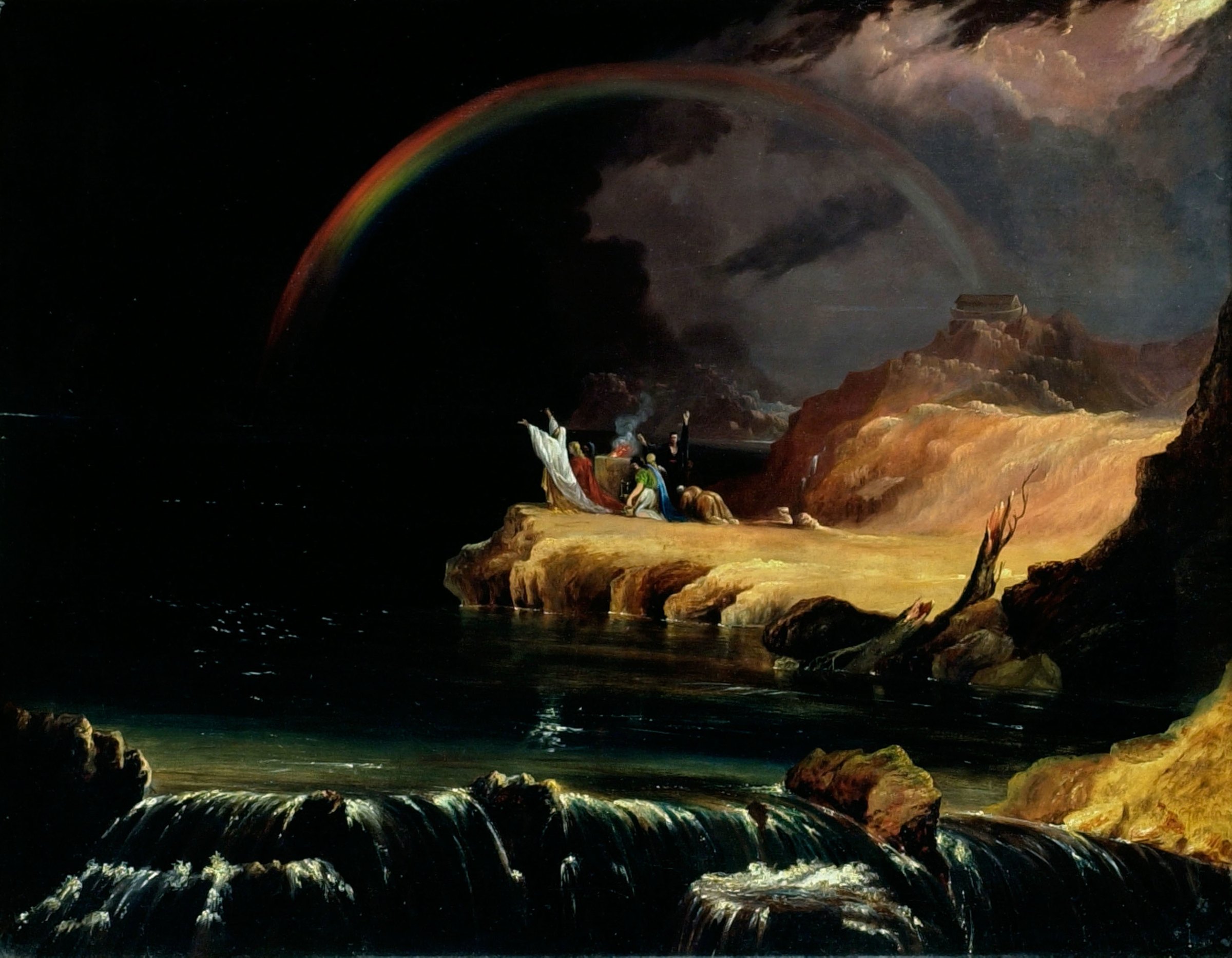
- The bowA rainbow arches across the storm cloud.Genesis 9:13
- The altarSmoke rises from a fire on a stone altar.Genesis 8:20
- Noah and his familyA white-robed figure lifts both arms, and the others kneel.Genesis 9:8
- The arkThe ark rests high on a mountain ridge.Genesis 8:4
- The broken treeA shattered trunk lies at the water's edge.Genesis 7:23
- The draining waterWater still spills over the rocks below.Genesis 8:13
Follower of John Martin, The Covenant, about 1843. Public domain.
Six parts of the canvas, each numbered where it stands, with the verse it answers to.
Four Scenes With a Bow
Genesis 9, Ezekiel 1 and Revelation 4 and 10, the bow in the cloud and the bow in the visions.
Scripture shows the bow in the clouds over the earth once and in visions of heaven three times.
| Scene | Where the bow stands | What surrounds it |
|---|---|---|
| After the flood | in the clouds over the earth | the ark, the altar, the creatures |
| By the river Chebar | in the brilliance around Him | the living creatures, the wheels and the expanse |
| The throne in heaven | encircling the throne | the twenty-four elders and the four living creatures |
| The mighty angel | above the head of an angel wrapped in a cloud | a little scroll and seven thunders |
The oath of Noah in IsaiahIsaiah 54:9 to 10
Isaiah takes the oath God swore in Noah's day as the pattern for His mercy to Jerusalem. The prophet does not mention the bow.
Though the mountains may be removed and the hills may be shaken, My loving devotion will not depart from you, and My covenant of peace will not be broken,” says the LORD, who has compassion on you.The prophet carries the oath of Noah on to God's loving devotion.
What Scripture Says and What Readers Have Heard
Two verses use the bow, as a sign and as a likeness, and a medieval rabbi reads its shape.
A SIGN OF THE COVENANT
The covenant the sign marks is made for all generations to come.
THE LIKENESS OF THE GLORY
Ezekiel compares the light around God to a bow on a rainy day.
The bow turned away from the earthChizkuni, as Ramban reports him
Ramban, in his Commentary on the Torah on Genesis 9:12, reports a reading he found in Chizkuni. The bow is set with its ends bent toward the earth, so that no arrow could seem to be shot from heaven at the ground. Chizkuni notes that warriors turn their weapons downward when they ask for peace.
Qeshet, Oth and Berith
The bow, the sign and the covenant, counted in Genesis 9.
Berith stands seven times in Genesis 9, more than the bow and the sign together.
The three counts as a table
| Word in Genesis 9:8 to 17 | Uses |
|---|---|
| berith, covenant, H1285 | 7 |
| oth, sign, H226 | 3 |
| qeshet, bow, H7198 | 3 |
Uses of each word in the Hebrew text of Genesis 9:8 to 17, on bars from zero.
The four other bows of GenesisGenesis 21:16, 27:3, 48:22 and 49:24
Genesis uses qeshet four more times. Hagar sits a bowshot from her son, and Isaac sends Esau out with his quiver and bow. Jacob gives Joseph land he took with sword and bow, and his blessing says Joseph's bow stayed steady when the archers attacked.
Yet he steadied his bow, and his strong arms were tempered by the hands of the Mighty One of Jacob, in the name of the Shepherd, the Rock of Israel,The last bow of Genesis is held steady by the Mighty One of Jacob.
What the Text Does Not Say
Four questions about the bow that Genesis leaves open.
Genesis names the bow as a sign and leaves its history and its colours unstated.
| What is not said | What the verse does say |
|---|---|
| Did rain or rainbows come before the flood? | It records the sign from the day of the covenant and says no more. |
| Which way does the bow point? | It appears in the clouds over the earth. |
| How many colours does it have? | Revelation compares the bow around the throne to an emerald. |
| Does a rainbow mean the storm is over? | The promise concerns a flood that destroys all life. |
The Bow Around the Throne
Revelation 4:3 and 10:1, the sign of mercy beside the scenes of judgment.
In Revelation the bow returns where judgment is about to fall. Before the seals are opened John sees it encircling the throne, and before the last trumpet he sees it over the head of a mighty angel. The God who judged the earth by water named a sign of His restraint, and the same sign stands around Him as the last judgments begin.
“The rainbow was the seal and token of the covenant of the providence that God made with Noah and his posterity with him, and is a fit emblem of that covenant of promise that God has made with Christ as the head of the church, and all his people in him, which covenant is as the waters of Noah unto God, an everlasting covenant, ordered in all things and sure.”
Matthew Henry · Commentary on the Whole Bible · on Revelation 4:3Puritan
Voices on the Rainbow
Three teachers from the thirteenth century to the nineteenth, each with the work named.
died 1274 · Bonaventure
“In the mystery of the cleansing of crimes, Christ is symbolized by the bow in the clouds, which is the sign of the covenant.”
Bonaventure · Collations on the Hexaemeron, Collation 14 · on Genesis 9:13Patristic
1798 to 1870 · Albert Barnes
“The rainbow is not simply a token of glory and splendor. The ‘cloud’ and the ‘day of rain’ point to its original message of forgiveness and mercy, and this is especially suited to Ezekiel’s commission, which was first to denounce judgment, and then promise restoration.”
Albert Barnes · Notes, Explanatory and Practical, on the Old and New Testaments (1832-1869) · on Ezekiel 1:28Evangelical
1802 to 1910 · Jamieson, Fausset & Brown
“Here, however, the predominating color among the prismatic colors is green, the most refreshing of colors to look upon, and so symbolizing God's consolatory promises in Christ to His people amidst judgments on His foes. Moreover, the rainbow was the appointed token of God's covenant with all flesh, and His people in particular.”
Jamieson, Fausset & Brown · Commentary Critical and Explanatory on the Whole Bible · on Revelation 4:3Reformed
Where Careful Readers Differ
Was the bow already in the sky, and does it point to Christ?
A bow that already existed, appointed as a signRamban, Commentary on the Torah; Jamieson, Fausset and Brown
Ramban holds that the rainbow comes naturally from the sun on damp air and had stood in the clouds since creation. He reads My bow and I have set as describing something God already owned, now made a sign from that day. Jamieson, Fausset and Brown also read set as appoint, a familiar sight made a pledge. The objection: Ramban himself grants that the words first read as though God made a new thing in the heavens.
The bow as a figure of ChristBonaventure; Matthew Henry
Matthew Henry, on Genesis 9:16, ties the bow's light to Christ as the Sun of righteousness, who has a rainbow about His throne, and Bonaventure's line among the voices takes the same view. The objection: Genesis makes the bow a sign between God and every living creature, and the New Testament never cites Genesis 9 about Christ.
Books to Read Next
Three works a student reads next, each free to read.
Commentary on the Whole Bible
Matthew Henry · 1708 to 1710
His notes on Genesis 9 and Revelation 4 follow the bow from the flood to the throne.
Read his Genesis notesCommentary on the Torah
Ramban (Nachmanides) · thirteenth century
It is set out verse by verse through the five books of Moses.
Read at SefariaNotes, Explanatory and Practical
Albert Barnes · 1832 to 1869
The volumes on the Prophets take Ezekiel chapter by chapter.
Read his Ezekiel notesThe Sign God Remembers
The bow in the cloud tells the reader that God binds Himself to His word, and that His mercy stands around His throne even when He judges. Paul says that God's promises are settled in Jesus, and the text asks the reader to rest on them.
For all the promises of God are “Yes” in Christ. And so through Him, our “Amen” is spoken to the glory of God.Sources
Scripture is the Berean Standard Bible.
- James Strong, Exhaustive Concordance of the Bible, 1890, entries H7198, H226, H1285 and G2463, with their occurrence counts and their uses in Genesis by Strong's number.
- Ramban (Nachmanides), Commentary on the Torah, on Genesis 9:12, translated by Charles B. Chavel, 1971 to 1976.
- Jamieson, Fausset and Brown, Commentary Critical and Explanatory, 1871, on Genesis 9:13.
- Albert Barnes, Notes, Explanatory and Practical, on Ezekiel 1:28.
- Jamieson, Fausset and Brown, Commentary Critical and Explanatory, 1871, on Revelation 4:3.
- Matthew Henry, Commentary on the Whole Bible, 1710, on Revelation 4:3.
- Matthew Henry, Commentary on the Whole Bible, 1710, on Genesis 9:16.
- Bonaventure, Collations on the Six Days, Collation 14, on Genesis 9:13.
Keep Studying
Studies1
People and groups3
Symbols9
Words1