
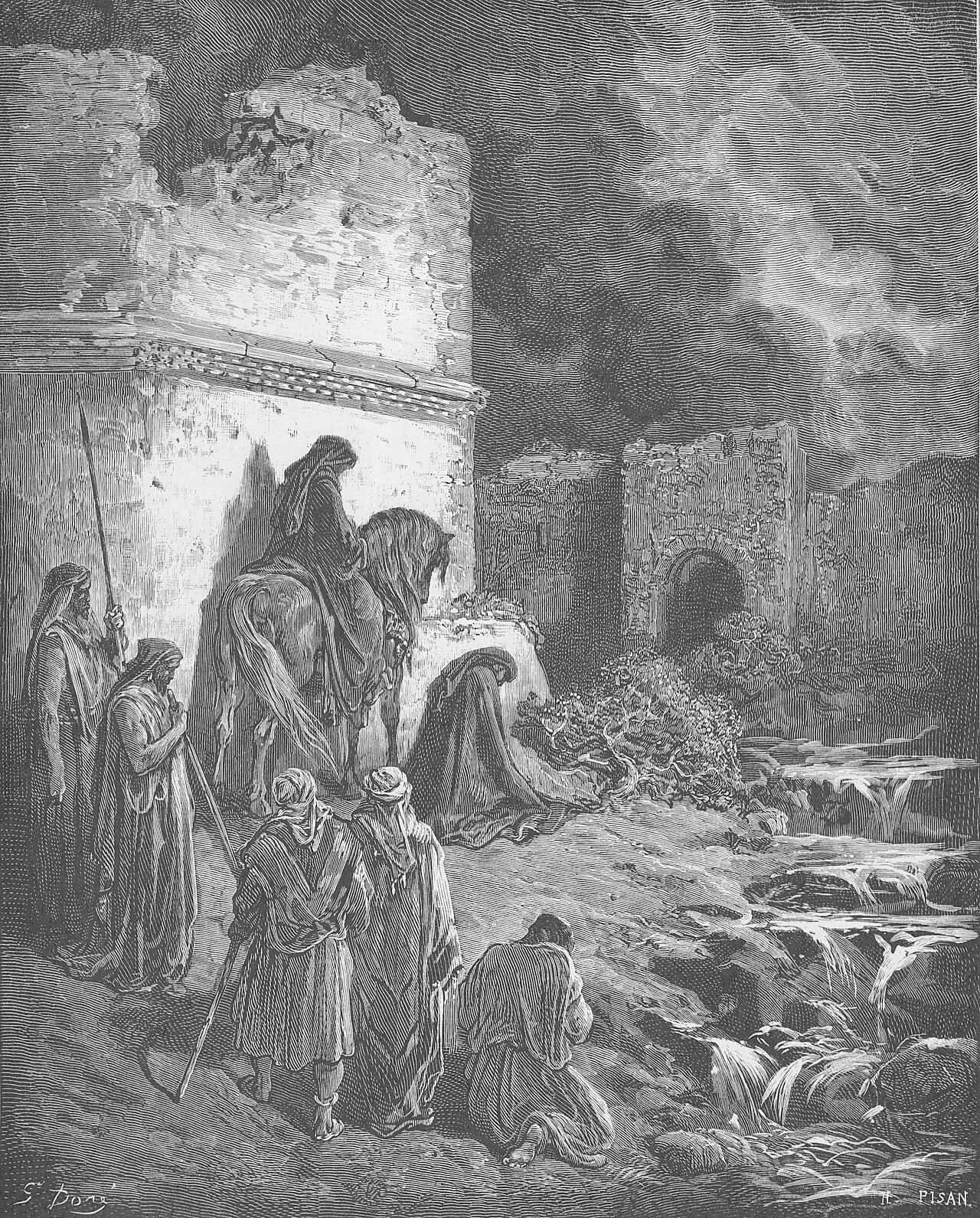
Nehemiah Views the Ruins of Jerusalem's Walls, Gustave Doré, 1866. Public domain.
Old Testament · Book 16 of 66
Nehemiah
Nehemiah records how Nehemiah came from Persia and led the people to rebuild the walls of Jerusalem in fifty-two days. Ezra reads the law, the people renew the covenant, and Nehemiah later returns to correct their failures.
Nehemiah records how Nehemiah came from Persia and led the people to rebuild the walls of Jerusalem in fifty-two days. Ezra reads the law, the people renew the covenant, and Nehemiah later returns to correct their failures.
What is Nehemiah about?
Nehemiah is the account, mostly in his own words, of a Jewish cupbearer at the Persian court who hears that the wall of Jerusalem lies broken and its gates burned. He prays, asks the king for leave, and is sent as governor. Under mockery and threat the people rebuild the wall in fifty-two days. Ezra then reads the Law in the square, the people confess their sins, and their leaders seal a covenant to keep it. The city is settled and the wall dedicated with two choirs. The book ends with Nehemiah back from the king, putting right what had slipped, and praying: “Remember me, O my God, with favor” (13:31).
All 13 chapters
Every chapter of the book, in one grid. Each cell opens that chapter.
- The wallNehemiah 1 to 7
- The wordNehemiah 8 to 10
- The cityNehemiah 11 to 13
The colour is the movement of the book the chapter stands in, and every cell opens that chapter's Study level.
Who wrote it, where, when, for whom, and why?
The book opens as the words of Nehemiah son of Hacaliah and tells most of its story in his own voice, from the news at Susa to his last prayer (13:31). Other parts stand in the third person: the list of those who first returned, which chapter 7 says Nehemiah found written in a register (7:5), and the lists of chapters 10 to 12. The list of priests runs to the days of Jaddua and of Darius the Persian (12:22).
These are the words of Nehemiah son of Hacaliah: In the month of Chislev, in the twentieth year, while I was in the citadel of Susa,
Nehemiah 1:1, Berean Standard Bible.
The book begins in the citadel of Susa, where Nehemiah serves the king, and moves to Jerusalem, where the rest of it stands. Jerusalem is a large city with few people inside a broken wall (7:4). Its enemies stand around it: Sanballat and the army of Samaria, Tobiah the Ammonite, the Arabs and the men of Ashdod (4:2, 4:7). The one call away from the city is to the plain of Ono (6:2).
Nehemiah dates the news to the month of Chislev in the twentieth year, and his request to the month of Nisan in the twentieth year of King Artaxerxes (2:1). The wall is finished on the twenty-fifth of Elul (6:15), the Law is read on the first day of the seventh month (8:2), and the fast falls on the twenty-fourth (9:1). He governs from the twentieth year to the thirty-second (5:14), goes back to the king in that year, and returns some time later (13:6).
The book is written for the people of Judah who came back from the exile, the remnant in the province (1:3) who settled in Jerusalem and in the towns of Judah (11:3). Its lists name their families, priests, Levites, singers and gatekeepers, so a later reader could find his house among those who returned and those who sealed the covenant (10:1 to 27).
The book records a people rebuilt around the Law: the wall so that Jerusalem would no longer be a disgrace (2:17), the Law read so that the people understood it (8:8), and a covenant sworn to keep it (10:29). Nehemiah asks four times that God remember what he did (5:19, 13:14, 13:22, 13:31), and the book ends on that prayer.
Then I said to them, “You see the trouble we are in. Jerusalem lies in ruins, and its gates have been burned down. Come, let us rebuild the wall of Jerusalem, so that we will no longer be a disgrace.”
Nehemiah 2:17, Berean Standard Bible.
Judah is a small province of the Persian empire. The governors west of the Euphrates must see the king's letters before Nehemiah may pass (2:7 to 9), the king's forest supplies the timber (2:8), and earlier governors had taxed the people for their food (5:15). Its neighbours have leaders of their own: Samaria to the north, the Ammonites, the Arabs and Ashdod on the coast (4:7).
Sources. Nehemiah 1:1, 1:3, 2:1, 2:7 to 9, 2:17, 4:2, 4:7, 5:14 and 15, 5:19, 6:2, 6:15, 7:4, 7:5, 8:2, 8:8, 9:1, 10:1 to 27, 10:29, 11:3, 12:22, 13:6, 13:14, 13:22 and 13:31. Every verse is read in the Berean Standard Bible.
How is Nehemiah arranged, and what is it for?
The three movements the book falls into, then what it teaches and what it was written to do.
- The wallNehemiah 1 to 7, 197 verses; the turn at 6:15
Nehemiah hears of the broken wall at Susa, is sent by the king, and leads the rebuilding against every threat.
- The wordNehemiah 8 to 10, 95 verses; the turn at 8:8
Ezra reads the Law to the people, they keep the feast of booths, confess their sins and seal a covenant.
- The cityNehemiah 11 to 13, 114 verses; the turn at 13:6
Jerusalem is settled by lot and its wall dedicated, and Nehemiah returns from the king to put right what had slipped.
The theme
A broken city is rebuilt in the order the book tells it: first its wall, then its people under the Law, then its common life. Each step begins in prayer and meets resistance, from enemies outside in the first movement and from the people's own lapses in the last. The wall is finished in weeks, but the covenant sworn in chapter 10 has to be enforced again in chapter 13, point by point.
The purpose
The book was written so that the people who came back from the exile would know how Jerusalem was made a city again, who built it, who swore to keep the Law in it and who settled in it. It shows the God of heaven granting success to people who pray and work, and it ends with a governor asking God to remember him, since the reforms depend on God and not on him.
The wall's gates in the order of chapter 3, round to where the roster began
The gates in the order of chapter 3 (10)
- 1The Sheep Gate 3:1Eliashib the high priest and his fellow priests, who dedicated it.
- 2The Fish Gate 3:3The sons of Hassenaah.
- 3The Jeshanah Gate 3:6Joiada son of Paseah and Meshullam son of Besodeiah.
- 4The Valley Gate 3:13Hanun and the residents of Zanoah, with a thousand cubits of wall.
- 5The Dung Gate 3:14Malchijah son of Rechab, ruler of Beth-haccherem.
- 6The Fountain Gate 3:15Shallun son of Col-hozeh, ruler of Mizpah.
- 7The Water Gate 3:26The temple servants of Ophel repaired opposite it.
- 8The Horse Gate 3:28The priests, each in front of his own house.
- 9The East Gate 3:29Shemaiah son of Shecaniah, its guard.
- 10The Inspection Gate 3:31Malchijah the goldsmith repaired opposite it.
Back to gate 1 (3:32): The goldsmiths and the merchants, from the upper room above the corner back to the first gate.
- The first choir, the solid arrow (12:31 to 37): To the right, toward the Dung Gate, then the Fountain Gate, up the steps of the City of David to the Water Gate.
- The second choir, the dashed arrow (12:38 to 39): To the left, past the Tower of the Ovens and the Broad Wall, over the Jeshanah Gate and the Fish Gate to the Sheep Gate.
- The house of God (12:40): both choirs stand there together.
The wall, Nehemiah 1 to 7
What the text says in these 7 chapters, and the pages they open on.
In the month of Chislev, Nehemiah, cupbearer to King Artaxerxes at Susa, hears from his brother Hanani that the wall of Jerusalem is broken down and its gates burned. He weeps, fasts and prays for days, confessing the sins of Israel and of his own father's house. In Nisan the king sees his sad face, and Nehemiah prays to the God of heaven before he answers. He is sent with letters and timber, rides round the ruins by night, and calls the leaders to build. Chapter 3 names the builders gate by gate. Sanballat and Tobiah mock, then plot an attack, and the builders work with one hand and hold a weapon with the other (4:17). Nehemiah cancels the debts the nobles had pressed on the poor, refuses every trap laid for him, and sees the wall finished. Chapter 7 sets the gatekeepers in place and copies the list of those who first returned.
So the wall was completed in fifty-two days, on the twenty-fifth of Elul.
- Study
Nehemiah 1the news from Jerusalem, and the prayer at SusaShow the summary and 4 pagesShow summary, 4 pagesHide the summary
In Chislev, in Shushan the palace, Hanani comes from Judah with the report that breaks the book open: 'The remnant who survived the exile are there in the province, in great trouble and disgrace. The wall of Jerusalem is broken down, and its gates are burned with fire.' Nehemiah sat down and wept, and mourned certain days, fasting and praying before the God of heaven: confessing the sins of Israel and of his own father's house, then pleading the word given to Moses: scattering for trespass, gathering for return, even from the uttermost part of the heavens. 'Give Your servant success this day, I pray, and grant him mercy in the sight of this man.' The last line sets it all up: 'At that time I was the cupbearer to the king.'
- Hanani brings the news of the broken wall and the burned gates (1:2 to 3).
- Nehemiah confesses Israel's sins and holds God to his word to Moses to gather the scattered (1:5 to 9).
- He asks for mercy before the king, whose cupbearer he is (1:11).
On this chapter (4)
- The exile and return
The fall of Jerusalem and the returns under Persia.
- The remnant
The people who survived the exile.
- Is the book Nehemiah's own memoir?
Answered under Where do readers disagree, lower on this page, with each reading and who holds it.
- Nehemiah 1:4
The verse on its own page, with the commentators on it by era.
- Study
Nehemiah 2the king's leave, and the night ride round the ruinsShow the summary and 4 pagesShow summary, 4 pagesHide the summary
Four months later, in Nisan, Nehemiah carries his grief into the throne room, and the king asks why his countenance is sad: 'Then I was very sore afraid.' He answers plainly: the city of his fathers' sepulchres lies waste. Asked what he requests, he prays mid-conversation ('So I prayed to the God of heaven'), then asks for letters of passage and timber from the king's forest, granted 'according to the good hand of my God upon me.' Sanballat and Tobiah are grieved. In Jerusalem he rides out alone by night to survey the ruined gates, telling no man, then calls the city: 'Come, and let us build up the wall of Jerusalem, that we be no more a reproach.'
- The king sees his sad face and asks what he wants (2:1 to 4).
- He is sent with letters for the governors and timber from the king's forest (2:7 to 9).
- He inspects the walls by night and calls the leaders to build (2:12 to 18).
On this chapter (4)
- Persia
The empire that sent Nehemiah.
- The seventy weeks
Daniel's count and the decree of 2:1 to 8.
- Was the year 445 BC, and how is it counted?
Answered under Where do readers disagree, lower on this page, with each reading and who holds it.
- Nehemiah 2:4
The verse on its own page, with the commentators on it by era.
- Study
Nehemiah 3the builders named gate by gateShow the summary and 3 pagesShow summary, 3 pagesHide the summary
The builders' roll: the whole circuit of the wall assigned name by name and gate by gate. Eliashib the high priest and his brethren begin with the sheep gate and sanctify it; from there the list runs to the fish gate, the old gate, the valley gate, the dung gate, the fountain gate by the king's garden, the water gate, the horse gate, and the gate of Hammiphkad. Goldsmiths, apothecaries, merchants, rulers of half-districts, and the daughters of Shallum each take a portion, many repairing 'over against his house.' One sour note in the chapter: the nobles of the Tekoites 'put not their necks to the work of their lord.'
- The high priest and the priests begin at the Sheep Gate and dedicate it (3:1).
- Each company repairs its own stretch, and the nobles of Tekoa refuse the work (3:5).
- Shallum repairs his section with the help of his daughters (3:12).
On this chapter (3)
- The wall
The rebuilding in fifty-two days.
- Where did the wall run, and what has been found?
Answered under Where do readers disagree, lower on this page, with each reading and who holds it.
- Nehemiah 3:1
The verse on its own page, with the commentators on it by era.
- Study
Nehemiah 4mockery, a plot, and builders armedShow the summary and 3 pagesShow summary, 3 pagesHide the summary
Ridicule first. 'What are these feeble Jews doing?' asks Sanballat, and Tobiah adds that a fox going up would break down their stone wall. Nehemiah prays, and the wall rises to half its height, 'for the people had a mind to work.' When mockery fails, conspiracy follows. So 'we prayed to our God and posted a guard against them day and night.' Judah complains that the strength of the burden-bearers is decayed and there is much rubbish. Nehemiah answers, 'Do not be afraid of them. Remember the Lord, who is great and awesome, and fight for your brothers, your sons and your daughters, your wives and your homes.' From that day half held spears while half wrought, every builder with his sword girded at his side: 'Our God will fight for us!'
- Sanballat and Tobiah mock the builders, and Nehemiah prays (4:1 to 5).
- The enemies plot an attack, and a guard is posted day and night (4:8 to 9).
- The builders work armed, with a trumpeter beside Nehemiah (4:17 to 18).
On this chapter (3)
- The watchman
The guard on the wall.
- Who was Sanballat, and what do the Elephantine papyri say?
Answered under Where do readers disagree, lower on this page, with each reading and who holds it.
- Nehemiah 4:9
The verse on its own page, with the commentators on it by era.
- Study
Nehemiah 5the debts cancelled, and the governor's own tableShow the summary and 1 pageShow summary, 1 pageHide the summary
The threat turns inward. A great cry rises from the people against their own brethren: fields, vineyards, and houses mortgaged for grain and for the king's tribute, sons and daughters brought into bondage. Nehemiah is very angry, holds a great assembly, and confronts the nobles: 'You are exacting usury from your own brothers! … Shouldn’t you walk in the fear of our God to avoid the reproach of our foreign enemies?' They agree to restore the lands and the money, and he shakes out his lap as a sign against any who fails to perform it; the assembly says Amen and praises Jehovah. Then his own accounting: twelve years as governor without eating the bread of the governor, because the bondage was heavy upon the people.
- The poor cry out that they have mortgaged their fields and sold their children (5:1 to 5).
- Nehemiah makes the nobles swear to return what they took (5:7 to 13).
- In twelve years as governor he never takes the governor's food allowance (5:14 to 15).
On this chapter (1)
- Nehemiah 5:7
The verse on its own page, with the commentators on it by era.
- Study
Nehemiah 6the traps refused, and the wall finishedShow the summary and 2 pagesShow summary, 2 pagesHide the summary
Four times Sanballat and Geshem summon him to the plain of Ono, and four times comes the same answer: 'I am doing a great work and cannot come down. Why should the work stop while I leave it to go down to you?' The fifth message arrives as an open letter charging rebellion and a plot to be crowned king; Nehemiah replies that they invent it out of their own heart, and prays, 'But now, my God, strengthen my hands.' A hired prophet urges him to hide inside the temple: 'Should a man like me run away? … I will not go!' The wall was finished in fifty and two days, and the nations 'realized that this task had been accomplished by our God.'
- He refuses four calls to meet on the plain of Ono (6:2 to 4).
- He answers the open letter and prays for strength (6:5 to 9).
- The wall is finished on the twenty-fifth of Elul (6:15).
On this chapter (2)
- The wall
The rebuilding in fifty-two days.
- Nehemiah 6:15
The verse on its own page, with the commentators on it by era.
- Study
Nehemiah 7the gates guarded, and the list of the first returnShow the summary and 2 pagesShow summary, 2 pagesHide the summary
With the doors hung and the porters, singers, and Levites appointed, Nehemiah gives charge of Jerusalem to his brother Hanani and to Hananiah the governor of the castle, 'for he was a faithful man, and feared God above many.' The gates are to be opened late and barred early, with watches set, every man over against his own house. But the city is large and wide and the people few, and the houses not yet builded. God puts it into his heart to reckon the people by genealogy. And he finds the register of those who came up at the first, reproduced here in full, the same roll as Ezra 2, down to the 42,360 of the assembly.
- Hanani and Hananiah are put in charge of the city and its gates (7:2 to 3).
- The city is large and its people few (7:4).
- Nehemiah finds the register of those who first returned and copies it (7:5 to 73).
On this chapter (2)
- The exile and return
The first return under Cyrus.
- Nehemiah 7:4
The verse on its own page, with the commentators on it by era.
Five attempts to stop the wall, then the finish, in the order the text gives them
- 14:1 to 5
Sanballat and Tobiah
- Tried
- Ridicule before the army of Samaria.
- Answer
- Nehemiah prays, and the wall rises to half its height (4:6).
- 24:8 to 9
Sanballat, Tobiah and their allies
- Tried
- A plot to attack Jerusalem.
- Answer
- The people pray and post a guard day and night.
- 36:2 to 3
Sanballat and Geshem
- Tried
- Four invitations to meet on the plain of Ono.
- Answer
- He will not come down from a great work.
- 46:5 to 8
Sanballat
- Tried
- An open letter charging him with plotting to be king.
- Answer
- He answers that nothing of the kind has happened.
- 56:10 to 13
Shemaiah son of Delaiah, hired by Tobiah and Sanballat
- Tried
- A call to hide in the temple.
- Answer
- He will not run away, and sees that God had not sent him.
- 66:15 to 16
The surrounding nations
- Heard
- The wall is finished on the twenty-fifth of Elul.
- Result
- They are afraid and disheartened, for they see that God did the work.
Characters (7)
Who the text names. A name with a page carries its door.
- Nehemiah
Cupbearer to the king, then governor of Judah, who tells the story in his own voice.
- Artaxerxes
The Persian king who grants him leave, letters and timber (2:8).
- Hanani
His brother, who brings the news (1:2) and is later put in charge of Jerusalem (7:2).
- Sanballat
The Horonite who ridicules the builders before the army of Samaria (4:2).
Show the next 3
- Tobiah
The Ammonite official who says a fox would break down the wall (4:3).
- Geshem
The Arab who joins the call to meet on the plain of Ono (6:2).
- Shemaiah
The son of Delaiah, hired to lure Nehemiah into the temple (6:10 to 12).
Places (4)
Where the chapters stand.
Themes (4)
What these chapters raise, a door where a page stands.
- The wall
The rebuilding in fifty-two days, argued in full.
- Prayer
Nehemiah prays at every turn, before the king and against the enemy (2:4, 4:9).
- The watchman
The guard set day and night on the wall.
- Persia
The empire that ruled Judah in these years.
Where the New Testament uses these chapters. No New Testament passage quotes or names these seven chapters. Two later Christian readings stand below, marked as such.
- Later Christian readingNehemiah 4:17 at The Sword and the Trowel. Charles Spurgeon named his monthly magazine after the builders who worked with one hand and held a weapon with the other, a picture of building the church and defending it. Held by Charles Spurgeon, The Sword and the Trowel (1865). The New Testament does not make this reading.
- Later Christian readingNehemiah 2:4 at a later commentary. Nehemiah's silent prayer before he answers the king is read as a model for prayer in the middle of work. Held by Matthew Henry, Commentary on the Whole Bible (1706), on 2:4. The New Testament does not make this reading.
The word, Nehemiah 8 to 10
What the text says in these 3 chapters, and the pages they open on.
In the seventh month the people gather in the square before the Water Gate and ask Ezra to bring out the Book of the Law of Moses. He reads from daybreak until noon while the Levites explain it, and the people weep as they hear it. Nehemiah and Ezra tell them the day is holy and send them home to eat and to share (8:10). The next day the leaders find the command to live in booths, and the whole assembly keeps the feast as it had not been kept since the days of Joshua. On the twenty-fourth day they fast in sackcloth, read the Law and confess, and the Levites pray the long prayer of chapter 9, telling Israel's story from creation to the exile. The leaders then put a binding agreement in writing and seal it (9:38), and chapter 10 lists what they swear to keep: no marriage with the peoples of the land, the Sabbath, the seventh year, the temple tax, the wood, the firstfruits and the tithes.
So they read from the Book of the Law of God, explaining it and giving insight, so that the people could understand what was being read.
- Study
Nehemiah 8Ezra reads the Law, and the feast of boothsShow the summary and 4 pagesShow summary, 4 pagesHide the summary
The book comes out in public. All the people gather as one man into the broad place before the water gate and ask Ezra for the book of the law of Moses; he reads from early morning until midday before men, women, 'and all that could hear with understanding,' and the ears of all the people were attentive. He stands on a pulpit of wood; when he opens the book the people stand, answer 'Amen, Amen' with lifted hands, and bow their faces to the ground. The Levites 'gave the sense, so that they understood the reading.' The people weep, and are told, 'the joy of Jehovah is your strength.' They find the feast of booths written, and keep it with very great gladness.
- Ezra reads the Law from daybreak until noon, and the Levites explain it (8:3 to 8).
- The people are told not to grieve, for the joy of the LORD is their strength (8:9 to 12).
- They find the feast of booths in the Law and keep it for seven days (8:14 to 18).
On this chapter (4)
- Tabernacles
The feast of booths.
- The Mosaic covenant
The Law read at the Water Gate.
- Did Ezra come before Nehemiah, or after?
Answered under Where do readers disagree, lower on this page, with each reading and who holds it.
- Nehemiah 8:8
The verse on its own page, with the commentators on it by era.
- Study
Nehemiah 9the fast, and the long prayer of confessionShow the summary and 1 pageShow summary, 1 pageHide the summary
On the twenty-fourth day the assembly returns in fasting and sackcloth, reading in the book a fourth part of the day and confessing a fourth part. Then the Levites lead Scripture's longest recital of covenant history in one prayer: 'You alone are the LORD. You created the heavens … You give life to all things'. Abraham chosen, Egypt and the divided sea, Sinai, the pillar of cloud and fire, manna and water out of the rock, forty years in which 'Their clothes did not wear out and their feet did not swell.' Again and again the fathers dealt proudly; again and again God is 'a forgiving God, gracious and compassionate, slow to anger and rich in loving devotion, and You did not forsake them.' They end as servants in their own land, and make a sure covenant in writing.
- The people fast and confess on the twenty-fourth day (9:1 to 3).
- The Levites pray Israel's story from creation and Abram to the exile (9:6 to 31).
- They call themselves slaves in their own land and make a binding agreement (9:36 to 38).
On this chapter (1)
- Nehemiah 9:6
The verse on its own page, with the commentators on it by era.
- Study
Nehemiah 10the covenant sealed, and what it bindsShow the summary and 2 pagesShow summary, 2 pagesHide the summary
The sealed covenant, its signatories listed first: Nehemiah the governor, then priests, Levites, and chiefs of the people. The rest, with their wives, sons, and daughters, every one that had knowledge and understanding, clave to their brethren and entered into a curse and an oath to walk in God's law given by Moses. The terms are specific: no intermarriage with the peoples of the land; no buying on the sabbath from those who bring wares; release of the land and of every debt in the seventh year; a yearly third of a shekel for the temple service; the wood-offering by lot; firstfruits, firstborn, and tithes brought in. 'We will not forsake the house of our God.'
- The governor, the priests, the Levites and the leaders seal the agreement (10:1 to 27).
- The people swear to keep the Law of God given through Moses (10:28 to 29).
- They bind themselves to the Sabbath, the temple tax, the wood, the firstfruits and the tithes (10:31 to 39).
On this chapter (2)
- Sabbath rest
The Sabbath the covenant binds.
- Nehemiah 10:29
The verse on its own page, with the commentators on it by era.
The seventh month, from the reading to the sealed agreement
The first day
Ezra reads the Law from daybreak until noon, the Levites explain it, and the people weep and are sent to feast.
The second day
The heads of the families study the Law with Ezra and find the command to live in booths.
Seven days and an eighth
The people live in booths, Ezra reads each day, and an assembly is held on the eighth day.
The twenty-fourth day
The people fast, read and confess, the Levites pray, and the leaders put their agreement in writing.
Characters (4)
Who the text names. A name with a page carries its door.
- Ezra
The priest and scribe who reads the Law to the assembly (8:2).
- The Levites
They explain the Law to the people as they stand in their places (8:7).
- The heads of the families
They study the Law with Ezra on the second day (8:13).
- Those who sealed
Nehemiah the governor first, then the priests, the Levites and the leaders (10:1 to 27).
Places (2)
Where the chapters stand.
- The square
Where Ezra reads to the assembly from a wooden platform (8:1 to 4).
- The booths
Built on rooftops, in courtyards and in the squares (8:16).
Themes (3)
What these chapters raise, a door where a page stands.
- The Law of Moses
The covenant at Sinai the people swear again to keep.
- Tabernacles
The feast of booths, kept in the seventh month.
- Sabbath rest
The Sabbath and the seventh year the covenant binds (10:31).
Where the New Testament uses these chapters. No New Testament passage quotes or names these three chapters. One later Christian reading stands below, marked as such.
- Later Christian readingNehemiah 8:8 at a later commentary. The Levites who read the Law and explained it are read as a pattern for preaching that gives the sense of the text. Held by Matthew Henry, Commentary on the Whole Bible (1706), on 8:8. The New Testament does not make this reading.
The city, Nehemiah 11 to 13
What the text says in these 3 chapters, and the pages they open on.
Jerusalem has a wall but few people (7:4), so the leaders settle in the city and the rest cast lots to bring one in ten to live there (11:1). Chapter 11 lists who settled in the city and in the towns, and chapter 12 lists the priests and Levites from the first return. At the dedication two thanksgiving choirs walk the top of the wall in opposite directions and meet in the house of God, and the joy of Jerusalem is heard far away (12:43). Chapter 13 opens after Nehemiah has gone back to the king. On his return he finds a room in the temple courts given to Tobiah, the Levites unpaid, the Sabbath kept as a market day, and men married to women of Ashdod, Ammon and Moab. He puts each right, and he closes three of them with a prayer that God remember him.
While all this was happening, I was not in Jerusalem, because I had returned to Artaxerxes king of Babylon in the thirty-second year of his reign. Some time later I obtained leave from the king
- Study
Nehemiah 11one in ten settled in JerusalemShow the summary and 2 pagesShow summary, 2 pagesHide the summary
Jerusalem is repopulated by lot. The princes already dwelt there, and one of every ten from the rest was brought in to dwell in 'the holy city,' the nine parts remaining in the other towns. And the people blessed all the men that willingly offered themselves to dwell in Jerusalem. The lists follow: chiefs of Judah and Benjamin who settled there, priests who did the work of the house, Levites, the overseer of the Levites, singers set over the business of the house of God, and porters keeping watch at the gates. Then the villages, from Beer-sheba and Kiriath-arba to the valley of Hinnom, where the rest of the people dwelt.
- One in ten is chosen by lot to live in Jerusalem (11:1 to 2).
- The chapter lists the families that settled in the city (11:3 to 24).
- It then lists the towns and villages where the rest of Judah lived (11:25 to 36).
On this chapter (2)
- Zion and Jerusalem
The holy city.
- Nehemiah 11:1
The verse on its own page, with the commentators on it by era.
- Study
Nehemiah 12the priests listed, and the wall dedicatedShow the summary and 2 pagesShow summary, 2 pagesHide the summary
First the rosters: the priests and Levites who came up with Zerubbabel and Jeshua, and the generations after them; then the dedication of the wall. Levites are sought out of all their places to keep it with gladness, thanksgivings, singing, cymbals, psalteries, and harps. Two great companies of them that gave thanks go in procession upon the wall itself in opposite directions, Ezra before the one and Nehemiah after the other, until they meet in the house of God. 'They offered great sacrifices that day, and rejoiced; for God had made them rejoice with great joy… so that the joy of Jerusalem was heard even afar off.'
- The priests and Levites who came up with Zerubbabel are listed (12:1 to 26).
- The priests and Levites purify the people, the gates and the wall (12:30).
- Two choirs walk the wall and meet in the house of God (12:31 to 43).
On this chapter (2)
- Zion and Jerusalem
The holy city.
- Nehemiah 12:43
The verse on its own page, with the commentators on it by era.
- Study
Nehemiah 13the reforms on Nehemiah's returnShow the summary and 3 pagesShow summary, 3 pagesHide the summary
The last chapter is every reform having to be made a second time. Reading in the book of Moses, they separate the mixed multitude. Nehemiah had returned to the king; coming back, he finds that Eliashib had prepared Tobiah a great chamber in the very courts of the house of God: 'and it grieved me sore: therefore I cast forth all the household stuff of Tobiah out of the chamber.' The Levites' portions had gone unpaid and the singers had fled to their fields; he sets them again in their place. He shuts the gates against sabbath traffic, and contends with those who married women of Ashdod, Ammon, and Moab, whose children could not speak the Jews' language. 'Remember me, O my God, for good.'
- Nehemiah throws Tobiah's goods out of the temple room (13:4 to 9).
- He restores the Levites' portions and shuts the gates on the Sabbath (13:10 to 22).
- He confronts the marriages and ends by asking God to remember him (13:23 to 31).
On this chapter (3)
- Sabbath rest
The Sabbath kept at the gates.
- Was the harshness of 13:25 right?
Answered under Where do readers disagree, lower on this page, with each reading and who holds it.
- Nehemiah 13:31
The verse on its own page, with the commentators on it by era.
Four reforms on Nehemiah's return, each with what he found and what he did
| Reform | What he found | What he did | Prayer |
|---|---|---|---|
| The storeroom13:4 to 9 | Eliashib had given Tobiah a large room in the courts of the house of God. | He threw out Tobiah's goods, had the rooms purified and put back the temple articles. | None at this reform. |
| The Levites' portions13:10 to 14 | The Levites and singers had not been paid and had gone back to their fields. | He rebuked the officials, set the Levites at their posts and appointed treasurers over the tithe. | 13:14 |
| The Sabbath13:15 to 22 | Wine was trodden and goods sold in Jerusalem on the Sabbath. | He rebuked the nobles, shut the gates at dusk and set the Levites to guard them. | 13:22 |
| The marriages13:23 to 29 | Men had married women of Ashdod, Ammon and Moab, and half their children could not speak the language of Judah. | He rebuked and struck them, made them swear an oath, and drove away the high priest's grandson. | 13:29 |
Characters (4)
Who the text names. A name with a page carries its door.
- Eliashib
The priest in charge of the storerooms, a relative of Tobiah (13:4).
- The two choirs
They walk the wall in opposite directions and meet at the house of God (12:31 to 40).
- Tobiah, again
Given a room in the temple courts, and thrown out of it (13:5 to 8).
- Jehoiada's son
A grandson of the high priest, son-in-law to Sanballat, driven away (13:28).
Places (3)
Where the chapters stand.
- Jerusalem, the holy city
Settled by one family in ten, chosen by lot (11:1).
- The storerooms
The rooms of the house of God for the tithes and the offerings (12:44, 13:5).
- Ammon
The Ammonites, with the Moabites, barred from the assembly in the Law read at 13:1.
Themes (3)
What these chapters raise, a door where a page stands.
- Zion and Jerusalem
The city of God through the Scriptures.
- The remnant
The people who came back and were kept.
- Separation
The marriages of 13:23 to 28 and the covenant of 10:30.
Where the New Testament uses these chapters. No New Testament passage quotes or names these three chapters.
- Author
- Nehemiah (chs. 1–7, 11–13 largely first-person memoir); Ezra-material probably compiled alongside
- Date
- Events 445–432 BC; final compilation late-5th century BC
- Audience
- The post-exilic community; later readers tracing civic and spiritual reform as paired work
Where do readers disagree?
One list: the readings with their holders, and what the evidence does not settle.
Did Ezra come before Nehemiah, or after?
Ezra→- Ezra first, in the seventh year of Artaxerxes I. Held by H. G. M. Williamson, Ezra, Nehemiah (1985), and by Derek Kidner, Ezra and Nehemiah (1979).
- Nehemiah first, and Ezra under Artaxerxes II. Held by Albin van Hoonacker, Néhémie et Esdras (1890).
- Ezra between Nehemiah's two terms. Held by John Bright, A History of Israel (1959).
What the evidence does not settle: Whether the names of Ezra in Nehemiah 8 and 12 stood in the first account or were joined to it by the book's editor, and which Artaxerxes Ezra 7 means.
The argument in full
Ezra first, in the seventh year of Artaxerxes I. Ezra 7:7 and 8 dates Ezra's arrival to the seventh year and Nehemiah 2:1 dates Nehemiah's to the twentieth of the same king, and the two men stand together at the reading of the Law (8:9) and in the list of 12:26.
Nehemiah first, and Ezra under Artaxerxes II. Ezra's king is read as the second Artaxerxes, so Ezra comes after Nehemiah; Nehemiah's own account of the wall never names Ezra, and Ezra finds a city already settled.
Ezra between Nehemiah's two terms. The seventh year of Ezra 7:8 is read as the thirty-seventh, which puts Ezra in Jerusalem while Nehemiah is away with the king; no manuscript carries that number.
Who was Sanballat, and what do the Elephantine papyri say?
- The governor of Samaria under Artaxerxes I. Held by A. E. Cowley, Aramaic Papyri of the Fifth Century B.C. (1923), whose edition prints the Elephantine letter of 407 BC naming the sons of Sanballat, governor of Samaria.
- A family of governors who reused the name. Held by Frank Moore Cross, A Reconstruction of the Judean Restoration (1975).
- A Sanballat of Alexander's time. Held by Flavius Josephus in his Antiquities of the Jews, book 11.
What the evidence does not settle: Whether the son-in-law of 13:28 and the priest in Josephus are one story told twice, and how many men bore the name.
The argument in full
The governor of Samaria under Artaxerxes I. A letter from the Jewish colony at Elephantine in Egypt writes to Delaiah and Shelemiah, sons of Sanballat, and names Johanan as high priest in Jerusalem, the Johanan of 12:22.
A family of governors who reused the name. Papyri from Wadi Daliyeh name a later Sanballat governing Samaria in the fourth century BC, so the office ran in one family and the name recurs across generations.
A Sanballat of Alexander's time. Josephus sets a Sanballat and his son-in-law, a priest of Jerusalem, a century later, and ties them to the temple on Mount Gerizim; he is read as having joined two men of one name.
Where did the wall run, and what has been found?
The wall→- The old eastern hill only. Held by H. G. M. Williamson, Nehemiah's Wall Revisited (1984).
- A stretch found on the eastern slope. Held by Eilat Mazar, The Wall That Nehemiah Built (2009).
- A city too small for the list. Held by Professor Israel Finkelstein, Jerusalem in the Persian Period and the Wall of Nehemiah (2008).
What the evidence does not settle: The text names gates and towers and gives no distances but the thousand cubits of 3:13, and the Persian layers are dated from the fill around them.
The argument in full
The old eastern hill only. The wall of chapter 3 follows the line of the City of David and the temple mount, and the western hill, settled in the time of the kings, was left outside it.
A stretch found on the eastern slope. A wall and a tower excavated on the eastern slope of the City of David are dated by the pottery and seals in their fill to Nehemiah's time.
A city too small for the list. The Persian layers of Jerusalem are thin, so the long list of chapter 3 may describe a later wall; he dates Mazar's tower later than she does.
Is the book Nehemiah's own memoir?
- His memoir, set into a larger book. Held by H. G. M. Williamson, Ezra, Nehemiah (1985).
- One work with Chronicles, by one writer. Held by William Foxwell Albright, The Date and Personality of the Chronicler (1921).
- A work of its own, apart from Chronicles. Held by Sara Japhet, The Supposed Common Authorship of Chronicles and Ezra-Nehemiah Investigated Anew (1968).
What the evidence does not settle: Where the memoir ends and the editor's work begins in chapters 7 to 12, since the text marks no seam.
The argument in full
His memoir, set into a larger book. The first person of chapters 1 to 7, 12:31 to 43 and chapter 13 is Nehemiah's own account, and an editor joined it to the lists and to the Ezra chapters.
One work with Chronicles, by one writer. Chronicles, Ezra and Nehemiah share their interests and their lists, and he named Ezra as the writer who compiled them with Nehemiah's memoir.
A work of its own, apart from Chronicles. The language and the outlook of Ezra and Nehemiah differ from those of Chronicles, so the books had different writers.
Was the harshness of 13:25 right?
- A needed defence of a small people. Held by Derek Kidner, Ezra and Nehemiah (1979).
- A record told without the text's approval. Held by David J. A. Clines, The Nehemiah Memoir: The Perils of Autobiography (1990).
What the evidence does not settle: The text records the acts and his prayer to be remembered (13:31), and it gives no verdict of its own; the same canon receives Ruth the Moabite by faith.
The argument in full
A needed defence of a small people. The children could not speak the language of Judah (13:24), and Nehemiah's own argument is Solomon, whom foreign wives drew into sin (13:26), so the concern is faith and not descent.
A record told without the text's approval. The memoir is Nehemiah's own case for himself, and the book reports his acts without saying that God approved each one.
Was the year 445 BC, and how is it counted?
The seventy weeks→- Nisan, 445 BC. Held by Sir Robert Anderson, The Coming Prince (1894).
- Nisan, 444 BC. Held by Harold Hoehner, Chronological Aspects of the Life of Christ (1977).
What the evidence does not settle: Whether Nehemiah counted the king's years from the spring or from the autumn, which moves the date by a year.
The argument in full
Nisan, 445 BC. The twentieth year of Artaxerxes I is fixed from the Persian king lists, and he counts Daniel's weeks from the grant of 2:1 to 8 in that month.
Nisan, 444 BC. Chislev (1:1) and Nisan (2:1) both fall in the twentieth year, which fits a year counted from the autumn, and that places Nisan of the twentieth year in 444 BC.
The pages Nehemiah opens on
Studies36
Show the next 6 titles
- Tabernacles
- Sabbath Rest
- Zion and Jerusalem
- The Mosaic Covenant
- The Historical Books
- The Joy of the LORD Is Your Strength
Show the next 6 titles
- Stewardship
- The Feast of Trumpets
- The Words Chazaq, Amats and Parrhesia
- The Kings of Israel & Judah
- The Golden Calf: Covenant Made, Broken, Remade
- The Words Enkrateia and the City Without Walls
Show the next 6 titles
Sources for this page
The painting in the band is Nehemiah Views the Ruins of Jerusalem's Walls, Gustave Doré, 1866. Public domain. The movements, the chapter entries, the graphics and the Context are read off the text of Nehemiah. The works behind the readings under Where do readers disagree are Albin van Hoonacker, Néhémie et Esdras (1890); Sir Robert Anderson, The Coming Prince (1894); William Foxwell Albright, The Date and Personality of the Chronicler (1921); A. E. Cowley, Aramaic Papyri of the Fifth Century B.C. (1923); John Bright, A History of Israel (1959); Sara Japhet, The Supposed Common Authorship of Chronicles and Ezra-Nehemiah Investigated Anew (1968); Frank Moore Cross, A Reconstruction of the Judean Restoration (1975); Harold Hoehner, Chronological Aspects of the Life of Christ (1977); Derek Kidner, Ezra and Nehemiah (1979); H. G. M. Williamson, Nehemiah's Wall Revisited (1984) and Ezra, Nehemiah (1985); David J. A. Clines, The Nehemiah Memoir: The Perils of Autobiography (1990); Israel Finkelstein, Jerusalem in the Persian Period and the Wall of Nehemiah (2008); Eilat Mazar, The Wall That Nehemiah Built (2009); and Flavius Josephus, Antiquities of the Jews. The later readings name Matthew Henry, Commentary on the Whole Bible (1706), and Charles Spurgeon, The Sword and the Trowel (1865). Every verse quoted on this page is the Berean Standard Bible, read from the store.