
Nehemiah 6:15
in Nehemiah 6So the wall was completed in fifty-two days, on the twenty-fifth of Elul.
BSB
The same verse in ASV and KJV ▾
ASV
So the wall was finished in the twenty and fifth day of the month Elul, in fifty and two days.
KJV
So the wall was finished in the twenty and fifth day of the month Elul, in fifty and two days.
⋯
This verse in Nehemiah 6
Commentary
7 notes on this verseA commentator
Albert Barnes1798–1870
Notes, Explanatory and Practical, on the Old and New Testaments (1832-1869)
Elul - The sixth month, corresponding to the latter part of August and the beginning of September. In fifty and two days - Josephus states that the repairs of the wall occupied two years and four months. But Nehemiah’s narrative is thoroughly consistent with itself, and contains in it nothing that is improbable. The walls everywhere existed at the time that he commenced his task, and only needed repairs. The work was partitioned among at least 37 working parties, who labored simultaneously, with material ready at hand; and, notwithstanding all menaces, uninterruptedly.
This site's exposition
in fifty and two days
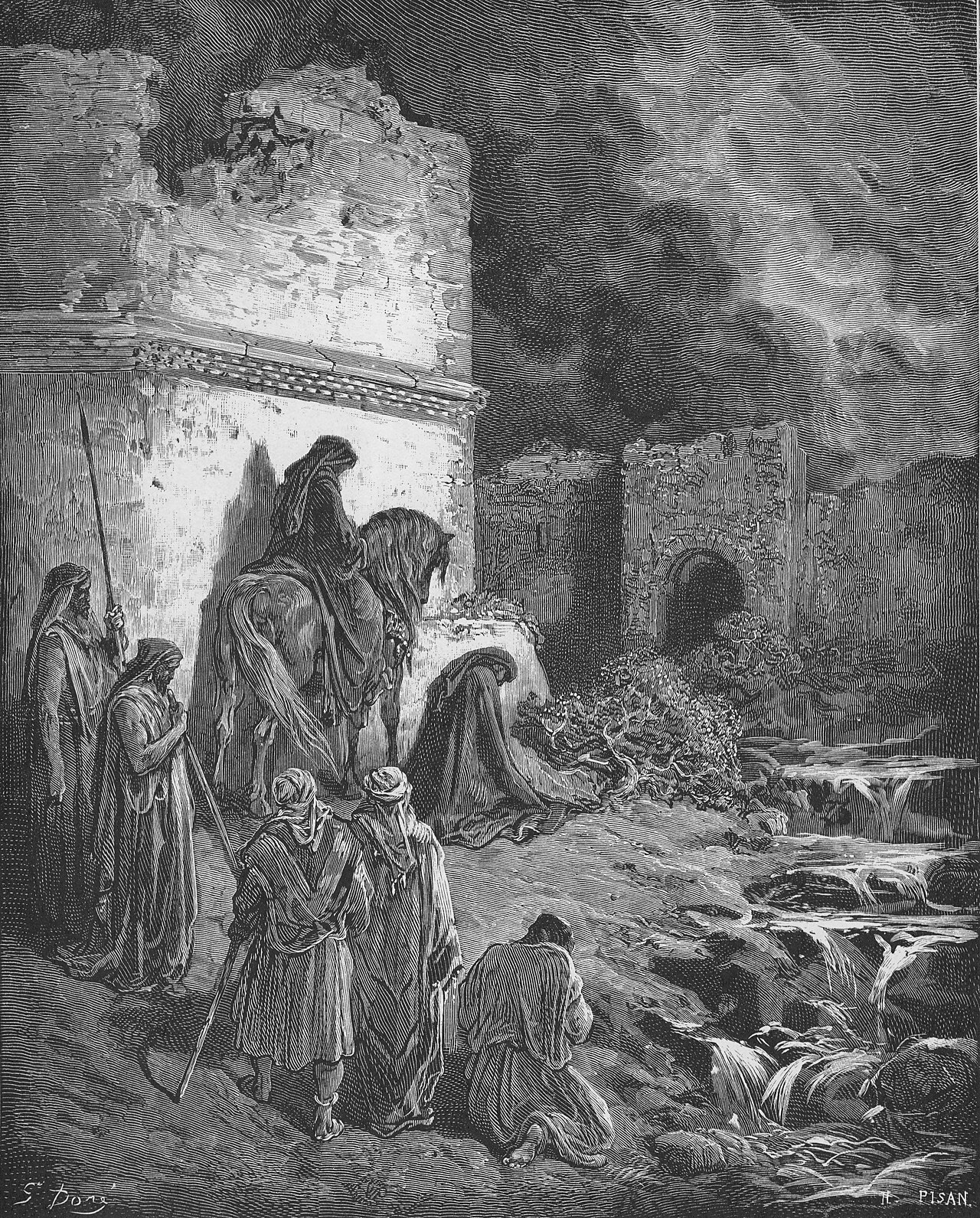
So the wall was finished in the twenty and fifth day of the month Elul, in fifty and two days, a single sentence closing five chapters of siege and slander. Elul falls in late summer, the sixth month of the Hebrew calendar, so the whole campaign from Nehemiah's first night ride around the ruins to the last stone set runs inside one working season. Henry credits the enemies' own threats with quickening the pace, since fear of attack pressed the builders to finish before danger could arrive. Keil sets the fifty two days against Josephus's much longer figure and finds Nehemiah's own count, tied to a named month and a named king's reign, the more reliable record.
The record, by era
The Medieval Church1 voice
Now the wall was completed on the twenty-fifth day of the month Elul, etc. The month Elul, according to the Hebrews, is the sixth month of the year, which the Romans call September. And rightly is the wall of the holy city completed in the …
The Puritans and the Awakening3 voices
5 Then sent Sanballat his servant unto me in like manner the fifth time with an open letter in his hand; 6 Wherein was written, It is reported among the heathen, and Gashmu saith it, that thou and the Jews think to rebel: for which cause thou buildest the wall, that thou mayest be their king, according to these words.
quarantine:scripture (2026-07-29) — verbatim-scripture
So the wall was finished in the twenty fifth day of the month Elul,....
Many were employed, and there was room for them; what they did they did cheerfully, and minded their business because they loved it. The threats of their enemies, which were intended to weaken them, it is likely, quickened them to go on with their work the more vigorously, that they might get it done before the enemy came.
The Nineteenth Century1 voice
The twenty and fifth - of - Elul - This Jewish month answers to a part of our August and September. Fifty and two days - I see no difficulty in supposing that several thousand workmen, each of whom was working as for God, should be able to complete this wall in fifty-two days. There is little doubt that several parts of the old wall were entire; in many places the foundations still remained; there were all the materials of the old wall still at hand; and though they had to clear and carry away much rubbish, yet they do not appear to have had any stones to quarry. The work mentioned here was little when compared to what Caesar did in Gaul and other places; and to what Titus did at Jerusalem, who built a wall round Jerusalem of five thousand paces in three days, besides, thirteen towers of ten stadia in circuit. And Quintus Curtius and Arrian inform us that Alexander the Great built the walls of Alexandria, on the Tanais, which were nearly eight miles in compass, in the space of between twenty and thirty days. Nehemiah therefore had time sufficient in fifty-two days to repair and restore the walls of Jerusalem. See Calmet on this place.
How the passage was read
What the Jewish commentators add
On the verses either side of this one
and also Noadiah the prophetess She and the rest of the false prophets received pay from Sanballat and his cohorts in order to frighten me with their false prophecies.
This section is reception history: how the passage was read and kept in the Jewish tradition. Where a reading parts from an essential of the Christian faith, the section says so at that point.
Texts and citation data: Sefaria; each excerpt follows its version’s licence. 3 further sources are cited on this chapter that carry no English text this site may quote or only restate the verse.
The words behind it
8 Hebrew wordsEvery Hebrew word of this verse in the order it stands, with what it means and the door to its own study. The last column counts the times a word stands in the whole Bible: the rarer the word, the more the places it appears belong together.
| Hebrew | Sound | Meaning | Word study | In the Bible |
|---|---|---|---|---|
| וַתִּשְׁלַם֙ | vatishlam | and it was complete | H7999 → | |
| הַֽחוֹמָ֔ה | hachomah | the wall | H2346 → | 133 times |
| בְּעֶשְׂרִ֥ים | beesrim | on [day] twenty | H6242 → | 315 times |
| וַחֲמִשָּׁ֖ה | vachamishah | and five | H2568 → | 343 times |
| לֶאֱל֑וּל | leelul | of Elul | H435 → | |
| לַחֲמִשִּׁ֥ים | lachamishim | to fifty | H2572 → | 163 times |
| וּשְׁנַ֖יִם | ushenayim | and two | H8147 → | 768 times |
| יֽוֹם׃ פ | yom | day[s] | H3117 → | 2304 times |
וַתִּשְׁלַם֙and it was complete
vatishlamH7999 →
הַֽחוֹמָ֔הthe wall
hachomahH2346 →133 times
בְּעֶשְׂרִ֥יםon [day] twenty
beesrimH6242 →315 times
וַחֲמִשָּׁ֖הand five
vachamishahH2568 →343 times
לֶאֱל֑וּלof Elul
leelulH435 →
לַחֲמִשִּׁ֥יםto fifty
lachamishimH2572 →163 times
וּשְׁנַ֖יִםand two
ushenayimH8147 →768 times
יֽוֹם׃ פday[s]
yomH3117 →2304 times
A shaded row is a word that stands 400 times or fewer in the Bible.
The walk
8 stopsEach card is a verse this one points to, and under it the verses that one points to in turn. Where several paths arrive at the same place, that place is listed first: the text keeps returning to it.
Through
Psalms 1:3He is like a tree planted by streams of water, yielding its fruit in season, whose leaf does not wither, and who prospers in all he does.
it leads to
- Jeremiah 17:8
He is like a tree planted by the waters that sends out its roots toward the stream. It does not fear when the heat comes, and its leaves are always green. It does not…
- Ezekiel 47:12
Along both banks of the river, fruit trees of all kinds will grow. Their leaves will not wither, and their fruit will not fail. Each month they will bear fruit, because the water from…
- Psalms 92:14
In old age they will still bear fruit; healthy and green they will remain,
- John 15:6
If anyone does not remain in Me, he is like a branch that is thrown away and withers. Such branches are gathered up, thrown into the fire, and burned.
- Ezekiel 19:10
Your mother was like a vine in your vineyard, planted by the water; it was fruitful and full of branches because of the abundant waters.
- Jeremiah 17:8
Through
Daniel 9:25Know and understand this: From the issuance of the decree to restore and rebuild Jerusalem, until the Messiah, the Prince, there will be seven weeks and sixty-two weeks. It will be rebuilt with streets…
it leads to
- Ezra 4:24
Thus the construction of the house of God in Jerusalem ceased, and it remained at a standstill until the second year of the reign of Darius king of Persia.
- Isaiah 55:4
Behold, I have made him a witness to the nations, a leader and commander of the peoples.
- John 4:25
The woman said, “I know that Messiah” (called Christ) “is coming. When He comes, He will explain everything to us.”
- Ezra 4:24
Where this verse is studied
On this page
About Nehemiah
This page draws on Adam Clarke, Commentary on the Bible; Albert Barnes, Notes, Explanatory and Practical, on the Old and New Testaments (1832-1869); Bede, Commentary on Ezra and Nehemiah; John Gill, Exposition of the Old Testament (1748-1763); Keil, The Books of Ezra, Nehemiah, and Esther and Matthew Henry, Commentary on the Whole Bible.