
The story
A crowd of many thousands stood in an open field outside Bristol in 1739 to hear a preacher who had been shut out of the churches, and much of it was coal miners who had never been inside one. The tears made white channels down their blackened faces, and Whitefield wrote that down.
It began in a farm town, not a capital. In the winter of 1734 Jonathan Edwards, pastor at Northampton in Massachusetts, was preaching on being made right with God by faith when the young people of his town stopped joking about it. Within six months, by his own careful count, some three hundred people in a town of about eleven hundred had been changed. He wrote it up honestly, including what troubled him, and A Faithful Narrative was read across the Atlantic, so that when the next wave came, people already knew its name.
Do not be amazed that I said, ‘You must be born again.’Whitefield preached this text so relentlessly that people asked him why; the answer he gave was simply that they must be born again, and the whole era turned on that one demand, that inherited religion is not enough.
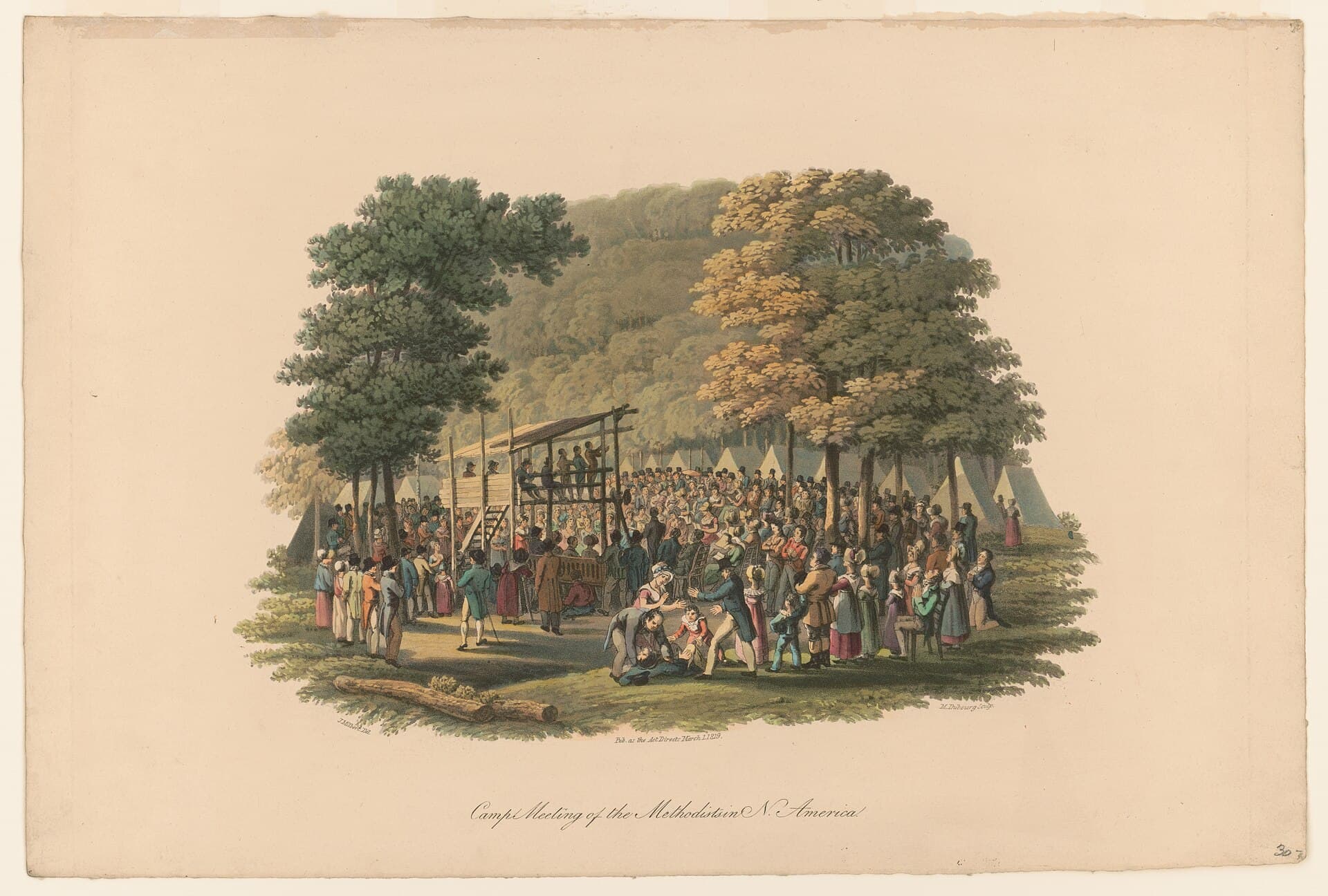
In England the door opened outdoors. In February 1739 George Whitefield, locked out of the pulpits by clergy who thought him a fanatic, stood on a rise at Kingswood near Bristol and preached to about two hundred coal miners. They had no parish and no pew; nobody's church had ever come for them. Whitefield wrote that he first knew they were affected when he saw the white gutters their tears made down their coal-blackened faces.
That is the hinge of this whole era: the preaching went to where the people actually were. Miners, sailors, brickmakers, and soldiers lived outside the parish system, and the parish system was largely content to let them. Whitefield talked John Wesley into the fields, though Wesley thought open-air preaching nearly sinful, on April 2, 1739, he wrote that he "submitted to be more vile" and preached from a little rise outside Bristol to about three thousand people. He kept it up for fifty more years and, by common estimate, rode a quarter of a million miles doing it.
The Spirit Himself testifies with our spirit that we are God’s children.This is what Wesley had been missing before Aldersgate and preached everywhere after it: that a believer can actually know he belongs to God, not merely hope so.
The two great preachers did not agree. Whitefield was a Calvinist: God chooses, and the chosen come. Wesley was an Arminian: Christ died for everyone, and grace can be resisted. In 1740 and 1741 they fought it out in print and the movement split into two streams, and both of them meant it, this was not a small disagreement, and neither man pretended it was.
They also refused to stay enemies. They preached in each other's causes, and Whitefield asked in his will that Wesley preach his funeral sermon; in November 1770 Wesley stood up and did it. The story most often retold is that someone asked Whitefield whether he expected to see Wesley in heaven, and he answered no. Wesley would be so near the throne, and he at such a distance, that he would hardly be able to see him. Whether or not the words are exact, the friendship was.
Beloved, do not believe every spirit, but test the spirits to see whether they are from God. For many false prophets have gone out into the world.Edwards took this verse as his text for The Distinguishing Marks in 1741, and it became the era's rule for handling an outpouring: not fear it, not swallow it whole, but test it.
Meanwhile Edwards did something braver than either defending the revival or fearing it: he tested it. People were crying out, shaking, and falling down, and half of New England wanted to call that proof and the other half wanted to call it proof of the opposite. Edwards said both were wrong. In The Distinguishing Marks (1741) and Religious Affections (1746) he argued that strong bodily effects settle nothing either way, and gave the real marks instead: Jesus exalted, sin hated, Scripture honored, love produced, and a life that keeps on afterward. Test the fire; do not put it out.
The theology the people actually kept was the theology they sang. Charles Wesley wrote something like six thousand hymns, "And Can It Be" out of the week of his own conversion, "O for a Thousand Tongues to Sing" on its first anniversary, and converts who owned no books carried whole doctrines home in their mouths. Forty years later John Newton, a former slave-ship officer turned country parson, and his neighbor the poet William Cowper published the Olney Hymns for their weeknight meetings. Number forty-one was Newton's own story: amazing grace, that saved a wretch like me.
O LORD, I have heard the report of You; I stand in awe, O LORD, of Your deeds. Revive them in these years; make them known in these years. In Your wrath, remember mercy!The prayer the awakened prayed for each other and for the next generation; it is where the word "revival" in this sense comes from, and it kept the movement asking God rather than admiring itself.
Crowds are easy; keeping them is not. In February 1742 Wesley's Bristol society was divided into groups of about a dozen so that a leader could visit each member weekly, and the visit quickly turned into an honest conversation about how that person was actually doing with God. Wesley made it the backbone of the movement. That is why Methodism outlived its founders while other revivals evaporated: a convert was not left alone with an experience, he was put in a room with eleven people who would ask him about it every week.
Much of it was carried by women, and much of it was paid for by one. Selina Hastings, Countess of Huntingdon, spent her fortune on the revival after 1746, made Whitefield her chaplain, funded some sixty chapels, and opened a college at Trevecca in 1768. Sarah Crosby began leading and then plainly preaching to hundreds; Mary Bosanquet made the scriptural case to Wesley in 1771, and he allowed that a woman under an extraordinary call could preach. Behind the Wesleys themselves stood their mother Susanna, who had taught nineteen children one at a time and told her husband that her kitchen meetings were not going to stop.
The era's writings, 1 to 3 of 9: each with its date and one line on what it holds.
| Writing | Date | What it holds |
|---|---|---|
| A Faithful Narrative of the Surprising Work of God | written 1737, from the 1734–35 revival | Edwards's town-by-town, person-by-person report of what happened in Northampton, the book that told two nations what a revival looks like from the inside, and made the next wave something people prayed for and expected. |
| The Distinguishing Marks of a Work of the Spirit of God | 1741 | Edwards's short, sharp test: crying out, fainting, and strong bodily effects prove nothing either way; the real marks, drawn from 1 John 4, are that Jesus is honored, sin is opposed, Scripture is loved, and people come out of it loving God and each other. |
| A Treatise Concerning Religious Affections | 1746 | The full-length version of the same argument, and still the standard book on telling real spiritual experience from a counterfeit. Its verdict: Christian practice is the chief sign, what the heart felt is proved by what the life does. |
The fire crossed lines that respectable religion had not. Whitefield preached to enslaved Africans, Samuel Davies in Virginia baptized them and taught them to read so they could have the hymnbook, and out of that soil came Harry Hosier, the formerly enslaved preacher who rode with Francis Asbury and whom many hearers judged the better of the two, and Richard Allen, converted as a young man in Delaware, who would found the African Methodist Episcopal Church. The Awakening also had to be told on itself: Whitefield pressed for slavery to be legalized in Georgia and used enslaved labor to support his Bethesda orphanage. Wesley called the trade the execrable sum of all villainies and Newton confessed his part in it publicly, the same revival produced both the sin and its accusers, and honesty requires saying so.
Where it went next is the point. Whitefield's orphan house at Bethesda opened in 1740 and Wesley's people ran schools, free medical help, and a lending fund for the poor; Robert Raikes started Sunday schools in Gloucester in 1780 that taught working children to read; awakened men like John Howard walked into the prisons and wrote down what they found. In 1785 a young Member of Parliament named William Wilberforce was converted, went to Newton for advice, and was told to stay in politics. Six days before he died in 1791, Wesley wrote him one last letter telling him to go on against that execrable villainy, the slave trade fell in 1807.
The era's writings, 4 to 6 of 9: each with its date and one line on what it holds.
| Writing | Date | What it holds |
|---|---|---|
| The Journal of the Rev. John Wesley | 1735–1790 | Fifty-five years of daily entries from the saddle: the storm at sea, Aldersgate, the mobs, the miners, the arguments, the deathbeds. It is the single richest first-hand record of the revival in England. |
| George Whitefield's Journals | 1738–1741, with later additions | Whitefield's own account of the field preaching, the colliers at Kingswood, the crossings, the American tours. He wrote them young, and in later life edited out some of what he judged youthful heat, which is itself worth noticing. |
| Charles Wesley's hymns | roughly 1738–1788 | Something on the order of six thousand hymns, written so ordinary people would carry the doctrine home in their mouths, "And Can It Be" (1738), from the week of his own conversion, and "O for a Thousand Tongues to Sing" (1739), written on the first anniversary of it. |
By 1800 the shape of modern evangelical Christianity was set: the call to be born again, the hymnbook, the small group, and the assumption that a converted people will go do something about the world outside the meeting. The next generation read these men and looked at a map. William Carey, a shoemaker with a homemade globe, was already asking why anyone should stay home.
The era's writings, 7 to 9 of 9: each with its date and one line on what it holds.
| Writing | Date | What it holds |
|---|---|---|
| Olney Hymns | 1779 | John Newton and William Cowper's collection for a country parish, containing "Amazing Grace," "Glorious Things of Thee Are Spoken," and "There Is a Fountain Filled with Blood." Written for farm workers to sing on a weeknight; still sung everywhere. |
| The Rules of the United Societies | 1743 | One page of Wesley's, and the whole discipleship system in it: do no harm, do good, attend upon the ordinances of God. Members were asked about these weekly in their class, face to face. |
| Thoughts Upon Slavery | 1774 | Wesley's frontal attack on the slave trade, published while it was still profitable and respectable to defend it. Newton would add his own confession in Thoughts Upon the African Slave Trade (1788), written by a man who had captained the ships. |
1 John 4:1, Habakkuk 3:2