
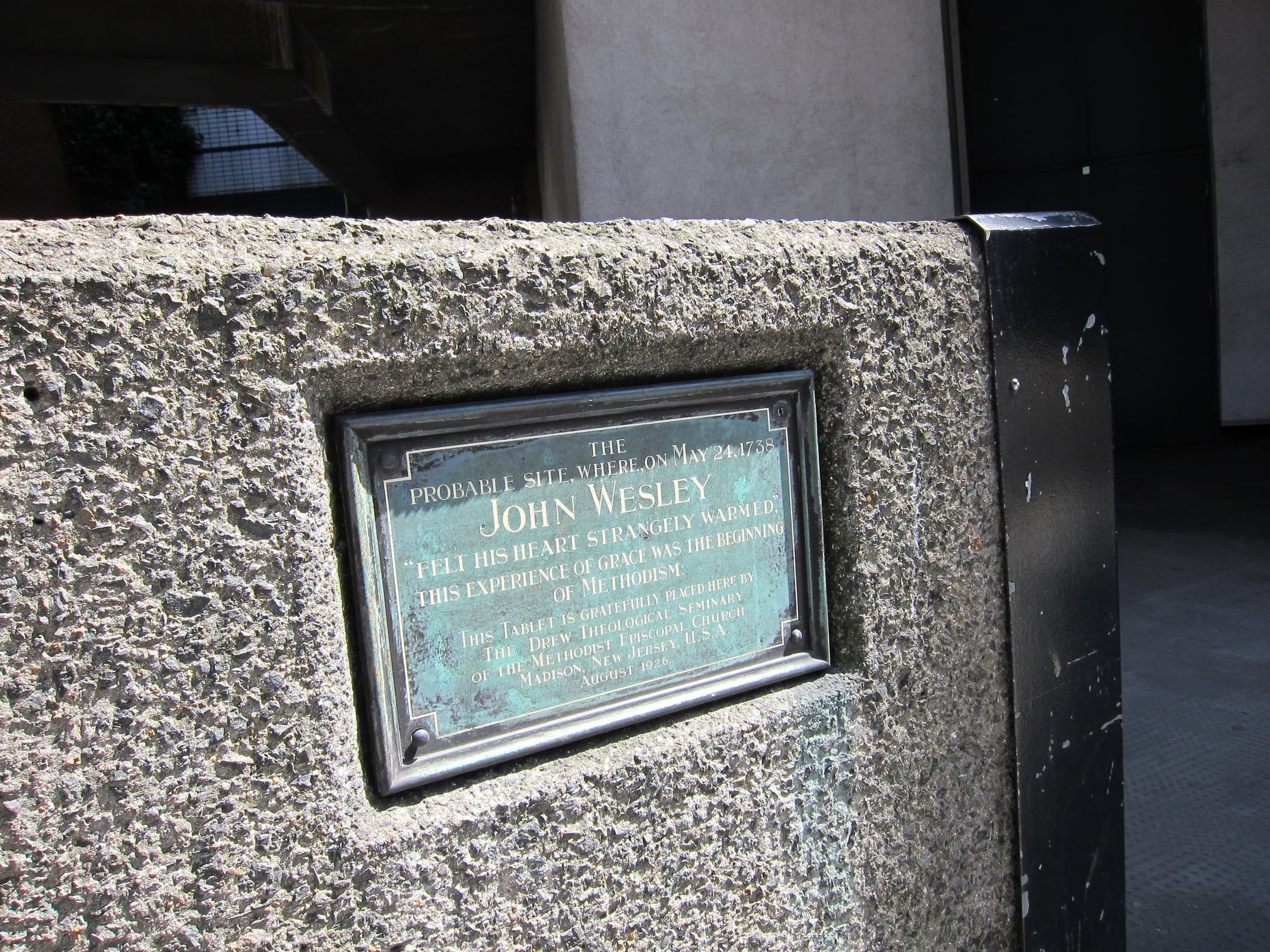
The tablet that marks Wesley's evening in Aldersgate Street, photographed by Ianpegg, 2013. CC0.
John Wesley's evening in Aldersgate Street · Story · Featured Study
Aldersgate, 1738
John Wesley's Journal records the evening his heart was warmed in a London meeting room, and the doubts of the months that followed.
- When
- 24 May 1738
Wesley set down the moment to the quarter hour: “About a quarter before nine.”
For in Christ Jesus the law of the Spirit of life set you free from the law of sin and death.
Summary
John Wesley's Journal names this evening in London as the hour he first trusted Christ alone.
- His brother Charles wrote a hymn on his own new faith the day before.
- Sir Frederick Bridge judged that the anthem Wesley heard that day was set by Henry Purcell.
- Wesley went to see the Moravians at Herrnhut that August.
The Verses of the Day
Wesley's entry names the Scripture he read and heard before the evening meeting.
Twice that morning Wesley turned to a text in his Testament, and in the afternoon he heard a psalm sung, and he copied each text into his Journal.
Through these He has given us His precious and magnificent promises, so that through them you may become partakers of the divine nature, now that you have escaped the corruption in the world caused by evil desires.It is the only text of the day Wesley names by chapter and verse, and he read it at about five in the morning.
When Jesus saw that the man had answered wisely, He said, “You are not far from the kingdom of God.” And no one dared to question Him any further.Wesley's Testament fell open at these words of Jesus as he went out, and he quotes them without a reference.
Out of the depths I cry to You, O LORD! O Lord, hear my voice; let Your ears be attentive to my plea for mercy.The anthem at St Paul's Cathedral that afternoon set this psalm, and Wesley copied its words into his entry.
Who Wrote of the Day
Five records tell of the day and the months around it, and Wesley himself wrote two of them.
Four of the five records come from the Wesleys or their editors, and the fifth is a tablet of 1926.
| Record | Written | What it adds |
|---|---|---|
| Wesley's own Journal, as Nehemiah Curnock edited it | He kept it that year and published it in parts | It gives the hours of the day in his own words |
| Charles Wesley's journal, as Thomas Jackson edited it in 1849 | He kept it that same week | It tells of his brother's arrival at ten that night |
| Wesley's later notes on his Journal, which Jackson first printed | They carry no date | They give his second thoughts on his state before Aldersgate |
| Curnock's notes, which stand in the Standard Edition | They came out with a preface of October 1909 | They name the two rival sites and the likely reader |
| The tablet that stands in Aldersgate Street | It was placed in August 1926 | It names the site as probable |
From the Voyage Home to the Evening Meeting
Four months ran from Wesley's crossing from Georgia to the meeting in Aldersgate Street.
Wesley was at sea on his way home from America in January. On 29 January he wrote that “I, who went to America to convert others, was never myself converted to God.”
In March he found his brother Charles at Oxford recovering from pleurisy, and with him the Moravian Peter Böhler.
On Sunday 5 March Böhler convinced him of unbelief, Wesley wrote, and of “the want of that faith whereby alone we are saved.”
Wesley asked whether he should give up preaching. Böhler told him, “Preach faith till you have it; and then, because you have it, you will preach faith.”
On Whitsunday, 21 May, Charles Wesley wrote that he “waked in hope and expectation of His coming.” He wrote that he found himself convinced, “I knew not how nor when.”
Three days later Wesley went in the evening “very unwillingly” to a society in Aldersgate Street, where one was reading Luther's preface to the Epistle to the Romans.
He wrote, “while he was describing the change which God works in the heart through faith in Christ, I felt my heart strangely warmed.”
His entry goes on, “I felt I did trust in Christ, Christ alone for salvation.”
He wrote that an assurance was given him “that He had taken away my sins, even mine, and saved me from the law of sin and death.”
He told everyone in the room what he now felt. Soon, he wrote, the enemy suggested that this could not be faith, since he had no joy.
He was taught, his entry says, that peace and victory over sin are essential to faith, and that God sometimes gives and sometimes withholds the joy that comes with it.
At home he was “much buffeted with temptations; but cried out, and they fled away.”
The Room and the Reader
Wesley named the street and left the house and the reader unnamed.
Curnock wrote in 1909 that two sites claimed the honour: Trinity Hall in Little Britain and Hall House in Nettleton Court, each once the home of a religious society.
He judged that “the balance of evidence is in favour of the Nettleton Court site.”
Curnock thought it extremely probable that the reader was William Holland, so that Charles had read to Holland and Holland then read to John.
What the Record Leaves Unsaid
No one outside the Wesley family set down what happened in the room.
None of the others in the room left an account of the evening in the record, so Wesley is the one witness to his own experience.
The Months After
Wesley's own pages show how long it took him to be settled in what he received.
That October Wesley examined his own life and wrote, “I cannot find in myself the love of God, or of Christ.”
On 4 January 1739 his Journal printed reflections it gave to “One who had had the form of godliness many years”: “I affirm I am not a Christian now.”
The same reflections said that a year before he had received “such a sense of the forgiveness of my sins as till then I never knew.”
Years later, beside his words of 29 January, Wesley wrote, “I am not sure of this.”
Of himself before Aldersgate he wrote, “I had even then the faith of a servant, though not that of a son.”
How the Key Verse Was Taught
Four voices from the early church to the nineteenth century take up Romans 8:2.
John Chrysostom (died 407)
Homilies on the Epistle to the Romans, Homily 13
A homily of the early church asks what name Paul gives the Spirit in this verse.
“It is the Spirit he is here calling the law of the Spirit. For as he calls sin the law of sin, so he here calls the Spirit the law of the Spirit.”
Patristic
Matthew Henry (1662 to 1714)
Commentary on the Whole Bible
An exposition of the eighteenth century sets out what the freedom of the verse holds.
“The covenant of grace made with us in Christ is a treasury of merit and grace, and thence we receive pardon and a new nature, are freed from the law of sin and death, that is, both from the guilt and power of sin”
Puritan
John Gill (1697 to 1771)
Exposition of the New Testament
A commentary of the 1740s weighs what the law of the verse may mean.
“These words are of difficult interpretation. They may be understood of the Gospel revealing and declaring deliverance from the law of Moses”
Reformed Baptist
Adam Clarke (1762 to 1832)
Commentary on the Bible
A nineteenth-century exposition names the power the gospel brings to the heart.
“The Gospel of the grace of Christ, which is not only a law or rule of life, but affords that sovereign energy by which guilt is removed from the conscience, the power of sin broken, and its polluting influence removed from the heart.”
Methodist
John Gill, Adam Clarke
In Their Own Words
The brothers wrote these lines on the voyage home, of the meeting room, and on the night itself.
Charles Wesley (1707 to 1788)
Journal, 24 May 1738, volume I
Ten o'clock that night
“Towards ten, my brother was brought in triumph by a troop of our friends, and declared, 'I believe.' We sang the hymn with great joy, and parted with prayer.”
Methodist
About this saying1 paragraph
His brother wrote down how that night of 1738 ended.
John Wesley (1703 to 1791)
Journal, 24 January 1738, Curnock, Standard Edition, volume I
At sea in January
“I went to America, to convert the Indians; but oh, who shall convert me?”
Evangelical
About this saying1 paragraph
He asked this on the voyage home in 1738, four months before the evening in Aldersgate Street.
John Wesley
Journal, 24 May 1738, section 15, Curnock, Standard Edition, volume I, page 476
His first prayer
“I began to pray with all my might for those who had in a more especial manner despitefully used me and persecuted me.”
Evangelical
About this saying1 paragraph
His Journal makes this his first act in 1738 after his heart was warmed.
Where Historians Disagree
Wesley's biographers differ on what the evening was, and his editor asked what was read.
Was Aldersgate Wesley's conversion?4 paragraphs
Curnock held in 1909 that until that evening Wesley “neither knew, as a normal experience, the meaning of saving faith, nor had he the power to fulfil his Lord's mission.”
Fitchett wrote in 1906 that by Wesley's own explanation he was “converted” at that hour.
Overton had written in 1891, “If John Wesley was not a true Christian in Georgia, God help millions of those who profess and call themselves Christians!”
Tyerman read the evening in 1872 as the day Wesley knew he was accepted, “happy as well as safe.”
Was it the preface to Romans?1 paragraph
Wesley's Journal names Luther's preface to the Epistle to the Romans. Curnock asked whether “Romans” was a misprint or an error of association for “Galatians,” and wrote that “The discovery of a missing Diary would set the question at rest.”
Books to Read Next
The Journal of the Rev. John Wesley, Standard Edition, volume I
Nehemiah Curnock, editor · 1909
Curnock prints the entry of 24 May with notes on the two sites and the reader.
Free at the Internet ArchiveThe Journal of the Rev. Charles Wesley, volume I
Thomas Jackson, editor · 1849
In it Charles Wesley records the brothers' Whitsun week from his own side.
Free at the Internet ArchiveThe Life and Times of the Rev. John Wesley, volume 1
Luke Tyerman · 1872
Tyerman weighs Wesley's later sermon against the Journal of that year.
Free at the Internet ArchiveWhat Aldersgate Left
The evening gave the Methodists the words their tablet quotes, and Wesley's own later pages left the question of what had begun that night open to his biographers.
Sources
Scripture is the Berean Standard Bible.
- The Holy Bible, Berean Standard Bible (read 2026)
- The Journal of the Rev. John Wesley, ed. Nehemiah Curnock, Standard Edition, volumes I and II (London: R. Culley; volume I's preface dated October 1909), the entries of 24 and 29 January, 4 and 5 March and 24 May 1738, 1 August and October 1738 and 4 January 1739, with Curnock's notes.
- The Journal of the Rev. Charles Wesley, ed. Thomas Jackson, volume I (London: John Mason, 1849), and The Early Journal of Charles Wesley (London: Charles H. Kelly, prefatory note 1909), the entries of 21 to 24 May 1738.
- Luke Tyerman, The Life and Times of the Rev. John Wesley, volume 1 (New York: Harper, 1872)
- J. H. Overton, John Wesley (London: Methuen, 1891), pages 60 and 61.
- W. H. Fitchett, Wesley and His Century (London: Smith, Elder, 1906), pages 126 and 127.
- John Chrysostom, Homilies on the Epistle to the Romans, Homily 13, in Nicene and Post-Nicene Fathers, first series, volume 11, ed. Philip Schaff (Edinburgh: T. and T. Clark; the preface dated March 1889)
- Matthew Henry, Commentary on the Whole Bible, on Romans 8:2.
- John Gill, Exposition of the New Testament (1746 to 1748), on Romans 8:2.
- Adam Clarke, Commentary on the Bible, on Romans 8:2.
Keep Studying
People and groups9
Doctrines1
Church history2