
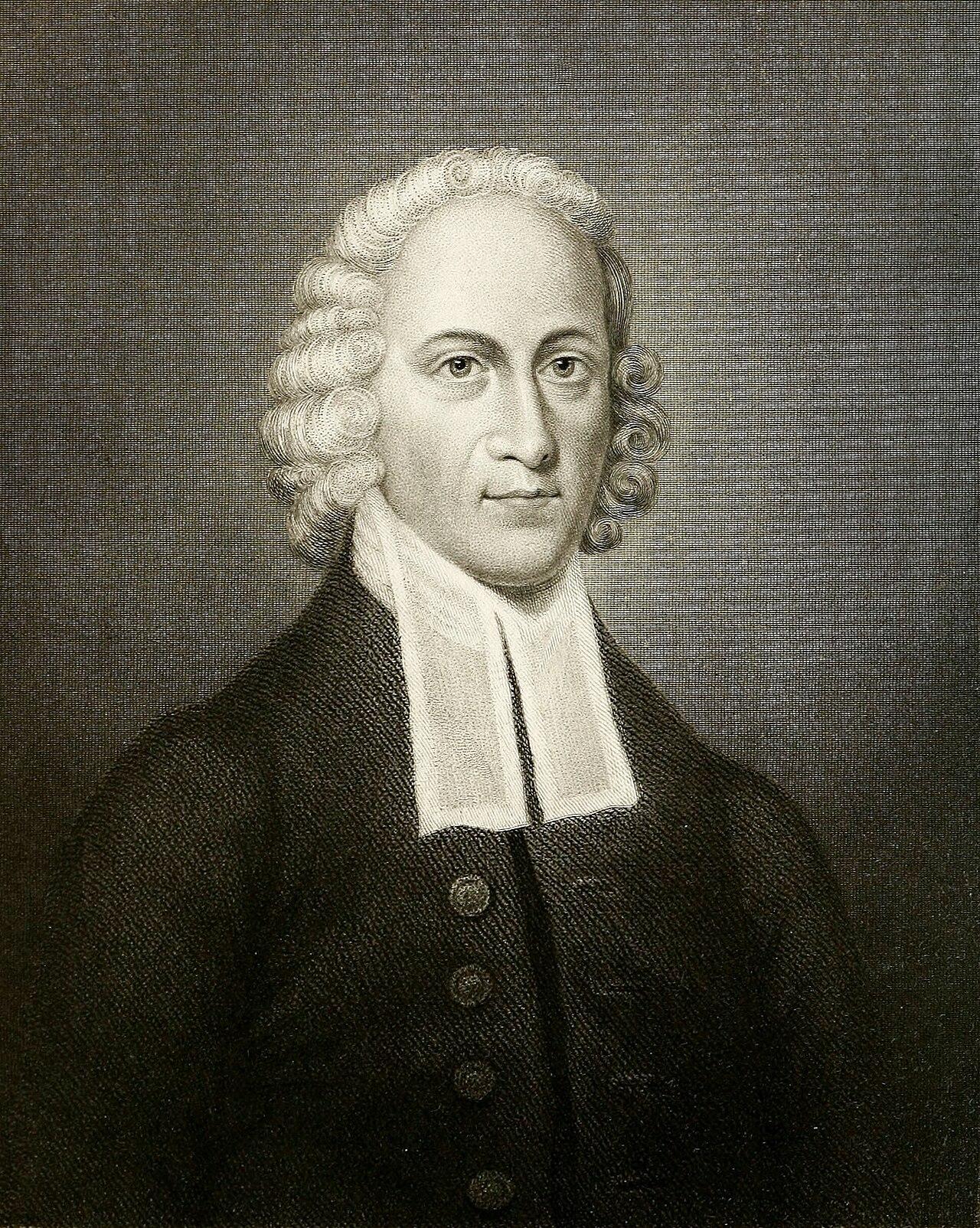
R. Babson and J. Andrews, Jonathan Edwards, before 1855. Public domain.
New England and New Jersey, 1703 to 1758 · Person · Featured Study
Jonathan Edwards
A Connecticut-born minister whose account of one town's revival was read on both sides of the Atlantic.
He counted the souls of a revival as a hope, wrote down its signs and its failures, and lost his pulpit fifteen years later.
Though you have not seen Him, you love Him; and though you do not see Him now, you believe in Him and rejoice with an inexpressible and glorious joy,
- Born
- 5 October 1703 at Windsor in Connecticut
- Died
- 22 March 1758 at Princeton
- Family
- father: Timothy Edwards; wife: Sarah Pierpont; grandfather: Solomon Stoddard
- Places
- Windsor, New Haven, Northampton, Stockbridge, Princeton
Summary
Jonathan Edwards was ordained at Northampton in 1727 as colleague to his grandfather Solomon Stoddard. In the middle of the 1730s his town was awakened, and his account of it was printed in London and Boston. He preached at Enfield in 1741 and wrote tests for a true work of the Spirit. His church later dismissed him, and he died at Princeton in 1758.
- His Religious Affections of 1746 takes 1 Peter 1:8 as its text.
- His church voted to dismiss him over who should come to the Lord's Supper.
- He bought and kept enslaved people.
The Text of the Affections
One verse heads his treatise on the affections, and another heads his sermon at Enfield.
Edwards set 1 Peter 1:8 over the first part of his Treatise Concerning Religious Affections. He read in it Christians under persecution who loved Christ unseen and rejoiced with joy unspeakable.
He wrote that such trials show true religion and tell it apart from false. The question of his life is how a pastor who had watched a revival learned to test it.
Vengeance is Mine; I will repay. In due time their foot will slip; for their day of disaster is near, and their doom is coming quickly.”From it he drew the doctrine that only the pleasure of God keeps the wicked out of hell.
The Life in Order
Samuel Hopkins gives most of the dates in the first life of Edwards, printed at Boston in 1765.
He served Northampton for twenty-three years and four months.
- 5 October 1703He was born at Windsor in ConnecticutHopkins, 1765
- 1716 to 1720He studied at Yale CollegeHopkins, 1765
- August 1722His preaching in New York beganHopkins, 1765
- 1724Tutor at YaleHopkins, 1765
- February 1727He was ordained at Northampton as colleague to Solomon StoddardHopkins, 1765
- July 1727He married Sarah Pierpont of New HavenHopkins, 1765
- 1734 and 1735Northampton was awakenedEdwards, A Faithful Narrative
- 8 July 1741Sinners preached at EnfieldThe sermon's title page
- 1746His Religious Affections was publishedHopkins, 1765
- 22 June 1750His church dismissed himHopkins, 1765
- 8 August 1751He was fixed as missionary to the Indians at StockbridgeHopkins, 1765
- March 1758He died at PrincetonHopkins, 1765
Each step of the life stands with its witness.
1734 and 1735, 8 July 1741, 1746, 22 June 1750, 8 August 1751, March 1758
From Windsor to Princeton
Hopkins tells the life, and Edwards told the revival of his town himself.
Edwards was born at Windsor in Connecticut on 5 October 1703, the son of Timothy Edwards, minister of the parish on the east side of the river. He entered Yale College in 1716 and took his first degree in 1720, a little before he was seventeen.
He preached to a small church in New York for about eight months from August 1722 and became a tutor at Yale in 1724. Northampton then called him to serve beside his grandfather Solomon Stoddard, and he was ordained there on 15 February 1727. That July he married Sarah Pierpont, the daughter of a New Haven minister.
Jonathan Edwards was pastor of Northampton, Massachusetts, when in the winter of 1734 and 1735 the town was seized by a concern for God that he said left scarcely a house untouched. His careful printed account, A Faithful Narrative of the Surprising Work of God, carried the news across the Atlantic and helped kindle the transatlantic Great Awakening.
George Whitefield preached in his pulpit in October 1740 and wrote in his journal that Edwards wept during the whole time of the sermon. On 8 July 1741 Edwards preached Sinners in the Hands of an Angry God at Enfield, and the sermon was soon printed at Boston.
When the revival brought both real conversions and real excesses, Edwards watched closely and wrote down how to tell the difference, in The Distinguishing Marks and then Religious Affections.
Stoddard had admitted to the Lord's Supper people who made no profession of conversion. Edwards came to think the practice wrong and argued it in print in 1749. A council met in June 1750, and his church voted for his dismissal.
After his dismissal he went to the frontier mission at Stockbridge. There he wrote the works that Hopkins counted among the greatest of the century, his Freedom of the Will of 1754 among them.
He died of a smallpox inoculation weeks after becoming president of the College of New Jersey at Princeton. Hopkins writes that he was inoculated on 13 February 1758 and died on 22 March.
The Enslaved in His House
The Yale and Slavery Research Project names the people Edwards bought and kept.
Kenneth Minkema of the Jonathan Edwards Center at Yale writes that Edwards bought a succession of slaves at Northampton and Stockbridge. The first was a teenaged girl named Venus, bought at Newport in 1731, and the last a child named Titus, in 1756. Minkema names others as Leah, Rose, and a married couple, Joseph and Sue.
Minkema writes that Edwards defended slavery as allowed by Scripture. In the one document known to discuss it, he also criticised the slave trade and called it unjust to take away the freedom of people born free.
In Their Own Words
Five sayings from his narrative of 1736 to his treatise on the affections, each with its year.
Jonathan Edwards (1703 to 1758)
A Faithful Narrative of the Surprising Work of God, page 8
Like a flash of lightning
“The news of it seemed to be almost like a flash of Lightning, upon the Hearts of young People, all over the Town, and upon many others.”
Congregationalist
About this saying1 paragraph
He wrote this in 1736 of how the news of one young woman's conversion went through the town.
Jonathan Edwards
A Faithful Narrative of the Surprising Work of God, page 16
More than three hundred souls
“I am far from pretending to be able to determine how many have lately been the Subjects of such Mercy; but if I may be allowed to declare any thing that appears to me probable in a thing of this nature, I hope that more than three Hundred Souls were savingly brought home to Christ, in this Town, in the space of half a Year (how many more I don't guess) and about the same Number of Males as Females.”
Congregationalist
About this saying1 paragraph
In the same letter of 1736 he gave his count of the converted as a hope.
Jonathan Edwards
Sinners in the Hands of an Angry God, the application
The door of mercy
“And now you have an extraordinary opportunity, a day wherein CHRIST has flung the door of mercy wide open, and stands in the door calling and crying with a loud voice to poor sinners”
Congregationalist
About this saying1 paragraph
These words close the Enfield sermon of 1741.
Jonathan Edwards
The Distinguishing Marks of a Work of the Spirit of God, section I
What the body shows
“A Work is not to be judged of by any Effects on the Bodies of Men; such as Tears, Trembling, Grones, loud Outcries, Agonies of Body, or the failing of bodily Strength.”
Congregationalist
About this saying1 paragraph
He wrote this in The Distinguishing Marks of 1741 against judging a revival by its outcries.
Jonathan Edwards
A Treatise Concerning Religious Affections (Boston, 1746), part 1, page 3
Holy affections
“True Religion, in great Part, consists in holy Affections.”
Congregationalist
About this saying1 paragraph
This is the opening claim of his Religious Affections, printed at Boston in 1746.
The People Around Him
The witnesses name his family, a guest, his biographer and the people he owned.
A grandfather's practice at the Lord's Supper cost him his pulpit.
| Person | Tie to Edwards | The witness |
|---|---|---|
| Timothy Edwards | His father, minister at Windsor for above fifty-nine years, who died two months before him. | Hopkins, 1765 |
| Solomon Stoddard | His grandfather and the elder pastor at Northampton, whose rule for the Supper he later opposed. | Hopkins, 1765 |
| Sarah Pierpont | His wife, born at New Haven in 1710, the daughter of the Rev. James Pierpont. | Hopkins, 1765 |
| George Whitefield | The English preacher who came to his town and pulpit in October 1740. | Whitefield's journal, in Tyerman |
| David Brainerd | The missionary whose life Edwards published in 1749. | Hopkins, 1765 |
| Samuel Hopkins | The minister who wrote the first life of Edwards and printed his resolutions in it. | Hopkins, 1765 |
| Aaron Burr | His son-in-law, president of the college before him. | Hopkins, 1765 |
| Venus | The first person he is known to have owned. | Minkema, the Yale and Slavery Research Project |
Aaron Burr, Venus
The Places of His Life
His life ran along the Connecticut River, out to the Berkshire frontier and down to New Jersey.
He left the river towns for the frontier and then for a college.
| Place | What the witnesses say | The witness |
|---|---|---|
| Windsor | His father preached on the east side of the river from 1694. | Hopkins, 1765 |
| New Haven | Yale College stood there, and his wife was born there. | Hopkins, 1765 |
| New York | The church there was too small, he judged, to keep a minister. | Hopkins, 1765 |
| Northampton | The town had about two hundred families when Whitefield came in 1740. | Tyerman, 1876 |
| Enfield | The title page of Sinners names the town and the day, 8 July 1741. | The sermon, third edition, 1772 |
| Stockbridge | He went there in 1751 as missionary to the Indians. | Hopkins, 1765 |
| Princeton | Two of his daughters lived there when he came to the college in 1758. | Hopkins, 1765 |
The Signs of a True Work
He judged the revival by its fruit in the heart and the life, never by tears or outcries.
His Religious Affections has three parts. The first sets out the nature of the affections and their place in religion. The second shows what are no certain signs that affections are gracious, and the third shows the signs of affections truly gracious and holy.
So the strength of a feeling proved nothing either way, and great effects on the body were no sure evidence. Edwards looked for holy affections that bore fruit in a changed life.
He did not hide the failures of his own town. In the Faithful Narrative he wrote that late in May 1735 the Spirit of God seemed to withdraw, and that a man of the town then took his own life.
The Voices
One teacher on 1 Peter 1:8.
Irenaeus (died 202)
Against Heresies Book V
Our face shall see the face of the Lord
“‘For now,’ he says, ‘we know in part, and we prophesy in part, but then face to face.’ And this it is which has been said also by Peter: ‘Whom having not seen, ye love; in whom now also, not seeing, ye believe; and believing, ye shall rejoice with joy unspeakable.’ For our face shall see the face of the Lord and shall rejoice with joy unspeakable,-that is to say, when it shall behold its own Delight.”
on 1 Peter 1:8Patristic
What the Witnesses Leave Open
Readers differ on his count of the converted, on Whitefield's visit, on the vote that removed him and on what Sinners shows of him.
The number of convertsJonathan Edwards; the Yale editors
Edwards gave more than three hundred souls as what appeared to him probable, and he said he could not determine the number. The awakening revivals brief reports that the Yale editors set his figure beside Stoddard's admissions and Edwards's own count of communicants.
The days of Whitefield's visitGeorge Whitefield; Sereno Dwight
Whitefield's journal gives Friday 17 to Monday 20 October 1740, with the last sermon on the Sunday. Dwight's memoir, as the awakening revivals brief reads it, has him arrive on the evening of 16 October.
The vote of 1750Samuel Hopkins; the awakening revivals brief
Hopkins writes that the council resolved on the dismissal by a majority of one voice, and that the people voted for it above two hundred to twenty. The church records of those years are silent, and Trumbull is reported to have followed Edwards's own journal as Dwight quotes it.
What Sinners shows of himthe awakening story brief; Samuel Hopkins
Sinners is the sermon most readers know, and its last pages call sinners to the open door of mercy. Hopkins writes that he had no strong, loud voice and made little motion in the pulpit, and Hopkins does not name Enfield.
Books to Read Next
The Life and Character of the Late Reverend Mr. Jonathan Edwards
Samuel Hopkins · 1765
Hopkins wrote it seven years after Edwards died and printed his resolutions in it.
Read Hopkins free at the Internet ArchiveA Faithful Narrative of the Surprising Work of God
Jonathan Edwards · 1738
The Boston printing of 1738 carries the prefaces of Watts and Guyse and of the Boston ministers.
Read the Narrative free at the Internet ArchiveA Treatise Concerning Religious Affections
Jonathan Edwards · 1746
Its three parts set out what proves nothing and what marks gracious affections.
Read the Affections free at the Internet ArchiveWhat Edwards Left
He left the narrative of a revival, the tests he set for revivals, and a record that includes the people he owned.
Sources
Scripture is the Berean Standard Bible.
- The Holy Bible, Berean Standard Bible (read 2026)
- Samuel Hopkins, The Life and Character of the Late Reverend Mr. Jonathan Edwards (Boston: S. Kneeland, 1765)
- Jonathan Edwards, A Faithful Narrative of the Surprising Work of God, third edition (Boston: S. Kneeland and T. Green, 1738)
- Jonathan Edwards, A Treatise Concerning Religious Affections (Boston, 1746; the printing of 1772 read)
- Jonathan Edwards, Sinners in the Hands of an Angry God, third edition (Boston, 1772)
- Luke Tyerman, The Life of the Rev. George Whitefield, volume 1 (London, 1876), printing Whitefield's journal for October 1740.
- Kenneth P. Minkema, Jonathan Edwards, the Yale and Slavery Research Project, Yale University.
- Irenaeus, Against Heresies, book 5, on 1 Peter 1:8.
Keep Studying
People and groups6