
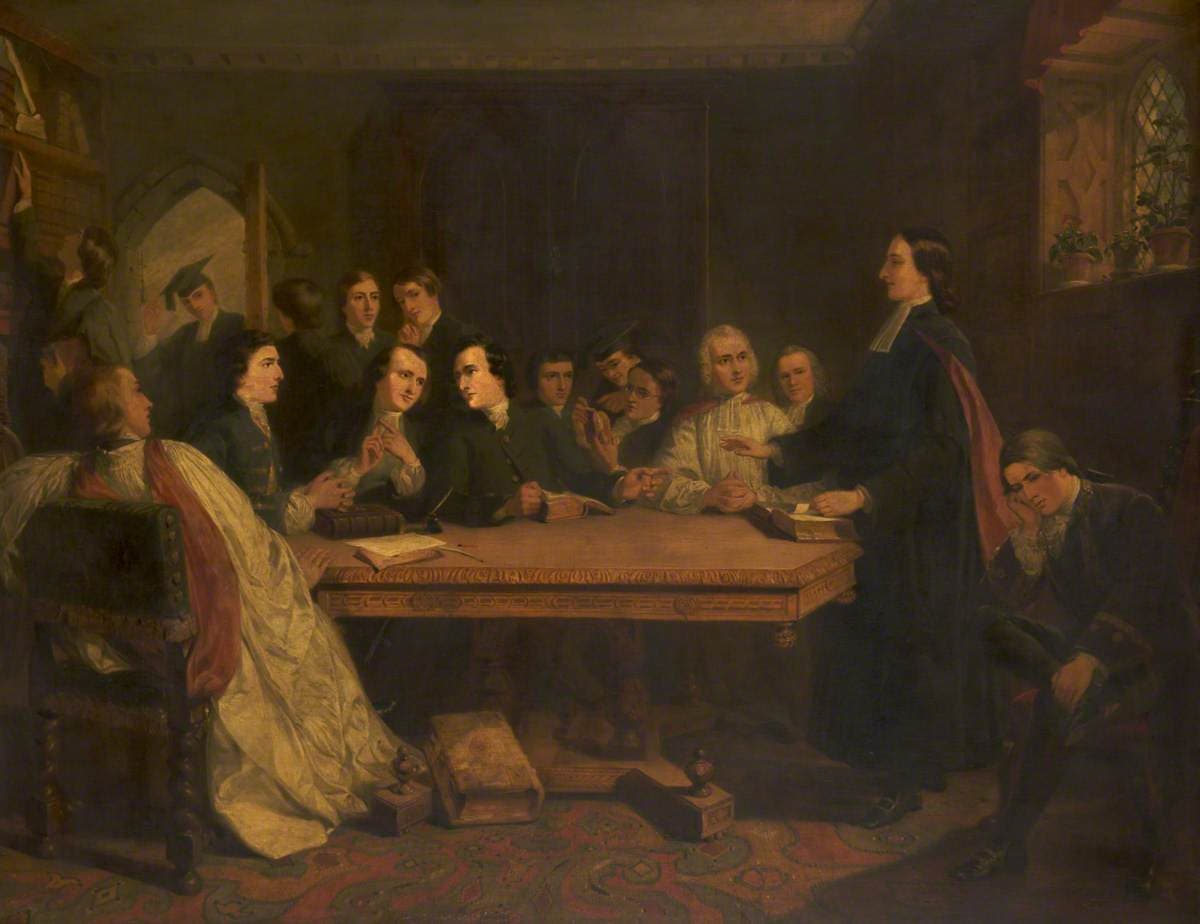
Marshall Claxton, John Wesley and His Friends at Oxford, 1858. Public domain.
AD 1729 to 1735 · Story · Featured Study
The Holy Club
A few Oxford men kept a rule of study and weekly communion from 1729, added visits to the prisons in 1730, and were mocked for it.
- When
- November 1729 to 1735
A few months before he died, George Whitefield said that whenever he went to Oxford he could not help running to “the spot where Jesus Christ first revealed Himself to me.”
how God anointed Jesus of Nazareth with the Holy Spirit and with power, and how Jesus went around doing good and healing all who were oppressed by the devil, because God was with Him.
Summary
The Holy Club was a nickname for a small society that John and Charles Wesley, William Morgan and Robert Kirkham kept at Oxford from 1729. George Whitefield joined it while he was a poor student of Pembroke College.
- Wesley wrote in 1786 that the four of 1729 had grown to fifteen by 1735.
- Wesley wrote in 1765 that a Christ Church student's jest gave them the name Methodists, which was soon known all over the university.
- Tyerman counts Whitefield the last of the Oxford Methodists to join them.
The Questions the Club Put to Its Critics
Wesley's letter of 1732 grounds the club's questions in Scripture.
The first of the club's questions to its critics rested on Acts 10:38, and the second on Paul's command to do good to all.
Therefore, as we have opportunity, let us do good to everyone, and especially to the family of faith.Wesley's letter rests the club's visits to the prisoners and the poor on this command.
The Members and Their Colleges
Each member stands with his college and the year he came in.
Four members met in 1729, and four more came in 1732.
| Member | College | When he came in |
|---|---|---|
| John Wesley | Fellow of Lincoln | November 1729 |
| Charles Wesley | Student of Christ Church | November 1729 |
| William Morgan | Commoner of Christ Church | November 1729 |
| Robert Kirkham | Merton | November 1729 |
| Ingham | Queen's | 1732 |
| Broughton | Exeter | 1732 |
| Clayton | Brasenose | April 1732 |
| James Hervey | Lincoln | About April 1732 |
| George Whitefield | Pembroke | 1735, by Wesley's count |
Clayton, James Hervey, George Whitefield
The Story From the First Evenings to the Sickbed
Prisons, fasts and a death in Dublin shaped the club's first years.
In May 1729 Charles Wesley wrote to his brother that he had persuaded a young neighbour and himself to take the sacrament every week.
John Wesley came to reside at Oxford in November 1729. He, Charles, William Morgan and one more then agreed to spend three or four evenings a week together, reading the classics and on Sundays a book of divinity.
They devoted themselves to the apostles’ teaching and to the fellowship, to the breaking of bread and to prayer.This verse is MannaFest's choice for a company that met to read and to take communion together.
In the summer of 1730 Morgan called at the gaol to see a man condemned for killing his wife.
On 24 August 1730 the brothers walked with him to the Castle, and they agreed to go there once or twice a week. They began to visit the sick poor of the town as well.
Their father, Samuel Wesley, answered their account on 21 September 1730 with the Latin words Valde probo, which the edition renders as I greatly approve.
And the King will reply, ‘Truly I tell you, whatever you did for one of the least of these brothers of Mine, you did for Me.’Wesley's questions to the club's critics close on this verse.
By the end of 1730 the company counted five, and a member from Merton was laughed at in his college for belonging to the Holy Club.
Samuel Wesley wrote again on 1 December, and he sent his sons a verse of Paul's in the Greek.
Great is my confidence in you; great is my pride in you; I am filled with encouragement; in all our troubles my joy overflows.It was Samuel Wesley's answer to the mockery of his sons.
William Morgan died in Dublin on 26 August 1732, and word went round that the Wesleys had killed him by the fasting they advised.
John Wesley wrote to Morgan's father, Richard Morgan, that the young man had given up fasting about a year and a half before his death.
Fogg's Weekly Journal printed an attack on the members, and an anonymous pamphlet of 1733, The Oxford Methodists, answered it.
I care very little, however, if I am judged by you or by any human court. In fact, I do not even judge myself.Wesley begins his defence to Richard Morgan with Paul's words on the judgment of men.
George Whitefield came up to Pembroke College towards the end of 1732 as a servitor, and students who had the power chose him to wait on them, which lessened his costs.
He sent an old apple seller of his college to tell Charles Wesley of a woman in a workhouse who had tried to take her own life. Charles learned who had sent her and asked him to breakfast.
Charles soon lent him a book called The Life of God in the Soul of Man. Whitefield wrote that it taught him true religion was “a union of the soul with God, and Christ formed within us.”
Therefore if anyone is in Christ, he is a new creation. The old has passed away. Behold, the new has come!Whitefield took from that book the teaching of this verse.
Whitefield kept the club's rule of weekly communion at Christ Church and its fasts on Wednesdays and Fridays, and visited the sick and the prisoners.
After a long illness of body and mind he found himself set free, and Tyerman dates the day about seven weeks after Easter in 1735.
After this, knowing that everything had now been accomplished, and to fulfill the Scripture, Jesus said, “I am thirsty.”Whitefield's account of his sickbed turns on these words of Christ.
2 Corinthians 7:4, 1 Corinthians 4:3, 2 Corinthians 5:17, John 19:28
The Oxford the Members Knew
Oxford gave the brothers and Whitefield very different places.
When Whitefield arrived, Tyerman writes, Charles Wesley had been six years at Christ Church and was a college tutor.
Their own father had gone up to Exeter College as a servitor half a century before, and Samuel Johnson had left Pembroke only twelve months before Whitefield entered it.
Who Tells the Story
Wesley, Whitefield and a Methodist historian of the nineteenth century tell it.
John Wesley's letter to Richard Morgan is the club's own account, written within two months of Morgan's death to clear the brothers' names. Wesley printed it at the head of the first part of his Journal.
Whitefield told his own part in A Short Account of God's Dealings with the Reverend Mr. George Whitefield (1740). Luke Tyerman, a Wesleyan minister, gathered the members' lives in The Oxford Methodists (1873) and wrote Whitefield's life in 1876.
What the Record Leaves Unsaid
Some details of the story have no witness.
Whitefield gives no date for his breakfast with Charles Wesley. Wesley's letter says only that the Holy Club was a common jest at Merton and names no one who first used it.
What Wesley Later Made of Oxford
In 1738 Wesley judged his Oxford years by a verse of Paul's.
On 24 May 1738 Wesley wrote an account of his own life. In it he set down that from 1730 he visited the prisons and the poor, and from the next spring kept the Wednesday and Friday fasts, eating nothing until three in the afternoon.
He wrote that none of it gave him “any assurance of acceptance with God,” and that he had been “building on the sand.”
For no one can lay a foundation other than the one already laid, which is Jesus Christ.Wesley set this verse against his Oxford years in 1738.
In Their Own Words
A father, a fellow and a servitor speak of the club in their own words, the father twice.
George Whitefield (1714 to 1770)
A Short Account of God's Dealings with the Reverend Mr. George Whitefield (1740), as Luke Tyerman prints it in The Life of the Rev. George Whitefield, vol. 1, page 25
Delivered from the burden
“Upon which I cast myself down on the bed, crying out, ‘I thirst! I thirst!’ Soon after this, I found and felt in myself that I was delivered from the burden that had so heavily oppressed me.”
Calvinistic Methodist
About this saying1 paragraph
Whitefield gave this account in 1740, five years after the day.
John Wesley (1703 to 1791)
Letter to Richard Morgan, 18 October 1732, the introductory letter of his Journal, page 11
The names of Methodists
“As for the names of Methodists, Supererogation-men, and so on, with which some of our neighbours are pleased to compliment us, we do not conceive ourselves to be under any obligation to regard them, much less to take them for arguments.”
Evangelical
About this saying1 paragraph
John Wesley gave the club's answer to its nicknames in 1732.
Samuel Wesley
Letter to John and Charles Wesley, 1 December 1730, printed in John Wesley's letter to Richard Morgan at the head of his Journal, page 8
Steer steady
“Bear no more sail than is necessary, but steer steady.”
Church of England
About this saying1 paragraph
Samuel Wesley gave this counsel in 1730, after the Merton jest.
Samuel Wesley
Letter to John Wesley, 21 September 1730, printed in John Wesley's letter to Richard Morgan at the head of his Journal, page 6
A fast friend
“You have reason to bless God, as I do, that you have so fast a friend as Mr. M. who, I see, in the most difficult service, is ready to break the ice for you.”
Church of England
About this saying1 paragraph
Samuel Wesley wrote of William Morgan's part in the visits in 1730.
Samuel Wesley, Samuel Wesley
Where Historians Disagree
Three questions of the club divide its historians.
Who began the club?3 paragraphs
Nehemiah Curnock edited the Journal in 1909. He held that Charles Wesley, Kirkham and Morgan had formed the society before John joined it, and that John “did not himself conceive the idea of the Holy Club.”
Thomas Jackson's life of Charles (1841) places the first use of the name Methodist while John was away.
Against that reading, John Wesley's own accounts of 1732 and 1765 begin with the evenings agreed on after his return in November 1729.
When did Whitefield join?2 paragraphs
Wesley's Short History of 1765 gives the year 1735.
Against that year, Whitefield wrote that he longed for above a twelvemonth to know the members before Charles sent for him. He came up late in 1732, so the breakfast fell in 1733 or after.
Was Wesley's letter written in 1730 or 1732?2 paragraphs
The printed copies of the Journal date the letter to Richard Morgan 18 October 1730, and the New York Works of 1832 still does.
Against that year, Curnock reports from Joseph Benson's edition of the Works (1809) a copy in Charles Wesley's hand dated 1732. Curnock prints 1732, since the letter tells of Morgan's death in August of that year.
Books to Read Next
Three free books carry the story, the first of them Wesley's own Journal.
The Journal of the Rev. John Wesley, vol. 1
John Wesley, edited by Nehemiah Curnock · 1909
It prints the Journal with Curnock's notes on the Oxford society.
Read it free onlineThe Oxford Methodists
Luke Tyerman · 1873
It gives the lives of Clayton, Ingham, Gambold, Hervey and Broughton.
Read it free onlineA Short Account of God's Dealings with the Reverend Mr. George Whitefield
George Whitefield · 1740
It is Whitefield's own story of Pembroke, Charles Wesley and his illness.
Read it free onlineWhat the Club Left
Of all the names the university gave the society, Methodist is the one that lasted, and in 1735 the chief of its members sailed for America.
Sources
Scripture is the Berean Standard Bible.
- The Holy Bible, Berean Standard Bible (read 2026)
- John Wesley, letter to Richard Morgan, Oxford, 18 October 1732, the introductory letter of his Journal, in The Works of the Rev. John Wesley, vol. III (New York: B. Waugh and T. Mason, 1832), pages 5 to 11.
- John Wesley, The Journal of the Rev. John Wesley, edited by Nehemiah Curnock, Standard Edition, vol. 1 (London: Robert Culley, 1909), the introduction and pages 87 to 88.
- John Wesley, A Short History of Methodism (1765), sections 4 and 5.
- John Wesley, Journal, 24 May 1738, sections 5 and 6, in The Works of the Rev. John Wesley, vol. III (New York: B. Waugh and T. Mason, 1832), pages 71 to 72.
- John Wesley, Thoughts upon Methodism (London, 4 August 1786), in The Works of the Rev. John Wesley, vol. 10 (New York: J. and J. Harper, 1826)
- George Whitefield, A Short Account of God's Dealings with the Reverend Mr. George Whitefield (London, 1740), as Luke Tyerman prints it in The Life of the Rev. George Whitefield, vol. 1 (London: Hodder and Stoughton, 1876), pages 14 to 27.
- Luke Tyerman, The Life of the Rev. George Whitefield, vol. 1 (London: Hodder and Stoughton, 1876), pages 10 to 27.
- Luke Tyerman, The Oxford Methodists (New York: Harper and Brothers, 1873), the preface and chapter 1.
- Thomas Jackson, The Life of the Rev. Charles Wesley, vol. 1 (London: John Mason, 1841), pages 14 to 16.
Keep Studying
Studies5
People and groups7