
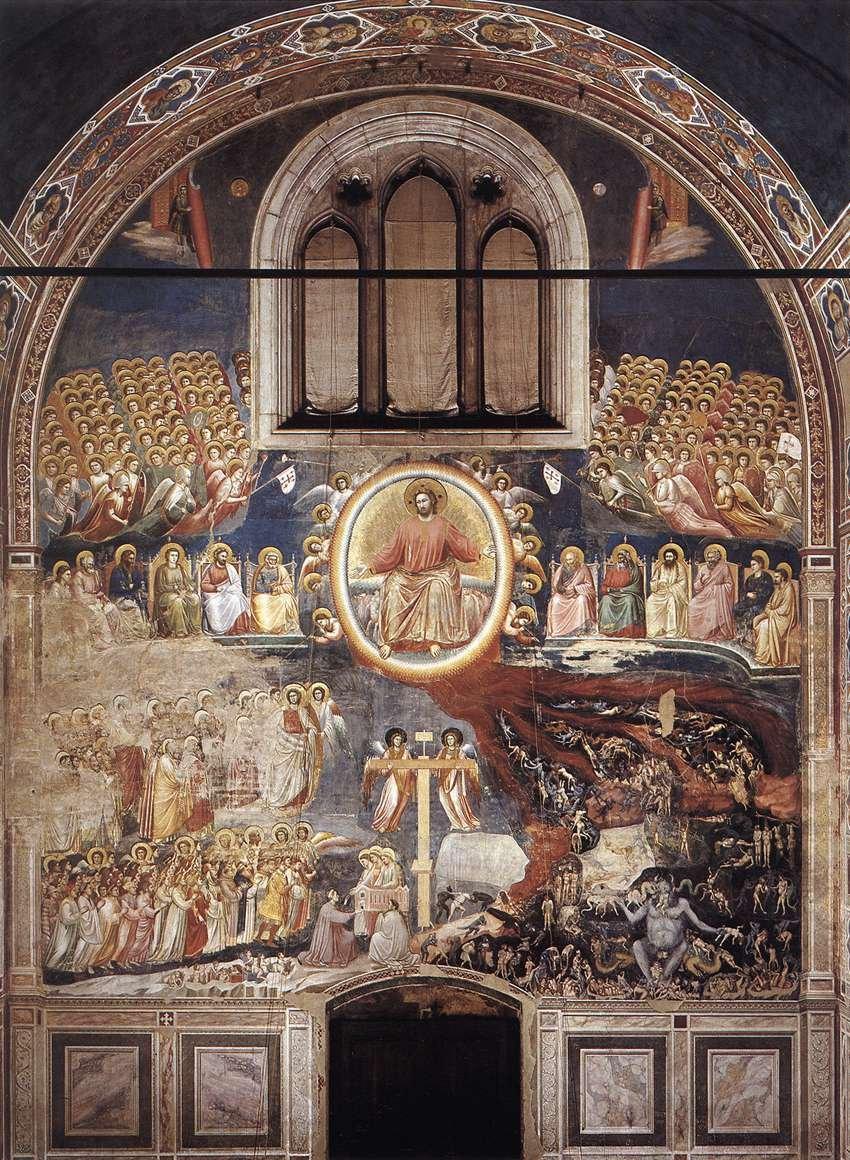
Giotto di Bondone, The Last Judgment, 1306. Public domain.
Revelation 20 and 1 Thessalonians 4 · Doctrine · Featured Study
The End Times
The return of Christ, the resurrection and the judgment close this age, and a new heaven and earth follow.
John told his first readers that it was already the last hour.
For the Lord Himself will descend from heaven with a loud command, with the voice of an archangel, and with the trumpet of God, and the dead in Christ will be the first to rise. After that, we who are alive and remain will be caught up together with them in the clouds to meet the Lord in the air. And so we will always be with the Lord.
For the Lord Himself will descend from heaven with a loud command, with the voice of an archangel, and with the trumpet of God, and the dead in Christ will be the first to rise. After that, we who are alive and remain will be caught up together with them in the clouds to meet the Lord in the air. And so we will always be with the Lord.
- Fullest statement
- Revelation 21:1 to 4 “Then I saw a new heaven and a…”
Summary
The end times are what the Bible says will happen when Jesus Christ comes back. The dead will rise, the world will be judged, and God will live with His people for ever.
- The Nicene Creed says Christ will come again in glory to judge the living and the dead.
- Daniel saw one like a son of man given a kingdom that will not end.
- Christians differ over the thousand years of Revelation 20 and the time of the catching up.
What the Bible Means by the Last Days
The words name both the present age and a day still ahead.
Peter and the writer of Hebrews speak of the last days as begun.
No, this is what was spoken by the prophet Joel: ‘In the last days, God says, I will pour out My Spirit on all people. Your sons and daughters will prophesy, your young men will see visions, your old men will dream dreams.Peter gives the first sense at Pentecost.
On many past occasions and in many different ways, God spoke to our fathers through the prophets. But in these last days He has spoken to us by His Son, whom He appointed heir of all things, and through whom He made the universe.Hebrews gives the same sense.
They also wait for His return.
“Men of Galilee,” they said, “why do you stand here looking into the sky? This same Jesus, who has been taken from you into heaven, will come back in the same way you have seen Him go into heaven.”The angels give the second sense at the ascension.
The Events in Order
Scripture names each event in its own place.
Four events every reading of the end places in the same order.
- The returnThe Son of Man comes in His glory, and all the angels with Him.Matthew 25:31
- The resurrectionAll who are in their graves hear His voice and come out.John 5:28 to 29
- The judgmentThe dead, great and small, stand before the throne, and the books are opened.Revelation 20:12
- The new creationJohn sees a new heaven and a new earth, and God dwells with His people.Revelation 21:1 to 3
The order draws on Matthew 25, John 5, and Revelation 20 and 21.
Where the catching up, the great tribulation and the thousand years fall in this order is disputed, and the studies of the rapture and the millennium set out the readings with their holders.
What Every Tradition Confesses
The Nicene Creed of 381 closes on the hope that follows the judgment.
Its last article reads, “we look for the resurrection of the dead; and the life of the world to come.”
The hope reaches back to Daniel's night vision.
In my vision in the night I continued to watch, and I saw One like the Son of Man coming with the clouds of heaven. He approached the Ancient of Days and was led into His presence. And He was given dominion, glory, and kingship, that the people of every nation and language should serve Him. His dominion is an everlasting dominion that will not pass away, and His kingdom is one that will never be destroyed.Daniel sees the coming King.
Do not be amazed at this, for the hour is coming when all who are in their graves will hear His voice and come out—those who have done good to the resurrection of life, and those who have done evil to the resurrection of judgment.Jesus promises the resurrection of all.
What Scripture Leaves Unsaid
No verse gives the date, and the Westminster Confession says why.
No one knows about that day or hour, not even the angels in heaven, nor the Son, but only the Father.Jesus sets a limit on every reckoning.
The Westminster Confession teaches that Christ will have that day “unknown to men, that they may shake off all carnal security, and be always watchful.”
Hope and Readiness
Scripture gives the return to the church as comfort and as a call to watch.
Paul wrote to a church that grieved over its dead.
Therefore encourage one another with these words.Paul gives the hope a use.
as we await the blessed hope and glorious appearance of our great God and Savior Jesus Christ.Paul names what believers wait for.
Jesus gave His disciples a householder's lesson.
Therefore keep watch, because you do not know the day on which your Lord will come. But understand this: If the homeowner had known in which watch of the night the thief was coming, he would have kept watch and would not have let his house be broken into. For this reason, you also must be ready, because the Son of Man will come at an hour you do not expect.Jesus teaches readiness for an unknown hour.
Peter explained the waiting.
The Lord is not slow in keeping His promise as some understand slowness, but is patient with you, not wanting anyone to perish but everyone to come to repentance.Peter gives the reason for the wait.
Matthew 24:42 to 44, 2 Peter 3:9
How the Teachers Read It
Teachers from the third century to the twenty-first read the return and the last days.
Hippolytus of Rome (died 235)
Hippolytus Dogmatical and Historical Fragments
Hippolytus of Rome closed a work to Theophilus with the blessed hope of Titus 2:13.
“These things, then, I have set shortly before thee, O Theophilus, drawing them from Scripture itself, in order that, maintaining in faith what is written, and anticipating the things that are to be, thou mayest keep thyself void of offence both toward God and toward men, ‘looking for that blessed hope and appearing of our God and Saviour,’ when, having raised the saints among us, He will rejoice with them, glorifying the Father. To Him be the glory unto the endless ages of the ages. Amen.”
on Titus 2:13Patristic
Matthew Henry (1662 to 1714)
Commentary on the Whole Bible
Matthew Henry, on Acts 2:17, explained why the gospel age bears that name.
“It refers to the last days, the times of the gospel, which are called the last days because the dispensation of God's kingdom among men, which the gospel sets up, is the last dispensation of divine grace, and we are to look for no other than the continuation of this to the end of time.”
on Acts 2:17 to 21Puritan
J.C. Ryle (1816 to 1900)
Expository Thoughts on the Gospels: Matthew
Ryle, on Matthew 24, kept the Lord's coming apart from a believer's death.
“There are verses in this passage which are often much misapplied. ‘The coming of the Son of Man’ is frequently spoken of as being the same thing as death; the texts which describe the uncertainty of his coming are used in epitaphs, and thought suitable to the tomb. But there is no solid ground for such an application of this passage. Death is one thing, and the coming of the Son of Man is quite another. The subject of these verses is not death, but the second advent of Jesus Christ. Let us remember this.”
on Matthew 24:36 to 51Reformed Evangelical
Chuck Missler (1934 to 2018)
The Rapture, Personal Update (Koinonia House), 1 Aug 2014
Chuck Missler placed the catching up within the whole of Scripture.
“The more we take the Bible seriously, and the more we study the Bible as a whole, the clearer it becomes that the Rapture of the Church worldwide is an essential ingredient in God’s plan.”
on 1 Thessalonians 4:16 to 17Calvary Chapel-influenced Independent
Where the Readings Part
Each reading of Revelation 20 stands with its holders and the objection it meets.
Three readings of the thousand years, each with its holders and a work to read.
| Reading | The thousand years | Held by | A work to read |
|---|---|---|---|
| Premillennial | A reign of Christ on earth after His return, before the last judgment | Justin Martyr; Irenaeus | Justin, Dialogue with Trypho 80 and 81 |
| Amillennial | The present reign of Christ and His saints in the age of the church | Augustine | Augustine, City of God 20.7 and 20.9 |
| Postmillennial | An age in which the gospel wins the world before Christ returns | Charles Hodge | Hodge, Systematic Theology, volume 3 |
Christ reigns on earth after His returnJustin Martyr; Irenaeus
Justin wrote that John was “one of the apostles of Christ.”
In Justin's words, John prophesied “that those who believed in our Christ would dwell a thousand years in Jerusalem.”
After that, Justin wrote, would come “the eternal resurrection and judgment of all men.”
Irenaeus taught that “it behooves the righteous first to receive the promise of the inheritance which God promised to the fathers, and to reign in it,” and “that the judgment should take place afterwards.”
Justin himself granted that “many who belong to the pure and pious faith, and are true Christians, think otherwise.”
Augustine objected to the reign as some described it, with “immoderate carnal banquets.”
The thousand years are the age of the churchAugustine of Hippo
Augustine wrote of the earthly reign, “I myself, too, once held this opinion.”
He came to read the thousand years as the present age, writing that “the Church even now is the kingdom of Christ, and the kingdom of heaven.”
This reading must take the binding of Satan and the first resurrection of Revelation 20:4 to 6 as present and spiritual, and it sets aside the reading Justin and Irenaeus taught before Augustine.
The gospel wins the world before Christ returnsCharles Hodge
Hodge called it “the common doctrine of the Church” that “the conversion of the world” comes before the second coming of Christ.
Hodge granted that the doctrine of a pre-millennial advent “has been extensively held from the days of the Apostles to the present time.”
Against this reading stands Paul's word in 2 Thessalonians 2:3 that the day will not come until the rebellion occurs.
The timing of the catching upIts holders are named on the study of the rapture
Christians who hold a catching up of the church part over its timing. The study of the rapture sets out each timing with its holders.
Books to Read Next
Four works on the subject are free to read.
Dialogue with Trypho
Justin Martyr · second century
Justin gives his hope of the thousand years in chapters 80 and 81.
Read at New AdventAgainst Heresies, book 5
Irenaeus of Lyons · second century
Irenaeus gives his teaching on the renewed creation in chapters 32 and 35.
Read at New AdventThe City of God, book 20
Augustine of Hippo · fifth century
Augustine explains his reading of Revelation 20 in chapters 7 to 9.
Read at New AdventSystematic Theology, volume 3
Charles Hodge · 1872
Hodge sets out what attends the second advent in part 4, chapter 4.
Read at the Christian Classics Ethereal LibraryCome, Lord Jesus
The Bible closes on the promise of the return and the church's answer to it.
He who testifies to these things says, “Yes, I am coming soon.” Amen. Come, Lord Jesus!Jesus gives the promise, and John gives the answer.
Sources
Scripture is the Berean Standard Bible.
- The Nicene Creed, in Philip Schaff, The Creeds of Christendom, volume 2.
- The Westminster Confession of Faith, chapter 33, Of the Last Judgment, paragraph 3.
- Justin Martyr, Dialogue with Trypho, chapters 80 and 81.
- Irenaeus of Lyons, Against Heresies 5.32.1.
- Augustine of Hippo, The City of God, book 20, chapters 7 and 9.
- Charles Hodge, Systematic Theology, volume 3, part 4, chapter 4, section 5.
- Hippolytus of Rome, Dogmatical and Historical Fragments, on Titus 2:13.
- Matthew Henry, Commentary on the Whole Bible, 1710, on Acts 2:17.
- J.C. Ryle, Expository Thoughts on the Gospels: Matthew, 1856, on Matthew 24:36 to 51.
- Chuck Missler, The Rapture, Personal Update (Koinonia House), 1 August 2014.
Keep Studying
Studies5
People and groups6
Doctrines18
Subjects3
Go further2