
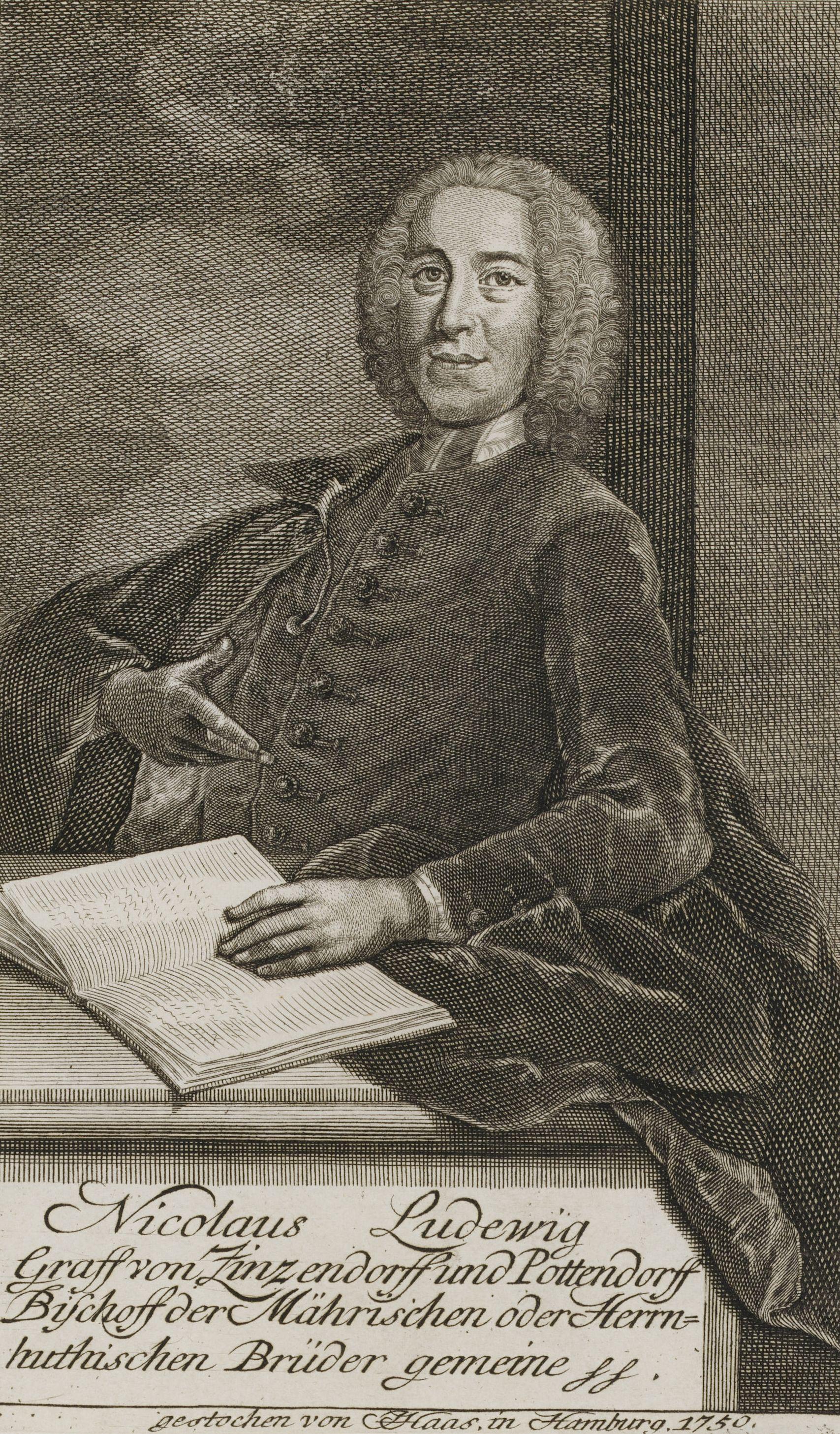
Jonas Haas, Nicolaus Ludwig von Zinzendorf, 1750. Public domain.
Saxony and the world, to 1760 · Person · Featured Study
Count Zinzendorf
He gave the exiles of Herrnhut their home, led their renewed church as its bishop and died there in 1760.
A Saxon count promised a carpenter a refuge for his friends. Within ten years, from a swampy corner of his estate, they were sending men across the ocean.
For to me, to live is Christ, and to die is gain.
For to me, to live is Christ, and to die is gain.
- Born
- 26 May 1700 at Dresden
- Died
- 9 May 1760 at Herrnhut
- Family
- wife: Erdmuth Dorothea; son: Christel
- Places
- Dresden, Halle, Berthelsdorf, Herrnhut, St Thomas, Pennsylvania, London
Summary
Zinzendorf grew up in a Pietist house and at Francke's school at Halle, and he bought the estate of Berthelsdorf in 1722. Christian David led refugees there from Moravia that June. After the communion of August 1727 the settlement began a watch of prayer, and in 1732 it sent its first missionaries. Saxony banished him, and he was made a bishop of the Brethren in 1737.
- He stayed a Lutheran in his own eyes while he led a church.
- J. E. Hutton calls him the chief sinner of the Sifting Time, the saddest years of that church.
- He told the enslaved of St Thomas that their condition was God's appointment, and Hutton prints the speech.
One Passion and One Basin
Paul's words in Philippians 1:21 sit nearest to his motto, and John 13 gave the Brethren a rite.
Hutton prints his saying that he had but one passion and names no verse beside it, so the tie to Philippians 1:21 is an inference. John 13 he named himself, when he revived the foot-washing at Herrnhut. "No man," he declared, "can read John xiii. without being convinced that this should be done."
The question of this life is how one nobleman's devotion to Christ made a church. It is also how the same devotion led that church into its worst years.
So if I, your Lord and Teacher, have washed your feet, you also should wash one another’s feet.He held this command to bind the Brethren, and they kept it at Herrnhut.
The Life in Order
Most dates come from Hutton's history of the Brethren's church.
Ten years ran from the first tree felled to the first missionaries sent.
- 26 May 1700He was born at DresdenThe grave-stone, in Hutton
- As a boyHe went to Francke's school at Halle and founded the Order of the Mustard SeedHutton
- On his tourHe read the words under Feti's Ecce Homo at DüsseldorfHutton
- April 1722He bought Berthelsdorf and installed John Andrew Rothe as pastorHutton
- 8 June 1722Christian David brought the first exiles to the estateHutton
- 7 September 1722He married Erdmuth DorotheaHutton
- 13 August 1727The Brethren took communion at BerthelsdorfHutton
- 21 August 1732Leonard Dober and David Nitschmann left for St ThomasHutton
- 1736Augustus III banished him from SaxonyHutton
- 20 May 1737Jablonsky and David Nitschmann ordained him a bishopHutton
- 1738A new edict expelled him againHutton
- 1739He spent three months on St ThomasHutton
- 3 September 1741He met John Wesley in Gray's Inn GardensHutton
- 1743 to 1750The Sifting Time ran among the BrethrenHutton; the Herrnhut brief, c45
- 9 May 1760He died at HerrnhutThe grave-stone, in Hutton
Each step of the life stands with its witness.
13 August 1727, 21 August 1732, 1736, 20 May 1737, 1738, 1739, 3 September 1741, 1743 to 1750 and 1 more
From Dresden to the Hutberg
Hutton tells it from Spangenberg and the Brethren's records, and he does not spare him.
Count Zinzendorf was a Saxon nobleman raised in Pietism who let a band of persecuted Moravian refugees settle on his estate in 1722. His grandmother, a leader in Pietist circles, reared him, and at Halle the masters set boys to spy on him. His family insisted on the law, and he took a post at the Saxon court at Dresden.
Christian David, a carpenter, asked him for a refuge, and he promised one. His steward led the exiles to a swampy stretch of common pasture called the Hutberg, or Watch-Hill.
The village they built, Herrnhut, "the Lord's watch," was quarrelsome until a communion service in August 1727 that the community ever after described as its Pentecost. Zinzendorf offered the confession at Berthelsdorf that day. Out of it came a prayer watch, men and women covering every hour, that by the Moravians' own records continued for around a hundred years.
Out of the praying came the sending. Within six years Herrnhut was dispatching missionaries to enslaved Africans in the Caribbean and to Greenland, decades before Carey. Antony Ulrich, a baptized slave from St Thomas, had asked for someone to teach his sister and brother.
Augustus III banished him in 1736 for religious novelties, conventicles and false doctrine. His reply was to gather a Pilgrim Congregation and carry the work abroad. He preached on St Thomas in 1739 and in Pennsylvania for two years from 1741.
A society in Aldersgate Street in London is where John Wesley's heart was "strangely warmed," after the Moravian Peter Boehler had taught him.
He died at Herrnhut on 9 May 1760 after John de Watteville had spoken the blessing over him. Hutton gives more than four thousand mourners. Ministers from Holland, England, Ireland, North America and Greenland took turns at his coffin on the way to the Hutberg.
The Sifting Time
Hutton dates it from about 1743 to 1750, among the Brethren of the Wetterau and beyond.
Hutton calls it the saddest period in the history of the Brethren's Church. The Brethren called the Count "Papa" and Christ "Brother Lambkin," and they called themselves wound-parsons and cross-air little sponges.
"The chief sinner was the Count himself," Hutton writes. Zinzendorf compared the Trinity to a family, with the Holy Ghost as mother, and the Church as the Son's bride, born in His side-wound. They held birthday festivals in his honour at Marienborn.
It ended within the decade. Spangenberg gave the verdict Hutton thought best: "the spirit of Christ did not rule in our hearts; and that was the real cause of all our foolery."
In 1752 the English debts came to nearly a hundred thousand pounds, and Zinzendorf pledged himself for the whole sum.
In Their Own Words
Five sayings as his biographers and the Brethren's books record them, from his youth to his last days.
Nicolaus Ludwig von Zinzendorf (1700 to 1760)
Spangenberg (1775), page 2164; Hutton (1909), page 180
One passion
“I have … but one passion—’tis He, ’tis only He.”
Moravian
About this saying1 paragraph
Hutton sets this among his sayings as a young man, with Spangenberg's life of 1775 cited for it. The Athenaeum printed an English form in 1829.
Nicolaus Ludwig von Zinzendorf
Hutton (1909), pages 179 to 180
Rather damned with Christ
“If it were possible … that there should be another God than Christ I would rather be damned with Christ than happy with another.”
Moravian
About this saying1 paragraph
Hutton gives this beside the saying above, from before 1710, in the words he says Zinzendorf used.
Nicolaus Ludwig von Zinzendorf
A discourse of 12 May 1748, in The Memorial-Days of the Renewed Church of the Brethren, page 90
The tabernacle at Herrnhut
“The whole place represented truly, a visible tabernacle of God among men, and till the 13th of August, there was nothing to be seen and heard but joy and gladness: then, this uncommon joy subsided, and a calmer sabbatic period succeeded.”
Moravian
About this saying1 paragraph
He looked back on August 1727 in a discourse of 12 May 1748, in the Memorial-Days of the Brethren.
Nicolaus Ludwig von Zinzendorf
Letter of 12 April 1732, in J. E. Hutton, A History of Moravian Missions, pages 20 to 21
Seekers after the truth
“You are not to aim at the conversion of whole nations: you must simply look for seekers after the truth who, like the Ethiopian eunuch, seem ready to welcome the Gospel.”
Moravian
About this saying1 paragraph
He wrote this in a letter of 12 April 1732, some months before Dober and Nitschmann left.
Nicolaus Ludwig von Zinzendorf
His words in his last days, in August Gottlieb Spangenberg, The Life of Nicholas Lewis Count Zinzendorf, page 502
A few first-fruits
“Did you suppose, in the beginning, that the Saviour would do as much as we now really see, in the various Moravian settlements, amongst the children of God of other denominations, and amongst the heathen? I only entreated of Him a few first-fruits of the latter, but there are now thousands of them.”
Moravian
About this saying1 paragraph
Near his death in May 1760 he looked back on the missions to the heathen.
The People Around Him
The witnesses name his teachers, his household, his workers and his one famous opponent.
A carpenter brought him the people he led.
| Person | Tie to Zinzendorf | The witness |
|---|---|---|
| Philipp Jakob Spener | He watched over the child, as Hutton says, and was a friend of the father. | Hutton |
| August Hermann Francke | His school at Halle held the boy, and it treated him hard. | Hutton |
| Erdmuth Dorothea | She married him in 1722, and Herrnhut called her a princess of God. | Hutton |
| John Andrew Rothe | He became pastor of Berthelsdorf on the Count's appointment. | Hutton |
| Christian David | He led the Moravian exiles out of their homeland. | Hutton |
| Leonard Dober and David Nitschmann | They left from his door for St Thomas. | Hutton |
| Antony Ulrich | He spoke to the Count at Copenhagen and to the Brethren at Herrnhut. | Hutton; Spangenberg |
| Anna Nitschmann | She helped begin the Single Sisters' House, and the festivals at Marienborn honoured her with him. | Hutton |
| August Gottlieb Spangenberg | He worked beside the Count for years and became his biographer. | Hutton; Spangenberg |
| John Wesley | He visited Marienborn and Herrnhut, and he parted from Zinzendorf in 1741. | Hutton |
Antony Ulrich, Anna Nitschmann, August Gottlieb Spangenberg, John Wesley
The Places of His Life
His life runs from a Saxon court through an exile that covered two oceans.
His exile took him far from the estate he had bought.
| Place | What the witnesses say | The witness |
|---|---|---|
| Dresden | He was born there and served at its court. | Hutton |
| Halle | He went to school there. | Hutton |
| Berthelsdorf | He bought it, and the communion of 1727 took place in its church. | Hutton |
| Herrnhut | The exiles built it on the Hutberg, and he is buried above it. | Hutton |
| Marienborn | He rented it in exile, and the excesses of the Sifting Time reached it. | Hutton |
| St Thomas | He called it a greater marvel than Herrnhut. | Hutton |
| Pennsylvania | He spent two years there trying to form one Congregation of God in the Spirit. | Hutton |
| London | An Act of Parliament recognized the Brethren in 1749, and they made it their centre. | Hutton |
Pennsylvania, London
A Church inside the Church
He meant Herrnhut to serve the Lutheran church, and it became a church of its own.
Hutton describes him at Berthelsdorf as a loyal member of the national Lutheran Church, carrying out Luther's wish for a fellowship of true believers. He told the exiles to obey the law of the land and rejected the idea of a new sect.
His own ordination changed that. Once a bishop, he stood at the head of a church with its own orders. An Act of Parliament of 1749 declared it an Episcopal Church in Britain. The tension between a renewal movement and a church runs through the whole of his life.
How the Key Verse Was Taught
Ambrose and Albert Barnes read what Paul meant by to live is Christ.
Ambrose of Milan (died 397)
On the Decease of His Brother Satyrus, Book 2
Ambrose read the verse at his brother's death as a call to die with Christ.
“We see, then, that this death is a gain and life a penalty, so that Paul says: ‘To me to live is Christ and to die is gain.’ What is Christ but the death of the body, the breath of life? And so let us die with Him, that we may live with Him.”
on Philippians 1:21Patristic
Albert Barnes (1798 to 1870)
Notes, Explanatory and Practical, on the Old and New Testaments (1832 to 1869)
Albert Barnes read it as the one aim of Paul's life.
“His aim was not honor, learning, gold, pleasure; it was, to glorify the Lord Jesus. This was the single purpose of his soul - a purpose to which he devoted himself with as much singleness and ardor as ever did a miser to the pursuit of gold, or a devotee of pleasure to amusement, or an aspirant for fame to ambition.”
on Philippians 1:21Evangelical
What the Witnesses Leave Open
Readers differ on slavery, the Sifting Time, the watch, Wesley and the picture at Düsseldorf.
What he taught the enslavedZinzendorf; J. E. Hutton
Hutton writes that Zinzendorf was a firm believer in slavery and regarded it as a divinely appointed system. He prints the speech of 1739 on St Thomas, which says, "God punished the first negroes by making them slaves."
Hutton argues that the Brethren's teaching of industry and order did the most to make emancipation possible. That defence is his own, and he wrote as a Moravian.
How far the Count was to blameJ. E. Hutton; August Gottlieb Spangenberg
Hutton lays the worst of it on him. Spangenberg records his warnings and says he did not foresee the excess and checked it. Spangenberg was his colleague and successor.
How long the watch lastedJ. E. Hutton; William Binnie
Hutton writes, "It is said to have lasted without interruption for over a hundred years." That rests on the Brethren's own tradition. William Binnie noted in 1883 that it was no longer kept, and neither fixes the year it stopped.
How far Aldersgate was MoravianJohn Wesley; J. E. Hutton
Wesley names only a society in Aldersgate Street. Hutton, a Moravian historian, says it had no more connection with the Moravian Church than any other religious society in England, and consisted of Anglicans. Wesley had Boehler's teaching before he went there.
The words under the pictureJ. E. Hutton
Hutton says the words under the picture asked the viewer what he had done for the One who suffered all this for him, and he calls the incident famous.
Books to Read Next
A History of the Moravian Church
J. E. Hutton · 1909
Hutton gives the whole life and judges it hard where he thinks it due.
Read Hutton free at Project GutenbergThe Life of Nicholas Lewis Count Zinzendorf
August Gottlieb Spangenberg, translated by Samuel Jackson · 1838
His colleague and successor wrote the life from close knowledge.
Read Spangenberg free at the Internet ArchiveWhat Zinzendorf Left
Zinzendorf left a church with missions on several shores, a book of daily texts still printed, and a warning in the years of the Sifting.
Sources
Scripture is the Berean Standard Bible.
- The Holy Bible, Berean Standard Bible (read 2026)
- J. E. Hutton, A History of the Moravian Church (second edition, 1909)
- August Gottlieb Spangenberg, The Life of Nicholas Lewis Count Zinzendorf, translated by Samuel Jackson (London, 1838)
- William Binnie, "Zinzendorf", in The Evangelical Succession, second series (Edinburgh: Macniven and Wallace, 1883), page 267.
- The Athenaeum (London), no. 69, 18 February 1829, article "Herrnhut".
- John Wesley, The Journal of John Wesley, 24 May 1738.
- Ambrose of Milan, On the Decease of His Brother Satyrus, Book 2.
- Albert Barnes, Notes, Explanatory and Practical, on Philippians 1:21.
Keep Studying
People and groups8
Church history10