
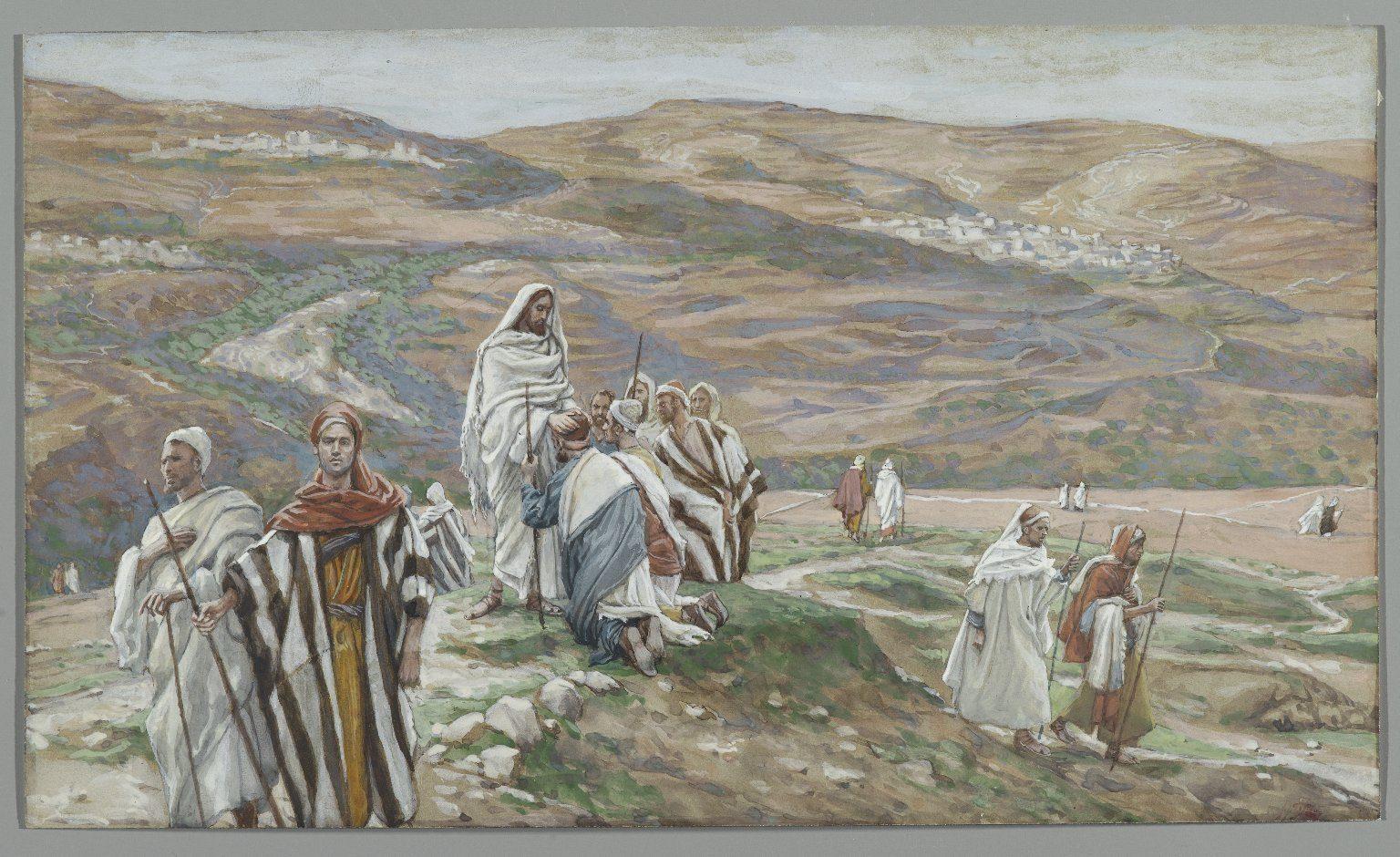
James Tissot, He Sent Them Out Two by Two, 1886 to 1894. Public domain.
Luke 10:1 · Subject · Featured Study
The Sending of the Seventy-Two
Luke alone tells of this second, larger mission, sent out after the Twelve.
Whoever listens to you listens to Me; whoever rejects you rejects Me; and whoever rejects Me rejects the One who sent Me.”
- Book
- Luke
- Hold in memory
- Luke 10:2, Luke 10:20
Jesus gave ordinary followers His own work to do.
Summary
Jesus gave a larger band of disciples a mission of their own. They took almost nothing with them, and they told each town that God's kingdom was near. They came back full of joy.
- Which number Luke wrote is still an open question of the text.
- The number recalls Moses' seventy elders and the table of nations in Genesis 10.
- Bede read the number as the count of the world's nations.
A Mission Ahead of Jesus
Jesus sent the seventy-two after He had set out for Jerusalem, to the towns on His road.
After this, the Lord appointed seventy-two others and sent them two by two ahead of Him to every town and place He was about to visit.Luke places the sending right after Jesus set out for Jerusalem, so the mission belongs to that road.
Jesus had already sent out the Twelve in Luke 9:1 to 6. Heinrich Meyer linked this second mission to the messengers Jesus sent ahead into a Samaritan village in Luke 9:52.
Meyer also held that the seventy-two went ahead as forerunners. By healing and preaching they prepared each town for the coming of the Messiah.
Seventy or Seventy-Two
Two readings of Luke 10:1 stand in the ancient copies.
Codex Vaticanus and Codex Sinaiticus, both of the fourth century, give different numbers.
| Reading | Witnesses | Where it is read |
|---|---|---|
| Seventy-two | Codex Vaticanus (B), Codex Bezae (D), the Curetonian Syriac and the Latin Vulgate, with many Fathers | the Berean Standard Bible |
| Seventy | some Alexandrian and Caesarean copies, among them Codex Sinaiticus, and the received Greek text | the King James Version |
Adam Clarke noted in 1832 that several manuscripts and versions read seventy-two. Jerome chose that reading for the Latin Vulgate.
Luke gives the number a second time when the disciples return, and most of the witnesses that read seventy-two at the sending read it there too.
Orders for the Road
Jesus told the pairs what to carry, where to stay and what to say in every town.
Jesus sent the pairs out with seven orders, from prayer for workers to the dust wiped off.
- PrayAsk the Lord of the harvest to send out more workers.Luke 10:2
- GoGo out like lambs among wolves.Luke 10:3
- Travel lightCarry no purse, bag or sandals, and greet no one on the road.Luke 10:4
- Bless the houseSpeak peace to the house, and let it rest on a man of peace.Luke 10:5 to 6
- Stay putEat what is offered and stay in the same house.Luke 10:7
- Heal and tellHeal the sick and say that the kingdom of God is near.Luke 10:9
- Wipe off the dustIn a town that refuses them, wipe its dust from their feet as a testimony.Luke 10:10 to 11
Each order stands in Luke 10:2 to 11 in the order Jesus gave it.
Albert Barnes explained the order to greet no one. A greeting in that land meant long embraces and bows, and the business of the seventy-two was urgent.
For the Scripture says, “Do not muzzle an ox while it is treading out the grain,” and, “The worker is worthy of his wages.”The letter cites as Scripture the same words Jesus gave the pairs at Luke 10:7.
Woe to the Lake Towns
Jesus named three towns by the lake that had seen His miracles.
Chorazin, Bethsaida and Capernaum stood within a few miles of one another near the north end of the lake.
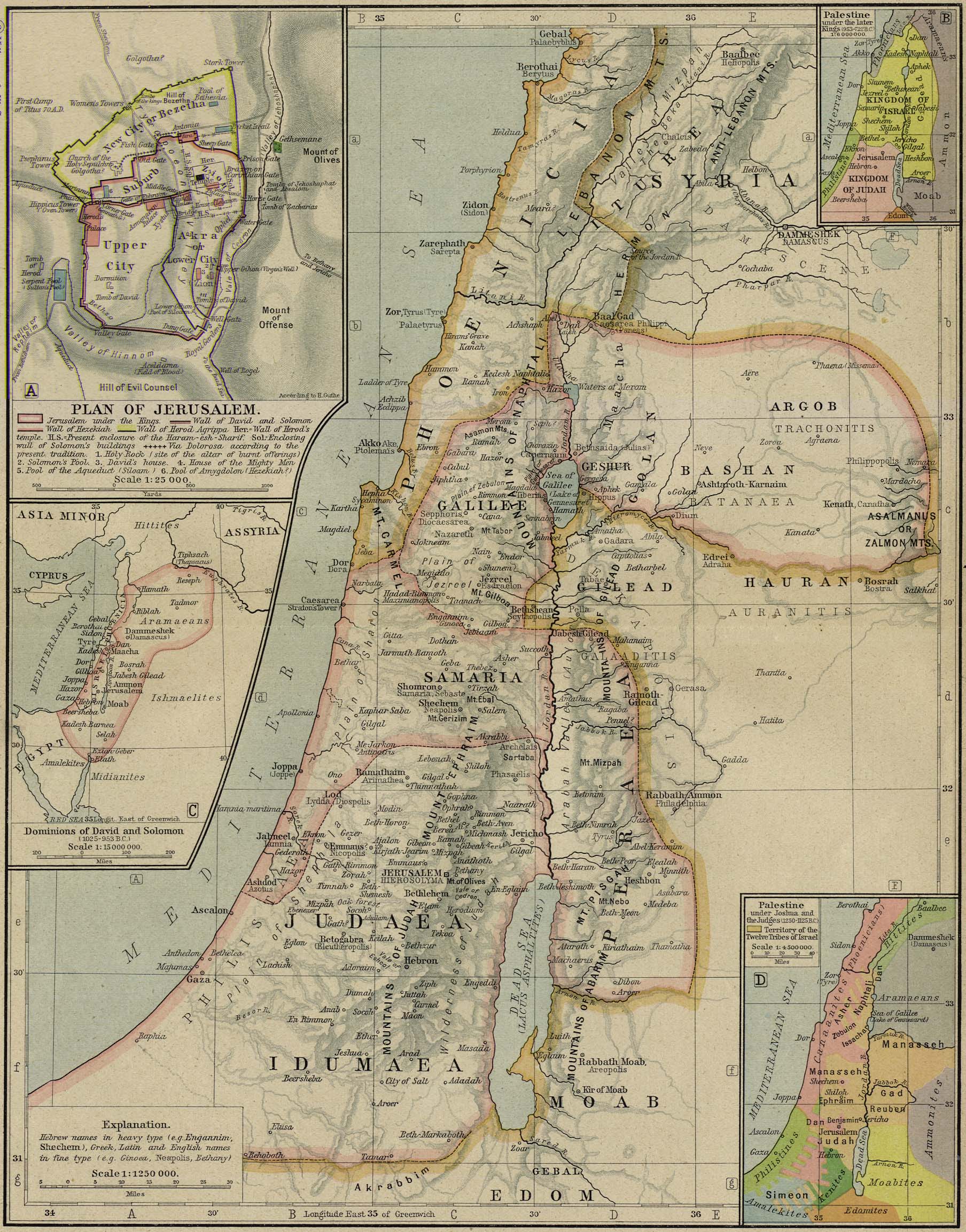
- Located: the site is known
- Identified: the point stands for an area, or is rounded
- Proposed: one candidate among several
- 1Chorazin, A town that saw His miracles and did not repent, Luke 10:13
- 2?Bethsaida, A town that saw His miracles and did not repent, Luke 10:13
- 3Capernaum, The town that would be brought down to Hades, Luke 10:15
- 4Tyre, A Gentile port that would have repented, Luke 10:14
- 5Sidon, A Gentile port that would have repented, Luke 10:14
Base map: Reference map of ancient Palestine, Rand McNally reference map (1926), public domain. Places with a place page stand at its coordinates and the others at the point cited for each, set on the plate by Jerusalem and Damascus, as the plate prints them.
Chorazin stands at Khirbet Karraza (score 701 of 1,000) and Bethsaida at et-Tell (score 330), as OpenBible.info ranks them.
Woe to you, Chorazin! Woe to you, Bethsaida! For if the miracles that were performed in you had been performed in Tyre and Sidon, they would have repented long ago, sitting in sackcloth and ashes.The woe measures the lake towns against Gentile cities that never saw what they saw.
The Return With Joy
The disciples' report of power met a word about where their joy belonged.
The seventy-two reported that even the demons submitted to them in His name (Luke 10:17). Jesus answered with a vision of Satan's fall and a grant of authority over the enemy (Luke 10:18 to 19).
Nevertheless, do not rejoice that the spirits submit to you, but rejoice that your names are written in heaven.”Jesus moves their joy from power over spirits to their place with God.
“For the names of the saints are written in the book of life not in ink, but in the memory and grace of God. And the devil indeed fell from above; but men being below have their names inscribed above in heaven.”
Theophylact of Ohrid · Catena Aurea by Aquinas · on Luke 10:20Patristic
What the Number Recalls
Cyril, Bede and Augustine each read the number as a sign of something larger.
The seventy elders who received the SpiritJamieson, Fausset and Brown (1871), on Luke 10:1; Heinrich Meyer (1873), on Luke 10:1
Jamieson, Fausset and Brown saw an allusion to the seventy elders of Israel on whom the Spirit came in the wilderness (Numbers 11:24 to 25). Cyril of Alexandria had already found an outline of the mission in Moses' choice of seventy.
Two men, however, had remained in the camp—one named Eldad and the other Medad—and the Spirit rested on them. They were among those listed, but they had not gone out to the tent, and they prophesied in the camp.This verse is why some readers count seventy-two elders and some seventy.
Heinrich Meyer also held that Jesus had the seventy elders of the people in view, as the Twelve answered to the tribes. Eric Franklin, in The Oxford Bible Commentary (2001), as Wikipedia reports him, counted Eldad and Medad to make seventy-two.
The objection: Bede read the number from the nations instead, because the gospel was to go to the foreign nations.
The nations of the worldBede, in Thomas Aquinas, Catena Aurea, on Luke 10:1 to 2
Bede held that seventy-two were sent rightly, because the gospel was to be preached to that many nations of the world. As the twelve answered to the twelve tribes, these were ordained as teachers of the foreign nations.
Genesis 10 lists seventy nations, and the Greek Septuagint lists seventy-two, as Wikipedia's article on Luke 10 reports from Eric Franklin.
The objection: Heinrich Meyer answered that Luke gives the mission no Gentile field. The Samaritan village had already turned Jesus away (Luke 9:53 to 56).
The second order of the church's ministersAugustine, Questions on the Gospels, Book 2, in Thomas Aquinas, Catena Aurea, on Luke 10:1
Augustine read the twelve apostles as a figure of the bishops and the seventy-two as a figure of the presbyters, the second order of priests.
The objection: Augustine himself noted that in the earliest times both orders were called presbyters and both were called bishops.
What the Prophets Longed to See
The mission ended with Jesus' prayer of thanks and a blessing on the disciples.
Then Jesus turned to the disciples and said privately, “Blessed are the eyes that see what you see. For I tell you that many prophets and kings desired to see what you see but did not see it, and to hear what you hear but did not hear it.”The blessing explains why the mission mattered to the disciples themselves.
Just before, Jesus praised the Father for hiding the things of the kingdom from the wise and revealing them to little children (Luke 10:21).
Sources
Scripture is the Berean Standard Bible.
- Heinrich August Wilhelm Meyer, Critical and Exegetical Commentary on the New Testament, on Luke 10 (1873)
- Wikipedia, the articles Seventy disciples and Luke 10, citing Bruce Metzger, A Textual Commentary on the Greek New Testament.
- Adam Clarke, Commentary on the Bible (1832), on Luke 10:1.
- Jamieson, Fausset and Brown, Commentary Critical and Explanatory on the Whole Bible (1871), on Luke 10:1.
- Bede (735), on Luke 10:1 to 2, in Thomas Aquinas, Catena Aurea (1264)
- Augustine (430), Questions on the Gospels, Book 2, question 14, on Luke 10:1, in Thomas Aquinas, Catena Aurea (1264)
- Cyril of Alexandria (444), on Luke 10:1 to 2, in Thomas Aquinas, Catena Aurea (1264)
- Albert Barnes, Notes, Explanatory and Practical, on the Old and New Testaments (1832 to 1869), on Luke 10:4.
- Theophylact of Ohrid (1107), on Luke 10:20, in Thomas Aquinas, Catena Aurea (1264)
- OpenBible.info, Bible Geocoding Data, ancient.jsonl, the identifications of Chorazin, Bethsaida and Sidon.
Keep Studying
People and groups4
Go further7