
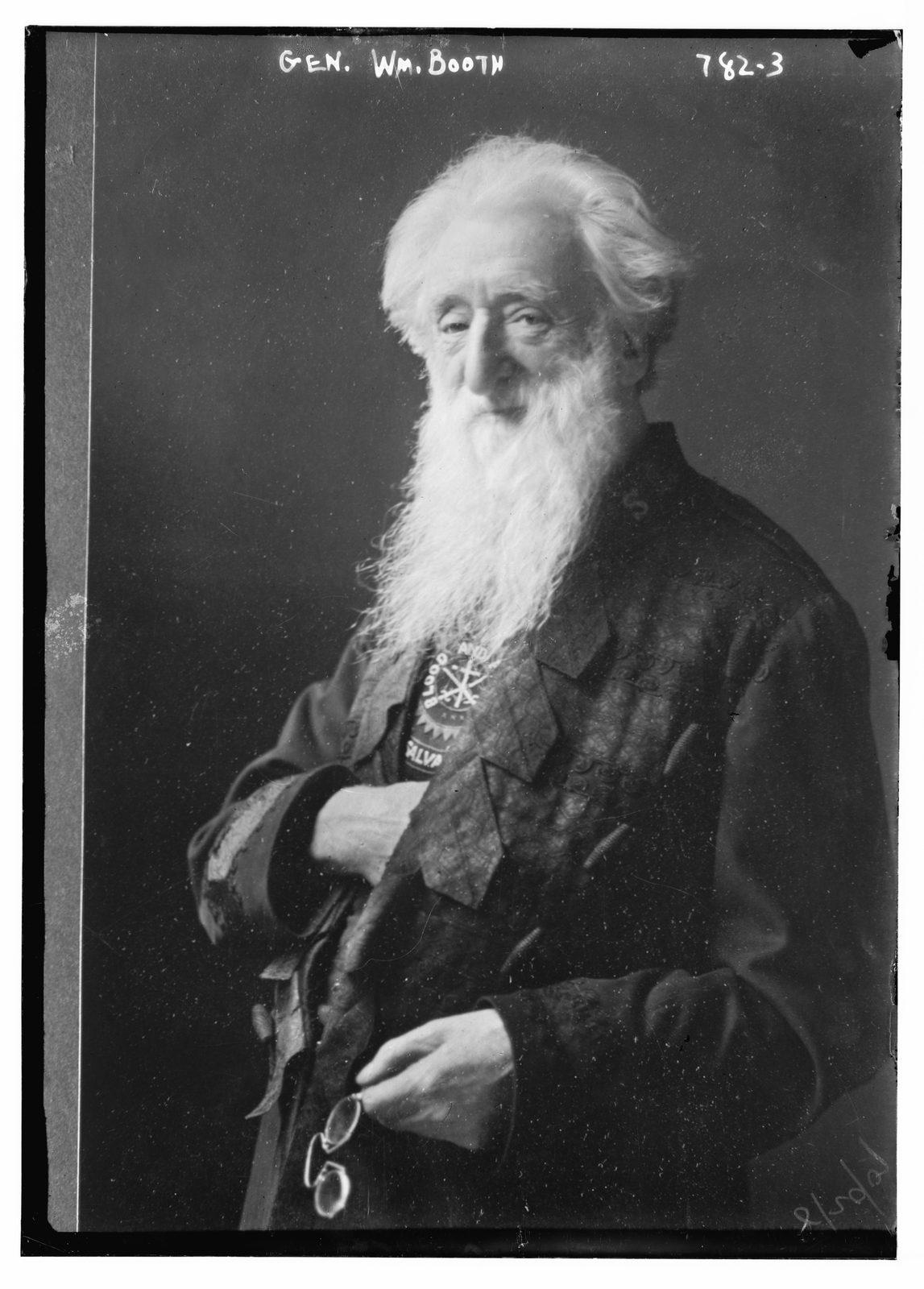
Bain News Service, General William Booth, 1909. Public domain.
Nottingham and the East End of London, to 1912 · Person · Featured Study
William Booth
He led The Salvation Army as its General from 1878 until he died in 1912.
A pawnbroker's apprentice from Nottingham gave the rest of his life to the poor of London.
He saved us, not by the righteous deeds we had done, but according to His mercy, through the washing of new birth and renewal by the Holy Spirit.
He saved us, not by the righteous deeds we had done, but according to His mercy, through the washing of new birth and renewal by the Holy Spirit.
- Born
- 10 April 1829 at Nottingham
- Died
- 20 August 1912 at Hadley Wood, north of London
- Family
- mother: Mary Moss Booth; wife: Catherine Mumford; eldest son: William Bramwell Booth
- Places
- Nottingham, Gateshead, Whitechapel, Hadleigh, Hadley Wood
Summary
William Booth left the Methodist ministry to preach as a revivalist, and he found his work among the poor of East London. The mission he began there grew into a body of preachers in uniform, with its own flags, bands and newspaper. He commanded it for the rest of his life.
- In Darkest England (1890) set out his plan to lift the poorest out of the streets.
- He fed and housed the poor so that they might more easily find the Cross, as his preface says.
- His eldest son Bramwell succeeded him as General.
The Washing of Regeneration
Titus 3:5 states his hope, and Luke 10 gives the part he chose.
The preface of In Darkest England rests his hope for the poor on the remaking of the individual by the Holy Ghost. Later in the book he answers his critics from the parable of the Samaritan.
The question of this life is why a preacher who held that only the Spirit saves a man also built shelters, workshops and farms.
He went to him and bandaged his wounds, pouring on oil and wine. Then he put him on his own animal, brought him to an inn, and took care of him.He named the Samaritan's part as the part his scheme would play.
The Life in Order
Most dates come from the table of events in Railton's life of 1912.
He was thirty-six when the East End became his field.
- 10 April 1829Born at NottinghamRailton
- 1844His conversionRailton
- 10 April 1852Entered the Methodist ministryRailton
- 16 June 1855Married Catherine MumfordRailton
- 1861Began to travel as a revivalistRailton
- 5 July 1865Mission work in East London beganRailton
- Christmas 1878The Christian Mission renamed, and Booth titled GeneralRailton
- 29 December 1879First number of The War CryRailton
- 4 October 1890Catherine Booth's deathRailton
- 1891Hadleigh farm colony openedRailton
- 23 May 1912Operation on the remaining eye, and total blindnessRailton
- 20 August 1912Death at Rookstone, Hadley WoodRailton
Each step of the life stands with its witness.
Christmas 1878, 29 December 1879, 4 October 1890, 1891, 23 May 1912, 20 August 1912
From Nottingham to the East End
Begbie tells the boyhood, and Railton tells the mission and the Army.
William Booth was a Nottingham pawnbroker's apprentice. His father's ruin took him out of school at thirteen, and Begbie writes that the shop stood in the poorest part of the town.
He preached as a layman in Nottingham, served in the Methodist New Connexion, and left its ministry to travel as a revivalist. The family then settled in London.
In 1865 he was asked to take services in a tent in an old burial ground in Whitechapel, because the expected preacher had fallen ill. He preached in the open air on the Mile End Waste, a strip of unpaved fair ground beside the road.
He meant at first to send the converts he won in London's East End to the churches. They would not go, he wrote, and were not wanted when they did, so he built his own movement. It was renamed The Salvation Army in 1878, with brass bands, uniforms, and his wife Catherine preaching beside him.
His people were assaulted and jailed on their marches. By Railton's count, 699 of his officers and soldiers were assaulted in 1882 alone, and 86 were imprisoned.
His book In Darkest England laid out farms, refuges, and job schemes for the 'submerged tenth.'
At his death more than 65,000 came to see him in his coffin at Clapton, and more than 35,000 gathered at Olympia for the memorial service.
The Way Out
The scheme moved people from city shelters to farms and on to new lands.
Booth counted the people he called the Submerged Tenth at three millions. He set the Cab Horse Charter as the standard of his scheme.
The scheme had three parts. The City Colony would take people in from the streets of the town, the Farm Colony would train them on the land, and the Over-Sea Colony would settle them abroad.
He signed the trust deed of the scheme in 1891.
In Their Own Words
Five sayings, from 1865 to his book of 1890.
William Booth (1829 to 1912)
his account of the tent in Whitechapel, 1865, as George Scott Railton prints it, chapter VII
I have found my destiny
“O Kate, I have found my destiny! These are the people for whose Salvation I have been longing all these years.”
Methodist
About this saying1 paragraph
In 1865 he walked home from the tent in Whitechapel and said this to his wife, as Railton prints his own account.
William Booth
Letter to the Home Secretary, October 1881, in Harold Begbie, The Life of General William Booth, volume 1, page 481
Assault upon us
“There has never been a breach of the peace where the authorities have made it plainly understood that assault upon us will be treated as assaults upon any other people.”
Methodist
About this saying1 paragraph
He wrote this to the Home Secretary in October 1881, during the riots against his marches.
William Booth
Letter of 27 August 1886, printed in Muktifauj, pages xvi to xvii
To the Indians you must be Indians
“In order to conquer you must stoop, becoming with the Apostle all things to all men, in order that you may win them to your Master. This must mean, if anything at all, that to the Indians you must be Indians.”
Methodist
About this saying1 paragraph
In a letter of 27 August 1886 he told his officers in India to live as the people lived.
William Booth
In Darkest England, Part I, chapter 2 (1890), page 20
The Cab Horse's Charter
“These are the two points of the Cab Horse's Charter. When he is down he is helped up, and while he lives he has food, shelter and work.”
Methodist
About this saying1 paragraph
In the second chapter of his book of 1890 he set the standard of the scheme.
William Booth
In Darkest England and the Way Out, page 110
Nearly treble the amount
“For instance, we propose at once to commence manufacturing match boxes, for which we shall aim at giving nearly treble the amount at present paid to the poor starving creatures engaged in this work.”
Methodist
About this saying1 paragraph
The same book of 1890 promised a better rate to the people who made match boxes.
The People Around Him
His household led the Army with him, and his officers wrote its history.
His wife and his eldest son carried the work beside him.
| Person | Tie to Booth | The witness |
|---|---|---|
| Mary Moss Booth | His mother kept the household through his father's ruin. | Begbie |
| Catherine Booth | She preached from 1860 and gave the Army its first corps flag. | Railton |
| William Bramwell Booth | Born in 1856, he followed his father in command. | Railton |
| George Scott Railton | The First Commissioner wrote the life of 1912. | Railton |
| Frederick Booth-Tucker | He led the Army's work in India from 1882. | Muktifauj |
| Sir William Harcourt | As Home Secretary he rebuked a town that left the Army to a mob. | Begbie |
The Places of His Life
He was born in the Midlands and did his life's work in London.
His work moved from a tent in Whitechapel to a hall in the City.
| Place | What the witnesses say | The witness |
|---|---|---|
| Nottingham | His birthplace and the town of his apprenticeship. | Begbie |
| Gateshead | He was stationed there from 1857, and Catherine first spoke in public there. | Booth-Tucker |
| Whitechapel Road | The mission's first headquarters. | Railton |
| Queen Victoria Street | Headquarters from 1880. | Railton |
| Hadleigh, Essex | Site of the land colony. | Railton |
| Rookstone, Hadley Wood | He was operated on and died in the house there. | Railton |
The Penitent Form
His meetings ended with a call to kneel in front of everyone.
Railton describes the Penitent Form as a row of seats in front of the platform. All who wish to seek salvation are invited to kneel there and pray for forgiveness, as a public sign that they will leave their sins.
Railton adds that the form was no invention of the Army. People in many ages, he writes, have come forward to an altar to confess their need in the open.
The Voices
Two teachers on Titus 3:5.
Ambrose of Milan (died 397)
On the Holy Spirit 3.10.64
The new birth comes through water and the Holy Spirit
“Who is the one who is born of the Spirit and is made Spirit? It is one who is renewed in the Spirit of his mind. It is one who is regenerated by water and the Holy Spirit. We receive the hope of eternal life through the laver of regeneration and renewing of the Holy Spirit. And elsewhere the apostle Peter says: ‘You shall be baptized with the Holy Spirit.’ For who is he that is baptized with the Holy Spirit but he who is born again through water and the Holy Spirit?”
on Titus 3:5Patristic
William Booth (1829 to 1912)
In Darkest England and the Way Out (1890), the preface
Relief of misery makes the way to the Cross easier
“My only hope for the permanent deliverance of mankind from misery, either in this world or the next, is the regeneration or remaking of the individual by the power of the Holy Ghost through Jesus Christ. But in providing for the relief of temporal misery I reckon that I am only making it easy where it is now difficult, and possible where it is now all but impossible, for men and women to find their way to the Cross of our Lord Jesus Christ.”
Methodist
What the Witnesses Leave Open
Readers differ on what the social scheme achieved and on what his first trade was.
Whether the scheme succeededWilliam Booth; The Times, as Railton reprints it
Booth wrote in his preface that his results had come mainly by spiritual means, and that many of the poor could not climb out without help. The Times, in its leader on his death, judged that the social schemes had met with only moderate success.
The same leader called his partial success an astonishing fact. Railton reprints it whole among the tributes.
His first tradeWilliam Booth; Harold Begbie
Booth spoke of his first work only as a business or a trade. Begbie, writing in 1920, says the shop was a pawnbroker's and holds that its sights shaped the rest of his life.
Books to Read Next
In Darkest England and the Way Out
William Booth · 1890
Booth wrote it himself and dated the preface in October of that year.
Read it free at Project GutenbergThe Authoritative Life of General William Booth
George Scott Railton · 1912
An officer of the Army tells the life and prints the table of its events.
Read it free at Project GutenbergThe Life of General William Booth, volume 1
Harold Begbie · 1920
Begbie tells the boyhood and the riots at length.
Read Begbie free at the Internet ArchiveWhat Booth Left
Booth left an army of preachers in uniform, a scheme of shelters and colonies for the poor, and a book that counted them.
Sources
Scripture is the Berean Standard Bible.
- The Holy Bible, Berean Standard Bible (read 2026)
- George Scott Railton, The Authoritative Life of General William Booth (1912)
- William Booth, In Darkest England and the Way Out (1890)
- Harold Begbie, The Life of General William Booth, volume 1 (1920)
- F. de L. Booth-Tucker, The Life of Catherine Booth, volume 1 (1892)
- F. Booth Tucker, Muktifauj, or Forty Years with the Salvation Army in India and Ceylon.
- Ambrose of Milan, On the Holy Spirit 3.10.64.
Keep Studying
People and groups5