
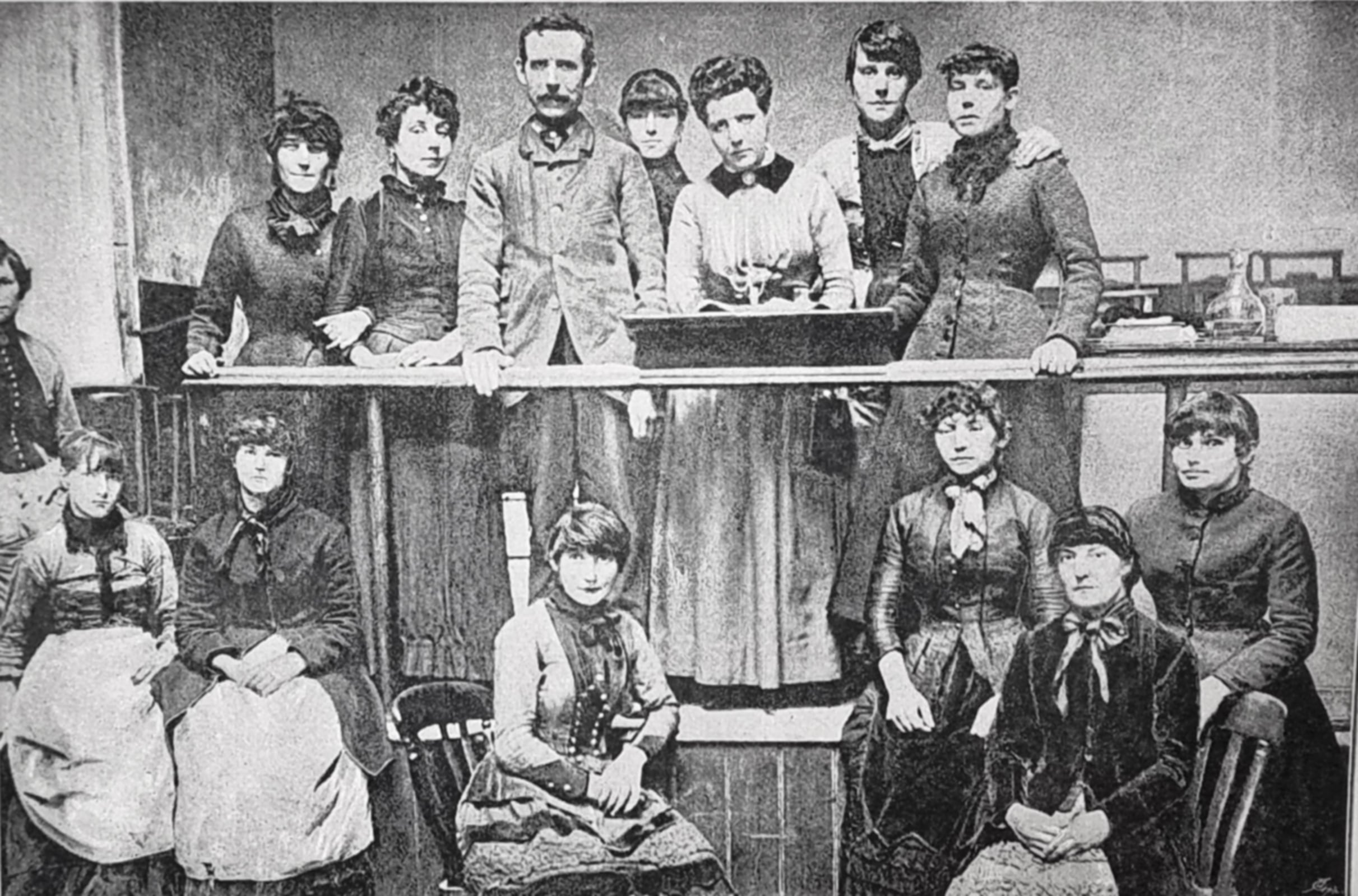
Unknown photographer, Annie Besant and the Matchgirls Strike Committee, 1888. Public domain.
Old Ford, East London · Story · Featured Study
The Match Girls and the Army
Three years after the strike at Bryant and May, the Salvation Army opened a factory of its own that made only safety matches.
- Where
- Bow, Old Ford, East London
- Who
- William Booth, James Barker, Mr Nunn
- When
- From 1891 to about 1901 (probable)
By Christmas 1891 scores of women were besieging the gates of the Army's match factory every day, by its own report.
Look, the wages you withheld from the workmen who mowed your fields are crying out against you. The cries of the harvesters have reached the ears of the Lord of Hosts.
Summary
The factory stood in Lamprell Street, Old Ford, and the Army spent some £2,000 to fit it out. James Oxley-Brennan's history has about seventy workers making matches there by early April, and Danielle Strickland has Booth opening it in May. Every figure for its pay comes from the Army.
- Colonel James Barker led Booth's inquiry into the trade, by the Army's notes.
- The matches were sold under the name Lights in Darkest England.
- The hours ran from 8 in the morning to 6 at night, six days a week.
The Texts of the Withheld Wage
The letter of James and the parable of the Good Samaritan stand beside the factory's pay.
This study asks what the Army's match factory changed for those who made matches. It also asks how far the Army's own account of it can be trusted. It gives the pay the Army said it offered and the story from the strike at Bow to the factory at Old Ford. It also gives the disease the poison caused, what the factory did and left undone, and the quarrel over what ended the disease. Booth himself wrote in 1890 that his scheme could "play the part of the Good Samaritan".
He went to him and bandaged his wounds, pouring on oil and wine. Then he put him on his own animal, brought him to an inn, and took care of him.
This is the man whose part Booth claimed for the Darkest England scheme.
Luke 10:34BSB
What the Army Said It Paid
Four Army sources measure the rise in pay, and their measures differ.
The promise was nearly treble, and the rates printed show about one and three-fifths.
| Source | Year | Its measure | Of whom |
|---|---|---|---|
| Booth, In Darkest England and the Way Out | 1890 | "Nearly treble" the amount then paid, as an aim | Makers of match boxes |
| The Darkest England Social Scheme, the first year's report | 1891 | "Nearly double" the ordinary rates, and 15s against 9s 4½d for forty-five gross in a week | Its sixty outside box-workers |
| Danielle Strickland, Challenging Evil, chapter 3 | 2010 | 4d a gross against 2¼d or 2½d | Makers of match boxes |
| The Army's teachers' notes on the factory | Undated | "More than one third above the rate in other factories" | Its factory workers |
Forty-five gross come to 9s 4½d at 2½d and to 15s at 4d, so the report's comparison uses the higher of the two old rates.
From Bow to Old Ford
The Army's Heritage Centre, its notes and its first report give the road from the strike to the factory.
In 1888 the women and girls of Bryant and May's factory at Bow went on strike. The Army's Heritage Centre names precarious employment, low wages, long hours and a system of fines among their conditions. It adds the danger of yellow phosphorus.
The Army's teachers' notes place Booth's own inquiry after the strike. The Army's first report says that the strike materially bettered the makers' position. It traces the factory to what its officers met in their relief work.
The report describes a spacious, well ventilated building, with a second door from each drying room onto an iron balcony and a fire escape. Its manager, a Mr Nunn, had twenty-five years in the match business. At its first Christmas the report counts sixty women and girls in the factory proper, about six indoor hands, ten preparers and the home workers. Together they turned out a thousand gross a week.
A widow and her children2 paragraphs
A school inspector told the Army of a widow of nearly sixty who wanted her twelve-year-old son on half time to help her make boxes. The Guardians had offered to take her and the boy into the workhouse and would do nothing for her daughter of fifteen.
Working from daylight far into the night, the family made two gross a day for two shillings and elevenpence a week. The Army took the girl into the factory and gave the mother box work at home at double her old rates, the report says.
The Poison and the Piece Rate
Those who handled the phosphorus risked the jaw, and those who made the boxes were paid by the piece.
Matches that struck on any dry surface were made with phosphorus, which the Army's sources call white or yellow. Workers who ate with unwashed hands carried it to their mouths, and it destroyed the bone of the jaw. The disease was called phossy jaw or matchmakers' leprosy.
The report tells of a woman who had lost part of the bone of her face through a first attack. She came to the factory door with a half-starved baby. "No employer would take her now", it says, and it adds that a second attack "always proves fatal".
The boxes were largely made at home by married women. The report calls the box-makers the most miserable of the skilled workpeople. It tells of one mother with a sick husband and seven children, who could reach ten or eleven gross a day with their help.
What the Factory Did and Left Undone
The report gives the profit, and the notes and Oxley-Brennan give its size and its end.
The report claims a "fair profit" and gives its own figure of £475 for the first months, about £1,250 a year.
The workforce stayed small beside the trade. The Army's notes give one hundred workers, and Oxley-Brennan gives sixty-five in 1899, with room for three hundred if demand had permitted.
Harold Begbie, Booth's biographer, finds his letters and diaries turning from about 1893 to the changed heart. He writes, "We read but seldom of match manufactories".
The end is dated two ways. Oxley-Brennan says that production is believed to have been phased out early in 1900. The Army's notes say that Booth closed the factory ten years after it opened, with his purpose achieved. The notes name no work for those words of purpose.
How the Key Verse Was Taught
A tractate of the fifth century and a commentary of the nineteenth on the wages that cry out.
Hilary of Arles (died 449)
INTRODUCTORY TRACTATE ON THE LETTER OF JAMES
Hilary of Arles explains what a cry reaching the Lord's ears can mean of God.
“What James means here is not that God has ears but that he can use his power to put right the wrongs which exist on earth.”
on James 5:4Patristic
Jamieson, Fausset & Brown (1802 to 1910)
Commentary Critical and Explanatory on the Whole Bible
The commentary of 1871 weighs a debt kept back against a gift withheld.
“Sins peculiarly offensive to God are said to ‘cry’ to Him. The rich ought to have given freely to the poor; their not doing so was sin. A still greater sin was their not paying their debts.”
on James 5:4Reformed
In Their Own Words
William Booth in 1890, and the Army's first report with the words of two workers it records.
William Booth (1829 to 1912)
In Darkest England and the Way Out, page 110
Nearly treble
“For instance, we propose at once to commence manufacturing match boxes, for which we shall aim at giving nearly treble the amount at present paid to the poor starving creatures engaged in this work.”
Methodist
About this saying1 paragraph
This promise of 1890 is the measure against which the later rates are read.
The Editor of All the World
The Darkest England Social Scheme: A Brief Review of the First Year's Work (1891), page 3
Forced into being
“The Army Match Factory was forced into being through knowledge of existent unrighteous conditions of labour, borne in on us by our officers’ almost fruitless toil to obviate their results”
Salvation Army
About this saying1 paragraph
The author of the report, whom Bramwell Booth's preface calls the Editor of All the World, gave this reason for the factory at Christmas 1891.
The Editor of All the World
The Darkest England Social Scheme: A Brief Review of the First Year's Work (1891), page 135
A light heart
“I can come to work with a light heart, now I have not the dread I had before”
Salvation Army
About this saying1 paragraph
A worker named Gertie answered her manager in these words, as the report of 1891 gives them.
The Editor of All the World
The Darkest England Social Scheme: A Brief Review of the First Year's Work (1891), page 137
This was God's work
“I felt condemned, I remembered this was God’s work”
Salvation Army
About this saying1 paragraph
In the report of 1891 a woman making boxes at home, tempted to work on a Sunday to get forward with the rent, sees the labels and says this.
What Ended Phossy Jaw, and What the Matches Cost
The Army's writers credit its example, the statute book shows an Act of 1908, and the sources differ on the price.
Did the Army's example end the disease?1 paragraph
Strickland writes that the great manufacturers "soon had to abandon their old, unhealthy methods" and that phossy jaw became "a matter of history" by the start of the twentieth century. The report of 1891 says that until the Army entered the market the evils "remained substantially what they always had been". Both are the Army's own account of itself.
Did the firms and the law end it?2 paragraphs
Safety matches were older than the factory. Oxley-Brennan writes that Bryant and May bought the British rights from their Swedish inventor in 1855 and adopted a new safety match composition in 1900.
The White Phosphorus Matches Prohibition Act is dated 21 December 1908. It came into operation on 1 January 1910, and its ban on sale reached retail dealers on 1 January 1911.
What did the matches cost?1 paragraph
The price divides the Army's own writers. Strickland calls the matches "only slightly dearer", and the Heritage Centre calls them "more expensive than regular matches". Oxley-Brennan prints a trade price of six shillings a gross after July 1891.
Books to Read Next
In Darkest England and the Way Out
William Booth · 1890
Booth sets out the scheme and makes his promise about the pay for match boxes.
Read Booth free at the Internet ArchiveThe Darkest England Social Scheme: A Brief Review of the First Year's Work
The Editor of All the World, with a preface by W. Bramwell Booth · 1891
Its fourteenth chapter gives the factory's first year, in the Army's own words.
Read the report free at the Internet ArchiveThe Life of General William Booth, volume 2
Harold Begbie · 1920
Begbie's chapter Going Back to First Causes draws on Booth's later letters and diaries.
Read Begbie free at the Internet ArchiveThe Wage and the Promise
By the Army's own figures, the factory paid above the rate of the trade and less than Booth first proposed.
Sources
Scripture is the Berean Standard Bible.
- The Holy Bible, Berean Standard Bible (read 2026)
- William Booth, In Darkest England and the Way Out (1890), page 110 and the reply to his critics.
- Harold Begbie, The Life of General William Booth, volume 2, chapter 15, Going Back to First Causes (1920)
- Danielle Strickland (ed.), Challenging Evil (2010), chapter 3, Sweated Labour.
- The Salvation Army, Victorian Photo Collection B, Matchbox Factory, teachers' notes.
- The Salvation Army International Heritage Centre, guide on sweating.
- James Oxley-Brennan, The Salvation Army match factory, an online exhibit drawing on David Mitchell (1973)
- White Phosphorus Matches Prohibition Act 1908 (8 Edw. 7 c. 42), sections 2 and 5, which date its operation and its ban on sale.
Keep Studying
Studies5