
Luke 10:34 · Story · Servanthood
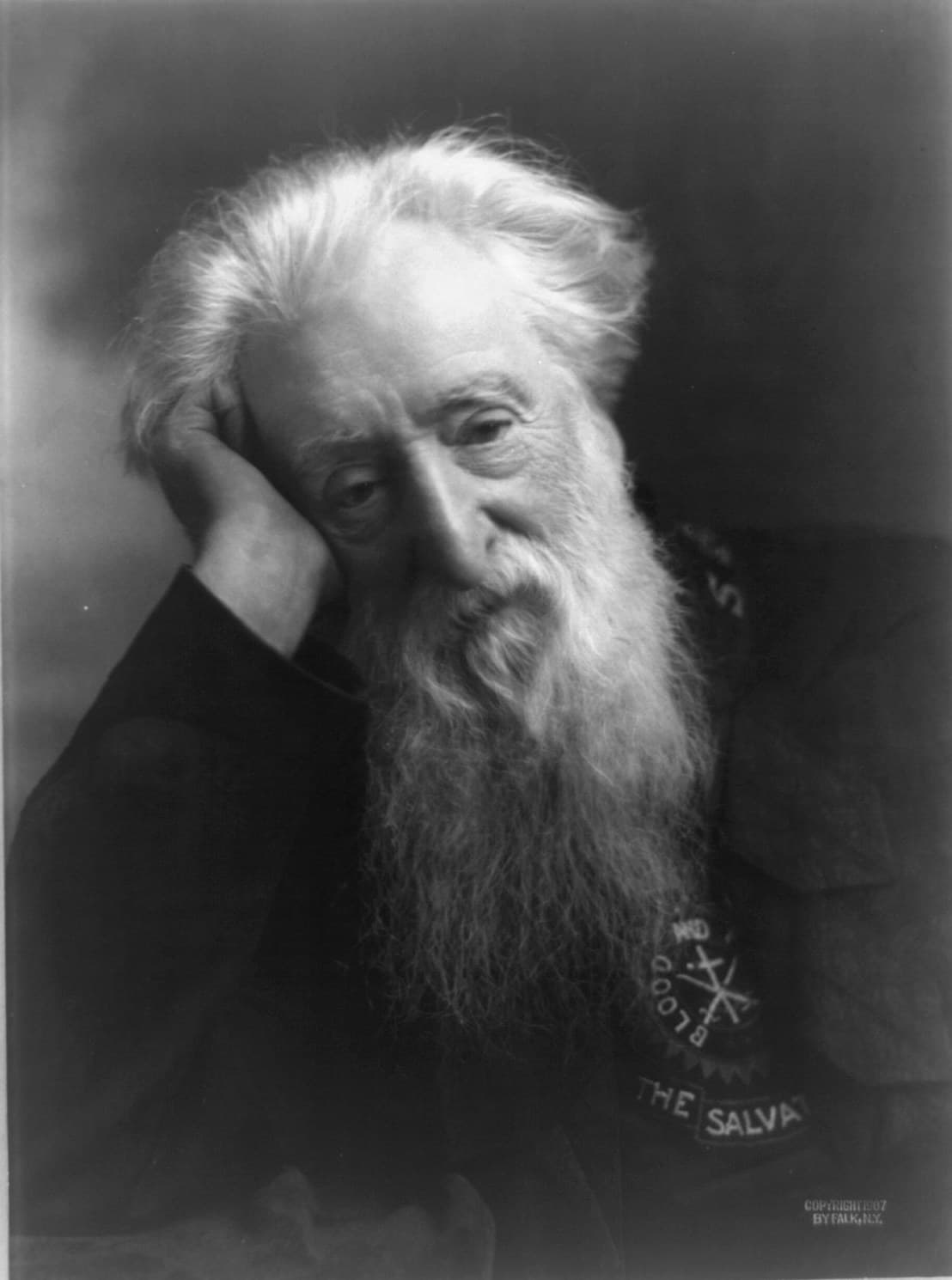
William Booth and the Salvation Army
William Booth began a mission in the East End of London in 1865 that became the Salvation Army.
As a child in Nottingham, Booth watched the hungry stocking weavers of the town wander the streets, and he wrote in 1890 that the sight had given him a lifelong wish to help the poor.
He went to him and bandaged his wounds, pouring on oil and wine. Then he put him on his own animal, brought him to an inn, and took care of him.
- When
- 1865 to 1912 AD
Summary
William Booth was a Methodist minister who left the ministry of his denomination and gave his life to the poorest people of England. He organised his followers as an army with himself as its General, and they preached in the streets and the slums. In 1890 he published a plan to give the destitute shelter, food and work, so that preaching and practical help would go together.
- Booth was born in Nottingham on 10 April 1829 and died on 20 August 1912.
- He married Catherine Mumford in 1855, and she worked beside him until her death in 1890.
- Booth named the destitute of England the Submerged Tenth and wrote his book of 1890 for them.
Why Booth Turned to the Poor
Booth wrote down his reason twenty-five years after the mission began.
William Booth and the Salvation Army tells the life of the preacher who founded the Army and of his book In Darkest England, and the Way Out. It belongs to the value of servanthood, because Booth spent his life on people the churches of his day had not reached.
The question the story answers is how a Methodist minister came to lead a movement of preaching and social rescue, and what he said it was for. It gives his reason in his own words and his life in dated events from Railton's authoritative life of him. It then gives the plan of In Darkest England and two judgments of that plan, his own and that of The Times at his death.
In the preface to In Darkest England, and the Way Out, Booth set out why he wanted more than the churches' usual remedies. “The rescued are appallingly few”, he said. He added that “my humanity and my Christianity, if I may speak of them in any way as separate one from the other, have cried out”. They cried out for a wider method of “reaching and saving the perishing crowds”.
Booth's Life and the Army in Dates
Railton's biography of 1912 closes with a table of the dated events of Booth's life.
Booth was thirty-six when he began the East London mission and led the work for forty-seven years after it.
To scale: 11 of 11 stops dated; a mark that would lie on another stands in a lane under the axis.
- Birth at Nottingham10 April 1829 ADFixed by Railton's Chapter I and his portrait caption
- Conversion1844 ADFixed by Railton's table of events
- Enters the Methodist ministry10 April 1852 ADFixed by Railton's table of events
- Marriage to Catherine Mumford16 June 1855 ADFixed by Railton's table of events
- Begins to travel as a revivalist1861 ADFixed by Railton's table of events
- Mission work begins in East London5 July 1865 ADFixed by Railton's table of events and Chapter IX
- The Christian Mission takes the name The Salvation Army1878 ADFixed by Railton's table of events, at Christmas of that year
- First number of the War Cry29 December 1879 ADFixed by Railton's table of events
- In Darkest England, and the Way Out published1890 ADFixed by the book's preface, dated October 1890
- Death of Catherine Booth4 October 1890 ADFixed by Railton's Chapter XIX
- Death of William Booth20 August 1912 ADFixed by Railton's portrait caption and Chapter XXIV
A timeline of eleven dated events, each row naming the record that fixes its date.
The Christian Mission takes the name The Salvation Army, First number of the War Cry, In Darkest England, and the Way Out published, Death of Catherine Booth, Death of William Booth
From Nottingham to Whitechapel
Railton's biography follows Booth from lay preaching to the head of an army.
Booth preached as a layman in Nottingham before he entered the ministry. He chose the Methodist New Connexion as the church nearest his “notions of system and order”, and Railton records his retirement from its ministry before he travelled as a revivalist. He and Catherine then settled in London to give their children a fixed home.
In 1865 he was asked to take some services in a tent set up in an old burial ground in Whitechapel, because the expected preacher had fallen ill. He walked home and told his wife, in the words Railton prints, “O Kate, I have found my destiny! These are the people for whose Salvation I have been longing all these years.”
Booth called the work the Christian Mission. In 1878 its stations grew “from thirty to eighty”, Railton writes, and only at the end of that year was the Mission first called “a Salvation Army”. Booth took the title of General, and the stations came to be called corps.
In Darkest England, and the Way Out
Booth's book of 1890 proposed three kinds of colony for the poorest.
He reckoned them at “three millions as representing the total”, which came “roughly to one-tenth of the population”.
He set his aim by the London cab horse. “When he is down he is helped up, and while he lives he has food, shelter and work”, he wrote. Then he asked, “Can the Cab Horse Charter be gained for human beings? I answer, yes.”
The scheme had three parts, the City Colony, the Farm Colony and the Over-Sea Colony. The City Colony was to be a set of “Harbours of Refuge for all and any who have been shipwrecked in life, character, or circumstances”. From there people would pass on to work on the land and then to settlement abroad.
Booth answered his critics from the parable. “We may not be priests and Levites, but we can at least play the part of the Good Samaritan”, he wrote. He asked his readers to bind up the wounds of the fallen and take them to the colony to recover.
Did the Social Scheme Serve the Gospel?
Booth and The Times judged the scheme of 1890 in different ways.
The question is whether Booth's social scheme carried his preaching further or proved a weaker part of his work.
Rescue of the body serves the saving of the soulWilliam Booth
Booth wrote in the same preface that his results “have been mainly attained by spiritual means”. Thousands, he said, had come out of destitution “to be happy and honest citizens and true sons and servants of God”. He offered the scheme for those who could not climb out unaided, because with many, he wrote, that “seems to be literally impossible”.
The objection: The Times judged at his death that the scheme had provided “no panacea for poverty.”
The social schemes had only moderate successThe Times, in its leader on Booth's death
The leader of The Times that Railton reprints among the tributes judged that “the Social Schemes outlined in In Darkest England have met with only moderate success, as all cool observers foretold in 1890.”
The objection: the same leader called Booth's success, “partial though it has been”, “an astonishing fact.”
One of the Church's Servants to the Poor
Booth's service had a long line of servants before it in Britain.
In the preface of 1890 Booth spoke of “forty years of active service in the salvation of men”.
Sources
Scripture is the Berean Standard Bible.
- William Booth, In Darkest England, and the Way Out (London: The Salvation Army, 1890), the preface dated October 1890, Part I chapter 2, The Submerged Tenth, Part II, and the reply to critics.
- George Scott Railton, The Authoritative Life of General William Booth, Founder of the Salvation Army (1912), Chapters III, IV, VI, VII, IX, XIX, XXIV and XXV and the table of important events.
- The Times, leader on the death of General Booth, August 1912, as Railton reprints it in Chapter XXV, Tributes.
- George Müller, A Narrative of Some of the Lord's Dealings with George Müller, Written by Himself, First Part, the account of the Orphan-Houses in Bristol.
- Thomas Clarkson, The History of the Rise, Progress, and Accomplishment of the Abolition of the African Slave-Trade by the British Parliament (London, 1808), volume 2, Mr. Wilberforce's motions in the House of Commons.
Keep Studying
Read it1
Studies6
Doctrines1
Values2