
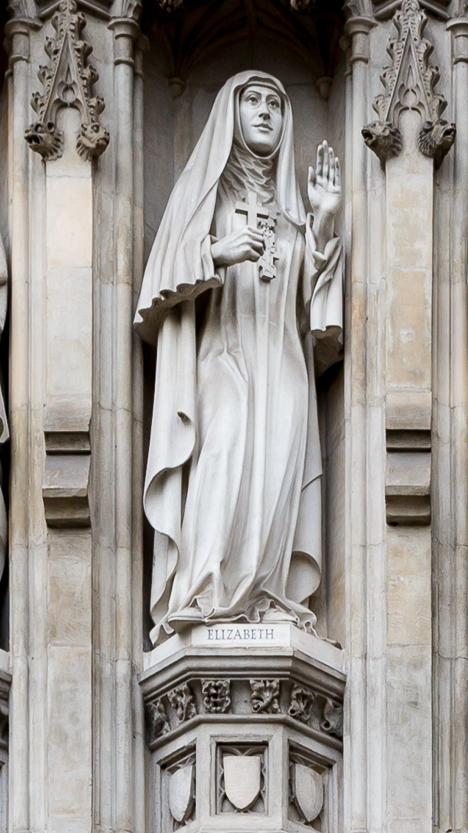
Uwe Aranas, the statue of Grand Duchess Elizabeth at Westminster Abbey, 2013. CC BY-SA 3.0.
Russia, to 1918 · Person · Featured Study
Grand Duchess Elizabeth
A princess of Hesse who married into the Romanov house, she led a convent of sisters of mercy until her murder in the revolution.
On the third day after a bomb killed her husband, the grand duchess went to the prison to see his killer.
But only one thing is necessary. Mary has chosen the good portion, and it will not be taken away from her.”
But only one thing is necessary. Mary has chosen the good portion, and it will not be taken away from her.”
- Born
- 1 November 1864, a princess of Hesse-Darmstadt
- Died
- 18 July 1918, in a mineshaft near Alapayevsk
- Family
- father: Louis IV, Grand Duke of Hesse and by Rhine; mother: Princess Alice; husband: Grand Duke Sergei Alexandrovich; sister: Alexandra Feodorovna
- Places
- Hesse-Darmstadt, England, Moscow, Ekaterinburg, Alapayevsk, Jerusalem
Summary
Elizabeth was a granddaughter of Queen Victoria. She married into the Russian royal family and joined the Orthodox Church. When her husband was killed, she gave her wealth to a house of prayer and care for the sick in Moscow. The Bolsheviks put her to death.
- She was named after Elizabeth of Hungary, a saint of her own family.
- The convent opened with six sisters, had thirty by the end of 1909 and 105 by 1918.
- In 1912 she wrote to Nicholas II to warn him about Rasputin.
The Sisters Her Convent Was Named For
Her community took the names of Martha and Mary, whose house Jesus visited in Luke 10.
The convent she opened in Moscow was the Saints Martha and Mary Convent of Mercy. The Abbey writes that it combined intercession and action. An embroidery she made of the two sisters stands for that path of good deeds and prayer.
The question of this life is how a princess of the imperial court came to live as a sister of mercy, and what the records say of the prison visit and of her death.
“Martha, Martha,” the Lord replied, “you are worried and upset about many things.Jesus answers Martha, busy with serving, in the house of the two sisters.
The Life in Order
The Abbey, the convent and a telegram of 1905 give the dates of the life.
Thirteen years passed between her husband's death and her own.
- 1 November 1864She was born a princess of Hesse-DarmstadtWestminster Abbey
- 1884She married Grand Duke Sergei AlexandrovichWestminster Abbey
- 13 April 1891She was received into the Orthodox Church on Lazarus SaturdayThe convent's page
- 4 February 1905Her husband, Grand Duke Sergei, was assassinatedThe Orthodox Church in America
- 7 February 1905She met the assassin Ivan KaliaevA Senate telegram of the next day
- 10 February 1909The Martha and Mary Convent of Mercy openedThe convent's page
- April 1909She and seventeen women were dedicated as Sisters of Love and MercyWestminster Abbey
- 7 May 1918She was arrested with two sisters of her conventWestminster Abbey
- 18 July 1918She was killed in a mineshaft near AlapayevskWestminster Abbey
- 1984The Russian Orthodox Church Abroad recognized her as a saintWestminster Abbey
- 1992The Moscow Patriarchate recognized her as a saintWestminster Abbey
Each step of the life stands with its witness, in the calendar the witness uses.
April 1909, 7 May 1918, 18 July 1918, 1984, 1992
From the Imperial Court to the Mineshaft
Her marriage brought her to Moscow, and her husband's death turned her life to the convent.
Her mother died when she was a child, and she came to England to live under the protection of Queen Victoria. In 1884 she married Grand Duke Sergei Alexandrovich, the fifth son of Tsar Alexander II.
Zhalnina notes that she was free to remain a Lutheran, since only the wife of an heir to the throne had to convert. In the seventh year of her marriage she was received into Orthodoxy of her own will. In the same year her husband became governor-general of Moscow.
In February 1905 Ivan Kaliaev threw a bomb near their house, and Sergei died. She gathered his remains, prayed for hours, and later asked the emperor to have mercy on the assassin.
The Abbey writes that she then gave away her jewellery and sold her most luxurious possessions. With the proceeds she opened the Martha and Mary home in Moscow. Its sisters soon opened a hospital, and she nursed sick and wounded soldiers in the hospitals.
After her arrest she was taken to Perm, then to Ekaterinburg and in May to Alapayevsk. There she and members of the imperial family were kept in a schoolhouse at the edge of the town. The Tsar and his family were shot, and on the next night she, the nun Varvara and the others were killed at a mineshaft.
What the Telegram of 1905 Records
A cipher telegram sent the day after records her meeting with the man who killed her husband.
The telegram was written by E. B. Vasilyev, head of the Governing Senate, and Zhalnina's article prints it in English. It says that she met Kaliaev at eight in the evening of 7 February in the office of the Pyatnitsky police unit.
She told him she was the wife of the man he had killed and asked him why he had done it. He stood and answered, "I did what I had been charged with. It's the fault of the existing regime."
By the telegram she then told him, "Knowing the generous heart of my late husband, I forgive you". She blessed him and stayed alone with him for about twenty minutes. After the meeting he told the officer, "The Grand Duchess is kind, and you all are cruel."
The convent's page says she went to him to ask him to repent and to pray to the Lord for forgiveness. Zhalnina adds that she left him the Gospel.
In Their Own Words
Maria Litzman put these four letters of hers into English.
Grand Duchess Elizabeth (1864 to 1918)
Letter to her father, Louis IV, Grand Duke of Hesse and Rhine, 1 January 1891
A pure and faithful heart
“I have come to this decision [to convert to the Orthodoxy] only due to my deep faith. I feel that I should stand before God with a pure and faithful heart.”
Orthodox
About this saying1 paragraph
On 1 January 1891 she wrote to her father, Louis IV, Grand Duke of Hesse and Rhine, of her coming reception into Orthodoxy.
Grand Duchess Elizabeth
Letter to V. F. Dzhunkovsky, adjutant of Grand Duke Sergei Alexandrovich, 1905
The victims of the rebellion
“It is my duty to help poor victims of the rebellion. I would rather be killed by a first accidental shot, than stay here doing nothing.”
Orthodox
About this saying1 paragraph
In 1905, the year of the revolution, she wrote to V. F. Dzhunkovsky, her husband's adjutant.
Grand Duchess Elizabeth
Letter to Nicholas II, 26 March and 18 April 1909
Engaged to Christ
“For me, taking monastic vows is something more serious than marriage is for a young woman. I’m becoming engaged to Christ and his service. I give everything I have to him and my neighbor.”
Orthodox
About this saying1 paragraph
In letters of March and April 1909 she wrote to Nicholas II of the vows she was about to take.
Grand Duchess Elizabeth
Letter to E. N. Narishkina, 1910
The same troubles
“If I want others to follow my principles I have to do things as they do, go through the same troubles.”
Orthodox
About this saying1 paragraph
In a letter of 1910 to E. N. Narishkina she answered those who told her to stay in her palace and do good from above.
The People Around Her
Her family stood at the head of two empires, and her last companions were a nun and the princes held with her.
Her circle ran from Queen Victoria to the princes held with her at Alapayevsk.
| Person | Tie to Elizabeth | The witness |
|---|---|---|
| Queen Victoria | Her grandmother | Westminster Abbey |
| Sergei Alexandrovich | Her husband from 1884 and governor-general of Moscow | Westminster Abbey; the convent |
| Alexandra Feodorovna | Her younger sister, the empress | Orthodox Church in America |
| Nicholas II | The Tsar, her correspondent in letters from 1909 to 1916 | Zhalnina, her letters |
| Ivan Kaliaev | A Social-Revolutionary, her husband's assassin | Zhalnina, the Senate telegram |
| Vladimir Dzhunkovsky | Adjutant to Grand Duke Sergei | Zhalnina, her letter to him |
| Varvara | A sister of her convent, killed with her | Westminster Abbey; the convent |
| Vladimir Paley | A young count held with her at Alapayevsk | Orthodox Church in America |
Varvara, Vladimir Paley
The Places of Her Life
Her life runs from a German court to Moscow, the Urals and a grave in Jerusalem.
Moscow held the thirteen years of her convent.
| Place | What the records say | The witness |
|---|---|---|
| Hesse-Darmstadt | The German grand duchy of her birth | Westminster Abbey |
| England | Where the faith of her youth was Anglican, as the Abbey judges it | Westminster Abbey |
| Moscow | Her husband's city as governor-general, and the site of her convent | The convent |
| Ekaterinburg | Where she was refused access to the Tsar's family and lodged in a convent | Orthodox Church in America |
| Alapayevsk | The town in the Urals where she was held in a schoolhouse | Orthodox Church in America |
| Jerusalem | The city of her grave | The convent; Orthodox Church in America |
How Her Church Judged Her
The Orthodox Church honours her as a martyr, and an Anglican abbey keeps her statue.
The Abbey writes that the Bolshevik party saw in the Orthodox Church a pillar of the old regime. In time, it adds, hundreds of priests and nuns were imprisoned and killed. Elizabeth was remembered, and the Russian Church Abroad and then the Moscow Patriarchate counted her among the saints.
The convent's page says her relics and those of the nun Barbara rest in the church of Mary Magdalene on the Mount of Olives. The convent keeps particles of them in its cathedral in Moscow. Her statue at Westminster Abbey is the work of the sculptor John Roberts.
The Voices
One teacher on Luke 10:42.
Ambrose of Milan (died 397)
Catena Aurea by Aquinas
Mary's desire of wisdom is the greater work
“May you then like Mary be influenced by the desire of wisdom. For this is the greater, this the more perfect work. Nor let the care of ministering to others turn thy mind from the knowledge of the heavenly word, nor reprove or think indolent those whom thou seest seeking after wisdom.”
on Luke 10:41 to 42Patristic
What the Witnesses Leave Open
The records differ on her words to Kaliaev, two calendars, her last hours, the order to kill her and one saying.
What she said to KaliaevThe Senate telegram, as Zhalnina prints it; the convent; the Orthodox Church in America
The telegram gives her words of pardon. The convent's page and the Orthodox Church in America say only that she urged him to repent.
Two calendarsThe Orthodox Church in America; Westminster Abbey
The Orthodox Church in America dates her husband's death 4 February 1905 and her own 5 July 1918, in the old Russian calendar. The Abbey gives 18 February and 18 July. Thirteen days separate 5 July from 18 July, and the Abbey's February date stands fourteen days after the old one.
Her last hoursThe Orthodox Church in America; Metropolitan Anastasius, as Zhalnina prints him
The Orthodox Church in America writes that the prisoners were thrown into the mineshaft and grenades after them, and that she lived for several hours and was heard singing hymns. A letter of Metropolitan Anastasius rests this on excavations made later and on peasants who heard singing from a distance.
Who gave the orderZoya Zhalnina; Westminster Abbey; the Orthodox Church in America
Zhalnina's article says she was thrown into the mine on Lenin's order and gives no document for it. The Abbey and the Orthodox Church in America name no one who gave the order.
A saying the Abbey printsWestminster Abbey
The Abbey sets these words on its page as hers, with no date or source. They read, "I am leaving a glittering world where I had a glittering position, but with all of you I am descending into a greater world".
Books to Read Next
Grand Duchess Elizabeth of Russia
Lubov Millar · 1991
The Abbey lists it in its further reading on her.
In print: find it wherever books are sold.
Ella, Princess, Saint and Martyr
Christopher Warwick · 2006
Christopher Warwick wrote her life as princess, saint and martyr.
In print: find it wherever books are sold.
What Elizabeth Left
Elizabeth left a convent of mercy in Moscow, letters that tell why she chose it, and a grave in Jerusalem.
Sources
Scripture is the Berean Standard Bible.
- The Holy Bible, Berean Standard Bible (read 2026)
- Westminster Abbey, "Grand Duchess Elizabeth", the Abbey's commemoration page.
- The Orthodox Church in America, the life of Grand Duchess Elizabeth, commemorated 18 July.
- The Saints Martha and Mary Convent of Mercy, "Grand Duchess Elizabeth Feodorovna", the convent's English page.
- Zoya Zhalnina, "Life Principles of Grand Duchess Elizabeth", translated by Maria Litzman, OrthoChristian.com, 2018, with her letters of 1891 to 1916 and the Senate telegram of 8 February 1905 in English.
- Ambrose of Milan, on Luke 10:41 and 42, in Thomas Aquinas, Catena Aurea.
Keep Studying
Read it1
People and groups3
Values3
Places2
Trials of life1