
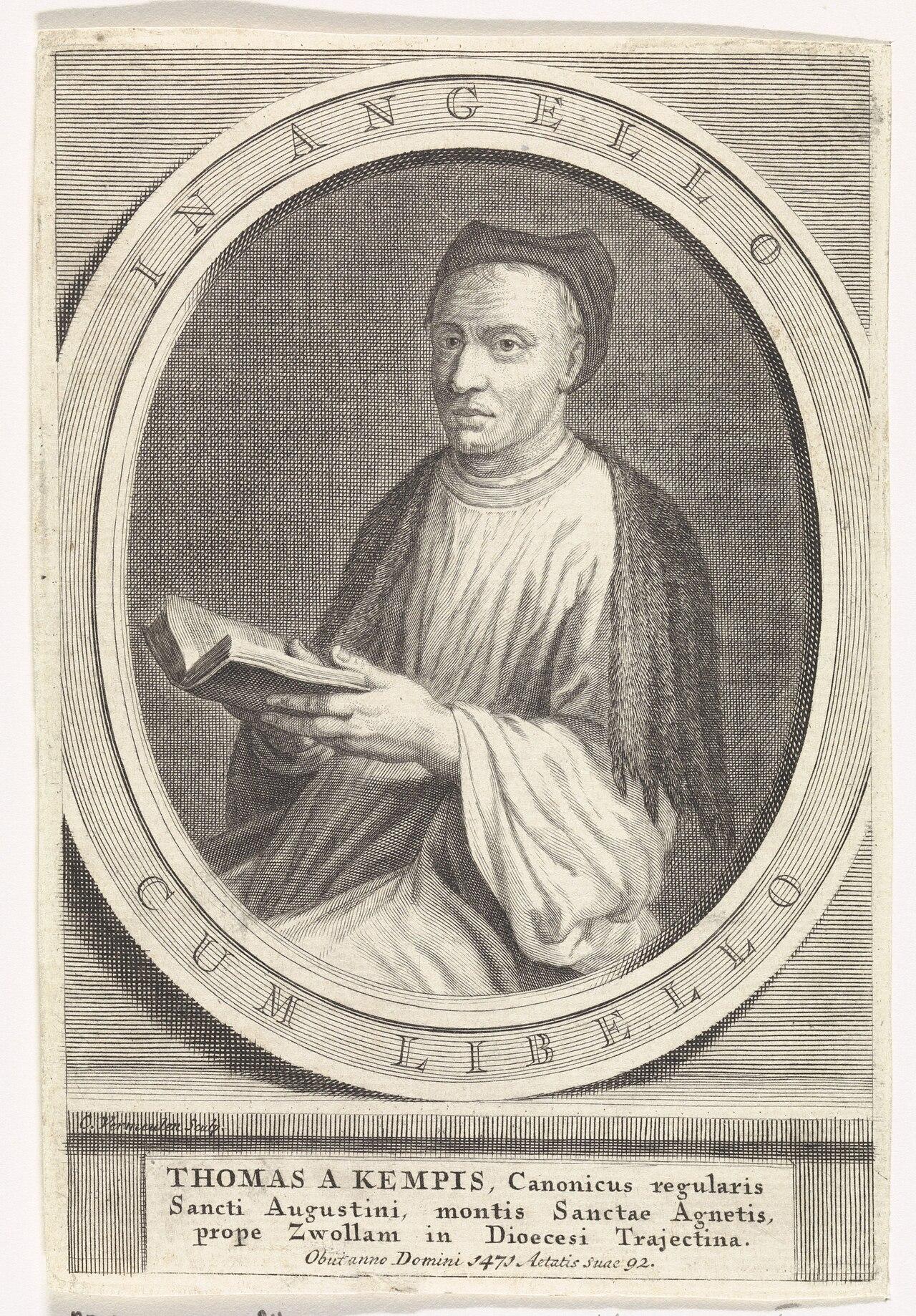
Cornelis Martinus Vermeulen after Abraham Bloemaert, Portrait of Thomas à Kempis, 1654 to 1709. CC0.
1380 to 1505 · The churches · Featured Study
The Brethren of the Common Life
Households in the Low Countries who took no vows, worked for their daily bread and kept schools in the century before the Reformation.
When Geert Groote began to preach at forty, Schaff wrote, “Throngs gathered to hear him in the churches and churchyards of Deventer, Zwolle, Leyden and other chief towns of the Lowlands.”
Once again, Jesus spoke to the people and said, “I am the light of the world. Whoever follows Me will never walk in the darkness, but will have the light of life.”
Once again, Jesus spoke to the people and said, “I am the light of the world. Whoever follows Me will never walk in the darkness, but will have the light of life.”
- Began
- About 1380, when Geert Groote began to preach at forty (probable)
- Bodies
- The Brethren of the Common Life, The canons regular of Windesheim
Summary
The Brethren of the Common Life were a community of the Low Countries, gathered by Geert Groote of Deventer. Its members took no vows and lived by their own work. After Groote died his disciple Florentius Radewyn founded the canons of Windesheim. Thomas a Kempis, a canon of their house at Mount St. Agnes, is the man most scholars name as the writer of The Imitation of Christ.
- Groote died of the pestilence in 1384, caught while he nursed the sick.
- Windesheim, their chief house of canons, was dedicated in 1387.
- Erasmus studied at their school at Deventer from 1474.
- John Wesley printed his own English Imitation, The Christian's Pattern, in London in 1735.
The Texts the Imitation Opens On
Wesley's edition sets a saying of Jesus on its first page and a line of Luke before it.
Wesley's English of the Imitation is The Christian's Pattern. Its first chapter, headed “Of the Imitation of Christ, and contempt of all the vanities of the world,” opens on a saying of Jesus from the Gospel of John. An engraved plate faces the first page. It shows a woman seated at the feet of Jesus while a second woman stands and speaks to him. Under the plate stands a reference to Luke 10:42, where Jesus tells Martha that only one thing is necessary.
But only one thing is necessary. Mary has chosen the good portion, and it will not be taken away from her.”The plate before page 1 of Wesley's edition of 1735 is captioned with this verse.
The Brethren's Branch of the Family of Churches
The branch runs from Groote's preaching in the Lowlands to a book printed in London.
The New Devotion grew inside the Roman church and reached Erasmus and Wesley.
1380 to 1387
- The Roman Catholic Church
- Groote's preaching
- The Brethren of the Common Life
- The canons of Windesheim
1441
1474
1735
Each date is read from Schaff's history, an encyclopedia article or Wesley's title page.
Renewal in the Western Church sets the Brethren beside the other renewals of the Latin church, from the Rule of Benedict to the twentieth century.
How the Brethren Began: Groote and His Followers
A member's life of the first fathers, a Catholic encyclopedia and a Protestant history tell the start.
Thomas a Kempis wrote the lives of the movement's first fathers. J. P. Arthur put them into English in 1905 as The Founders of the New Devotion, and Thomas tells there how Groote died on the feast of St. Bernard.
The Catholic Encyclopedia of 1910 gives the day of his death as 20 August 1384. It says he gathered the Brethren at Zwolle.
David Schaff, writing a Protestant history in 1910, names Florentius Radewyn beside Groote. Schaff says the two led the beginnings of the Windesheim Congregation and the Brothers of the Common Life.
Schaff writes that the Franciscans secured from the bishop of Utrecht a ban on preaching by men who were not ordained, and that Groote came under it. Groote appealed to Urban VI, who took the bishop's side, and he died before the decision was known.
The Truth They Pressed: Religion Seated in the Heart
Wesley's Journal of 1738 says what the Imitation taught him.
Wesley looked back in his Journal for 24 May 1738 to the year his father pressed him toward holy orders. He wrote that through Kempis's Christian Pattern “I began to see that true religion was seated in the heart.”
He dates that reading to when he was “about twenty-two.” His Plain Account of Christian Perfection names the year as 1726.
The Book in Its Makers' Own Records
The copyist's note and Wesley's printing say who made the book and who corrected it.
Thomas signed the book in 1441, and Wesley put his name to an English text in 1735.
| Record | Year | Its words |
|---|---|---|
| Thomas's signed codex, Brussels, Royal Library 5855 to 61 | 1441 | “finished and completed, 1441, by the hands of brother Thomas a Kempis of Mount St. Agnes, near Zwolle” |
| Wesley's title page | 1735 | “Compared with the Original, and corrected throughout By JOHN WESLEY, M.A. Fellow of Lincoln College, Oxon.” |
| Wesley's printer | 1735 | “LONDON: Printed for C. RIVINGTON, at the Bible and Crown in St. Paul's Church-yard.” |
The Houses and Their Counts
The houses no longer stand, so each count is taken from a book.
The Brethren held about forty houses, and the canons of Windesheim held more than eighty in Belgium alone.
| Body | The count | Who counted, and for when |
|---|---|---|
| The Brethren of the Common Life | 18 German houses and 20 in the Lowlands | Schulze, as Schaff gives it in 1910 |
| The school at Deventer | Over two thousand students | The Catholic Encyclopedia (1908), for 1500 |
| The canons of Windesheim | More than eighty monasteries in Belgium alone | The Catholic Encyclopedia (1908), sixty years after Groote's death |
Where the Brethren Went
Each place stands with the year its record gives.
The movement began in Deventer and Zwolle, and its book reached London.
| Year | Place | What happened there | Where it is recorded |
|---|---|---|---|
| 1340 | Deventer | Geert Groote was born. | The Catholic Encyclopedia, Gerard Groote (1910) |
| 1387 | Windesheim | The canons dedicated the house that gave their congregation its name. | Schaff (1910), page 280 |
| 1441 | Mount St. Agnes | Thomas put his name to a copy of his writings. | Schaff (1910), page 291 |
| 1474 | Deventer | Erasmus became an inmate of the school. | Schaff (1910), page 281 |
| 1505 | Cambray | The last house of the Brethren was founded. | Schaff (1910), page 280, note 1 |
| 1735 | London | C. Rivington printed Wesley's edition at the Bible and Crown. | The title page of 1735 |
In Their Own Words
John Wesley (1703 to 1791)
The Journal of the Rev. John Wesley, Wednesday 24 May 1738, paragraph 4
Too strict
“I was, however, very angry at Kempis for being too strict”
Evangelical
About this saying1 paragraph
In the same entry of 24 May 1738 Wesley set down his first quarrel with the book. Curnock prints it on page 466 of his first volume.
Thomas à Kempis
The Founders of the New Devotion, the life of Gerard the Great, the death of Gerard
The death of Gerard
“After the Festival of the Assumption of the Blessed Mary, ever Virgin, when the Feastday of St. Bernard (to whom Gerard was especially devoted) had dawned, this reverend father, then in the forty-fourth year of his age, delivered up to God his soul fortified by the Sacraments of the Church, made precious by faith, and ennobled by many virtues.”
Catholic
About this saying1 paragraph
Thomas tells the death of Groote, whom he calls Gerard, on page 48 of Arthur's English of 1905.
Thomas à Kempis
The Christian's Pattern, or a Treatise of the Imitation of Christ, book I, chapter I
He that followeth me
“He that followeth me, walketh not in darkness, saith the Lord. These are the words of Christ, by which we are admonished, that we ought to imitate his life and manners, if we would be truly enlightened, and delivered from all blindness of heart.”
Catholic
About this saying1 paragraph
The first lines of book I stand on page 1 of Wesley's edition of 1735, read here from the page image with the long s set as s.
Who Wrote the Imitation, and Whose the Brethren Were
Scholars have argued over the book's author, and Protestants and Catholics over the Brethren.
Schaff names Gerson, Gersen and Thomas a Kempis as the three claimants to the book worth weighing. He writes that it “is now quite generally ascribed to Thomas a Kempis, but among those who dissent from this opinion are scholars of rank.”
Karl Ullmann, a German Protestant, claimed the Brethren for the Reformation in his Reformers before the Reformation, printed in English in 1855. He held that their schools, their spreading of the Bible and their use of the mother tongue “exercised a positive influence upon the Reformation.”
The Catholic Encyclopedia of 1908 answers that the cry of heresy against Groote was raised in vain. It calls him “no less zealous for purity of faith than for purity of morals.”
Schaff, a Protestant himself, wrote that Groote “seems not to have opposed any of the doctrines of the Church.”
Books to Read Next
The Christian's Pattern
Thomas a Kempis, corrected by John Wesley · 1735
Wesley's preface on reading the book with advantage stands before the text.
Free at the Internet ArchiveThe Founders of the New Devotion
Thomas a Kempis, translated by J. P. Arthur · 1905
Thomas tells the lives of Groote and his first followers.
Free at the Internet ArchiveHistory of the Christian Church, volume V, part II
David S. Schaff · 1910
Schaff weighs the claimants to the Imitation and describes the houses.
Free at the Internet ArchiveReformers before the Reformation, volume II
Karl Ullmann · 1855
Ullmann makes the case that the Brethren prepared the way for the Reformation.
Free at the Internet ArchiveWhat the Brethren Handed On
The Catholic Encyclopedia says more than half of the Brethren's schools were swept away in the religious troubles of the sixteenth century, and the canons of Windesheim ended in the French Revolution. The Brethren handed on a book of inward devotion that crossed from a canon of Mount St. Agnes to a fellow of Lincoln College, Oxford. Wesley printed it in English three years before the night at Aldersgate Street when, by his Journal, “I felt my heart strangely warmed.”
Sources
Scripture is the Berean Standard Bible.
- The Holy Bible, Berean Standard Bible (read 2026)
- David S. Schaff, History of the Christian Church, volume V, part II, The Middle Ages, 1294 to 1517 (New York: Scribner, 1910), pages 278 to 281, 284 and 288 to 291.
- Thomas a Kempis, The Founders of the New Devotion, translated by J. P. Arthur (London: Kegan Paul, Trench, Trübner, 1905), page 48.
- The Christian's Pattern, or a Treatise of the Imitation of Christ, by Thomas a Kempis, compared with the original and corrected throughout by John Wesley (London: C. Rivington, 1735)
- The Journal of the Rev. John Wesley, standard edition, edited by Nehemiah Curnock, volume I (London: Charles H. Kelly, 1909), pages 466 and 475 to 476.
- John Wesley, A Plain Account of Christian Perfection, section 3, in The Works of John Wesley, edited by Thomas Jackson (1872), volume 11.
- Karl Ullmann, Reformers before the Reformation, translated by Robert Menzies, volume II (Edinburgh: T. and T. Clark, 1855), pages 4 to 5.
- The Catholic Encyclopedia, volume 7 (New York: Robert Appleton, 1910), Gerard Groote.
- The Catholic Encyclopedia, volume 4 (New York: Robert Appleton, 1908), Brethren of the Common Life.
- The Catholic Encyclopedia, volume 3 (New York: Robert Appleton, 1908), Canons and Canonesses Regular.
- The Catholic Encyclopedia, volume 14 (New York: Robert Appleton, 1912), Thomas a Kempis.
Keep Studying
People and groups6
Doctrines1
Subjects1