
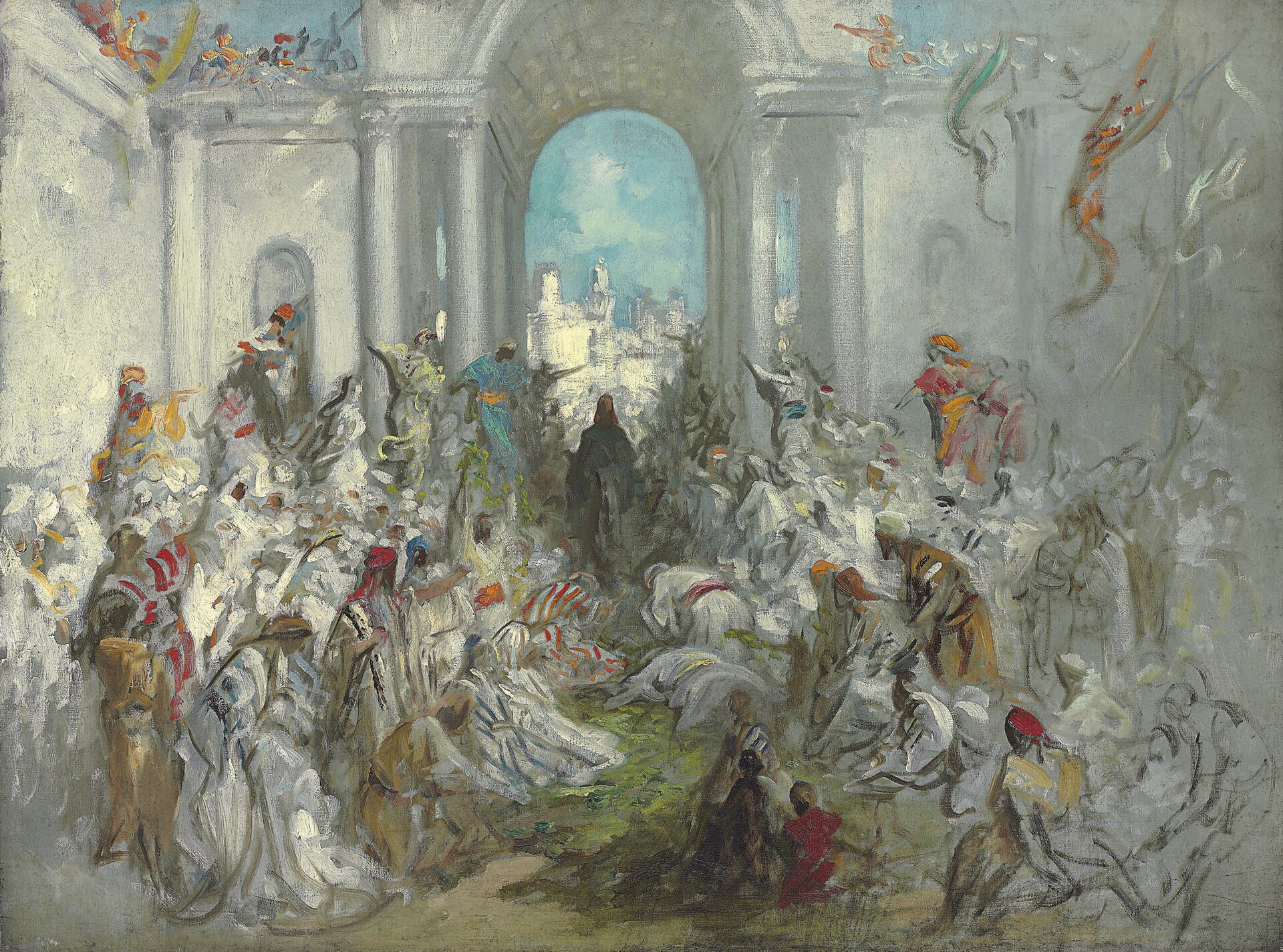
Matthewchapter 21
46 verses · Matthew, by tradition · AD 50 to 65 · The Gospels
Key verse
Saying unto them, Go into the village over against you, and straightway ye shall find an ass tied, and a colt with her: loose them, and bring them unto me.
It stands in Riding into Jerusalem on a Borrowed Colt, verses 1 to 11.
The chapter
Chapter summary
Triumphal entry on the colt (fulfilling Zech 9:9). Temple cleansed: 'my house shall be called the house of prayer.' The barren fig tree cursed. Chief priests question his authority; parable of the two sons, of the householder and the wicked husbandmen. 'The stone which the builders rejected is become the head of the corner.'
Context
Gospel · Matthew · Matthew overview
The world of this chapter
- Who
- Jewish readers who had walked into that same temple at Passover
- Where
- The descent from the Mount of Olives, the temple courts, and the road to Bethany
- When
- The final week in Jerusalem. c. AD 30 or 33, the year of the crucifixion is debated, with AD 30 and AD 33 the leading candidates
Historical context
Passover swelled the city enormously. Josephus gives figures for the pilgrim crowds that are certainly inflated, but every source agrees the population multiplied and the surrounding villages filled up. Rome knew it too: the governor came up from the coast with extra troops for the festival, because Passover celebrated a liberation from an empire.
The entry was staged to be read. Riding a donkey rather than a horse quoted Zechariah's prophecy of a king coming humble and mounted on a colt. The branches and the cloaks on the road were how a crowd greeted a victor, and the shout of Hosanna comes from Psalm 118, part of the set of psalms pilgrims sang on the way up.
The money changers had a reason to be where they were, and the reason explains the anger. The temple tax had to be paid in a particular coinage, and pilgrims arrived carrying the currency of a dozen provinces, so exchange was necessary. Animals for sacrifice had to pass inspection, so buying an approved one on site was easier than driving a lamb from Galilee. But the trade was set up in the Court of the Gentiles, the one part of the complex a non-Jew was allowed to enter, and the only place on earth where a Gentile could come to pray. It had been turned into a market.
The tenant parable describes an ordinary arrangement. Absentee landlords owned large Galilean estates and leased them to tenant farmers for a share of the crop, collected by agents. Disputes over that share were common, and violence against collectors was not unknown.
Significance
For Matthew's readers this was the week their leaders decided. The chapter puts the decision on display: the King arrives as prophesied, cleanses the house, and is challenged over his authority by the men who ran it.
The two parables then say plainly what the reader has been circling. The son who said no and went is the tax collector; the son who said yes and stayed home is the respectable man. And the vineyard will be given to a people producing its fruit, which is why Matthew's community, small and disowned, could believe it stood in the true line.
Where the chapter sits
Matthew 21 falls in Community in the Kingdom (chapters 18). Discourse 4: greatness, forgiveness.
Before it: Parables of the Kingdom, chapters 13. After it: Olivet Discourse, chapters 24–25.
The whole shape of Matthew→The structure of this chapter
Threads running through this chapter
- The stone which the builders refusedPattern, v. 42
The heads below are this chapter's scenes. The numbered points under each are its verses.
Riding into Jerusalem on a Borrowed Colt
unto the mount of Olives: Bethphage sits on the eastern slope of Olivet, the ridge Zechariah names as the place where the Lord's feet will one day stand, and Jesus turns that geography into the opening move of his last week. He sends two disciples for an ass tied and a colt with her, a detail no eyewitness could invent after the fact, and gives them a password rather than a plan: The Lord hath need of them. The bench reads the arrangement as prior word to the animal's owner rather than commandeered property, since straightway he will send them assumes a ready yes.
Matthew 21:1
“And when they drew nigh unto Jerusalem - They were going up now from Jericho. Mat 20:29. The distance was about 19 miles. The most of the way was a desert, or filled with caves, and rocks, and woods - a suitable place for robbers. See Luk 10:30. The Mount of Olives, or “Olivet,” is on the east of Jerusalem. Between this and Jerusalem there runs a small stream called the brook Kidron, or Cedron. It is dry in the hot seasons of the year, but swells to a considerable size in time of heavy rains.”
1 more voice on this verseWhat preachers and commentators have said about this verse, in their own words.
Matthew 21:1
“And when they drew nigh unto Jerusalem,.... The Syriac, Persic, and Ethiopic versions read, "when he drew nigh, or was near"; but not alone, his disciples were with him, and a multitude of people also; as is evident from the following account.”
Matthew 21:2
“Ye shall find an ass tied, and a colt - Asses and mules were in common use in Palestine: horses were seldom to be met with. Our blessed Lord takes every opportunity to convince his disciples that nothing was hidden from him: he informs them of the most minute occurrence; and manifested his power over the heart in disposing the owner to permit the ass to be taken away.”
Adam Clarke· Commentary on the Bible (1810-1826)evangelical
Matthew 21:3
“The Lord hath need of them - This means no more than the “master” has need of them. The word “Lord” often means no more than “master” as opposed to servant, Mat 10:24; Eph 6:5; 1Pe 3:5-6. The word is sometimes used in the Bible as applied to God, or as a translation of the name Yahweh. Its common use is a mere title of respect given by an inferior to a superior, by a servant to a master, by a disciple to a teacher. As a title of “high respect” it was given to Christ, or the Messiah.”
spoken by the prophet: All this was done, that it might be fulfilled, and Matthew's citation splices Zechariah 9:9 onto Isaiah 62:11's tell ye the daughter of Sion, reading the two prophets as one voice on one day. The king Zechariah promised comes meek and lowly, riding the beast of peace and labor rather than the war horse a conqueror rides, and the whole city sees the claim made in the open where earlier miracles were made in private. The colt and the ass together read to some commentators as a doubled detail from the Hebrew's own parallelism, an ass, even a colt, describing one animal in poetry, though Matthew narrates two beasts literally present, and the bench leaves both readings standing rather than forcing one.
Matthew 21:4
“All this was done - The word all, in this clause, is omitted by some MSS., versions, and fathers. Which was spoken - The Spirit of God, which predicted those things that concerned the Messiah, took care to have them literally fulfilled: 1. To show the truth of prophecy in general; and, 2. To designate Christ as the person intended by that prophecy. See the note on Mat 2:23.”
Adam Clarke· Commentary on the Bible (1810-1826)evangelical
Cross references
Matthew 21:4
- QuotingZechariah 9:9“Rejoice greatly, O Daughter of Zion! Shout in triumph, O Daughter of Jerusalem! See, your King comes to you, righteous and victorious, humble and riding on a donkey, on a colt, the foal of a donkey.”
touto de gegonen hina plerothe to rhethen, triumphal-entry fulfillment frame
Matthew 21:5
“Tell ye the daughter of Sion - The quotation is taken from Zec 9:9, but not in the precise words of the prophet. This entry into Jerusalem has been termed the triumph of Christ. It was indeed the triumph of humility over pride and worldly grandeur; of poverty over affluence; and of meekness and gentleness over rage and malice. He is coming now meek, full of kindness and compassion to those who were plotting his destruction!”
Adam Clarke· Commentary on the Bible (1810-1826)evangelical
1 more voice on this verse
Matthew 21:5
“The daughter of Sion - That is, the inhabitants of Jerusalem: the first words of the passage are cited from Isaiah lxii, 11; the rest from Zech. ix, 9. The ancient Jewish doctors were wont to apply these prophecies to the Messiah.”
John Wesley· Explanatory Notes upon the New Testament (1755)evangelical
Cross references
Matthew 21:5
- QuotingZechariah 9:9“Rejoice greatly, O Daughter of Zion! Shout in triumph, O Daughter of Jerusalem! See, your King comes to you, righteous and victorious, humble and riding on a donkey, on a colt, the foal of a donkey.”
'thy King cometh unto thee... upon an ass', triumphal-entry fulfillment formula (w/ Isa 62:11)
ConnectionsZechariah 9:9
did as Jesus commanded them: The disciples did as Jesus commanded them, and the simplicity of the obedience matches the simplicity of the charge; they fetch two animals on a stranger's word and a king's errand. They put on them their clothes, cloaks thrown as saddle and as covering both, and set him thereon, the pronoun most naturally read against the garments rather than forcing the Lord onto two beasts at once. Matthew Henry notes the poverty of the whole procession next to its meaning, a borrowed colt and borrowed cloaks bearing the Son of David into his own city.
Matthew 21:6
“This was but a poor piece of state, yet Christ accepted their good-will; and we are hereby taught to contrive how to make Christ welcome, Christ and his grace, Christ and his gospel, into our hearts and houses.”
Matthew Henry· Commentary on the Whole Bible (1707-1721)puritan
2 more voices on this verse
Matthew 21:6
“All of these circumstances surrounding his appearance point to the shape of the future. By means of parabolic signs and by the conditions of present things, the form of the future is here suggested. The Lord is taking possession of the nations! His brightness is approaching! He is occupying the minds of the nations—just as the rider of a beast. He is proclaimed by the entire army of his retinue of patriarchs, prophets and apostles. The patriarchs are spreading their garments, which signify their glory, under the Lord. By their generations, names and struggles, the Lord was prophesied.”
Hilary of Poitiers· written before 367· Commentary on Matthew 21.2patristic
Matthew 21:6
“But it seems that the Lord could not in so short a distance have sate upon both animals; seeing then that the history has either an impossibility or a meanness, we are sent to higher things, that is, to the figurative sense. The Apostles clothes which are laid upon the beasts may be understood either as the teaching of virtues, or discernment of Scriptures, or verities of ecclesiastical dogmas, with which, unless the soul be furnished and instructed, it deserves not to have the Lord take His seat there.”
Jerome· written before 420· Catena Aurea by Aquinaspatristic
Matthew 21:7
“And put on them their clothes - Thus acknowledging him to be their king, for this was a custom observed by the people when they found that God had appointed a man to the kingdom.”
Adam Clarke· Commentary on the Bible (1810-1826)evangelical
1 more voice on this verse
Matthew 21:7
“Never before had the Lord employed the services of beasts, nor surrounded Himself with the ornaments of green boughs, till now when He is going up to Jerusalem to suffer. He moved them that beheld to do that which they had before desired to do; so it was opportunity that was now given them, not their purpose that was changed.”
Pseudo-Chrysostom· written before 500· Catena Aurea by Aquinaspatristic
spread their garments in the way: The multitude spreads garments and branches in the way, the same royal courtesy Jehu received at his own anointing in 2 Kings 9:13, and their cry lifts Psalm 118:25-26 word for word, Hosanna, save now, addressed to the Son of David. The thread the book has carried since Joseph was first addressed as son of David reaches its loudest public sounding here, a crowd naming what Jerusalem's own leaders will not name. Some commentators tie the timing to a computed reading of Daniel 9:25's sixty-nine weeks landing on this very entry, a chronology argued rather than plainly stated in the text, and the exposition names it as that kind of reading rather than a settled date.
Matthew 21:8
“The multitudes that came out of Jericho, and followed the Saviour, cast down their garments, and strewed the way with branches of trees; and therefore it follows, But the multitudes spread their garments in the way; that is, beneath the feet of the ass, that it should not stumble against a stone, nor tread upon a thorn, nor fall into a ditch. Others cut down branches from the trees, and strewed them in the way; from the fruit-trees, that is, with which mount Olivet was clothed.”
Jerome· written before 420· Catena Aurea by Aquinaspatristic
2 more voices on this verse
Matthew 21:8
“And a very great multitude,.... Which consisted partly of the great multitude which followed Christ from Jericho, and partly of the much people that were come up to the feast of the passover from divers parts, and met him from Jerusalem; see Joh 12:12. These, many of them, for it cannot be thought to be done by them all, spread their garments in the way; either in the middle of the road, instead of carpets, to ride upon; the Persic version adds, "that he might pass over them": this they did, in honour to him as a king.”
Matthew 21:8
“Cut down branches from the trees - Carrying palm and other branches was emblematical of victory and success. See 1 Maccabees 13:51; 2 Maccabees 10:7; and Rev 7:9. The rabbins acknowledge that the prophecy in Zechariah refers to the Messiah; so Rab. Tancum, and Yalcut Rubeni has a strange story about the ass. “This ass is the colt of that ass which was created in the twilight of the sixth day. This is the ass which Abraham found when he went to sacrifice his son.”
Adam Clarke· Commentary on the Bible (1810-1826)evangelical
Matthew 21:9
“And when all that could be done was done, they added also the tribute of the tongue, as it follows, And the multitudes that went before, and that followed, cried, saying, Hosanna to the Son of David. I shall shortly examine what is the meaning of this word Hosanna. In the hundred and seventeenth Psalm, which is clearly written of the Saviour's coming, we read this among other things; Save me now, O Lord; O Lord, send now prosperity. Blessed art thou that art to come in the name of the Lord.”
Jerome· written before 420· Catena Aurea by Aquinaspatristic
1 more voice on this verse
Matthew 21:9
“It was foretold concerning this Son of David, that all nations shall call him blessed ( Ps. lxxii. 17 ); these here began, and all true believers in all ages concur in it, and call him blessed; it is the genuine language of faith. Note, First, Jesus Christ comes in the name of the Lord; he is sanctified, and sent into the world, as Mediator; him hath God the Father sealed.”
Matthew Henry· Commentary on the Whole Bible (1707-1721)puritan
Cross references
Matthew 21:9
- QuotingPsalms 118:26“Blessed is he who comes in the name of the LORD. From the house of the LORD we bless you.”
'Hosanna... Blessed is he that cometh in the name of the Lord'
ConnectionsPsalms 118:26
all the city was moved: , seio, the earthquake verb, the same shaking word the Gospel uses again at the crucifixion and the resurrection, as though Jerusalem itself cannot hold this entry without trembling. Yet the crowd's own answer to Who is this softens the acclamation of a moment before into a hometown label, Jesus the prophet of Nazareth of Galilee, true as far as it goes and short of what the Hosanna just confessed. The chapter's pattern of partial recognition, loud praise beside shallow understanding, opens here and will not resolve before the cross.
Matthew 21:10
“All the city was moved - Or, the whole city was in motion. Εσεισθη, was in a tumult - they saw and heard plainly that the multitude had proclaimed Christ king, and Messiah. Who is this? Who is accounted worthy of this honor?”
Adam Clarke· Commentary on the Bible (1810-1826)evangelical
Matthew 21:11
“While others were in doubt or enquiring, the worthless multitude confessed Him; But the people said, This is Jesus the Prophet from Nazareth in Galilee. (Ps. 24:8.) They begin with the lesser that they may come to the greater. They hail Him as that Prophet whom Moses had said should come like to himself, (Deut. 15:18.) which is rightly written in Greek with the testimony of the article, (ὁ προφήτες.) From Nazareth of Galilee, for there He had been brought up, that the flower of the field might be nourished with the flower of all excellencies.”
Jerome· written before 420· Catena Aurea by Aquinaspatristic
2 more voices on this verse
Matthew 21:11
“This is Jesus The Prophet - Ο προφητης That prophet whom Moses spoke of, Deu 18:18. I will raise them up a prophet - like unto thee, etc. Every expression of the multitude plainly intimated that they fully received our blessed Lord as the promised Messiah. - How strange is it that these same people (if the creatures of the high priest be not only intended) should, about five days after, change their hosannas for, Away with him! crucify him! crucify him! How fickle is the multitude!”
Adam Clarke· Commentary on the Bible (1810-1826)evangelical
Matthew 21:11
“This is Jesus from Nazareth - What a stumbling block was this! if he was of Nazareth, he could not be the Messiah. But they who earnestly desired to know the truth would not stumble thereat: for upon inquiry (which such would not fail to make) they would find, he was not of Nazareth, but Bethlehem.”
John Wesley· Explanatory Notes upon the New Testament (1755)evangelical
Tables Overturned; Children Crying Hosanna
cast out all them that sold and bought: Jesus cast out all them that sold and bought, and the trade he ends sat specifically in the Court of the Gentiles, the one court a Gentile worshipper was permitted to enter, so the commerce had crowded out the very access his house was meant to give the nations. His citation joins Isaiah 56:7, my house shall be called an house of prayer for all people, to Jeremiah 7:11's den of thieves, naming both what the temple was for and what it had become. This is the second such cleansing the Gospels record, the first near the start of his ministry in John 2, and the bench reads the repetition as proof the abuse had simply returned.
Matthew 21:12
“And he cast out all them that sold and bought. It should be known that in obedience to the Law, in the Temple of the Lord venerated throughout the whole world, and resorted to by Jews out of every quarter, innumerable victims were sacrificed, especially on festival days, bulls, rams, goats; the poor offering young pigeons and turtle-doves, that they might not omit all sacrifice. But it would happen that those who came from a distance would have no victim.”
Jerome· written before 420· Catena Aurea by Aquinaspatristic
2 more voices on this verse
Matthew 21:12
“He had cast them out three years before, John ii, 14; bidding them not make that house a house of merchandise. Upon the repetition of the offense, he used sharper words. In the temple - That is, in the outer court of it, where the Gentiles used to worship.”
John Wesley· Explanatory Notes upon the New Testament (1755)evangelical
Matthew 21:12
“They sold beasts for sacrifice, for the convenience of those that could more easily bring their money with them than their beast; and they changed money for those that wanted the half shekel, which was their yearly poll, or redemption-money; or, upon the bills of return; so that this might pass for the outward business of the house of God; and yet Christ will not allow of it.”
Matthew Henry· Commentary on the Whole Bible (1707-1721)puritan
Matthew 21:13
“My house shall be called the house of prayer - This is taken from Isa 56:7. But ye have made it a den of thieves - This is taken from Jer 7:11. Our Lord alludes here to those dens and caves in Judea, in which the public robbers either hid or kept themselves fortified. They who are placed in the Church of Christ to serve souls, and do it not, and they who enjoy the revenues of the Church, and neglect the service of it, are thieves and robbers in more senses than one.”
Adam Clarke· Commentary on the Bible (1810-1826)evangelical
Cross references
Matthew 21:13
- QuotingIsaiah 56:7I will bring them to My holy mountain and make them joyful in My house of prayer. Their burnt offerings and sacrifices will be accepted on My altar, for My house will be called a house of prayer for all the nations.”
'My house shall be called the house of prayer' (temple cleansing, w/ Jer 7:11)
- QuotingJeremiah 7:11“Has this house, which bears My Name, become a den of robbers in your sight? Yes, I too have seen it, declares the LORD.”
'ye have made it a den of thieves'
the blind and the lame came to him in the temple: , the one place in the Gospels this healing is set inside the temple courts themselves, immediately after the tables were overturned, as if the house is at once cleansed and made what a house of prayer should be. Children keep the Hosanna going, and the chief priests, sore displeased, ask Jesus to silence them; his answer, out of the mouth of babes and sucklings thou hast perfected praise, is his own citation of Psalm 8:2, and he applies to himself a psalm whose next line credits God with stilling the enemy and the avenger. The Son of David thread closes this scene the way it opened the chapter, praised by the powerless and resented by the powerful.
Matthew 21:14
“Christ's healing was a real answer to that question, Who is this ? His works testified of him more than the hosannas; and his healing in the temple was the fulfilling of the promise, that the glory of the latter house should be greater than the glory of the former.”
Matthew Henry· Commentary on the Whole Bible (1707-1721)puritan
Matthew 21:15
“The chief priests - were sore displeased - Or, were incensed. Incensed at what! At the purification of the profaned temple! This was a work they should have done themselves, but for which they had neither grace nor influence; and their pride and jealousy will not suffer them to permit others to do it.”
Adam Clarke· Commentary on the Bible (1810-1826)evangelical
Matthew 21:16
“Out of the mouth of babes - The eighth Psalm, out of which these words are quoted, is applied to Jesus Christ in three other places in the new covenant, 1Co 15:27; Eph 1:22; Heb 2:6. Which proves it to be merely a prophetic psalm, relating to the Messiah. It was a common thing among the Jews for the children to be employed in public acclamations; and thus they were accustomed to hail their celebrated rabbins.”
Adam Clarke· Commentary on the Bible (1810-1826)evangelical
Cross references
Matthew 21:16
- QuotingPsalms 8:2“From the mouths of children and infants You have ordained praise on account of Your adversaries, to silence the enemy and avenger.”
'Out of the mouth of babes and sucklings thou hast perfected praise'
ConnectionsPsalms 8:2
he lodged there: He left the city and lodged in Bethany, a pattern the whole Passion week will keep, days of open confrontation in the temple and nights withdrawn to friends outside the walls. Bethany was Lazarus's town, and the bench reads the nightly retreat as ordinary shelter and quiet safety rather than as hiding, since he taught in full public view every day this week until his hour came. The city that shook at his entrance is not the city that shelters him at night.
The Fig Tree That Withered Away
as he returned into the city, he hungered: A fig tree in full leaf promises fruit before its season, since figs in that region form before the leaves fully open, so foliage without fruit is a tree misrepresenting itself rather than merely an early tree. Jesus finds nothing thereon but leaves only and pronounces a sentence that becomes visible at once, the fig tree withered away, an acted parable rather than an act of temper. The bench reads it against the vineyard parable that follows in the same chapter, a nation with the outward show of covenant religion and none of its fruit, exactly what John the Baptist had already warned at 3:10, every tree that bringeth not forth good fruit is hewn down.
Matthew 21:18
“Now in the morning, as he returned into the city - Which was his custom from the time he wholly left Jerusalem, spending only the day time teaching in the temple; see Mat 21:17. This was probably on Thursday, the 12th day of the month Nisan. He hungered - Probably neither he, nor his disciples, had any thing but what they got from public charity; and the hand of that seems to have been cold at this time.”
Adam Clarke· Commentary on the Bible (1810-1826)evangelical
Matthew 21:19
“He saw a fig tree in the way - Επι της οδου, By the road side. As this fig tree was by the way side, it was no private property; and on this account our Lord, or any other traveler, had a right to take of its fruit. For a full explanation of this difficult passage, relative to this emblematic fig tree, see on Mar 11:13 (note), etc. Let no fruit grow on thee - Can a professor, who affords Christ nothing but barren words and wishes, expect any thing but his malediction?”
Adam Clarke· Commentary on the Bible (1810-1826)evangelical
How soon is the fig tree withered away!: The disciples marvel, How soon is the fig tree withered away, and Jesus turns their astonishment at the sign into a lesson on the faith that works it. Say unto this mountain, be thou removed, uses a common rabbinic idiom for overcoming what looks immovable, and spoken on the Mount of Olives facing the temple mount in the very week of its coming judgment, the saying carries a weight beyond a generic promise. The bench holds the promise as genuine and conditioned on believing prayer, not a formula divorced from the faith and the will of God it presumes.
Matthew 21:20
“How soon is the fig tree withered away! - We often say to our neighbors, “How suddenly this man died! Who could have expected it so soon?” But who takes warning by these examples? What we say to-day of Others, may be said to-morrow of Ourselves. Be ye also ready! Lord, increase our faith!”
Adam Clarke· Commentary on the Bible (1810-1826)evangelical
1 more voice on this verse
Matthew 21:20
“But if the Lord come seeking fruit with temptations, and one be found having nought of righteousness but only a profession of faith, which is leaves without fruit, he is soon withered, losing even his seeming faith; and every disciple makes this fig tree to wither, by making it be seen that he is void of Christ, as Peter said to Simon, Thy heart is not right in the sight of God (Acts 8:21.) For it is better that a deceitful fig tree which is thought to be alive, yet brings forth no fruit, should be withered up at the…”
Origen of Alexandria· written before 253· Catena Aurea by Aquinaspatristic
Matthew 21:21
“If ye have faith, and doubt not - See on Mat 17:20 (note). Removing mountains, and rooting up of mountains, are phrases very generally used to signify the removing or conquering great difficulties - getting through perplexities. So, many of the rabbins are termed rooters up of mountains, because they were dexterous in removing difficulties, solving cases of conscience, etc. In this sense our Lord’s words are to be understood. He that has faith will get through every difficulty and perplexity; mountains shall become molehills or plains before him.”
Adam Clarke· Commentary on the Bible (1810-1826)evangelical
1 more voice on this verse
Matthew 21:21
“Jesus answering, said, If ye have faith - Whence we may learn, that one great end of our Lord in this miracle was to confirm and increase their faith: another was, to warn them against unfruitfulness.”
John Wesley· Explanatory Notes upon the New Testament (1755)evangelical
Matthew 21:22
“But whenever we are not heard when we pray, it is either because we ask something adverse to the means of our salvation; or because the perverseness of those for whom we ask hinders its being granted to them; or because the performance of our request is put off to a future time, that our desires may wax stronger, and so may have more perfect capacity for the joys they seek after.”
Rabanus Maurus· written before 856· Catena Aurea by Aquinaspatristic
By What Authority Do You Do These Things?
By what authority doest thou these things?: is the chief priests' and elders' formal challenge, put to him as he taught in the temple he had just cleansed, the very body whose permission he had never sought and never needed. Jesus answers a question with a question, a recognized rabbinic method for testing whether an inquirer wants truth or only ammunition, and makes his answer conditional on theirs. The exchange sets up the trap that follows rather than avoiding the issue, since his counter-question is itself an answer to anyone willing to see it.
Matthew 21:23
“Or in these words they urge the same cavil as above, when they said, He casteth out demons through Beelzebub the Prince of the demons. (Mat. 12:24.) For when they say, By what authority doest thou these things? they doubt concerning the power of God, and would have it understood that the things He does are of the Devil. But when they add, Who gave thee this authority? they most clearly deny the Son of God, whom they suppose to work miracles, not by His own, but by others' strength.”
Jerome· written before 420· Catena Aurea by Aquinaspatristic
2 more voices on this verse
Matthew 21:23
“When he was come into the temple, the chief priests came - Who thought he violated their right: and the elders of the people - Probably, members of the sanhedrim, to whom that title most properly belonged: which is the more probable, as they were the persons under whose cognizance the late action of Christ, in purging the temple, would naturally fall.”
John Wesley· Explanatory Notes upon the New Testament (1755)evangelical
Matthew 21:23
“See also Mar 11:27-33; Luk 20:1-9. Mat 21:23 When he was come into the temple - That is, probably, into the inner court - the court of the Israelites. They took this opportunity of questioning him on this subject when he was not surrounded by the multitude. By what authority ... - There was a show of propriety in this question. He was making great changes in the affairs of the temple, and they claimed the right to know why this was done, contrary to their permission.”
Matthew 21:24
“I also will ask you one thing - Our Lord was certainly under no obligation to answer their question: he had already given them such proofs of his Divine mission as could not possibly be exceeded, in the miracles which he wrought before their eyes, and before all Judea; and, as they would not credit him on this evidence, it would have been in vain to have expected their acknowledgment of him on any profession he would make.”
Adam Clarke· Commentary on the Bible (1810-1826)evangelical
The baptism of John, whence was it?: from heaven or of men, catches the leaders in a dilemma of their own making rather than his; either answer costs them something they are unwilling to pay, the people's good opinion or the admission that John, and by his testimony Jesus, came from God. Their answer, we cannot tell, is not honest uncertainty but calculated evasion, and Jesus reads it as such and withholds his own answer on the same terms they set. The bench notes the leaders' governing motive laid bare here is fear of the people, not love of truth, the same fear that will keep them from arresting him openly through the rest of the week.
Matthew 21:25
“What then saith He? He doth not answer them directly, to show that, if they had been willing to see His authority, they could; but He asks them again, saying, "The baptism of John, whence is it? From heaven, or of men?" And what sort of inference is this? The greatest surely. For if they had said, from heaven, He would have said unto them, why then did ye not believe him? For if they had believed, they would not have asked these things.”
John Chrysostom· written before 407· Homily on the Gospel of Matthew 67patristic
4 more voices on this verse
Matthew 21:25
“If we shall say, From heaven; he will say unto us, Why did ye not then believe him?--"Why did ye not believe the testimony which he bore to Me, as the promised and expected Messiah?" for that was the burden of John's whole testimony.”
Jamieson, Fausset & Brown· Commentary Critical and Explanatory on the Whole Bible (1871)reformed
Matthew 21:25
“The baptism of John, whence was it?....”
Matthew 21:25
“What the Priests revolved in their malice is shown when he adds, But they reasoned with themselves. For had they replied that it was from heaven, the question was inevitable, Why then were ye not baptized by John?”
Jerome· written before 420· Catena Aurea by Aquinaspatristic
Matthew 21:25
“The baptism of John - Had John a Divine commission or not, for his baptism and preaching? Our Lord here takes the wise in their own cunning. He knew the estimation John was in among the people; and he plainly saw that, if they gave any answer at all, they must convict themselves: and so they saw, when they came to examine the question. See Mat 21:25, Mat 21:26.”
Adam Clarke· Commentary on the Bible (1810-1826)evangelical
Matthew 21:26
“But if we shall say, Of men; we fear the people--rather, "the multitude." In Luke (Lu 20:6) it is, "all the people will stone us"--"stone us to death." for all hold John as a prophet--Crooked, cringing hypocrites!”
Jamieson, Fausset & Brown· Commentary Critical and Explanatory on the Whole Bible (1871)reformed
Matthew 21:27
“And they answered Jesus, and said, We cannot tell--Evidently their difficulty was, how to answer, so as neither to shake their determination to reject the claims of Christ nor damage their reputation with the people.”
Jamieson, Fausset & Brown· Commentary Critical and Explanatory on the Whole Bible (1871)reformed
Two Sons and the Wicked Vinedressers
A certain man had two sons: , one who says I will not and afterward repents and goes, and one who says I go, sir, and does not, and Jesus builds the parable to be answered before its target is named. The first son's refusal followed by obedience pictures the publicans and harlots, whose lives openly said no to God until John's preaching turned them; the second son's polite yes followed by nothing pictures a religious profession with no fruit behind it. The bench reads both sons as real responses rather than as caricatures, since the parable's force depends on the second son's answer sounding entirely respectable.
Matthew 21:28
“A certain man had two sons - Under the emblem of these two sons, one of whom was a libertine, disobedient, and insolent, but who afterwards thought on his ways, and returned to his duty; and the second, a hypocrite, who promised all, and did nothing; our Lord points out, on the one hand, the tax-gatherers and sinners of all descriptions, who, convicted by the preaching of John and that of Christ, turned away from their iniquities and embraced the Gospel; and, on the other hand, the scribes, Pharisees, and self-righteous people, who, pretending a zeal for the law, would…”
Adam Clarke· Commentary on the Bible (1810-1826)evangelical
1 more voice on this verse
Matthew 21:28
“THE father had a right to the services of both his sons, for they were, according to the strict rendering of the word, children, or young men under age. They depended upon him for everything, so they were bound to obey his commands. He did not lay upon them any very heavy tax. He simply asked that they should set to work in his vineyard and go at once, seeing that, probably, there was need for the vines there and then to have their earnest attention.”
Charles Spurgeon· written before 1892· The Metropolitan Tabernacle Pulpit, Sermon No. 2747: “Saying Versus Doing” (lightly modernized text, CCEL edition)Particular Baptist
Matthew 21:29
“He answered and said, I will not--TRENCH notices the rudeness of this answer, and the total absence of any attempt to excuse such disobedience, both characteristic; representing careless, reckless sinners resisting God to His face.”
Jamieson, Fausset & Brown· Commentary Critical and Explanatory on the Whole Bible (1871)reformed
Matthew 21:30
“And he came to the second, and said likewise. And he answered and said, I go, sir--"I, sir." The emphatic "I," here, denotes the self-righteous complacency which says, "God, I thank thee that I am not as other men" (Lu 18:11). and went not--He did not "afterward repent" and refuse to go; for there was here no intention to go.”
Jamieson, Fausset & Brown· Commentary Critical and Explanatory on the Whole Bible (1871)reformed
1 more voice on this verse
Matthew 21:30
“I go, sir - This is all respect, complaisance, and professed, obedience; but he went not: he promised well, but did not perform. What a multitude of such are in the world, professing to know God, but denying him in their works! Alas! what will such professions avail, when God comes to take away the soul?”
Adam Clarke· Commentary on the Bible (1810-1826)evangelical
publicans and the harlots go into the kingdom of God before you: The publicans and the harlots go into the kingdom of God before you is among the hardest sentences Jesus speaks to the temple's own leaders, and he grounds it in a plain historical fact rather than an opinion: John came in the way of righteousness, the same righteousness thread the Sermon named as exceeding the scribes, and the tax collectors and prostitutes believed him while the leaders did not. Before you leaves the leaders' own door open rather than shut, since the rebuke is for unbelief persisted in even after seeing the publicans repent, not for a status assigned by birth. The bench reads this as Jesus' most direct application yet of the Gentiles-and-outcasts-gathered-in pattern that has run since the genealogy's own four women.
Matthew 21:31
“The publicans and the harlots - In all their former conduct they had said No. Now they yield to the voice of truth when they hear it, and enter into the kingdom, embracing the salvation brought to them in the Gospel. The others, who had been always professing the most ready and willing obedience, and who pretended to be waiting for the kingdom of God, did not receive it when it came, but rather chose, while making the best professions, to continue members of the synagogue of Satan.”
Adam Clarke· Commentary on the Bible (1810-1826)evangelical
Matthew 21:32
“John came unto you in the way of righteousness - Proclaiming the truth, and living agreeably to it. Or, John came unto you, who are in the way of righteousness. This seems rather to be the true meaning and construction of this passage. The Jews are here distinguished from the Gentiles.”
Adam Clarke· Commentary on the Bible (1810-1826)evangelical
planted a vineyard, and hedged it round about: A certain householder planted a vineyard, and hedged it round about, and digged a winepress, and built a tower, language lifted almost word for word from the Septuagint's Isaiah 5, the vineyard song where God plants and fences and waits for fruit. Every hearer in the temple that week knew the song, so the parable's identification of the householder as God and the vineyard as Israel needed no explanation before Jesus even reached the husbandmen. Letting it out to husbandmen and going into a far country pictures the stewardship given to Israel's own religious leaders, tenants rather than owners, accountable for a harvest that belongs to another.
Matthew 21:33
“A certain householder planted a vineyard - God planted the Church in Canaan; and hedged it round about - First with the law, then with his peculiar providence: and digged a wine press - Perhaps it may mean Jerusalem: and built a tower - The temple: and went into a far country - That is, left the keepers of his vineyard, in some measure, to behave as they should see good.”
John Wesley· Explanatory Notes upon the New Testament (1755)evangelical
1 more voice on this verse
Matthew 21:33
“He hath planted a vine of which Isaiah speaks, The vine of the Lord of Hosts is the house of Israel. (Isa. 5:7.) And hedged it round about; i. e. either the wall of the city, or the guardianship of Angels. A winepress, that is to say, An altar; or those winepresses after which the three Psalms, the 8th, the 80th, and the 83d are entitled, that is to say, the martyrs. And built a tower therein, that is, the Temple, of which it is said by Micah, And thou, O cloudy tower of the daughter of Sion. (Mic. 4:8.)”
Jerome· written before 420· Catena Aurea by Aquinaspatristic
Matthew 21:34
“He sent his servants - Prophets, which, from time to time, he sent to the Jewish nation to call both priests and people back to the purity of his holy religion. Receive the fruits of it - Alluding to the ancient custom of paying the rent of a farm in kind; that is, by a part of the produce of the farm. This custom anciently prevailed in most nations; and still prevails in the highlands of Scotland, and in some other places.”
Adam Clarke· Commentary on the Bible (1810-1826)evangelical
beat one, and killed another, and stoned another: The husbandmen beat one, and killed another, and stoned another, servants sent for the fruit and answered with the violence Israel's own history had shown its prophets, and the pattern repeats with a larger company before the owner sends his own son. They will reverence my son is the parable's most exposed line, since the plan the husbandmen actually form, come, let us kill him, and let us seize on his inheritance, answers the owner's hope with murder calculated to keep the vineyard rather than return it. Cast him out of the vineyard, and slew him anticipates a detail Matthew leaves the reader to notice rather than states, that Jesus would likewise suffer outside the city, without the gate.
Matthew 21:35
“Beat one - Εδειραν, took his skin off, flayed him: probably alluding to some who had been excessively scourged. Killed another, etc. - Rid themselves of the true witnesses of God by a variety of persecutions.”
Adam Clarke· Commentary on the Bible (1810-1826)evangelical
Matthew 21:36
“Again he sent other servants,.... Meaning, perhaps, such as suffered in the times of the Maccabees: more than the first; their number was greater, though their office was the same, at least not higher: and they did unto them likewise; they beat them with rods, they killed them with the sword, and stoned them, Heb 11:36.”
Matthew 21:37
“Last of all he sent - his son - This requires no comment. Our Lord plainly means himself. They will reverence - Εντραπησονται, they will reflect upon their conduct and blush for shame because of it, when they see my son. So the Syric and Persic.”
Adam Clarke· Commentary on the Bible (1810-1826)evangelical
2 more voices on this verse
Matthew 21:37
“But when He says, They will reverence my Son, He does not speak as in ignorance. For what is there that this householder (by whom in this place God is intended) knows not? But God is thus spoken of as being uncertain, in order that free-will may be reserved for man. Let us enquire of Arrius and Eunomius. See here the Father is said not to know somewhat. Whatever answer they make for the Father, let them understand the same of the Son, when He says that He knows not the day of the consummation of all things. (Mat. 22:36.)”
Jerome· written before 420· Catena Aurea by Aquinaspatristic
Matthew 21:37
“But last of all,.... In the last times, in the last days, in the end of the world, the Jewish world, at the close of their ecclesiastic and civil state; after all the prophets had been sent, and finished their course, came the greatest prophet of all, to seal up the vision and prophecy: he sent unto them son; not a servant as before, but a son; his own son, his only begotten son, the son of his love, his dearly beloved one; him he sent to these husbandmen the Jews.”
Matthew 21:38
“Or we may suppose this fulfilled in the case of those Jews who, knowing Christ, believed in Him. But what follows, But when the husbandmen saw the son, they said among themselves, This is the heir, come let us kill him, and let us seize on the inheritance, was fulfilled in those who saw Christ, and knew Him to be the Son of God, yet crucified Him.”
Origen of Alexandria· written before 253· Catena Aurea by Aquinaspatristic
2 more voices on this verse
Matthew 21:38
“This is the heir--Sublime expression this of the great truth, that God's inheritance was destined for, and in due time is to come into the possession of, His own Son in our nature (Heb 1:2). come, let us kill him, and let us seize on his inheritance--that so, from mere servants, we may become lords.”
Jamieson, Fausset & Brown· Commentary Critical and Explanatory on the Whole Bible (1871)reformed
Matthew 21:38
“Said among themselves - Alluding to the conspiracies which were then forming against the life of our blessed Lord, in the councils of the Jewish elders and chief priests. See Mat 27:1.”
Adam Clarke· Commentary on the Bible (1810-1826)evangelical
Matthew 21:39
“Cast him out of the vineyard - Utterly rejected the counsel of God against themselves; and would neither acknowledge the authority of Christ, nor submit to his teaching. What a strange and unaccountable case is this! - a sinner, to enjoy a little longer his false peace, and the gratification of his sinful appetites, rejects Jesus, and persecutes that Gospel which troubles his sinful repose.”
Adam Clarke· Commentary on the Bible (1810-1826)evangelical
3 more voices on this verse
Matthew 21:39
“Or, what He says, And cast him out of the vineyard, seems to me to be this; As far as they were concerned they judged Him a stranger both to the vineyard, and the husbandmen. When therefore the Lord of the vineyard cometh, what will he do unto those husbandmen?”
Origen of Alexandria· written before 253· Catena Aurea by Aquinaspatristic
Matthew 21:39
“And they caught him,.... Seized and laid hold of him, in a rude and violent manner, as they had some of the servants before.”
Matthew 21:39
“Christ was cast out of Jerusalem, as out of the vineyard, to His sentence of punishment.”
Hilary of Poitiers· written before 367· Catena Aurea by Aquinaspatristic
the lord therefore of the vineyard cometh: What will he do unto those husbandmen, Jesus asks, and the chief priests and elders answer their own trap exactly as David answered Nathan's story of the ewe lamb, he will miserably destroy those wicked men before they realize they have named their own sentence. Their answer also supplies the parable's turn, and will let out his vineyard unto other husbandmen, which shall render him the fruits in their seasons, stewardship transferred rather than the vineyard itself destroyed. The bench holds that the leaders answer honestly here precisely because the parable's form kept them from seeing until too late that the story was theirs.
Matthew 21:40
“When the lord therefore of the vineyard cometh--This represents "the settling time," which, in the case of the Jewish ecclesiastics, was that judicial trial of the nation and its leaders which issued in the destruction of their whole state. what will he do unto those husbandmen?”
Jamieson, Fausset & Brown· Commentary Critical and Explanatory on the Whole Bible (1871)reformed
Matthew 21:41
“He will miserably destroy those wicked men - So, according to this evangelist, our Lord caused them to pass that sentence of destruction upon themselves which was literally executed about forty years after. But Luke relates it differently: according to him, they said μη γενοιτο, God forbid! The Codex Leicestrensis omits οι λεγουσιν, they say; so that the following words appear to be spoken by our Lord. Michaelis supposes that in the Hebrew original the word was ויאמר waiomer, he said; for which the Greek translator might have read ויאמרו waiomeru, they said.”
Adam Clarke· Commentary on the Bible (1810-1826)evangelical
2 more voices on this verse
Matthew 21:41
“Like Caiaphas (John 11:49) so did they, not from themselves, prophesy against themselves, that the oracles of God were to he taken from them, and given to the Gentiles, who could bring forth fruit in due season.”
Origen of Alexandria· written before 253· Catena Aurea by Aquinaspatristic
Matthew 21:41
“But if it was given, as the two other Evangelists agree in representing it, by our Lord Himself, and the explicitness of the answer would seem to favor that supposition, then we can better explain the exclamation of the Pharisees which followed it, in Luke's report (Lu 20:16) --"And when they heard it, they said, God forbid"--His whole meaning now bursting upon them.”
Jamieson, Fausset & Brown· Commentary Critical and Explanatory on the Whole Bible (1871)reformed
The stone which the builders rejected: Jesus answers their own sentence with Psalm 118:22-23, the stone which the builders rejected, the same psalm the crowd sang at his entry a few days before, so the chapter is bracketed by one song of praise and one saying of rejection drawn from the identical psalm. Therefore say I unto you, the kingdom of God shall be taken from you, and given to a nation bringing forth the fruits thereof carries several honored readings: that the rulers of that generation are judged and stewardship passes to a believing remnant joined by the nations, or that it names the church gathered from Jew and Gentile alike; none of these readings is read here as God's final rejection of Israel as a people, since Paul will later insist God hath not cast away his people. The falling stone of verse 44 draws on Isaiah 8:14 and Daniel 2:34-35's stone that grinds the kingdoms to powder, the same stone chain the Old Testament briefs carried through Daniel, arriving here at the person it was always about.
Matthew 21:42
“Did ye never read in the scriptures-- (Ps 118:22, 23). The stone which the builders rejected, &c.--A bright Messianic prophecy, which reappears in various forms (Isa 28:16, &c.), and was made glorious use of by Peter before the Sanhedrim (Ac 4:11).”
Jamieson, Fausset & Brown· Commentary Critical and Explanatory on the Whole Bible (1871)reformed
1 more voice on this verse
Matthew 21:42
“The builders - The scribes and priests, whose office it was to build up the Church. Is become the head of the corner - Or the chief corner stone: he is become the foundation of the Church, on which the whole building rests, and is the principal corner stone, for uniting the Gentiles to it, as the chief corner stone of a house supports and links its two sides together.”
John Wesley· Explanatory Notes upon the New Testament (1755)evangelical
Cross references
Matthew 21:42
- QuotingPsalms 118:22“The stone the builders rejected has become the cornerstone.”
'The stone which the builders rejected' ('did ye never read in the scriptures')
ConnectionsPsalms 118:22
Matthew 21:43
“Therefore say I - Thus showing them, that to them alone the parable belonged. The kingdom of God shall be taken from you - the Gospel shall be taken from you, and given to the Gentiles, who will receive it, and bring forth fruit to the glory of God. Bringing forth the fruits - As in Mat 21:34 an allusion is made to paying the landlord in kind, so here the Gentiles are represented as paying God thus.”
Adam Clarke· Commentary on the Bible (1810-1826)evangelical
Matthew 21:44
“And whosoever shall fall on this stone shall be broken: but on whomsoever it shall fall, it will grind him to powder--The Kingdom of God is here a Temple, in the erection of which a certain stone, rejected as unsuitable by the spiritual builders, is, by the great Lord of the House, made the keystone of the whole.”
Jamieson, Fausset & Brown· Commentary Critical and Explanatory on the Whole Bible (1871)reformed
1 more voice on this verse
Matthew 21:44
“The 44th verse should certainly come before Mat 21:43, otherwise the narration is not consecutive. Mat 21:42. The stone which the builders rejected, is become the head of the corner, etc. Mat 21:44. Whosoever shall fall on this stone shall be broken, etc. This is an allusion to the punishment of stoning among the Jews.”
Adam Clarke· Commentary on the Bible (1810-1826)evangelical
they perceived that he spake of them: The chief priests and Pharisees perceived that he spake of them, understanding the parable perfectly the moment its sentence had left their own mouths, and their response confirms exactly what the parable accused them of. They sought to lay hands on him, choosing violence over repentance the same way the husbandmen in the story chose murder over rendering the fruit, and are stopped only because they feared the multitude, who took him for a prophet. The same fear of the people that kept them from answering honestly about John's baptism now keeps them from arresting Jesus in the open, a restraint that will not last the week.
Matthew 21:45
“The chief priests - perceived that he spoke of them - The most wholesome advice passes for an affront with those who have shut their hearts against the truth. When that which should lead to repentance only kindles the flame of malice and revenge, there is but little hope of the salvation of such persons.”
Adam Clarke· Commentary on the Bible (1810-1826)evangelical
4 more voices on this verse
Matthew 21:45
“What then ought they to have done on hearing these things? ought they not to have adored, to have marvelled at the tender care, that shown before, that afterwards? But if by none of these things they were made better, by the fear of punishment at any rate ought they not to have been rendered more temperate? But they did not become so, but what do they after these things? "When they had heard it," it is said, "they perceived that He spake of them.”
John Chrysostom· written before 407· Homily on the Gospel of Matthew 68patristic
Matthew 21:45
There follows the time of malice: "and when they had heard, they knew that he spoke of them."
Thomas Aquinas· written before 1274· Commentary on Matthewpatristic
Matthew 21:45
“Hard as were the hearts of the Jews in unbelief, they yet perceived that the Lord's sentence was directed against themselves.”
Jerome· written before 420· Catena Aurea by Aquinaspatristic
Matthew 21:45
“This, that they are afraid to lay hands on Jesus because of the multitudes, is daily acted in the Church, when any who is a brother only in name, is ashamed or afraid to assail the unity of faith and peace which he does not love, because of the good men with whom he lives.”
Rabanus Maurus· written before 856· Catena Aurea by Aquinaspatristic
Matthew 21:46
“But when they sought to lay hands on him--which Luke (Lu 20:19) says they did "the same hour," hardly able to restrain their rage. they feared the multitude--rather, "the multitudes." because they took him for a prophet--just as they feared to say John's baptism was of men, because the masses took him for a prophet (Mt 21:26).”
Jamieson, Fausset & Brown· Commentary Critical and Explanatory on the Whole Bible (1871)reformed
Keep studying
On this page
Studies5
People1
Sources for this chapter
The summary
Jamieson, Fausset & Brown, Commentary Critical and Explanatory; John Calvin, Commentaries; John Wesley, Explanatory Notes Upon the New Testament and Matthew Henry, Complete Commentary.
The context
Charles Spurgeon, The Treasury of David on Psalm 118 and Franz Delitzsch, Biblical Commentary on the Prophecies of Isaiah.
The exposition
Adam Clarke, Commentary on the Bible; Albert Barnes, Notes, Explanatory and Practical, on the Gospels; Jamieson, Fausset & Brown, Commentary Critical and Explanatory on the Whole Bible; John Calvin, Commentary on a Harmony of the Evangelists; John Chrysostom, Homilies on the Gospel of Matthew; John Gill, Exposition of the New Testament; John Lightfoot, Horae Hebraicae et Talmudicae on Matthew; John Wesley, Explanatory Notes upon the New Testament and Matthew Henry, Commentary on the Whole Bible.
The painting
The Triumphal Entry into Jerusalem, Gustave Doré (engraving), public domain