
Matthew 21:9
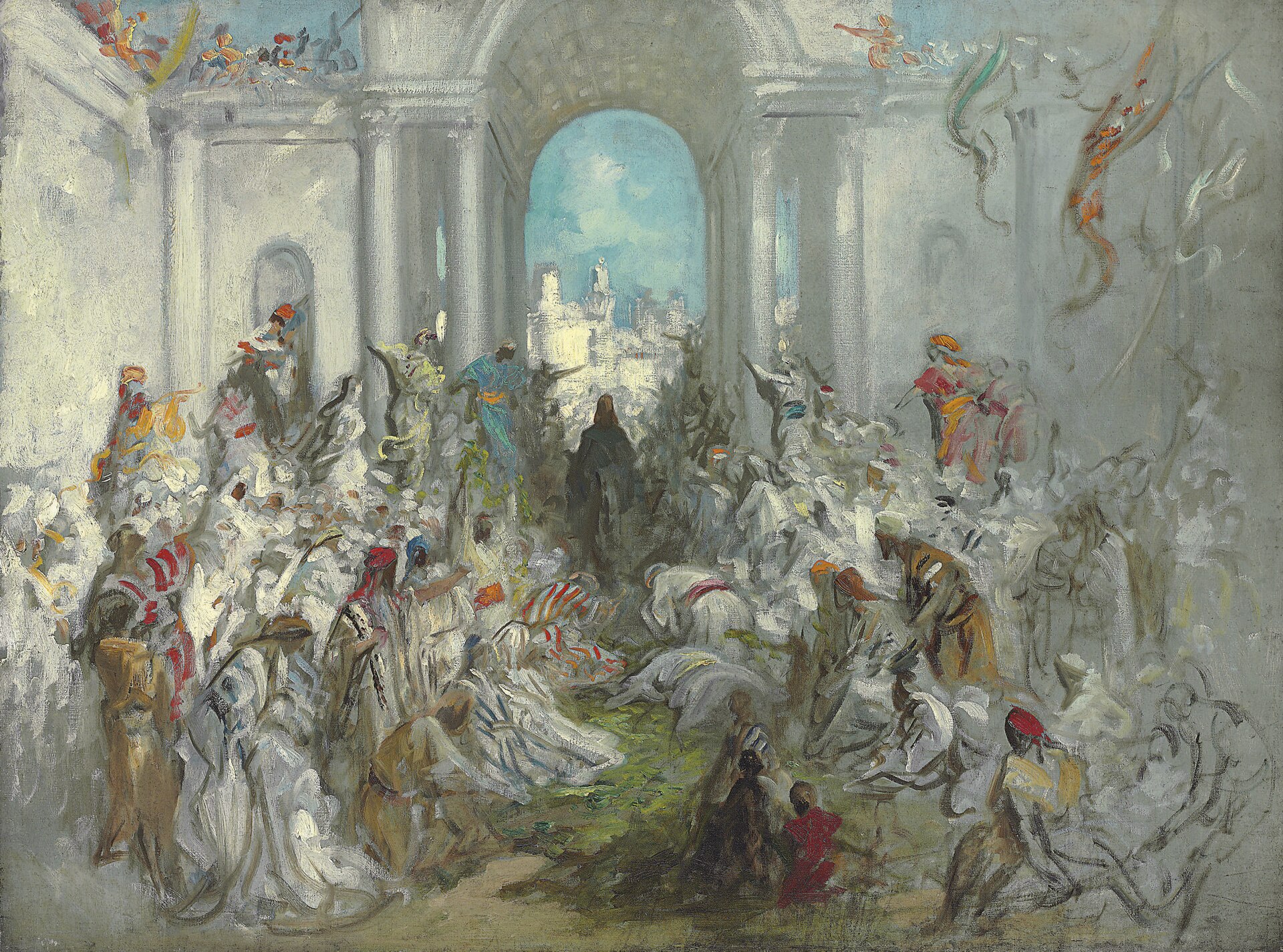
in Matthew 21The crowds that went ahead of Him and those that followed were shouting: “Hosanna to the Son of David!” “Blessed is He who comes in the name of the Lord!” “Hosanna in the highest!”
BSB
The same verse in ASV and KJV ▾
ASV
And the multitudes that went before him, and that followed, cried, saying, Hosanna to the son of David: Blessed is he that cometh in the name of the Lord; Hosanna in the highest.
KJV
And the multitudes that went before, and that followed, cried, saying, Hosanna to the Son of David: Blessed is he that cometh in the name of the Lord; Hosanna in the highest.
⋯
This verse in Matthew 21
Commentary
29 notes on this verseAnd when all that could be done was done, they added also the tribute of the tongue, as it follows, And the multitudes that went before, and that followed, cried, saying, Hosanna to the Son of David. I shall shortly examine what is the meaning of this word Hosanna. In the hundred and seventeenth Psalm, which is clearly written of the Saviour's coming, we read this among other things; Save me now, O Lord; O Lord, send now prosperity. Blessed art thou that art to come in the name of the Lord.
This site's exposition
spread their cloaks on the road
on Matthew 21:8-9
A massive crowd spread their cloaks on the road, the honor Jehu's men gave a new king in 2 Kings 9:13. Their cry takes up Psalm 118:25-26, Hosanna, a Hebrew plea meaning save now, and gives it to the Son of David. Matthew has carried that title since 1:20.
This site's exposition
Hosanna in the highest
Albert Barnes calls hosanna an acclamation of the Jews, used at their great festivals when the psalms of praise were sung. Henry reads the blessing on his coming in the name of the Lord as a word about his sending, a Son sealed by the Father. Passover was days away.
The record, by era
The Church Fathers5 voices
Or when they say, Hosanna to the Son of David; Blessed is He that cometh in the name of the Lord, it is the dispensation of Christ's humanity that they set forth; but His restoration to the holy places when then say, Hosanna in the highest.
Is this the crowd who would applaud his crucifixion? How was their hatred earned from his grace? Even the words of their commendation pointed to the power of redemption. "Hosanna" in Hebrew signifies the redemption of the house of David. They are calling upon the Son of David. They are celebrating the inheritance of the eternal kingdom. They are proclaiming blessing in the name of the Lord. Soon their shouting of "Crucify him!" would be blasphemy. But at present, the deeds he was doing were exhibiting the form of the future. It is granted that the crowd was doing these things with very confused emotions. The things that would follow would be different. Nevertheless they were, inadvertently and without willing it, pointing to heavenly things unfolding. In this way the whole city of Jerusalem was stirred.
The words of their song of praise, express His power of redemption; in calling Him the Son of David, they acknowledge His hereditary title to the kingdom.
Indeed, on the one hand, the fact that the donkey walks on the branches and leaves of palm trees would make it clearly known that not only he who was mounted upon it but also those who would believe in him were going to subdue …
And it is confounded of one perfect and one imperfect word. For 'Hosi' signifies 'save;' 'anna' is an interjection used in entreating. Because, namely, in all His good actions, He sought not His own but His Father's glory.
21 more voices on this verse
The Church Fathers8 voices
(Verse 9.) But the crowds that went before him and that followed him were shouting, saying, 'Hosanna to the Son of David! Blessings on the one who comes in the name of the Lord! Hosanna in the highest!' Let us now follow the spiritual order of discourse, for the story is clear. The crowds that had come out of Jericho and had followed the Savior and his disciples, after they saw the foal of a donkey loosed (which had been tied up before) and adorned with the apostles' garments, and the Lord Jesus sitting on it, they placed their garments on the ground and spread branches of trees on the road. And when they had completed all things with great effort, they also give testimony of their voice: and those who went before and those who followed after confessed not with a short and silent confession, but with a very loud clamor: Hosanna to the Son of David, blessed is he who comes in the name of the Lord. And what he says: The crowds that went before and that followed after, showed both the people who believed in the Lord before the Gospel, and those who believed in the Lord after the Gospel, praising Jesus with a unified voice of confession: and according to the example of the parable of the workers of different hours in the higher story, to accept one reward of faith. Furthermore, regarding what follows: 'Hosanna to the Son of David,' I remember having said, in a short letter to Damasus, who was the bishop of the city of Rome at that time, and now I will briefly explain. In the 117th psalm, which clearly speaks of the coming of the Savior, among other things we read: 'The stone which the builders rejected has become the cornerstone.' This was done by the Lord, and it is marvelous in our eyes. This is the day which the Lord hath made; we will rejoice and be glad in it. And immediately it follows: O Lord, save me: O Lord, prosper me. […]
Hosanna, some interpret 'glory,' some 'redemption;' and glory is His due, and redemption belongs to Him who has redeemed all men.
Those prophesying spoke of Christ who was to come; these speak in praise of the coming of Christ already fulfilled.
Again, setting measures of sorrow, when He had need to mourn, He weeps moderately, everywhere setting us rules, as I have said, and limits how far one ought to proceed, and not any further. So for this intent now also, since it happens that some are weak and have need of beasts to carry them, in this too He fixes a measure, showing that one ought not to yoke horses or mules to be borne by them, but to use an ass, and not to proceed further, and everywhere to be limited by the want. But let us look also at the prophecy, that by words, that by acts. What then is the prophecy? "Behold, thy King cometh to thee, meek, and riding on an ass, and a young colt;" not driving chariots, like the rest of the kings, not demanding tributes, not thrusting men off, and leading about guards, but displaying His great meekness even hereby. Ask then the Jew, what King came to Jerusalem borne on an ass? Nay, he could not mention, but this alone.
And yet He had often entered Jerusalem before, but never with so much circumstance. What then is the cause? It was the beginning then of the dispensation; and neither was He very well known, nor the time of His passion near; wherefore He mixed with them with less distinction, and more disguising Himself. For He would not have been held in admiration, had He so appeared, and He would have excited them to greater anger. But when He had both given them sufficient proof of His power, and the cross was at the doors, He makes Himself then more conspicuous, and doeth with greater circumstance all the things that were likely to inflame them. For it was indeed possible for this to have been done at the beginning also; but it was not profitable nor expedient it should be so. But do thou observe, I pray thee, how many miracles are done, and how many prophecies are fulfilled. He said, "Ye shall find an ass;" He foretold that no man should hinder them, but that all, when they heard, should hold their peace. But this is no small condemnation of the Jews, if them that were never known to Him, neither had appeared before Him, He persuades to give up their own property, and to say nothing against it, and that by His disciples, while these, being present with Him at the working of His miracles, were not persuaded.
And do not account what was done to be a small thing. For who persuaded them, when their own property was taken from them, and that, when they were perhaps poor men and husbandmen, not to forbid it? Why say I not to forbid it? not to ask, or even if they asked, to hold their peace, and give it up. For indeed both things were alike marvellous, as well, if they said nothing, when their beasts were dragged away, or if having spoken, and heard, "The Lord hath need of them," they yielded and withstood not, and this when they see not Him, but His disciples. By these things He teaches them, that it was in His power to have entirely hindered the Jews also, even against their will, when they were proceeding to attack Him, and to have made them speechless, but He would not. And another thing again together with these doth He teach the disciples, to give whatever He should ask; and, though he should require them to yield up their very life, to give even this, and not to gainsay. For if even strangers gave up to Him, much more ought they to strip themselves of all things. And besides what we have said, He was fulfilling also another prophecy, one which was twofold, one part in words, and another in deeds. And that in deeds was, by the sitting on the ass; and that by words, the prediction of Zacharias; because he had said, that the King should sit on an ass. And He, having sat and having fulfilled it, gave to the prophecy another beginning again, by what He was doing typifying beforehand the things to come. How and in what manner? He proclaimed beforehand the calling of the unclean Gentiles, and that He should rest upon them, and that they should yield to Him and follow Him, and prophecy succeeded to prophecy. But to me He seemeth not for this object only to sit on the ass, but also as affording us a standard of self-denial. […]
But He did these things, as I said, signifying beforehand the things to come. For here the church is signified by the colt, and the new people, which was once unclean, but which, after Jesus sat on them, became clean. And see the image preserved throughout. I mean that the disciples loose the asses. For by the apostles, both they and we were called; by the apostles were we brought near. But because our acceptance provoked them also to emulation, therefore the ass appears following the colt. For after Christ hath sat on the Gentiles, then shall they also come moving us to emulation. And Paul declaring this, said, "That blindness in part is happened to Israel, until the fullness of the Gentiles be come in; and so all Israel shall be saved." For that it was a prophecy is evident from what is said. For neither would the prophet have cared to express with such great exactness the age of the ass, unless this had been so. But not these things only are signified by what is said, but also that the apostles should bring them with ease. For as here, no man gainsaid them so as to keep the asses, so neither with regard to the Gentiles was any one able to prevent them, of those who were before masters of them. But He doth not sit on the bare colt, but on the apostles' garments. For after they had taken the colt, they then gave up all, even as Paul also said, "I will very gladly spend and be spent for your souls." But mark how tractable the colt, how being unbroken, and having never known the rein, he was not restive, but went on orderly; which thing itself was a prophecy of the future, signifying the submissiveness of the Gentiles, and their sudden conversion to good order. For all things did that word work, which said, "Loose him, and bring him to me:" so that the unmanageable became orderly, and the unclean thenceforth clean.
But these things He did, not as displaying any pomp, but at once, as I have said, both fulfilling a prophecy, and teaching self-denial, and at the same time also comforting His disciples, who were grieving for His death, and showing them that He suffers all these things willingly. And mark thou, I pray thee, the accuracy of the prophet, how he foretold all things. And some things David, some things Zechariah, had proclaimed beforehand. Let us also do likewise, and let us sing hymns, and give up our garments to them that bear Him. For what should we deserve, when some clothe the ass on which He was set, and others strew the garments even under her feet; but we, seeing him naked, and not being even commanded to strip ourselves, but to spend of what is laid by, not even so are liberal? And when they indeed attend upon Him before and behind, but we, when He cometh unto us, send Him away, and thrust Him off and insult Him.
The Medieval Church5 voices
In Christ from His conception there was the fullness of all grace with respect to the grace of a singular person and with respect to the grace of the Head and with respect to the grace of union. Through the grace of the Head, He …
A commentator
BonaventureCollations on the Hexaemeron, Collation 3 · Written in the 13th century.
proposed
This is the greatest miracle, that God be man, that the first be the last; wherefore all miracles are related to this one; and all cry out: "Hosanna to the Son of David!" In this miracle, faith receives its strength.
(ap. Anselm.) And the meaning is, Blessed, that is, Glorious, is He that cometh, that is, is incarnate; in the name of the Lord; that is, of the Father, by glorifying Him. Again they repeat, Hosanna, that is, Save, I pray thee, and define whither they would bo saved, in the highest, that is in the heavenly, not in the earthly places.
"And the multitudes that went before and that followed, cried out." Here is presented the honor exhibited to him in word. But by whom? By those going before and those following, namely, by those who were before the coming and after; and both seek salvation, …
In the literal account, laying down of clothing is a sign of great reverence, and the cutting of branches is a sign of festivity. But in the spiritual sense, learn that the apostles first laid down their garments, which are their virtues, and then the …
The Puritans and the Awakening2 voices
It was foretold concerning this Son of David, that all nations shall call him blessed ( Ps. lxxii. 17 ); these here began, and all true believers in all ages concur in it, and call him blessed; it is the genuine language of faith. Note, First, Jesus Christ comes in the name of the Lord; he is sanctified, and sent into the world, as Mediator; him hath God the Father sealed.
And the multitudes that went before,....
The Nineteenth Century6 voices
A commentator
Albert Barnes1798–1870
Notes, Explanatory and Practical, on the Old and New Testaments (1832-1869)
Hosanna to the son of David ... - The word “hosanna” means “save now,” or “save, I beseech thee.” It is a Syriac word, and was a form of acclamation used among the Jews. It was probably used in the celebration of their great festivals. During those festivals they sang Ps. 115; Ps. 116; Psa 117:1-2; Ps. 1
These verses contain a very remarkable passage in our Lord Jesus Christ’s life. They describe his public entry into Jerusalem when he came there for the last time, before he was crucified. There is something peculiarly striking in this incident in our Lord’s history. The narrative reads like the account of some royal conqueror’s return to his own city: “A very great multitude” accompanies him in a kind of triumphal procession. Loud cries and expressions of praise are heard around him: “All the city was moved.” The whole transaction is singularly at variance with the past tenor of our Lord’s life; it is curiously unlike the ways of him who did not “cry nor strive ” nor let his voice be heard “in the streets”—who withdrew himself from the multitude on other occasions, and sometimes said to those he healed, “See thou say nothing to any man.” ( Mark 1:44 ). And yet the whole transaction admits of explanation. The reasons of this public entry are not hard to find out. Let us see what they were. The plain truth is that our Lord knew well that the time of his earthly ministry was drawing to a close; he knew that the hour was approaching when he must finish the mighty work he came to do, by dying for our sins upon the cross. He knew that his last journey had been accomplished, and that there remained nothing now in his earthly ministry but to be offered as a sacrifice on Calvary. Knowing all this, he no longer, as in times past, sought secrecy; knowing all this, he thought it good to enter the place where he was to be delivered to death, with peculiar solemnity and publicity. It was not fitting that the Lamb of God should come to be slain on Calvary privately and silently. Before the great sacrifice for the sin of the world was offered up, it was right that every eye should be fixed on the victim.
These verses contain a very remarkable passage in our Lord Jesus Christ’s life. They describe his public entry into Jerusalem when he came there for the last time, before he was crucified. There is something peculiarly striking in this incident in our Lord’s history. The narrative reads like the account of some royal conqueror’s return to his own city: “A very great multitude” accompanies him in a kind of triumphal procession. Loud cries and expressions of praise are heard around him: “All the city was moved.”
A commentator
Charles Spurgeon1834–1892
The Metropolitan Tabernacle Pulpit, Sermon No. 3427: “The Blessed Christ” (lightly modernized text, CCEL edition) · Written before 1892.
proposed
ONE feels very thankful that we have a few Hebrew words in common use in our Christian assemblies—a kind of link between Israel after the flesh and Israel after the spirit. "Hallelujah," they sang of old, and we sing, "Hallelujah," too. "Abba Father," they said. We also say, "Abba Father." And this word, "Hosanna," is another of the few that remain to us of which we understand the meaning, though we use them still in a translated form—Hosanna—"save Lord," "bless Lord." "Blessed is He that comes in the name of the Lord." I did not mention in the reading of the Psalm—(the 118th Psalm)—that both the 25th and 26th verses of that Psalm begin with the word, Hosanna. One is translated, "Save Lord," and the other is, "Blessed is He that comes in the name of the Lord." I shall take this common exclamation, then, constantly used among the Jews, and we shall see as to its use among ourselves. And our first point will be to— I. CONSIDER OCCASIONS WHEN THIS EXCLAMATION, "Blessed is He that comes in the name of the Lord," HAS BEEN, OR WILL BE, SUITABLE. And, first, in the olden times, the Israelites were accustomed to use this cry, "Blessed is he that comes in the name of the Lord," when their heroes returned victorious from the battlefield. When they went up to the Temple to give thanks publicly to God for victories over their enemies, they were met by the people, with this exclamation ofjoy, "Blessed is he that comes in Jehovah's name." Very unlike the cries of other nations! Some nations only extolled the heroes, but the people of God see the hand of God, and they mark that the hero only comes in the name of the Lord. And while they give him blessings and wish him every good thing for what he has done, yet the praise is ascribed to the Master in whose name he comes—even Jehovah.
A commentator
Charles Spurgeon1834–1892
The Metropolitan Tabernacle Pulpit, Sermon No. 3427: “The Blessed Christ” (lightly modernized text, CCEL edition) · Written before 1892.
proposed
ONE feels very thankful that we have a few Hebrew words in common use in our Christian assemblies—a kind of link between Israel after the flesh and Israel after the spirit. "Hallelujah," they sang of old, and we sing, "Hallelujah," too. "Abba Father," they said. We also say, "Abba Father." And this word, "Hosanna," is another of the few that remain to us of which we understand the meaning, though we use them still in a translated form—Hosanna—"save Lord," "bless Lord." "Blessed is He that comes in the name of the Lord."
Hosanna to the son of David - When persons applied to the king for help, or for a redress of grievances, they used the word hosanna, or rather from the Hebrew הושיעה נא Hoshiah Na! Save now! or, Save, we beseech thee! - redress our grievances, and give us help from oppression! Thus both the words and actions of the people prove that they acknowledged Christ as their king, and looked to him for deliverance. How easily might he have assumed the sovereignty at this time, had he been so disposed! For instances of the use of this form of speech, see 2Sa 14:4; 2Ki 6:26; Psa 118:25. Son of David - A well-known epithet of the Messiah. He who cometh in the name, etc. He who comes in the name and authority of the Most High. Hosanna in the highest - Either meaning, Let the heavenly hosts join with us in magnifying this august Being! - or, Let the utmost degrees of hosanna, of salvation, and deliverance, be communicated to thy people! Probably there is an allusion here to the custom of the Jews in the feast of tabernacles. During the first seven days of that feast, they went once round the altar, each day, with palm and other branches in their hands, singing Hosanna: but on the eighth day of that feast they walked seven times round the altar, singing the hosanna; and this was termed the hosanna rabba, the Great hosanna: i.e. Assist with the greatest succor. Probably answering to the τοις υψιστοις of the evangelist, for on this day they beg the most speedy and powerful help against their enemies, and likewise pray for a prosperous and fruitful year. See Stehlin’s Jewish Traditions, vol. ii. p. 322.
The words behind it
25 Greek wordsEvery Greek word of this verse in the order it stands, with what it means and the door to its own study. The last column counts the times a word stands in the whole Bible: the rarer the word, the more the places it appears belong together.
| Greek | Sound | Meaning | Word study | In the Bible |
|---|---|---|---|---|
| οἱ | hoi | The | G3588 → | 19766 times |
| δὲ | de | now | G1161 → | 2765 times |
| ὄχλοι | ochloi | crowds | G3793 → | 175 times |
| οἱ | hoi | which | G3588 → | 19766 times |
| προάγοντες | proagontes | are going before | G4254 → | 20 times |
| αὐτὸν | auton | Him | G846 → | 5565 times |
| καὶ | kai | and | G2532 → | 9120 times |
| οἱ | hoi | those | G3588 → | 19766 times |
| ἀκολουθοῦντες | akolouthountes | following | G190 → | 90 times |
| ἔκραζον | ekrazon | they were crying out | G2896 → | 55 times |
| λέγοντες· | legontes | saying: | G3004 → | 1325 times |
| ὡσαννὰ | hosanna | Hosanna | G5614 → | 6 times |
| τῷ | to | to the | G3588 → | 19766 times |
| υἱῷ | huio | Son | G5207 → | 377 times |
| Δαυίδ, | dauid | of David! | G1138 → | 59 times |
| εὐλογημένος | eulogemenos | Blessed [is] | G2127 → | 41 times |
| ὁ | ho | the [One] | G3588 → | 19766 times |
| ἐρχόμενος | erchomenos | coming | G2064 → | 628 times |
| ἐν | en | in | G1722 → | 2738 times |
| ὀνόματι | onomati | [the] name | G3686 → | 227 times |
| κυρίου, | kuriou | of [the] Lord! | G2962 → | 711 times |
| ὡσαννὰ | hosanna | Hosanna | G5614 → | 6 times |
| ἐν | en | in | G1722 → | 2738 times |
| τοῖς | tois | the | G3588 → | 19766 times |
| ὑψίστοις.¶ | hupsistois | highest! | G5310 → |
οἱThe
hoiG3588 →19766 times
δὲnow
deG1161 →2765 times
ὄχλοιcrowds
ochloiG3793 →175 times
οἱwhich
hoiG3588 →19766 times
προάγοντεςare going before
proagontesG4254 →20 times
αὐτὸνHim
autonG846 →5565 times
καὶand
kaiG2532 →9120 times
οἱthose
hoiG3588 →19766 times
ἀκολουθοῦντεςfollowing
akolouthountesG190 →90 times
ἔκραζονthey were crying out
ekrazonG2896 →55 times
λέγοντες·saying:
legontesG3004 →1325 times
ὡσαννὰHosanna
hosannaG5614 →6 times
τῷto the
toG3588 →19766 times
υἱῷSon
huioG5207 →377 times
Δαυίδ,of David!
dauidG1138 →59 times
εὐλογημένοςBlessed [is]
eulogemenosG2127 →41 times
ὁthe [One]
hoG3588 →19766 times
ἐρχόμενοςcoming
erchomenosG2064 →628 times
ἐνin
enG1722 →2738 times
ὀνόματι[the] name
onomatiG3686 →227 times
κυρίου,of [the] Lord!
kuriouG2962 →711 times
ὡσαννὰHosanna
hosannaG5614 →6 times
ἐνin
enG1722 →2738 times
τοῖςthe
toisG3588 →19766 times
ὑψίστοις.¶highest!
hupsistoisG5310 →
A shaded row is a word that stands 400 times or fewer in the Bible.
The walk
8 stopsEach card is a verse this one points to, and under it the verses that one points to in turn. Where several paths arrive at the same place, that place is listed first: the text keeps returning to it.
Through
Luke 2:14“Glory to God in the highest, and on earth peace to men on whom His favor rests!”
it leads to
- Romans 5:1
Therefore, since we have been justified through faith, we have peace with God through our Lord Jesus Christ,
- Luke 19:38
“Blessed is the King who comes in the name of the Lord!” “Peace in heaven and glory in the highest!”
- Luke 1:79
to shine on those who live in darkness and in the shadow of death, to guide our feet into the path of peace.”
- Isaiah 9:6–7
For unto us a child is born, unto us a son is given, and the government will be upon His shoulders. And He will be called Wonderful Counselor, Mighty God, Everlasting Father, Prince of…
- Colossians 1:20
and through Him to reconcile to Himself all things, whether things on earth or things in heaven, by making peace through the blood of His cross.
- Romans 5:1
Through
Matthew 23:39For I tell you that you will not see Me again until you say, ‘Blessed is He who comes in the name of the Lord.’”
it leads to
- Psalms 118:26
Blessed is he who comes in the name of the LORD. From the house of the LORD we bless you.
- Romans 11:25
I do not want you to be ignorant of this mystery, brothers, so that you will not be conceited: A hardening in part has come to Israel, until the full number of the Gentiles…
- Luke 17:22
Then He said to the disciples, “The time is coming when you will long to see one of the days of the Son of Man, but you will not see it.
- Psalms 118:26
Where this verse is studied
On this page
Studies11
About Matthew
Who and where
1 name in this verse with a page on the site.
This page draws on 22 works. Open the list of works
This page draws on Adam Clarke, Commentary on the Bible; Albert Barnes, Notes, Explanatory and Practical, on the Old and New Testaments (1832-1869); Bonaventure, Breviloquium; Bonaventure, Collations on the Hexaemeron, Collation 3; Charles Spurgeon, The Metropolitan Tabernacle Pulpit, Sermon No. 3427: “The Blessed Christ” (lightly modernized text, CCEL edition); Glossa Ordinaria, Catena Aurea by Aquinas; Hilary of Poitiers, Commentary on Matthew 21.3; Hilary of Poitiers, Catena Aurea by Aquinas; J.C. Ryle, Expository Thoughts on the Gospels: Matthew; Jamieson, Fausset & Brown, Commentary Critical and Explanatory on the Whole Bible; Jerome, Catena Aurea by Aquinas; Jerome, Commentary on Matthew; John Chrysostom, Homily on the Gospel of Matthew 66; John Gill, Exposition of the New Testament; John Gill, Exposition of the New Testament (1746-1748); Matthew Henry, Commentary on the Whole Bible; Origen of Alexandria, Catena Aurea by Aquinas; Pseudo-Chrysostom, Catena Aurea by Aquinas; Remigius of Rheims, Catena Aurea by Aquinas; Severus of Antioch, CATHEDRAL SERMONS, HOMILY 20.39; Theophylact of Ohrid, Commentary on Matthew and Thomas Aquinas, Commentary on Matthew.