
Matthew 21:27
in Matthew 21So they answered, “We do not know.” And Jesus replied, “Neither will I tell you by what authority I am doing these things.
BSB
The same verse in ASV and KJV ▾
ASV
And they answered Jesus, and said, We know not. He also said unto them, Neither tell I you by what authority I do these things.
KJV
And they answered Jesus, and said, We cannot tell. And he said unto them, Neither tell I you by what authority I do these things.
⋯
This verse in Matthew 21
Commentary
14 notes on this verse(Verse 27) He also said to them: Neither do I tell you by what authority I do these things. They answered and said to him: We don't know. Then Jesus also replied to them: Neither do I tell you by what authority I do these things. But the Truth cannot lie, and he said: Neither do I tell you. From this, he shows that they know but refuse to answer, and he knows but refuses to say, because they keep silent about what they know.
This site's exposition
The baptism of John, whence was it
on Matthew 21:25-27
The baptism of John, whence was it, from heaven or of men, catches the leaders in a dilemma of their own making rather than his; either answer costs them something they are unwilling to pay, the people's good opinion or the admission that John, and by his testimony Jesus, came from God. Their answer, we cannot tell, is not honest uncertainty but calculated evasion, and Jesus reads it as such and withholds his own answer on the same terms they set. The bench notes the leaders' governing motive laid bare here is fear of the people, not love of truth, the same fear that will keep them from arresting him openly through the rest of the week.
The record, by era
The Church Fathers4 voices
And answering Jesus, they said: We do not know. Therefore, the most impious faction responded and, using the word of humility by which they claimed not to know, used it to plot deceit.
This godless party therefore make answer, and by a seeming humility of speech confessing that they know not, turned to hide their insidious designs. And they answered Jesus, and said, We know not. In saying that they knew not, they lied; and it might have followed upon their answering thus, that the Lord also should say, I know not; but truth cannot lie, and therefore it follows, And he said unto them, Neither tell I you by what authority I do these things. This shows that they knew, but would not answer, and that He also knew, but would not answer, because they would not speak what they knew.
A commentator
John ChrysostomHomily on the Gospel of Matthew 67 · Written in the 5th century.
proposed
And how was it they did not say that the baptism was of men? "They feared the people" it is said. Seest thou a perverse heart? In every case they despise God and do all things for the sake of men. For this man too they feared for their sakes not reverencing the saint but on account of men; and they were not willing to believe in Christ, because of men, and all their evils were engendered to them from hence. After this, because they, dealing craftily, said, "We know not," He said not, neither know I, but what? "Neither tell I you." For if indeed they had been ignorant it would have been requisite for them to be instructed; but since they were dealing craftily with good reason He answers them nothing.
He also said to them: Neither do I tell you by what authority I do these things. They answered and said to him: We don't know. Then Jesus also replied to them: Neither do I tell you by what authority I do these things. But the Truth cannot lie, and he said: Neither do I tell you. From this, he shows that they know but refuse to answer, and he knows but refuses to say, because they keep silent about what they know.
The Medieval Church1 voice
Full of spite that He had expelled the peddlers from the temple, the teachers of the law approached and asked Him such things as these: "Who are you to cast out from the temple those who do business there? As a priest do you do …
7 more voices on this verse
The Medieval Church2 voices
There are two reasons why the knowledge of truth should be kept back from those who ask; either when he who asks is unfit to receive, or from his hatred or contempt of the truth is unworthy to have that which he asks opened to him.
"And answering they said: we know not." They lie. Ps 26:12: "Iniquity hath lied to itself." Then Christ's response is presented: "neither do I tell you." In this is contained an example, that from him who will not say what he knows, the Lord hides …
The Puritans and the Awakening1 voice
And they answered Jesus and said, we cannot tell,....
The Nineteenth Century4 voices
A commentator
Jamieson, Fausset & Brown1802–1910
Commentary Critical and Explanatory on the Whole Bible (1871)
And they answered Jesus, and said, We cannot tell--Evidently their difficulty was, how to answer, so as neither to shake their determination to reject the claims of Christ nor damage their reputation with the people.
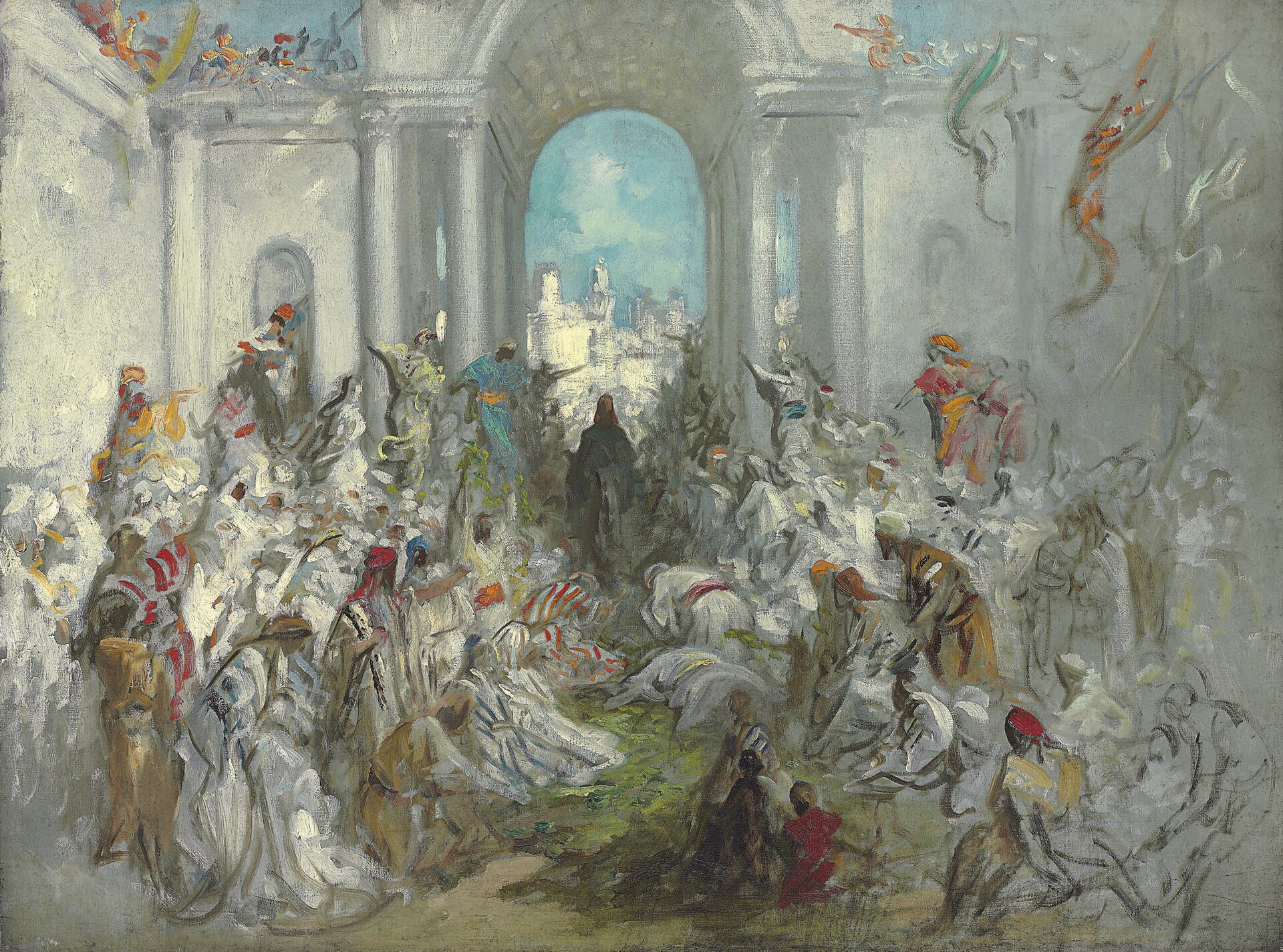
These verses contain a conversation between our Lord Jesus Christ and the chief priests and elders of the people. Those bitter enemies of all righteousness saw the sensation which the public entry into Jerusalem, and the cleansing of the temple, had produced. At once they came about our Lord, like bees, and endeavored to find occasion for an accusation against him. Let us observe in the first place how ready the enemies of truth are to question the authority of all who do more good than themselves.
These verses contain a conversation between our Lord Jesus Christ and the chief priests and elders of the people. Those bitter enemies of all righteousness saw the sensation which the public entry into Jerusalem, and the cleansing of the temple, had produced. At once they came about our Lord, like bees, and endeavored to find occasion for an accusation against him. Let us observe in the first place how ready the enemies of truth are to question the authority of all who do more good than themselves. The chief priests have not a word to say about our Lord’s teaching: they make no charge against the lives or conduct of himself or his followers. The point on which they fasten is his commission: “By what authority are you doing these things? And who gave thee this authority?” The same charge has often been made against the servants of God when they have striven to check the progress of ecclesiastical corruption. It is the old engine by which the children of this world have often labored to stop the progress of revivals and reformations. It is the weapon which was often brandished in the face of the Reformers, the Puritans, and the Methodists of the last century. It is the poisoned arrow which is often shot at city missionaries and lay agents in the present day. Too many care nothing for the manifest blessing of God on a man’s work, so long as he is not sent forth by their own sect or party. It matters nothing to them that some humble laborer in God’s harvest can point to numerous conversions of souls through his instrumentality; they still cry, “By what authority doest thou these things?” His success is nothing: they demand his commission. His cures are nothing: they want his diploma. Let us neither be surprised nor moved when we hear such things. It is old charge which was brought against Christ himself. “There is no new thing under the sun” ( Ecclesiastes 1:9 ).
We cannot tell - Simplicity gives a wonderful confidence and peace of mind; but double dealing causes a thousand inquietudes and troubles. Let a man do his utmost to conceal in his own heart the evidence he has of truth and innocence, to countenance his not yielding to it; God, who sees the heart, will, in the light of the last day, produce it as a witness against him, and make it his judge.
The words behind it
20 Greek wordsEvery Greek word of this verse in the order it stands, with what it means and the door to its own study. The last column counts the times a word stands in the whole Bible: the rarer the word, the more the places it appears belong together.
| Greek | Sound | Meaning | Word study | In the Bible |
|---|---|---|---|---|
| Καὶ | kai | And | G2532 → | 9120 times |
| ἀποκριθέντες | apokrithentes | answering | G611 → | 231 times |
| τῷ | to | <the> | G3588 → | 19766 times |
| Ἰησοῦ | iesou | Jesus | G2424 → | 908 times |
| εἶπαν· | eipan | they said; | G2036 → | 925 times |
| οὐκ | ouk | Not | G3756 → | 1664 times |
| οἴδαμεν. | oidamen | do we know. | ||
| ἔφη | ephe | Was saying | G5346 → | 66 times |
| αὐτοῖς | autois | to them | G846 → | 5565 times |
| καὶ | kai | also | G2532 → | 9120 times |
| αὐτός· | autos | He himself; | G846 → | 5565 times |
| οὐδὲ | oude | Neither | G3761 → | 141 times |
| ἐγὼ | ego | I myself | G1473 → | 839 times |
| λέγω | lego | tell | G3004 → | 1325 times |
| ὑμῖν | humin | you | G4771 → | 2973 times |
| ἐν | en | by | G1722 → | 2738 times |
| ποίᾳ | poia | what | G4169 → | 33 times |
| ἐξουσίᾳ | exousia | authority | G1849 → | 102 times |
| ταῦτα | tauta | these things | G3778 → | 1381 times |
| ποιῶ.¶ | poio | I do. | G4160 → | 569 times |
ΚαὶAnd
kaiG2532 →9120 times
ἀποκριθέντεςanswering
apokrithentesG611 →231 times
τῷ<the>
toG3588 →19766 times
ἸησοῦJesus
iesouG2424 →908 times
εἶπαν·they said;
eipanG2036 →925 times
οὐκNot
oukG3756 →1664 times
οἴδαμεν.do we know.
oidamen
ἔφηWas saying
epheG5346 →66 times
αὐτοῖςto them
autoisG846 →5565 times
καὶalso
kaiG2532 →9120 times
αὐτός·He himself;
autosG846 →5565 times
οὐδὲNeither
oudeG3761 →141 times
ἐγὼI myself
egoG1473 →839 times
λέγωtell
legoG3004 →1325 times
ὑμῖνyou
huminG4771 →2973 times
ἐνby
enG1722 →2738 times
ποίᾳwhat
poiaG4169 →33 times
ἐξουσίᾳauthority
exousiaG1849 →102 times
ταῦταthese things
tautaG3778 →1381 times
ποιῶ.¶I do.
poioG4160 →569 times
A shaded row is a word that stands 400 times or fewer in the Bible.
The walk
5 stopsEach card is a verse this one points to, and under it the verses that one points to in turn. Where several paths arrive at the same place, that place is listed first: the text keeps returning to it.
Through
Romans 1:28Furthermore, since they did not see fit to acknowledge God, He gave them up to a depraved mind, to do what ought not to be done.
it leads to
- 2 Thessalonians 2:10–12
and with every wicked deception directed against those who are perishing, because they refused the love of the truth that would have saved them.
- Titus 1:16
They profess to know God, but by their actions they deny Him. They are detestable, disobedient, and unfit for any good deed.
- Romans 1:21
For although they knew God, they neither glorified Him as God nor gave thanks to Him, but they became futile in their thinking and darkened in their foolish hearts.
- Jeremiah 9:6
You dwell in the midst of deception; in their deceit they refuse to know Me,” declares the LORD.
- Romans 1:24
Therefore God gave them over in the desires of their hearts to impurity for the dishonoring of their bodies with one another.
- 2 Thessalonians 2:10–12
Where this verse is studied
About Matthew
This page draws on 11 works. Open the list of works
This page draws on Adam Clarke, Commentary on the Bible; J.C. Ryle, Expository Thoughts on the Gospels: Matthew; Jamieson, Fausset & Brown, Commentary Critical and Explanatory on the Whole Bible; Jerome, Commentary on Matthew; Jerome, Catena Aurea by Aquinas; John Chrysostom, Homily on the Gospel of Matthew 67; John Gill, Exposition of the New Testament (1746-1748); Matthew Henry, Commentary on the Whole Bible; Rabanus Maurus, Catena Aurea by Aquinas; Theophylact of Ohrid, Commentary on Matthew and Thomas Aquinas, Commentary on Matthew.